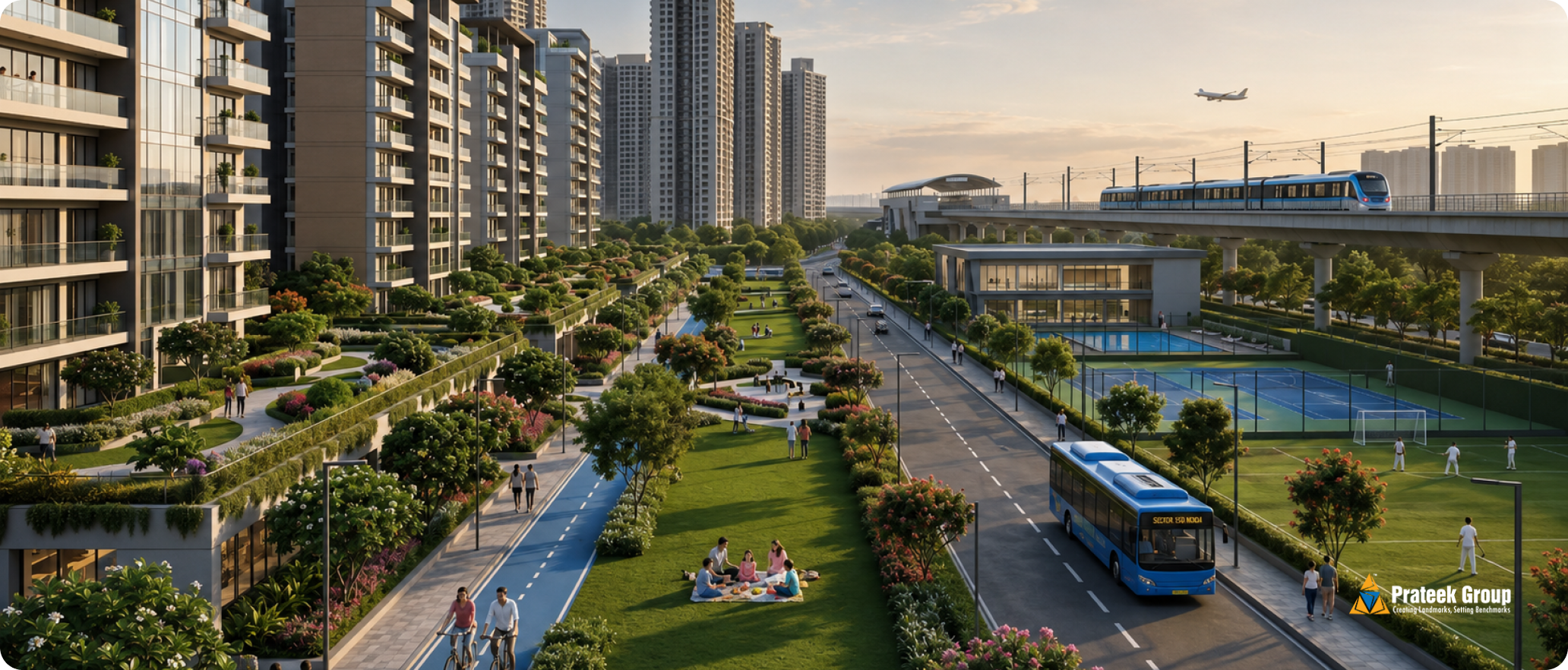
Every few years, a micro-market in the National Capital Region reaches a point where multiple infrastructure projects mature at the same time. When that happens, property prices rarely move in a straight line. They tend to move in steps, and each step usually follows a visible trigger.
Sector 150 Noida is approaching exactly that kind of moment.
Noida International Airport at Jewar has moved from promise to reality. The Union Cabinet has cleared a new Metro corridor along the Noida-Greater Noida Expressway. The Supreme Court has unlocked the long-stalled Sports City framework, with sports infrastructure now under binding timelines. Each of these developments, on its own, would matter to property values. Together, they create one of the most interesting five-year outlooks anywhere in Delhi NCR.
At Prateek Group, we have been building in Noida and NCR for over two decades, and we have watched infrastructure reshape property values across this region again and again. In this guide, we want to walk you through what is actually happening around Sector 150, what history tells us about how infrastructure influences prices, and what a realistic range of outcomes could look like by 2030.
One thing before we begin: this is not a prediction article, and it is certainly not a promise of returns. Real estate markets carry uncertainty, and anyone who guarantees you a future price is not being honest with you. What we can do is lay out the evidence, explain the logic, and help you form your own informed view.
TL;DR
Three Catalysts Converging on One Micro-Market
Sector 150 Noida enters 2026 with an operational Jewar Airport, a Cabinet-approved Metro extension to Botanical Garden, and a court-supervised Sports City revival, all maturing before 2030. Few NCR locations have ever seen this many infrastructure triggers reach their delivery phase within the same five-year window.
Is the Appreciation Already Priced In?
Buyers face a genuine dilemma: Sector 150 has already doubled in five years and averages around Rs 12,000 to 12,500 per sq ft, so how much upside actually remains? Add timeline slippage risks, modest 2 percent rental yields, and project-level legal variance, and the decision gets harder.
A Scenario-Based Outlook, Not a Prediction
Rather than promising returns, we map conservative, base, and optimistic scenarios ranging from roughly Rs 14,500 to Rs 23,000 per sq ft by 2030, each with explicit assumptions. History shows delivery phases, not announcements, create durable value, and that phase is unfolding now. Verification steps and buyer-fit guidance included.
Where Does Sector 150 Stand in Mid-2026?
Before we talk about 2030, we need an honest baseline. A future outlook is only as useful as the starting point it is built on. Sector 150 sits at the southern edge of Noida, along the Noida-Greater Noida Expressway, close to the point where it meets the Yamuna Expressway. It was master-planned as a low-density, green sector, with roughly 80 percent of its area reserved for open and green spaces, anchored by the large Shaheed Bhagat Singh Park.
That planning decision, made years ago, is the foundation of everything that has followed. Low density means limited housing supply. Limited supply, combined with rising demand, is the simplest and most reliable driver of price appreciation in any market. The numbers reflect this. As of 2026, average apartment prices in Sector 150 broadly range between Rs 10,000 and Rs 14,500 per sq ft depending on the project, with the sector average hovering around Rs 12,000 to Rs 12,500 per sq ft. Independent price trackers report a year-on-year appreciation of roughly 9 to 10 percent and a six-year compound annual growth rate of about 13 percent. Over the past five years, flat values in the sector have more than doubled.
Two other facts complete the picture:
- Rental yields remain modest, at around 2 percent. Sector 150 is fundamentally a capital appreciation and end-user market, not a rental yield market. This matters for how you should think about investing here, and we will return to it later.
- The legal overhang has lifted. For years, the Sports City registry freeze kept a portion of the sector’s inventory in limbo. Following the Supreme Court’s November 2025 order and the Noida Authority’s January 2026 implementation, registries have reopened under a structured framework. We will cover this in detail in its own section because it is one of the most important developments for the sector’s 2030 story.
So the baseline is clear: a premium, supply-constrained, green micro-market that has already appreciated strongly, now entering a phase where three major infrastructure catalysts are maturing simultaneously. If you would like a deeper look at the sector’s fundamentals before the infrastructure story, our earlier analysis of is Sector 150 still the best place to buy in Noida covers the ground-level picture in detail.
The natural next question: how exactly does infrastructure translate into property prices?
How Does Infrastructure Actually Influence Property Prices?
It is easy to say “infrastructure drives appreciation.” It is more useful to understand the mechanism, because the mechanism tells you when prices move, how much, and for whom.
In our experience across NCR, infrastructure influences prices through four distinct channels.
1. Accessibility premium
When travel time to jobs, airports, and city centers falls, more households can realistically live in a location. Demand widens, and prices adjust upward. This is the most direct channel, and it is why Metro corridors and expressways consistently correlate with price growth in surrounding sectors.
2. Economic gravity
Airports, industrial corridors, and commercial hubs create employment. Employment creates housing demand within commuting distance. This channel is slower but far more durable than pure connectivity, because it keeps adding demand year after year.
3. Confidence and liquidity
Buyers pay more for locations where the government has visibly committed capital, because committed capital signals that civic amenities, roads, and services will follow. Liquidity also improves: more buyers means easier resale, and easier resale itself supports higher prices.
4. The announcement-to-delivery curve
Prices typically respond in phases. There is a bump at announcement, a longer climb during visible construction, and a final adjustment when the asset actually opens and people experience the benefit. Markets often underprice the delivery phase because the announcement happened years earlier and attention has moved on.
That fourth channel is the key to understanding Sector 150 today. The announcements happened between 2017 and 2021. The delivery phase, for the airport, the Metro extension, and the Sports City resolution, is happening between 2026 and 2030. We have written before about how urban infrastructure is reshaping property prices in Delhi NCR, and the pattern across the region is consistent: the largest, most sustainable price adjustments cluster around delivery, not announcement.
With that framework in mind, let us examine each catalyst, starting with the biggest one.
Jewar Airport Is No Longer a Promise. What Does That Change?
For most of the past decade, Noida International Airport at Jewar was a line on a map and a topic of debate. That era is over.
The airport is now operational
Phase 1 was formally inaugurated on 28 March 2026, developed at an investment of around Rs 11,200 crore, and commercial flights began in mid-June 2026. The airport is being operated by Yamuna International Airport Private Limited, a concession of Zurich Airport International, and carries the IATA code DXN. You can track routes and operational updates directly on the official Noida International Airport website.
Operations are scaling quickly
From an initial handful of domestic routes, the airport moved within weeks to an expanded schedule covering many more destinations, with international operations targeted by the end of 2026. Phase 1 is designed for 12 million passengers per year, with a long-term master plan that scales capacity to around 70 million passengers annually by 2040. Passenger traffic in the first full month of operations crossed 33,000, a modest start that is growing month on month. The Government of India has positioned the project as a cornerstone of national aviation capacity, as reflected in the official coverage of the Phase 1 inauguration of Noida International Airport.
So what does this mean for Sector 150 specifically?
Sector 150 sits in the airport’s residential catchment, not its construction zone
The sector is roughly a 30 to 40-minute drive from the airport via the Yamuna Expressway. That distance is a feature, not a limitation. Locations immediately beside airports carry noise, height restrictions, and industrial land use. Locations 30 to 45 minutes away, with established social infrastructure and premium housing, tend to capture the highest quality of airport-driven demand: airline staff and management, aviation-linked businesses, frequent flyers, and NRI buyers who value direct international access.
The employment effect is the durable one
An international airport is an economic engine. Cargo hubs, logistics parks, hospitality, maintenance and repair operations, and the wider Yamuna Expressway industrial region under YEIDA’s development plans will generate employment for years. Every thousand jobs created within a 45-minute commute of Sector 150 adds households to its demand pool. This is the slow, compounding channel that continues working long after the inauguration headlines fade.
The perception effect has already begun
NCR’s premium buyers increasingly evaluate South Noida through the airport lens. Between 2021 and 2026, sectors along the expressway corridor saw capital values rise sharply, and market analysts consistently cite airport progress as a primary driver. We examined this dynamic in depth in our analysis of how Jewar Airport will change property prices in Noida and Greater Noida, and the core conclusion holds: the airport redraws the NCR’s map of desirable locations, and Sector 150 sits firmly inside the newly favored zone.
The honest caveat: a portion of the airport benefit is already priced in. The 100 percent plus appreciation of the past five years partly reflects airport anticipation. The question for 2030 is how the NCR’sof the operational reality, rising passenger volumes, international routes, and airport-linked employment, is still to be priced. Our view, based on how delivery phases have played out elsewhere in NCR, is that meaningful room remains, but the gains from here will track actual airport growth rather than speculation.
Which brings us to the second catalyst: getting around without a car.
How Could Metro Expansion Improve Accessibility for Sector 150?
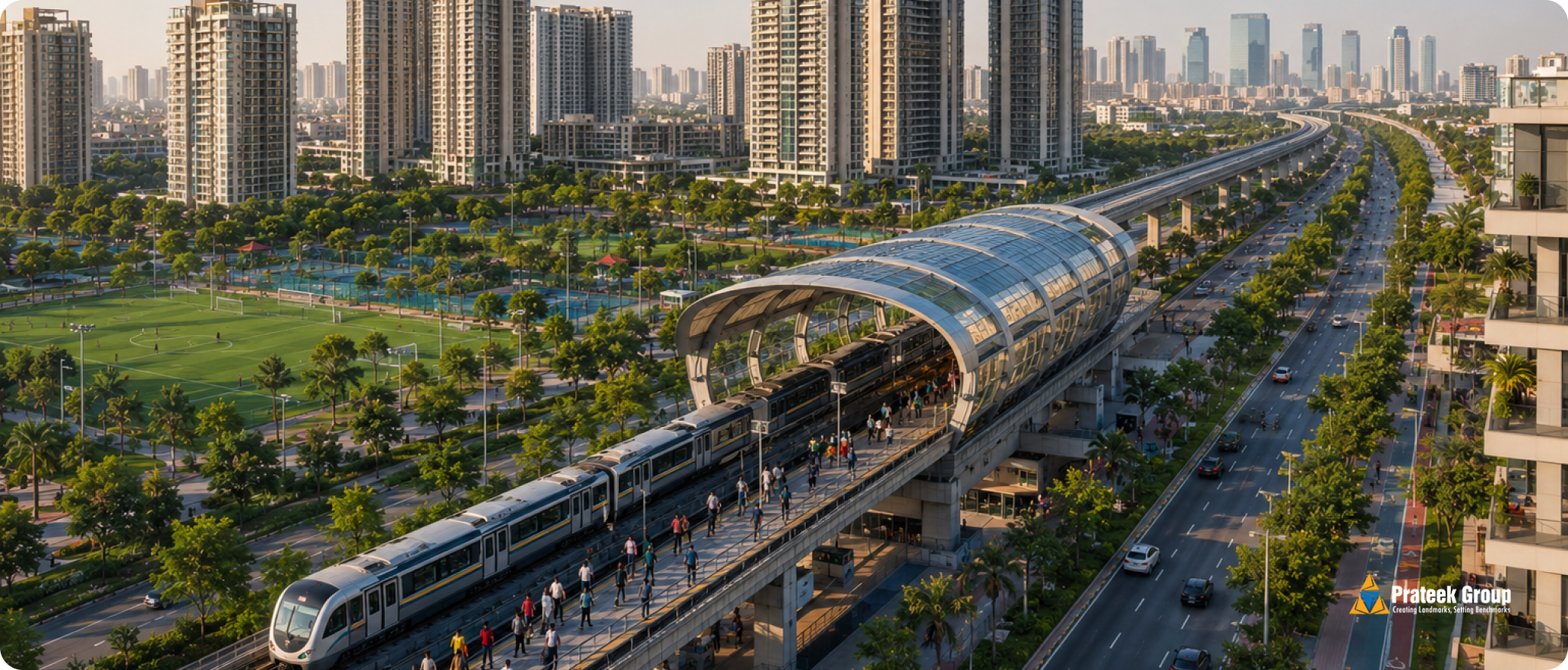
If the airport expands Sector 150’s economic gravity, the metro expands its daily usability. And 2026 has delivered the most significant Metro news this corridor has seen since the Aqua Line opened.
The approved extension
On 14 February 2026, the Union Cabinet approved an 11.56 km extension of the Aqua Line from Botanical Garden to Sector 142, at an estimated cost of about Rs 2,254 crore, with eight new elevated stations and a completion target of roughly four years. The corridor runs along the Noida-Greater Noida Expressway and will be implemented by the Noida Metro Rail Corporation, which operates the existing Aqua Line.
Why does this matter so much? Because of what happens at Botanical Garden.
The interchange changes everything
Today, an Aqua Line commuter switching to the Delhi Metro must exit at Sector 51 and walk to the separate Sector 52 station. It works, but it is friction, and friction suppresses ridership and the property premium that comes with it. The new corridor plugs the Aqua Line directly into Botanical Garden, one of NCR’s busiest interchanges, with seamless transfers to both the Blue Line and the Magenta Line. That means one-network access to South Delhi, Central Delhi, and, via the Magenta Line, Indira Gandhi International Airport.
For a Sector 150 resident, the practical meaning is simple: by around 2030, the Metro stops being a partial solution and becomes a genuine alternative to driving for Delhi-bound commutes.
The Bodaki connection adds a second dimension
A separate 2.6 km extension from the existing depot station to Bodaki, estimated at around Rs 416 crore, was cleared earlier and will connect the Aqua Line to the planned Boraki multi-modal transport hub, which is designed to integrate metro, Indian Railways, and regional bus connectivity. Sector 150 residents already use the nearby Aqua Line stations on the corridor; the Bodaki link extends the network’s reach toward the emerging transport spine of Greater Noida.
What does history suggest about Metro corridors and prices?
Research from national property consultancies has repeatedly found that residential markets within walkable distance of new Metro corridors outperform their wider city markets in the years around commissioning. Industry research platforms such as ANAROCK’s published market research have documented how NCR’s transit corridors, from Dwarka Expressway to the Noida Expressway belt, translate connectivity milestones into measurable price outperformance. The premium is typically strongest for locations that combine Metro access with other demand drivers, which is precisely Sector 150’s situation.
The realistic timeline matters here. The Botanical Garden extension has a construction horizon that lands around 2030, give or take. That means the Metro catalyst is a late-decade catalyst: its announcement effect is being absorbed now, and its delivery effect arrives at the end of our outlook window. For a buyer with a five-year horizon, that sequencing is actually attractive. You are entering during the construction phase of one catalyst while the delivery phase of another, the airport, is already underway.
Now to the third catalyst, the one that gives Sector 150 its identity.
What Role Will Sports City and Sports Infrastructure Play?
Sector 150 was conceived as part of Noida’s Sports City vision: residential development integrated with large-scale sports facilities, golf-centric greens, stadiums, academies, and recreational infrastructure. The vision was genuine. The execution, for a decade, was troubled. Understanding both halves of that story is essential to understanding the sector’s 2030 outlook.
The problem, honestly stated
Land for Sports City projects was allotted between 2011 and 2014 with binding conditions: developers were required to build substantial sports infrastructure alongside homes. Residential towers came up; much of the promised sports infrastructure did not. A CAG audit flagged serious irregularities, and in January 2021 the Noida Authority froze occupancy certificates and registries across Sports City projects. Thousands of families found themselves living in homes they could not legally register.
The resolution, and why it changes the outlook
On 24 November 2025, the Supreme Court approved a structured revival framework. The essential elements:
- Conditional occupancy certificates can be issued tower by tower where building norms are met.
- Registries reopened, and the Noida Authority began processing them from early January 2026, covering thousands of long-waiting homebuyers.
- Developers must clear a defined share of outstanding dues within strict timelines to unlock approvals.
- Sports infrastructure must now be completed within about three years under binding undertakings, with remaining civic infrastructure to follow within five years of the revised plan’s approval.
Read that last point again, because it is the part most commentary misses. The Supreme Court’s order does not merely resolve a legal dispute. It converts the original Sports City promise into a court-supervised delivery obligation with a timeline that lands squarely before 2030.
What this could mean for prices, in three layers:
Layer one: the legal discount unwinds. Properties that cannot be registered trade at a discount, historically in the range of 15 to 20 percent compared with registry-ready homes. As registries proceed and bank lending normalizes for compliant projects, that discount narrows. Some of this repricing is already underway in 2026.
Layer two: liquidity returns. A market where buyers can register, mortgage, and resell freely attracts far more participants than one under a cloud. Wider participation deepens demand and stabilizes pricing. For buyers, it also restores the exit option that any sound investment requires.
Layer three: the amenity premium arrives. If the mandated sports infrastructure is delivered on the court-supervised timeline, Sector 150 gains what almost no NCR micro-market has: genuine, large-scale sports facilities woven into a low-density green sector. Golf-facing homes, academy access, and stadium-grade amenities are lifestyle differentiators that premium buyers pay for. This layer is the least certain of the three, because it depends on execution, but it is also the one that could most distinctly separate Sector 150 from every comparable market by 2030.
Our advice to buyers is unchanged by the optimism: verify. Check project-specific occupancy certificate status, registration eligibility, and compliance updates on the Noida Authority’s official portal, and confirm the RERA registration of any project you evaluate on the UP RERA portal before committing funds. A sector-level recovery does not eliminate project-level differences, and the projects with clean compliance records will capture the recovery first.
How Do Expressways Contribute to Sector 150’s Appreciation Story?
Metro and airports capture headlines, but expressways quietly do much of the daily work of property value. Sector 150’s road position deserves its own examination because it is arguably the sector’s most underrated asset.
The sector sits at a rare three-way convergence. The Noida-Greater Noida Expressway runs along its edge, the Yamuna Expressway begins nearby and runs to the airport and Agra, and the Eastern Peripheral Expressway interchange is a short drive away, linking the corridor to the wider national highway network without touching Delhi’s congestion. Very few residential micro-markets in NCR can reach an international airport, two business districts, and a national expressway grid this directly.
What does this mean in practical, daily terms?
- The employment hubs along the Noida Expressway, including the IT and corporate campuses concentrated between Sector 125 and Sector 144, are a 15 to 25 minute drive.
- The new airport is reachable in roughly half an hour via the Yamuna Expressway, without a single urban traffic signal.
- Delhi, Ghaziabad, and Faridabad are accessible via the expressway grid, making the sector viable for households with workplaces spread across NCR.
The forward pipeline strengthens this further. Regional road planning through 2030 includes upgrades to expressway interchanges serving the airport corridor, proposed link roads improving access between the Noida Expressway belt and the Yamuna corridor, and the continued build-out of the region’s freight and logistics network. Each completed link shortens someone’s commute, and every shortened commute adds households to Sector 150’s realistic demand pool.
There is also a subtler effect worth understanding. Expressway-connected sectors tend to hold value better during market slowdowns. When demand cools, buyers become more selective, and selectivity favours locations with unambiguous connectivity. Sector 150 demonstrated this resilience through the registry-freeze years: despite a serious legal overhang, capital values kept climbing because the location fundamentals never weakened. That resilience is itself information about how the sector may behave in the less rosy scenarios for 2030.
For a fuller regional picture of how roads, Metro, and the airport interact across the city, our recent overview of why Noida’s growth looks well supported in 2026 connects these threads at the city level.
What Does the Historical Evidence Say About Appreciation?
Future outlooks earn credibility from historical honesty. So let us look plainly at what Sector 150 has already done and what that record does and does not tell us.
The record so far:
Period | Approximate Price Movement | Primary Drivers |
2016 to 2019 | Gradual growth from launch pricing | Early possession, sector build-out, expressway access |
2019 to 2021 | Moderate appreciation | Green-sector positioning, airport announcement effect |
2021 to 2024 | Sharp acceleration, capital values up over 100 percent in many projects | NCR premium housing boom, airport construction progress, supply scarcity |
2024 to 2026 | Continued strong growth, roughly 9 to 10 percent in the latest year | Airport inauguration, Metro approval, Sports City legal resolution |
Three observations matter for interpreting this table.
First, the biggest gains coincided with visible progress, not announcements. The 2021 to 2024 surge tracked the airport’s construction milestones and NCR’s post-pandemic premium housing demand, documented extensively in the research of national consultancies such as Knight Frank India’s published research on NCR’s residential market. This is the announcement-to-delivery curve in action.
Second, appreciation persisted through a serious legal problem. The registry freeze should have crushed prices. It did not, because scarcity and location kept demand alive. Now that the freeze is resolved, the sector enters 2026 to 2030 with a cleaner legal foundation than at any point in its history.
Third, past performance sets a high base. A market that has doubled cannot be expected to double again simply because it did so before. The next phase of appreciation must be earned by the next phase of catalysts. Fortunately, as we have seen, the catalyst pipeline through 2030 is unusually full.
What Are Realistic Price Scenarios for Sector 150 by 2030?
This is the question every reader wants answered, so let us answer it the only honest way: as scenarios with explicit assumptions, not as a single number dressed up as certainty.
We take mid-2026 average pricing of roughly Rs 12,000 to Rs 12,500 per sq ft as the base. All figures are sector-level averages; individual projects will vary meaningfully around them.
Scenario | Assumed Annual Growth | Indicative 2030 Range (per sq ft) | Key Assumptions |
Conservative | 5 to 7 percent | Rs 14,500 to Rs 16,500 | Airport scales slowly, Metro extension delayed beyond 2030, sports infrastructure partially delivered, broader NCR market cools |
Base Case | 8 to 11 percent | Rs 17,000 to Rs 19,500 | Airport grows on plan with international routes, Metro construction visibly advances, Sports City obligations largely met, stable interest rates |
Optimistic | 12 to 15 percent | Rs 20,000 to Rs 23,000 | Airport-linked employment accelerates, Metro nears commissioning by 2030, sports infrastructure fully delivered, premium NCR demand stays strong |
How to read this table responsibly:
- The conservative case is not a disaster case. Even with every catalyst underperforming, the supply scarcity and location fundamentals suggest positive, if modest, growth. A genuine downside case, involving a macroeconomic shock or a renewed legal freeze, could produce flat or negative periods, and buyers should acknowledge that possibility.
- The base case reflects continuation, not acceleration. It assumes the sector roughly sustains its recent trajectory as announcement effects hand over to delivery effects. It does not require anything extraordinary to happen.
- The optimistic case requires execution. Every element of it depends on projects being delivered on time, which, as NCR’s history shows, is never guaranteed.
- Monetary policy is a swing factor across all three. Interest rate movements directly affect premium housing affordability. The rate easing seen in 2026 supported demand; a reversal would work in the opposite direction.
We would also gently caution against the double-digit-forever mindset. Compounding at 15 percent for a decade produces numbers that eventually detach from income growth and rental economics. Sustainable appreciation over long periods tends to gravitate toward the base case, punctuated by step-ups around delivery events. Plan your finances around the conservative case, hope for the base case, and treat the optimistic case as upside rather than expectation.
What Risks Should Buyers Honestly Consider?
Trust is built by discussing risks as openly as opportunities. Here are the ones we believe every Sector 150 buyer should weigh.
Execution risk on timelines. The Metro extension has a multi-year construction horizon, and large Indian infrastructure projects routinely slip. The sports infrastructure obligations are court-supervised, which improves accountability, but supervision does not pour concrete. If you are buying primarily for a catalyst, build slippage into your expectations.
Project-level legal variance. The Sports City resolution operates tower by tower and project by project. Two buildings in the same sector can have very different compliance positions. Always verify occupancy certificate status, dues clearance, and registration eligibility for the specific tower you are buying in, not just the sector’s overall narrative.
Rental yield reality. At around 2 percent, rental income will not meaningfully service a home loan. If your investment plan depends on rent covering EMIs, Sector 150 is the wrong market. It rewards patient capital with appreciation, not cash flow.
Concentration of the airport thesis. A meaningful share of the sector’s premium rests on the airport’s success. Aviation projects can underdeliver on passenger and cargo projections in early years. The airport’s early ramp-up has been steady rather than explosive, which is normal, but buyers should track its trajectory rather than assume it.
Market cyclicality. NCR’s premium housing has had an exceptional run since 2021. Cycles turn. A cooling phase would slow appreciation everywhere, including Sector 150. The sector’s supply scarcity offers relative protection, not immunity.
Entry price discipline. Some projects now price years of future infrastructure benefit into today’s asking rates. Compare per sq ft pricing across comparable projects, and be willing to walk away from listings that have already borrowed 2030’s appreciation.
None of these risks, in our assessment, undermines the sector’s medium-term case. But every one of them belongs in your decision-making, and any advisor who skips them is selling rather than advising.
Who Should Consider Investing in Sector 150 Today?
Different buyers have different equations. Here is how we would frame the fit, based on the thousands of buyer conversations our teams have had across NCR.
The end-user family with a 7 to 10-year horizon: strong fit. You get the lifestyle benefits, the greenery, low density, and expressway access immediately, while the appreciation story plays out around you. You are not dependent on timing the market, and the improving social infrastructure compounds your quality of life each year.
The long-term investor focused on capital appreciation: a strong fit with discipline. The catalyst pipeline through 2030 aligns well with a five-year-plus holding period. Enter at a sensible price, choose a legally clean project, and let the delivery phase of the airport and Metro do the work.
The NRI buyer: increasingly strong fit. Direct international connectivity from the new airport materially changes the ownership experience for NRI families, and the premium, gated, professionally managed nature of Sector 150’s housing stock suits remote ownership. Currency dynamics in recent years have added a further tailwind for overseas buyers.
The yield-seeking investor: poor fit. As discussed, 2 percent yields do not make an income portfolio. Markets closer to dense employment clusters serve that goal better.
The short-term flipper: proceed with caution. Transaction costs, stamp duty, and taxation consume a large share of short-horizon gains, and near-term pricing already reflects the 2026 news cycle. This market rewards holding through delivery events, not trading between them.
The budget-constrained first-time buyer: consider alternatives first. Sector 150 is a premium market. If the entry ticket stretches your finances, comparable-quality options at lower price points exist elsewhere in the region, and our detailed Greater Noida West vs Sector 150 comparison walks through exactly that trade-off honestly.
And if your interest is specifically airport-driven, it is worth studying the full corridor before choosing your micro-market. Our guide to the best areas to buy near Noida International Airport in 2026 compares the candidate locations and explains why established sectors with existing social infrastructure often capture airport demand more reliably than raw land closer to the terminal.
What Makes Sector 150 Different From Other Noida Sectors?
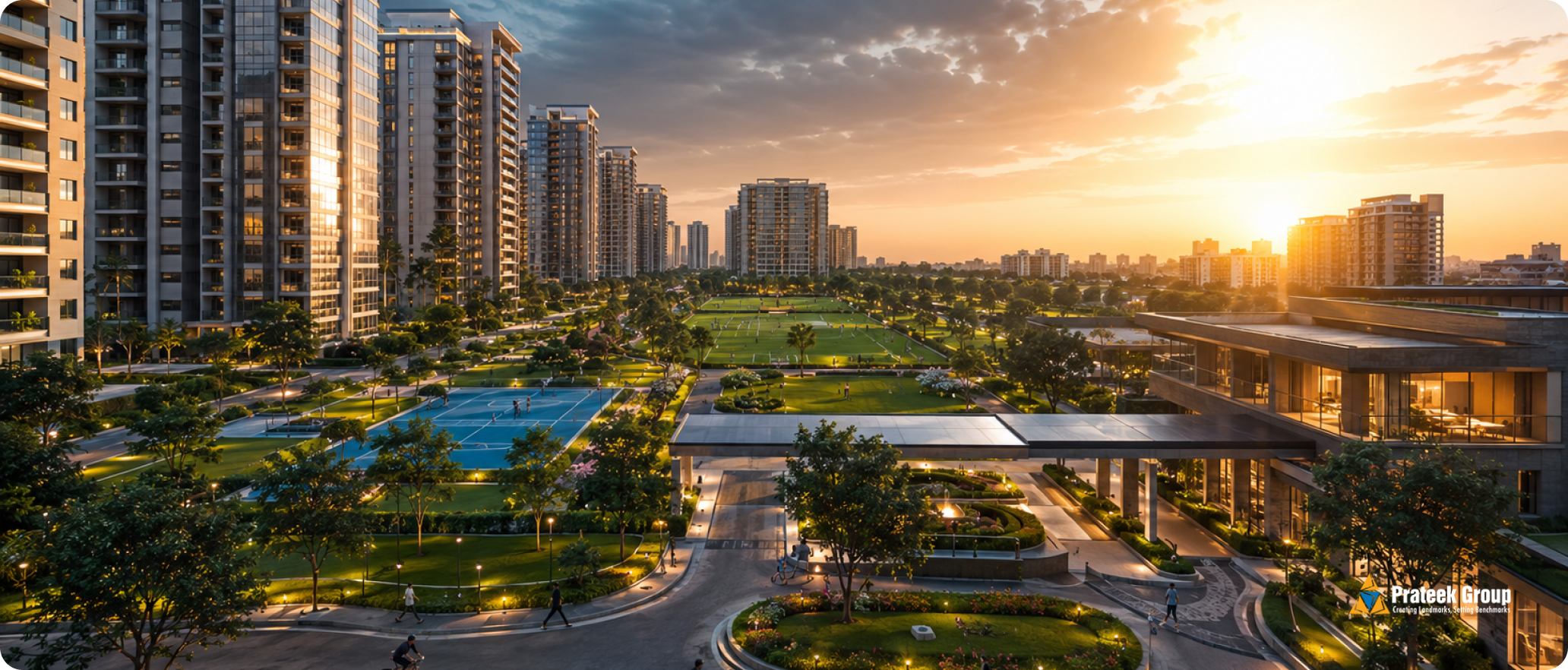
NCR has no shortage of sectors with an infrastructure story. So why does this one stand apart? In our view, four structural features separate Sector 150 from its peers.
- Supply is capped by design. Most NCR micro-markets can respond to rising demand with new towers. Sector 150 largely cannot, because its master plan reserves the overwhelming majority of land for green and open uses. When demand rises against fixed supply, price is the variable that adjusts. This single feature underwrites the entire long-term thesis.
- It is a convergence point, not a single-catalyst market. Sectors that depend on one project rise and fall with that project. Sector 150 sits at the intersection of the airport corridor, the Metro corridor, the expressway grid, and the Sports City framework. Weakness in one catalyst can be offset by strength in another, which lowers the variance of outcomes.
- The buyer profile is end-user heavy and premium. Markets dominated by speculators swing violently. Sector 150’s buyer base skews toward families and long-horizon investors in larger configurations, which produces steadier pricing and better-maintained communities. The quality of the resident base is itself an appreciating asset.
- The legal reset created a cleaner foundation than most established markets. Counterintuitively, the Sports City ordeal may end up strengthening the sector. Few micro-markets in India now operate under court-supervised infrastructure delivery timelines and freshly scrutinized compliance. The projects that have come through this process clean carry a level of verified legitimacy that ordinary markets never had to demonstrate.
Where Does Prateek Canary Fit Into This Picture?
We want to be transparent about our own position in this market because we believe disclosure builds more trust than pretended neutrality.
Prateek Canary is our premium residential development in Sector 150, and it is now ready to move in. It was conceived around the same principles that define the sector itself: generous open space, low-density towers, and homes designed for families who intend to stay, not trade.
In the context of everything this article has covered, three things are worth noting about how a development like Canary interacts with the sector’s 2030 outlook.
Ready-to-move status removes execution risk from your side of the equation. Every scenario we discussed carries timeline uncertainty on public infrastructure. A completed, occupied community lets you take the sector’s upside without adding construction risk of your own.
Location within the sector matters. Canary’s position gives residents direct access to the expressway network that connects to both the employment corridor and the airport, which is precisely the connectivity channel through which the sector’s appreciation thesis operates.
Community quality compounds. As the sector’s sports and civic infrastructure is delivered over the coming years, the developments best placed to benefit are those with established, well-managed resident communities already in place. Appreciation, when it comes, accrues to homes people actually want to live in.
We will simply say this: if the analysis in this article resonates with your own reading of the market, Canary is where our conviction about Sector 150 has taken physical form. We would be glad to show it to you.
Key Takeaways
Before we close, here is the entire argument in brief:
- Sector 150 enters the 2026 to 2030 window with three maturing catalysts: an operational international airport scaling toward international routes, a Union Cabinet-approved Metro extension linking the corridor to Botanical Garden’s interchange, and a court-supervised Sports City revival with binding infrastructure timelines.
- The sector’s baseline is strong but honestly priced: roughly Rs 12,000 to Rs 12,500 per sq ft on average, about 13 percent six-year CAGR, modest rental yields, and a legal overhang that resolved in early 2026.
- History suggests delivery phases matter more than announcements, and the delivery phase for all three catalysts falls within this decade.
- Realistic 2030 scenarios range from roughly Rs 14,500 to Rs 23,000 per sq ft depending on execution, macro conditions, and market cycles. Plan around the conservative case; treat the upper end as possibility, not promise.
- The market rewards patient, end-user-aligned capital and suits families, long-horizon investors, and NRI buyers far better than yield seekers or short-term traders.
- Project-level verification remains non-negotiable, even in a recovering sector. Check OC status, registration eligibility, and RERA records for the specific tower you buy.
Conclusion: The Decade Sector 150 Was Planned For
Some locations are made by accident. Sector 150 was made by intention: planned as a green, low-density counterpoint to NCR’s congestion, positioned at the meeting point of two expressways, and reserved for the kind of infrastructure that takes decades to deliver.
The frustrating part of intentional planning is the waiting. For years, Sector 150’s residents and investors held a thesis that existed mostly on paper: an airport under construction, a Metro under discussion, a sports vision under litigation.
That waiting phase is ending. The airport is flying. The Metro corridor is funded and approved. The sports infrastructure is under court-supervised timelines. Between now and 2030, the sector’s story shifts from anticipation to delivery, and delivery is historically when the most durable value is created.
None of this makes outcomes certain, and we encourage you to hold every scenario in this article, including ours, to the standard of your own verification. But if you have been waiting for the moment when Sector 150’s fundamentals, legal clarity, and infrastructure pipeline all point in the same direction, that moment, in our honest assessment, is now.
FAQs
1. Is Sector 150 Noida a good location for long-term wealth creation?
Sector 150 is widely considered a long-term investment destination because of its planned development, limited housing supply, premium positioning, and multiple infrastructure upgrades. While appreciation is never guaranteed, buyers with longer holding periods generally benefit more than those seeking quick returns.
2. Will infrastructure alone guarantee property appreciation in Sector 150?
No. Infrastructure improves a location’s attractiveness, but appreciation also depends on demand, project quality, economic conditions, interest rates, and overall market sentiment. Buyers should evaluate both location fundamentals and individual projects before making an investment decision.
3. How can buyers identify projects with better appreciation potential?
Compare factors such as builder reputation, construction quality, legal approvals, occupancy status, connectivity, community planning, maintenance standards, and future development around the project. Strong fundamentals generally outperform speculative pricing over longer investment horizons.
4. Is buying a ready-to-move property better than an under-construction project in Sector 150?
Ready-to-move homes eliminate construction uncertainty and allow buyers to inspect the finished product before purchasing. Under-construction projects may offer lower entry prices but involve execution, delivery, and market risks that should be carefully evaluated.
5. How important is builder credibility when buying in Sector 150?
Builder credibility plays a major role in timely delivery, construction quality, customer support, legal compliance, and long-term property value. Choosing an established developer can significantly reduce risks associated with residential real estate investments.
6. Can Sector 150 attract more end-users than investors in the coming years?
The sector’s green environment, low-density planning, premium residential communities, and improving infrastructure make it attractive for families. As social infrastructure matures, genuine end-user demand could continue strengthening alongside investment interest.
7. Should buyers wait until all infrastructure projects are completed before investing?
Waiting reduces uncertainty but may also mean entering the market at higher prices if infrastructure is successfully delivered. Buyers should balance current pricing, personal financial goals, and investment horizon instead of relying solely on project completion timelines.
8. How does low-density planning influence property values?
Low-density planning restricts excessive residential supply while providing more open spaces and better living conditions. When demand continues to grow and supply remains limited, such environments often support stronger long-term value compared to overcrowded neighborhoods.
9. What documents should buyers verify before purchasing property in Sector 150?
Buyers should verify RERA registration, occupancy certificate where applicable, title documents, approved building plans, registration eligibility, payment schedules, and builder approvals. Independent legal verification helps minimize future ownership or compliance-related risks.
10. Is Sector 150 suitable for NRIs looking to invest in Noida?
Many NRIs prefer Sector 150 because it combines premium residential communities with improving international connectivity, professional property management, and long-term growth potential. However, buyers should still conduct proper due diligence before investing.
11. What factors could slow down property appreciation in Sector 150?
Infrastructure delays, slower economic growth, higher interest rates, policy changes, reduced buyer demand, or project-specific legal issues can affect appreciation. Real estate performance depends on multiple market variables rather than a single catalyst.
12. How should buyers compare multiple residential projects in Sector 150?
Rather than comparing brochures alone, evaluate carpet area efficiency, construction quality, amenities, maintenance costs, legal approvals, builder track record, community planning, future resale prospects, and actual location advantages before making a decision.
13. Does premium pricing always indicate a better investment opportunity?
Not necessarily. Higher prices should be supported by better construction quality, superior location, stronger amenities, reputable developers, and long-term demand. Paying a premium without corresponding value may reduce future appreciation potential.
14. How often should buyers review market conditions before purchasing?
Buyers should monitor pricing trends, infrastructure progress, interest rates, government policies, and project updates throughout their buying process. Staying informed helps make decisions based on current market realities instead of outdated information.
15. Who benefits the most from buying property in Sector 150?
Sector 150 generally suits homebuyers seeking premium living environments and investors with medium- to long-term horizons. Buyers looking for immediate rental income or short-term trading opportunities may find other markets better aligned with their objectives.