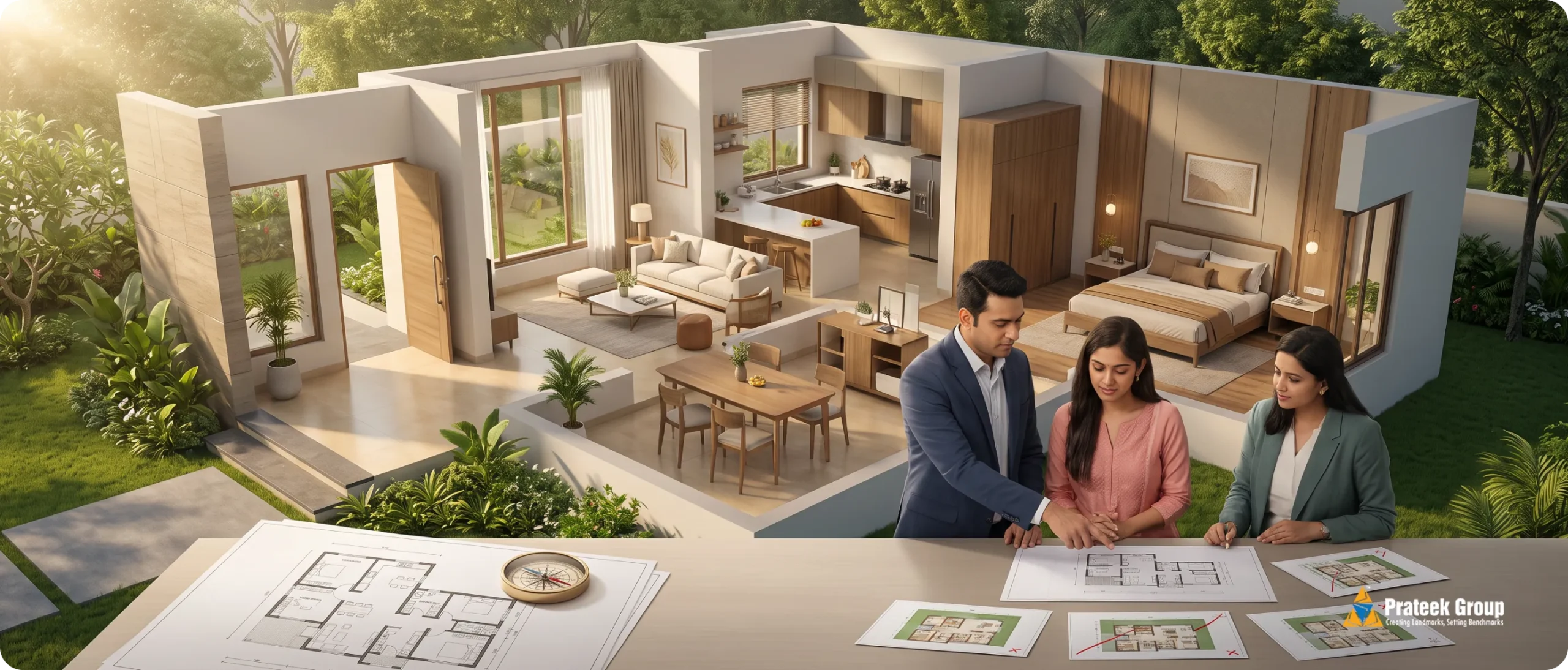
For many families in the NCR, the direction a home faces matters as much as its size or floor. Ask a group of buyers what they’re looking for, and “north-east facing” comes up again and again. It’s the facing most often recommended in vastu shastra, and it’s also 1 of the most practical in the climate of north India.
This guide explains what a north-east facing home is, how to check the facing of a flat before you buy, how to plan a north east house design room by room, where the master bedroom should go and what vastu says about north-south facing homes. It also answers the question many buyers are too polite to ask out loud: which facing house is not good?
We’ve presented vastu here as traditional guidance that many families value, alongside the practical reasons some of its principles make sense in daily life. It doesn’t guarantee outcomes, and we don’t present it that way. For an overview of all 4 main directions, see our guide to north, east, west or south facing houses as per vastu.
What vastu shastra is
Vastu shastra is a traditional Indian system of architecture and design that sets out principles for the layout of buildings, the placement of rooms and the use of directions. It draws on ideas about the balance of natural elements and the movement of the sun through the day and the year.
For homebuyers, vastu usually comes down to a few questions: which way the main entrance faces, where the kitchen, bedrooms, puja room and toilets are placed and whether the north-east corner of the home is kept open and light. Families differ in how strictly they follow it. Some want a fully vastu-compliant home. Others simply prefer a north or east entrance and a well-placed kitchen.
What a north-east facing home means
A north-east facing home is a home whose main entrance, or principal front, faces the north-east direction, between north and east. In vastu, the north-east corner is known as Ishan, associated with the divine, with clarity and with fresh beginnings. It’s considered the most auspicious direction for an entrance and for spaces used for prayer, study or meditation.
There’s a practical side to the preference too. In the NCR, which sits at about 28 degrees north, the sun rises in the east and moves across the southern half of the sky. A north-east facing home gets soft morning light and stays shaded from the harsh afternoon sun that hits west and south-west facing walls in summer. That makes north-east facing rooms easier to keep cool from April to June, when temperatures in Delhi NCR regularly cross 40°C.
How to check the facing of a flat
For a flat, the facing isn’t always obvious, and buyers often confuse the direction of the main door with the direction of the balcony or view. Here’s how to check.
Decide what you’re measuring
Most vastu consultants judge a flat’s facing by the direction of its main entrance door, since that’s where energy is said to enter. Some families judge by the direction the main balcony or living room faces. Agree which you mean before you compare flats, because the same flat can be “north-east facing” by 1 measure and “south-west facing” by another.
Use a compass
Stand inside the flat at the main door, facing outwards, and use a compass app on your phone. Keep the phone away from steel doors, grills and electrical boards, which can throw the reading off. Take the reading 2 or 3 times in slightly different spots and average them.
Check the plan
The approved floor plan usually shows a north arrow. Match it with your compass reading. If they disagree, trust a careful compass reading taken away from metal.
Ask about the tower orientation
In a large society, the same flat type may face different directions in different towers. If facing matters to you, check the tower and unit numbers that face north-east before you shortlist.
North east house design, room by room
Here’s how commonly followed vastu guidance arranges a north-east facing home, with the practical reason alongside. Treat it as a guide. Few flats in modern high-rises match every point, and that’s normal.
Space | Commonly suggested placement | Practical reason |
Main entrance | North-east, north or east | Morning light at the entrance, cooler in summer |
Puja or meditation space | North-east corner | Quiet, bright in the morning, away from heat |
Living room | North, east or north-east | Good daylight through the day without glare |
Kitchen | South-east, with the cook facing east | Morning light while cooking, and the hot side of the home holds the stove |
Master bedroom | South-west | The heaviest, most private corner, and cooler at night |
Children’s bedroom | West or north-west | Good evening light, away from the entrance |
Guest bedroom | North-west | Separate from the main family areas |
Toilets | North-west or west, never north-east | Keeps the bright corner free for living spaces |
Balcony | North or east | Usable in summer mornings and winter days |
Heavy storage | South or south-west | Keeps the north-east light and open |
Keep the north-east corner light and open
The single most repeated vastu principle for a north east house is to keep the north-east corner uncluttered. That means no heavy wardrobes, no storage lofts, no toilet and ideally a window or opening. In flats, it’s often the corner used for a small puja unit, a study desk or simply a clear space with a plant.
Colours and materials
Many families choose light colours, such as white, cream or pale yellow, for north-east facing rooms, which also reflect morning light well. Keeping heavy furniture and dark colours for the south and south-west side of the home is common vastu advice and helps balance the room visually.
East-facing and north-facing variations
Not every flat faces exactly north-east. Many face due east or due north, and both are widely regarded as good facings in vastu.
An east-facing home gets strong morning sun, which many families value for its brightness and warmth early in the day. In the NCR, east-facing rooms can get warm on summer mornings, but they cool down by afternoon as the sun moves west. East is associated in vastu with health and new beginnings, and an east-facing entrance is generally considered favourable.
A north-facing home, as covered below, gets even daylight with little direct sun and is associated with prosperity. It stays cool in summer, which suits the NCR’s long hot season.
For both, the same room guidance applies as for a north-east facing home: keep the north-east corner open, put the kitchen in the south-east where possible, keep toilets away from the north-east and use a south-west room as the master bedroom.
Surroundings and plot shape
Vastu also looks beyond the walls of the home. Commonly followed guidance prefers square or rectangular plots and buildings, since irregular shapes are said to create imbalance. It also suggests avoiding an entrance that faces straight down a road ending at the gate, a layout known as a T-junction, and prefers open space to the north and east, with taller structures to the south and west.
In a gated society, you can’t choose the shape of the tower, but you can look at what surrounds your flat. An open view to the north or east, such as a park or a low-rise area, fits vastu preferences and also brings more morning light. A tall tower immediately to the east or north of your flat will block that light, whatever the facing.
Balconies, staircases and water
A few other features come up in vastu discussions of homes and flats.
- Balconies. North and east balconies are generally preferred. Practically, they’re the most usable in summer, since they avoid the afternoon sun.
- Staircases. In independent homes, staircases are usually placed in the south, west or south-west, and kept out of the north-east.
- Water. Underground water tanks and borewells are traditionally placed in the north-east, while overhead tanks go in the south-west. In flats, this is decided by the building, not the buyer.
- Mirrors and heavy fixtures. Many families avoid large mirrors facing the bed and place heavy fixtures on the south and west walls.
North east master bedroom vastu
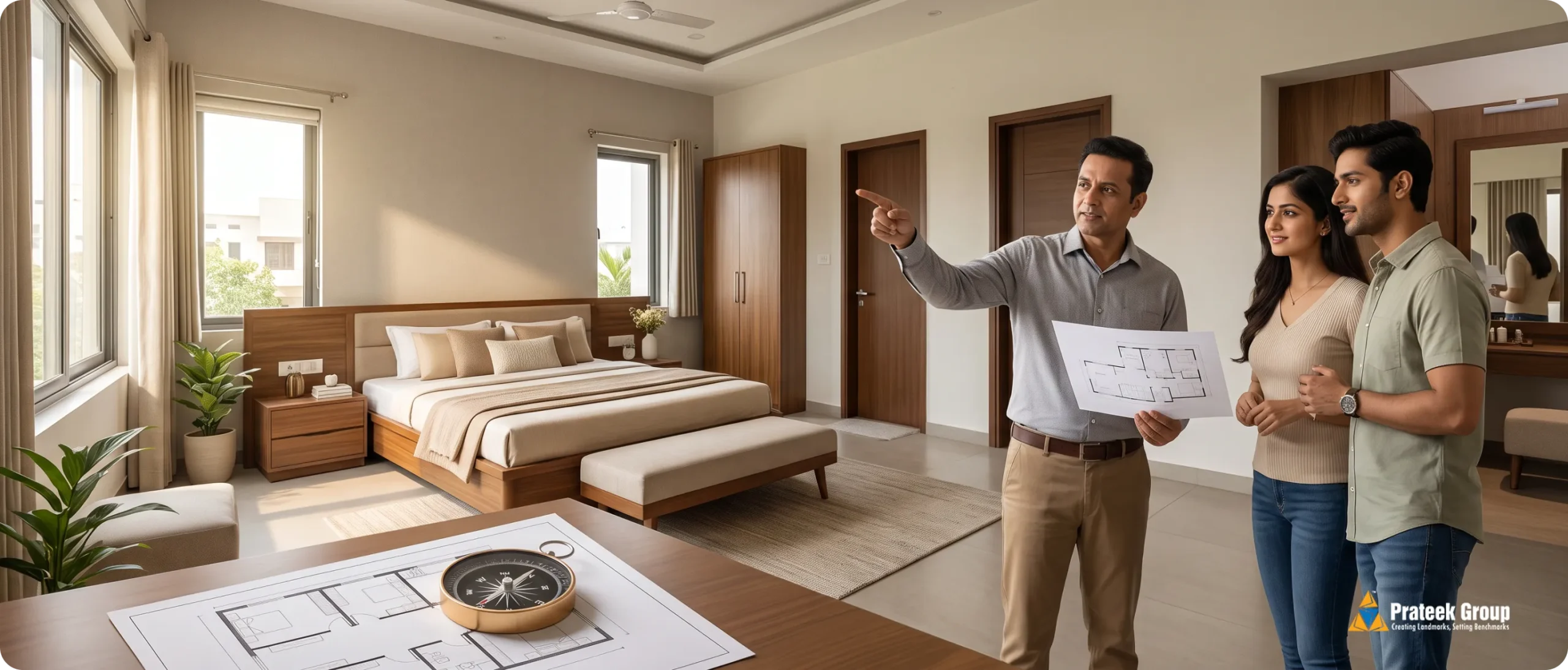
Buyers often ask about north east master bedroom vastu, because many flat layouts place a large bedroom in the north-east corner. Most vastu consultants recommend the master bedroom in the south-west, which is associated with stability and is usually the most private corner. A master bedroom in the north-east is generally not preferred for the main couple of the house in traditional guidance.
That doesn’t mean a flat with a north-east bedroom should be ruled out. Common approaches include using the north-east room as a children’s bedroom, a study or a guest room, and taking a south-west or south room as the master bedroom. If the north-east room has to be the master bedroom, families often keep it simple, light and uncluttered, place the bed in the south-west part of the room and avoid heavy storage along the north and east walls.
From a comfort point of view, a north-east bedroom is bright in the morning and cool through the day, which many people like. The decision is personal, and the right answer depends on how strictly your family follows vastu.
North south facing house vastu
A north south facing house can mean 2 different things, so it helps to separate them.
A north-facing home
In vastu, north is associated with prosperity and is ruled by Kubera, the god of wealth. North-facing entrances are widely regarded as favourable, particularly when the door sits in the correct portion of the north wall. Practically, north-facing rooms in the NCR get steady, diffused daylight with little direct sun, which keeps them cool in summer but can make them less warm in winter.
A south-facing home
South-facing homes are often seen as less favoured in popular vastu, though many practitioners say a south-facing entrance can work well if the door is placed in the right position along the south wall and the layout is planned with care. Practically, south-facing rooms get the most winter sun in the NCR, which makes them warm and bright from November to February. In summer, overhangs, balconies or shading help keep them comfortable.
A home with both north and south exposure
Some flats and houses are described as north-south facing because they have openings on both the north and south sides. That arrangement is excellent for cross-ventilation, since air can move through the home from 1 side to the other. In vastu terms, the entrance position still decides how the home is read. In comfort terms, it’s 1 of the best layouts for airflow in a hot climate.
Which facing house is not good?
Buyers ask which facing house is not good because they’ve heard that some directions are unlucky. In popular vastu, south-west and south facing entrances are the ones most often described as less favourable, with south-west entrances usually considered the most challenging.
There are 2 important caveats. First, many vastu practitioners say no facing is bad in itself. What matters is where exactly the entrance sits along the wall, how the rooms are arranged and whether the home is well lit and ventilated. Remedies such as adjusting the entrance, the placement of rooms or colours are commonly suggested for less favoured facings. Second, practical comfort doesn’t always line up with vastu preferences. A south-facing flat can be warmer and brighter in winter than a north-facing flat, which many families value.
If a south or south-west facing flat is otherwise right for you, in location, price and layout, don’t dismiss it without looking at the specific plan. Many families live happily in homes of every facing.
North-east facing plots vs north-east facing flats
Vastu applies a little differently to a plot and a flat, and it’s worth knowing the difference if you’re weighing both.
With a plot, you control the whole design. You can place the entrance, puja room, kitchen and bedrooms exactly where vastu suggests, and you can keep the north-east portion of the plot lower and more open than the south-west, which is a common recommendation. Many families building independent homes in Noida and Ghaziabad plan the entire layout with a vastu consultant from the start.
With a flat, the developer has already fixed the plan. Your choices are which flat to buy and how to arrange furniture and use each room. That’s why the checks in this guide focus on the entrance, the kitchen, the toilets and the north-east corner: they’re the points you can assess before buying and the hardest to change afterwards.
Simple adjustments families make in flats
Where a flat doesn’t match every vastu principle, families often make small, practical adjustments rather than walking away from an otherwise good home. Common ones include:
- Rearranging furniture. Moving heavy wardrobes and beds towards the south and west walls, and keeping the north-east side of rooms lighter.
- Choosing room uses. Using a north-east bedroom as a study or children’s room and a south-west room as the master bedroom.
- Colour choices. Light colours in north and east facing rooms, warmer or deeper tones on the south and west sides.
- The puja space. Placing a small mandir in the north-east of the living room or a bedroom if there’s no separate puja room.
- Keeping it clear. Avoiding clutter, shoe racks and storage in the north-east corner.
- Light and plants. Adding good lighting and a few plants to the north-east to keep it bright and fresh.
None of these changes the structure of the flat, and all of them can be undone. They let families respect vastu within the limits of a modern apartment.
Does facing affect resale value?
In the NCR, facing does influence demand. Many buyers specifically ask for east, north or north-east facing flats, and in popular societies these can sell faster or command a small premium over similar flats with less favoured facings. Park-facing or open-view flats often command a premium too, regardless of direction.
The effect varies by society and by buyer, and it’s rarely large compared with location, floor, condition and view. Still, if you’re buying with resale in mind, a north or east facing flat is usually easier to sell later. If you’re buying for your own use and a different facing suits your budget and layout, the saving may well be worth it.
Questions to ask before you choose a flat
- Which direction does the main entrance face, measured at the door?
- Which rooms sit in the north-east corner?
- Where are the kitchen and toilets?
- Is there a room in the south-west that can be the master bedroom?
- Does the flat get morning light, and is there cross-ventilation?
- Are the same flat types in other towers oriented differently?
- How does the flat feel at 4 pm in summer, when the west sun is strongest?
Visiting at different times of day answers many of these better than any plan. For the bigger picture of choosing where to live, our tips on choosing the right location for your home are a useful companion.
Beyond vastu: light, heat and air in the NCR
Vastu principles overlap in useful ways with what building science says about comfort in north India. Understanding the practical side helps you judge a flat whatever facing it has.
Sun and heat
The sun’s path through the sky changes with the seasons. In the NCR’s summer, the afternoon sun from the west and south-west is the main source of heat gain, so rooms on those sides get hottest. In winter, the sun sits lower in the south, so south-facing windows let in welcome warmth. The sun path at a given latitude explains why the same flat can feel very different in May and December.
Energy and comfort
India’s energy code for homes, known as Eco Niwas Samhita and developed by the Bureau of Energy Efficiency, encourages building design that reduces heat gain through walls, roofs and windows. Its public resources on Eco Niwas explain how orientation, shading and window placement affect how much energy a home needs for cooling. A well-oriented flat with shaded windows on its west side can cut air-conditioning use noticeably.
Ventilation
Cross-ventilation, where air enters on 1 side of a home and leaves on the other, makes a big difference to comfort and indoor air. The National Building Code of India, published by the Bureau of Indian Standards, sets requirements for light and ventilation in buildings. Our post on ventilation in Delhi NCR homes looks at why it matters for health.
Vastu in high-rise flats
Vastu grew up around independent houses and temples, and applying it to a flat on the 18th floor involves some judgement. Modern high-rises can’t always put every room in the ideal direction, because towers are planned around plot shape, sunlight and views.
That’s why many families take a practical approach: they look for a favourable entrance direction, a well-placed kitchen and toilets outside the north-east, then accept that some rooms won’t match every rule. Our post on how vastu and modern architecture can work together explores that balance.
Floor also matters for light and air. Higher floors usually get more light and breeze, while lower floors may be shaded by neighbouring towers. Our guide to choosing a floor in a high-rise apartment covers the trade-offs.
Vastu and a family’s peace of mind
Whatever you believe about vastu, there’s a simple reason to take it seriously when buying a home: it matters to many of the people who’ll live there. If a parent or grandparent will feel uneasy in a flat with the kitchen in the north-east, that unease is real, and it affects how the family feels about the home every day.
That’s why the best approach is usually a family conversation before the search begins. Agree which vastu points are essential, which are nice to have and which you’re happy to adjust with furniture and room use. With that list agreed, you can shortlist flats quickly and avoid falling for a home that someone in the family won’t accept.
It also helps to separate vastu from the other things that make a home work well. Light, ventilation, a quiet location, a good society and a fair price all matter at least as much. A north-east facing flat in a badly run society, on a noisy road or at a stretched price isn’t a good buy just because of its direction.
Vastu for renters
Vastu isn’t only for buyers. Many tenants in Noida and Ghaziabad also prefer north or east facing flats, and landlords with such flats often find they let faster. If you’re renting, the same checks apply: the entrance direction, the kitchen, the toilets and the north-east corner. Since you can’t change the structure, focus on furniture placement and how you use each room.
When to call a vastu consultant
For most flat buyers, the checks in this guide are enough to shortlist homes. Some families prefer a vastu consultant’s opinion before they commit, especially for a large purchase or an independent home. If you do use a consultant, share the approved floor plan with the north arrow marked, and ask them to focus on the points you can’t change, such as the entrance and the kitchen. Ask for practical suggestions for the rest, rather than structural changes that a society may not allow.
A vastu checklist for flat buyers
- Entrance direction. Check it with a compass, standing at the main door facing out.
- North-east corner. Is it free of toilets and heavy storage?
- Kitchen. Is it in the south-east or another acceptable zone?
- Master bedroom. Is there a south-west or south room that can serve as the master bedroom?
- Toilets. Are they away from the north-east?
- Light and air. Does the flat get morning light and cross-ventilation?
- Tower and unit. Does the same flat type face differently in other towers?
Tick what matters to your family and let the rest go. A flat that meets your core vastu needs and fits your budget, commute and lifestyle is usually the right choice.
Frequently asked questions
Is a north east facing house good as per vastu?
Yes. In vastu shastra, a north east facing house is widely regarded as the most auspicious, because the north-east corner, called Ishan, is associated with clarity and fresh beginnings. Practically, in the NCR it gets soft morning light and stays shaded from the harsh afternoon sun, which helps keep it cooler in summer.
What is the best north east house design as per vastu?
In a north east house design that follows common vastu guidance, the entrance faces north-east, north or east, the north-east corner is kept open for a puja or study space, the kitchen sits in the south-east, the master bedroom in the south-west and toilets away from the north-east. Heavy storage goes to the south and south-west.
Is a master bedroom in the north-east good as per vastu?
In north east master bedroom vastu, most practitioners prefer the master bedroom in the south-west, and a north-east master bedroom isn’t generally recommended for the main couple. Common alternatives are to use the north-east room for children, study or guests. If it must be the master bedroom, keep it light and uncluttered and place the bed in its south-west part.
How do I check if a flat is north east facing?
To check if a flat is north east facing, stand at the main entrance door facing outwards and take a compass reading on your phone, away from steel doors and electrical boards. Take 2 or 3 readings and compare them with the north arrow on the approved floor plan. Agree whether you’re judging by the entrance or the balcony.
Is a north south facing house good as per vastu?
A north-facing house is widely regarded as favourable in vastu, associated with prosperity. A south-facing house is often considered less favoured, though many practitioners say it can work well with the entrance in the right position. A home open on both north and south sides is excellent for cross-ventilation, which suits the NCR’s hot summers.
Which facing house is not good as per vastu?
In popular vastu, south-west and south facing entrances are most often described as less favourable, with south-west considered the most challenging. Many practitioners, though, say no facing is bad in itself, and that the exact entrance position, room layout, light and ventilation matter more. Remedies are commonly suggested for less favoured facings.
Why is the north-east corner kept empty in vastu?
The north-east corner is kept light and open in vastu because it’s associated with positive energy, clarity and the divine. Common guidance avoids toilets, heavy furniture and storage there, and many families place a small puja unit or plant in that corner instead. Practically, keeping that corner open lets morning light and air into the home, which improves daylight and ventilation.
Where should the kitchen be in a north east facing house?
In a north east facing house, common vastu guidance places the kitchen in the south-east corner, associated with the fire element, with the cook facing east while working. The north-west is often suggested as an alternative. Kitchens in the north-east are generally avoided, since that corner is kept for lighter uses such as prayer or study.
Can a flat in a high-rise follow vastu fully?
A flat in a high-rise can rarely follow vastu fully, because towers are planned around plot shape, sunlight and views. Many families focus on a favourable entrance direction, a well-placed kitchen and toilets outside the north-east, and accept that some rooms won’t match every rule. Balancing vastu with location, budget and layout usually leads to the best choice.
Does a north-facing flat get enough sunlight in the NCR?
A north-facing flat in the NCR gets steady, diffused daylight with little direct sun, which keeps rooms bright and cool in summer. In winter, it gets less direct warmth than a south-facing flat. Large windows, light colours and an open layout help a north-facing flat feel bright all year, and a balcony on the east or south side adds welcome winter sun.