The starting point
In 2005, a civil engineer who had spent two decades inside the Uttar Pradesh development machinery decided to build houses instead of approving them. That’s the whole origin of Prateek Group. No inherited land bank, no family business to step into. Prashant Tiwari started as a first-generation entrepreneur with one stated promise: quality construction, delivered on time.
Twenty years later the numbers behind that promise are 20 million sq. ft. of delivered residential and commercial space and more than 50,000 families living in Prateek addresses across Noida, Greater Noida and Ghaziabad. Those two figures show up in almost every piece of national coverage the group has earned since, and they’re the reason the coverage exists at all.
This piece is the full record. Formal awards, industry recognition, sales milestones that made business front pages, project features in national dailies, and the CSR work that gets covered in its own right. Everything here links back to the original, so you can read the source yourself.
The portfolio the coverage is actually about
Before the awards, it helps to know which buildings the headlines keep returning to, because the same handful of names carry most of the press.
Prateek Grand City is the 40-acre integrated township in Siddharth Vihar, Ghaziabad, launched in 2014 and still the group’s largest single development. Prateek Grand Begonia sits in the same micro-market and became the launch that dominated business coverage in 2025 and 2026. Prateek Canary in Sector 150, Noida, is the current premium flagship on the Expressway. Prateek Edifice in Sector 107 is the ready-to-move luxury address that has quietly produced some of the group’s biggest single transactions.
Behind those four are the projects that built the early reputation: Prateek Stylome in Sector 45, Prateek Wisteria in Sector 77, Prateek Laurel in Sector 120, Prateek Fedora in Sector 61, and The Royal Cliff at Crossings Republik. Prateek Aurelia covers the EWS and LIG commitment in Siddharth Vihar, and it generates a completely different kind of press from the luxury portfolio.
Knowing which project a story is about explains why certain kinds of coverage cluster around certain names.
Prateek Tiwari and the second generation
The other name that carries coverage is Prateek Tiwari, who joined as Managing Director in 2012. His remit covers media, marketing and the commercial and retail side of the business, which makes the 2026 mall announcement squarely his territory.
The generational handover matters to how the group is written about. A founder-led developer with a second generation already running marketing and commercial strategy reads differently to a journalist than a single-person operation does. It’s part of why the group gets treated as an institution rather than a one-man firm in sector coverage.
The awards cabinet, in order
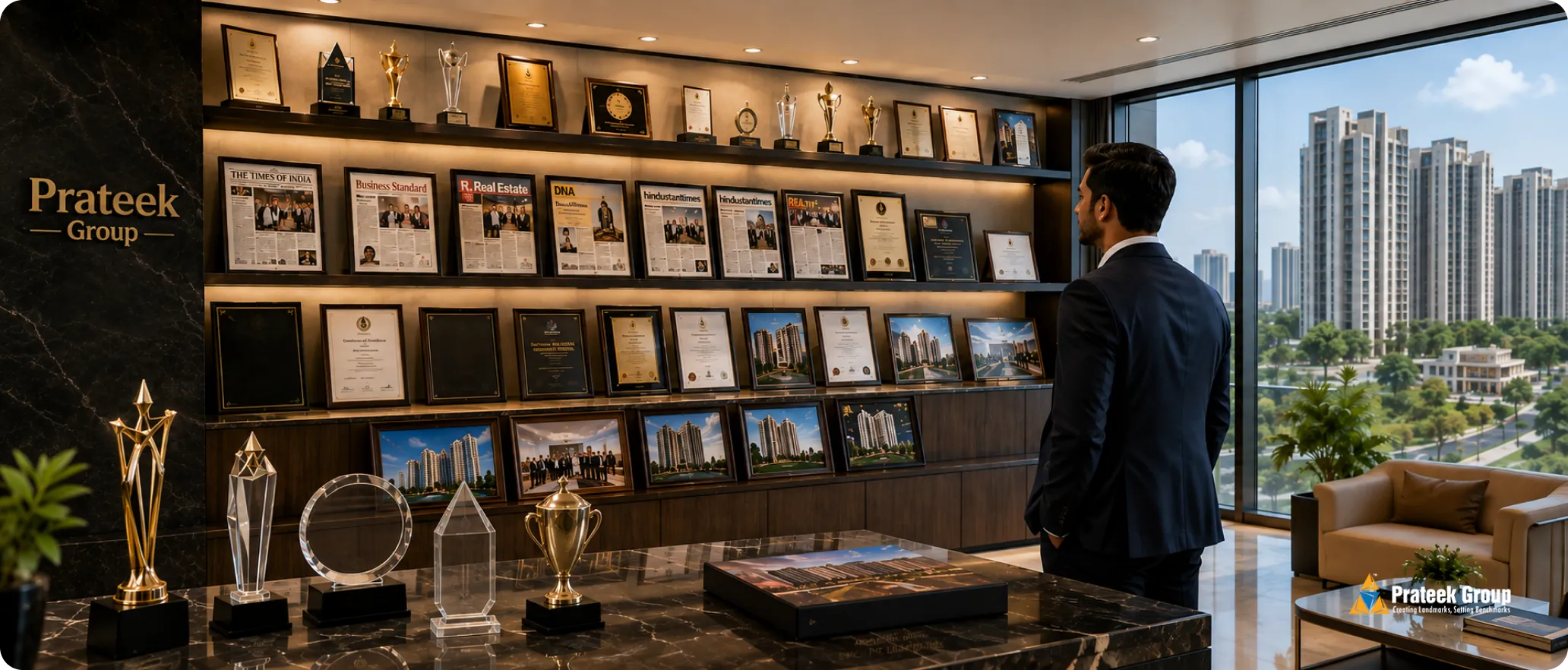
Prateek Group keeps its formal recognitions on a single awards page, and reading it chronologically is close to reading a growth chart.
The earliest major entry is Best Developer in Noida at UPCON 2014. That came nine years after the company was founded, which is quick for a single-founder operation in a market crowded with older names. UPCON was an Uttar Pradesh construction and infrastructure conclave, so the win mattered specifically in the group’s home region rather than as a pan-India claim. It set the pattern for what followed.
A year later came the NDTV Property Awards 2015, one of the more visible consumer-facing property honours of that period. In the same cycle the group picked up Luxury Project of the Year for Prateek Edifice and Affordable Housing of the Year for Prateek Grand City. Those two sitting side by side in one year is the single most useful fact on the awards page, because it shows the group being judged competitive at both ends of the market at the same time. Very few NCR developers of that size were doing that.
The ASSOCHAM recognition belongs in a different category. ASSOCHAM is one of India’s oldest apex trade bodies, so its awards carry weight with banks, institutional investors and government bodies in a way that consumer-facing programmes don’t. The Mail Today Awards, Star Realty Awards and Business Sphere Awards sit in the media-run bracket, built around independent juries but tied to publications.
The Hindustan Times Real Estate Titans award went to Prateek Grand City in the Iconic Premium Township category. That’s a meaningful line, because it recognised a township rather than a tower, and township execution is the harder discipline.
Two more recent entries round out the page. The Young Achiever’s Awards recognises leadership rather than a project. And the National Conclave on Environmental Services and Environmental Musketeers Awards 2025 marks the point where sustainability moved from a talking point in the group’s marketing into something an external body was willing to certify.
Then there’s the honour that arrived in 2026, and it’s a different order of thing entirely.
Forbes India, July 2026
In July 2026, Forbes India named Prateek Group among India’s Most Promising Brands through its Brand Connect showcase. The recognition placed Prateek Group alongside businesses identified for innovation, quality and customer-centric growth.
The announcement went out through ANI on 29 July and was carried by The Tribune and Punjab Kesari, among others. The coverage tied the recognition back to specific execution history rather than to marketing. It pointed to the completed portfolio of Royal Cliff, Fedora, Laurel, Wisteria, Stylome and Edifice, the 40-acre Grand City township, and Canary in Sector 150 as the continuing premium vision.
The reporting also flagged something most award writeups skip. One of the clearest tests of the group’s execution capability came during the COVID-19 period, when construction, supply chains and real estate operations were disrupted across the board. Delivery discipline through that stretch is a large part of why the brand held.
For a regional developer, a Forbes India listing is a different kind of asset from a real estate award. It travels outside the sector. Bankers read it. NRI buyers read it. It’s the recognition that moves the group from “well-known in Noida” toward “known nationally.”
2014 to 2018: the first wave of national attention
The press record starts earlier than most people assume. Print coverage on the company’s media archive goes back to 2011, with Economic Times and Times Property entries in January of that year.
The volume jumps sharply in August 2014, when Prateek Grand City launched. Business Standard, The Economic Times, Hindu Business Line, Dainik Jagran, Amar Ujala, Hindustan and Navbharat Times all ran it within days, and the coverage reached beyond NCR into Allahabad and Agra editions. That’s an unusually wide spread for a township launch, and it reflects the scale of what was announced.
The 2015 to 2018 stretch is dense with Times Property, HT Estates, Mail Today and Times of India features. In September 2015 the Times of India ran a CMD interview across Times Property, which is the first significant instance of Prashant Tiwari being treated as a sector voice rather than a company spokesman.
The most consequential business story of that period ran in August 2018, when PTI reported that Prateek Group had raised ₹275 crore from Piramal Capital and Housing Finance for Grand City. The report noted Piramal had already put ₹200 crore into Prateek Edifice, and that the group was preparing to repay that investment as the project neared completion. Institutional capital arriving during a national residential slowdown, and then being repaid, is a credibility marker that no award confers.
October 2024: the affordable housing story

In October 2024 the group announced Prateek Aurelia, an EWS and LIG housing society in Siddharth Vihar with an investment of ₹125 crore. The coverage pattern here is worth noting, because it ran differently from the luxury launches.
Financial Express and Business Standard carried the business angle. But the story travelled furthest in Hindi, where the price point led. Zee Business, News18 Hindi, ET Now Hindi, Punjab Kesari and Jagran all ran versions built around flats in the ₹5.5 lakh to ₹12.5 lakh band. Jagran’s framing captured it: the dream of an affordable home, with a modern flat available at ₹5.35 lakh.
A developer known mainly for premium housing running a genuine EWS scheme, and getting Hindi mass-market coverage for it, widens the brand in a way that award juries don’t.
January 2025: the launch that changed the coverage scale
Prateek Grand Begonia launched in January 2025 and produced the largest single burst of business coverage in the group’s history.
The Economic Times led with the ₹2,000 crore investment figure. Hindustan Times and Moneycontrol ran the same number. News18 framed it by topline at ₹6,000 crore. Construction Week put it at up to ₹6,000 crore across 2,400 units, and ET Now used ₹5,000 crore.
Different outlets were measuring different things, which is normal. Investment, topline and gross development value are three separate numbers. The point is that a single Ghaziabad launch was being covered simultaneously by ET, HT, Moneycontrol, News18, ET Now and the trade press. By February 2025, TV9 Hindi was running it as a ₹5,000 crore project with 2,400 homes, and Zee Business reported bookings already at 50%.
2026: the year the numbers did the talking
If 2025 was about announcements, 2026 has been about delivery figures. Four separate milestones drove the coverage, and each one landed across a wider set of publications than the last.
Q4 FY26 sales past ₹300 crore. Announced on 10 June through ANI and carried by The Tribune, Punjab Kesari, CNC 24, RealtyNMore and Realty First. The reporting framed it as sustained demand across the residential portfolio and a growing buyer preference for delivery-focused brands.
Grand Begonia crossing ₹1,200 crore. Moneycontrol covered it on 26 June and Financial Express put the detail in the headline: ₹1,200 crore on 600 home bookings. Construction Week India ran it as a sales milestone story, and RealtyNMore, Construction Xperts and Daily Hunt all carried the FY 2025-26 breakdown.
The ₹20 crore Edifice transaction. A single residence at Prateek Edifice sold for ₹20 crore, and Moneycontrol treated it as a market signal rather than a company announcement, framing it as evidence of appetite for ultra-luxury homes in Noida. CNC 24 and Realty & More covered it as a benchmark for the city.
The ₹500 crore high street mall. Announced in early August, this is the group’s clearest move into commercial annuity assets. The 2 lakh sq. ft. project in Siddharth Vihar will follow a 100% lease-based model, with Prateek Group retaining ownership and generating recurring rental revenue. Prashant Tiwari described it as part of a strategy to build a portfolio of income-generating commercial assets bringing shopping, dining, entertainment and community experiences into one ecosystem. Indian Retailing, The Realty Today and Constrofacilitator all covered it, and RealtyNXT pushed it out to its own audience.
August 2026: the Broadway showcase
The most recent story is also the most unusual. In late August the group staged an event in Delhi called “A Stage Called Tomorrow”, marking 20 years and previewing an upcoming Noida Expressway development.
The showcase used storytelling, theatre, dance, music and technology to introduce the project, moving away from the brochure-and-floor-plan format that real estate previews normally follow. Dilip Shankar voiced the city of Delhi as narrator, with Namit Khanna, Damandeep Sidhu, Sukhmani Lamba, Aakash Narula and Charu Shankar carrying different strands of the narrative.
Hindustan Times covered it on 25 August, followed by The Tribune, Business Standard and NewsX. It’s the kind of story that gets picked up because it’s genuinely different, and it earned coverage in outlets that don’t usually run project previews.
Project features: where each name got its own story in 2026
Separate from the milestone announcements, 2026 saw each flagship project earn standalone editorial features in national outlets. That’s a deliberate pattern and it’s worth tracking project by project.
Prateek Canary carried the heaviest load. Hindustan Times ran it in July as the next icon of luxury living in Noida. Mint covered it in June around the connectivity story in Sector 150. DNA framed it as strengthening Sector 150’s standing as a luxury residential destination in NCR. Three national outlets on one project inside two months.
Prateek Grand City got its own run. Republic covered it as the township redefining Ghaziabad’s skyline. Zee News built a piece around the 15-minute living idea, which is a planning concept rather than a sales pitch and gave the project a genuinely different angle. Mid-Day covered the 40-acre township in June.
Prateek Grand Begonia ran across Outlook India as a new chapter in township living, Mint in July, and ABP Live in June as one of Siddharth Vihar’s most anticipated luxury launches.
Prateek Edifice got the retrospective treatment. Mint ran a piece on how the Sector 107 project became one of Noida’s iconic luxury landmarks, which is unusual coverage for a completed project and only happens when a building has held its reputation. Deccan Herald went broader in June with a piece on how the group as a whole shaped the evolution of luxury living in Noida.
That’s four projects, ten national features, one calendar year. For a developer of this size it’s a heavy editorial footprint.
The corridor story: Noida Expressway, Jewar and Siddharth Vihar
A large share of 2026 coverage isn’t about Prateek at all on the surface. It’s about the corridors the group has built in, with Prateek cited as one of the developers defining them. That’s the most useful kind of coverage a developer can get, because it positions the brand as part of the geography rather than as an advertiser in it.
Noida Expressway has been the dominant thread. Business Standard ran the corridor story repeatedly, from the luxury rush in May to luxury projects worth checking later that month, then the Expressway as NCR’s fastest-growing luxury corridor in June, and by August what’s next for the Expressway. Navodaya Times ran the Hindi version tying the corridor to Jewar Airport.
The airport itself became a coverage engine once flights started. Navbharat Times ran a detailed piece in June on what operational flights mean for property rates and which pockets carry the most demand. The Economic Times tied Noida’s luxury demand to the airport in July.
Siddharth Vihar got the same treatment on the Ghaziabad side. ANI and The Tribune ran the infrastructure advantage argument in July. PNI News covered Ghaziabad’s shift from budget homes to premium addresses. Construction Xperts and RealtyNMore both ran the Siddharth Vihar story in May.
Even adjacent infrastructure earned mentions. The ₹900 crore Shahberi double-decker flyover was covered by The Realty Today and RealtyNMore, and the Delhi-Varanasi bullet train corridor by NDTV Hindi.
The 2026 print record
Digital coverage is easy to count. The print record is harder to see and arguably matters more for a homebuyer in Noida or Ghaziabad who still reads a physical paper.
The print archive shows the 2026 rhythm clearly. January opened with Army Day coverage in The Indian Express. February brought a Hindustan Times article. April was the busiest stretch, with The Indian Express, Dainik Jagran and NDTV Hindi on 17 April, Times Property on 18 April, and a four-paper cluster across Amar Ujala, Dainik Jagran, Hindustan and Navbharat Times on 23 April.
May carried Navodaya Times, Dainik Bhaskar and Amar Ujala on 3 May, then Hindustan on 11 May for the Mother’s Day work. June brought Navbharat Times on 6 June, Business Standard on 10 June for the sales milestone, and the six-paper Yoga Day cluster on 22 June. August closed with Hindustan on 5 August, Dainik Bhaskar and Navodaya Times on 16 August, and Times Property on 22 August.
Two things stand out. Hindi dailies carry more of the print load than English ones, which fits the buyer base. And CSR activity generates as much print as commercial news does.
The commentary seat: why journalists keep calling
The awards and milestones are the visible layer. Underneath them sits something more valuable for a brand, which is a standing invitation to comment on the sector.
Through 2026, Prateek Group has appeared as an expert voice in national coverage on questions that have nothing directly to do with its own projects. The Times of India on where homebuyers should file complaints. Business Today on the polarisation between luxury and affordable housing. Zee News on RERA reforms and rental expansion. Outlook Money on where HNIs and NRIs are placing money.
India TV alone has quoted the group across at least six separate 2026 pieces, on value homes, Sports City revival, NCR price growth, the NRI effect, billionaire growth and luxury demand and infrastructure as a valuation driver.
Hindi business media does the same. NDTV Hindi on Ghaziabad’s growth corridors, Navbharat Times on what Jewar Airport flights mean for property rates, Aaj Tak on real estate against gold as an investment.
That commentary position took years to build and it’s the asset that keeps the name in circulation between launches.
Prashant Tiwari as a sector voice
The chairman’s own profile has grown alongside the company’s. In February 2026, Realty & More ran a long interview under the line real estate isn’t about selling flats, it’s about selling dreams. In it he made a claim most developers avoid putting on record: that Prateek doesn’t raise prices artificially, that market demand sets rates, and that a project’s value will have multiplied by the time possession is handed over.
The same piece traced the path from two decades in the Uttar Pradesh Vikas Pradhikaran to founding the company, which is the detail that makes his approvals-side knowledge relevant rather than incidental.
In May 2026, The Interview World ran a separate profile piece on the group reimagining premium urban communities. And in a July advertorial feature carried by The Tribune and ANI, the group set out its own framing. The philosophy is stated as “Creating Landmarks, Setting Benchmarks”, with the portfolio positioned as a reflection of changing homebuyer aspirations.
Aakar Foundation: the CSR record
Prateek Foundation Aakar is the group’s CSR arm, and it earns coverage on its own, which is rare. Most developer CSR gets a company blog post and nothing more.
The Labour Day health camp for over 120 workers in Ghaziabad in May 2026 was picked up by RealtyNMore, Business News This Week, Business News Profit and Daily Pioneer.
The Mother’s Day programme with elderly women at the SHEOWS care centre in Delhi ran even wider: India CSR, Amar Ujala, Hindustan, RealtyNMore, Media Mart India and Smart Business News.
In August 2026, CNC 24 covered the foundation distributing stationery to more than 150 children on Independence Day, and the Noida Independence Day observance was reported by Dainik Bhaskar. World Environment Day activity got a mention in CNC 24’s roundup of developer sustainability work.
Print picked up the June Yoga Day activity across Navbharat Times, Dainik Jagran, Hindustan, Navodaya Times, Punjab Kesari and CSR Today on the same day, which is a genuinely wide spread for a CSR event.
How the coverage is structured
Looking at 20 years of it in one place, the press record sorts into five layers that behave differently and do different jobs.
The first is national business media. Economic Times, Financial Express, Moneycontrol, Business Standard, Business Today, Mint and Outlook Money. This layer covers numbers. It runs when there’s an investment figure, a sales milestone or a transaction that says something about the market. It carries the most weight with lenders, investors and institutional partners, and it’s the hardest to earn because it needs a real number attached.
The second is mainstream national news and broadcast. Hindustan Times, Times of India, India TV, Zee, NDTV, News18, ABP, Republic, Deccan Herald and The Tribune. This layer covers projects and expert commentary. It’s the layer that reaches homebuyers directly and it’s where brand familiarity gets built.
The third is the real estate and construction trade press. RealtyNMore, Realty First, The Realty Today, Construction Week India, Construction World, Construction Xperts, Indian Retailing and RealtyNXT. This layer covers everything, quickly, and in more technical detail than the general press bothers with. It’s read by brokers, channel partners, suppliers and competitors. For a developer, it’s the layer that shapes trade reputation.
The fourth is wire and syndication. ANI is the backbone here, with Business Standard, The Tribune, The Print, Punjab Kesari, Latestly, Daily Hunt, Big News Network and Lokmat Times carrying the feed. One ANI release routinely turns into eight to twelve live URLs inside 48 hours. It’s the layer that produces volume and search visibility.
The fifth is Hindi and regional print. Navbharat Times, Dainik Jagran, Amar Ujala, Hindustan, Dainik Bhaskar, Navodaya Times and Punjab Kesari. This is the layer closest to the actual buyer in Noida and Ghaziabad, and it’s the one most likely to be underweighted when people count coverage by domain authority alone.
Prateek Group is active in all five. Very few NCR developers of comparable size are.
What the record actually shows
Read all of it at once and a pattern emerges that no single award captures.
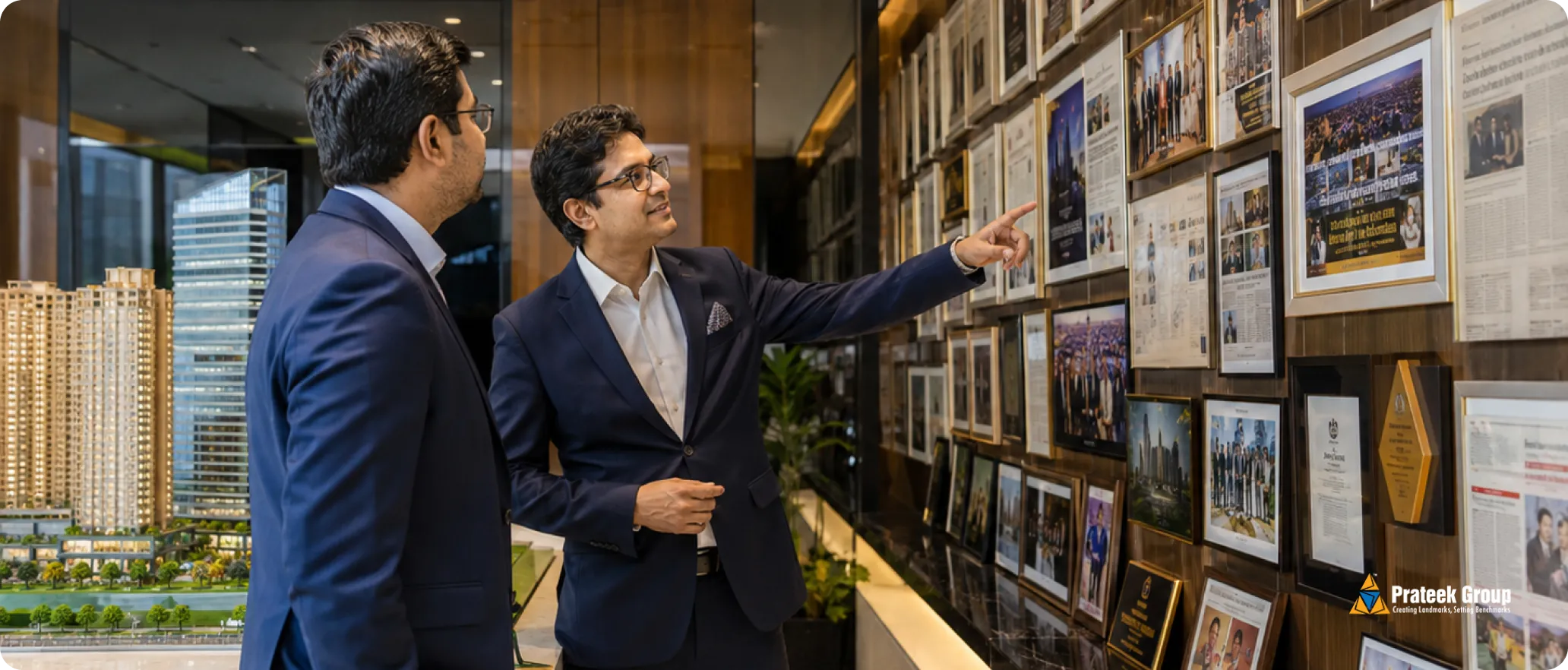
Prateek Group’s press presence isn’t built on one campaign or one trophy. It’s built on showing up repeatedly, across enough different kinds of story, that the name feels familiar to a buyer before they ever walk into a sales office. Awards from UPCON, NDTV, ASSOCHAM and Hindustan Times. Sales numbers in ET, Financial Express and Moneycontrol. Project features in Mint, Deccan Herald, Republic and Outlook. Commentary in Times of India, Business Today and India TV. CSR in India CSR and Amar Ujala. Hindi mass-market coverage in Zee, News18, Aaj Tak and Jagran.
There’s a second pattern worth naming. The group gets covered at both ends of the market simultaneously. A ₹20 crore apartment sale and a ₹5.35 lakh EWS flat generated national coverage within the same 24-month window. That’s a hard position to hold and it’s the clearest signal of what the company has become.
The 2026 additions, Forbes India, the ₹500 crore commercial move, the ₹1,200 crore project milestone and the Broadway showcase, all point the same direction. A regional developer widening into a national brand, and doing it on the strength of delivered numbers rather than announcements.
For anyone tracking the group, the primary sources are worth bookmarking directly: the awards page, the online coverage archive, the print archive with its year-by-year filter, and the press release page.
A note on reading the record
Two caveats are worth stating plainly, because they make the record more useful rather than less.
Some entries on the awards page carry the award name without a public year or ceremony detail. Mail Today Awards, Star Realty Awards, Business Sphere Awards and the Young Achiever’s Awards fall into that group. They’re presented here the way the company presents them, and anyone using them for due diligence should ask for the certificate rather than assume a date.
And a good share of the 2026 online coverage runs through ANI’s press release feed and outlets’ branded content sections, which is normal practice across Indian real estate. That doesn’t make the underlying facts wrong. The ₹1,200 crore sales figure, the ₹20 crore transaction and the ₹500 crore mall commitment were all independently picked up by Moneycontrol, Financial Express, Construction Week India and Indian Retailing in their own reporting. The distinction between placed coverage and earned coverage is worth keeping in view when the record is used as evidence.
What survives both caveats is substantial: an award record spanning 12 years and covering luxury, affordable and township categories, a Forbes India listing in 2026, institutional capital raised and repaid, four separate nine-figure milestones inside one financial year, and a commentary position across the country’s largest business and news desks.
That’s the reputation. It was built one delivered building at a time, and the press record is mostly a receipt for it.
Explore the projects behind the record
The coverage above is about buildings that exist. You can see them here.
Current and upcoming: Prateek Grand Begonia, Prateek Canary in Sector 150, Prateek Grand City at Siddharth Vihar and Prateek Aurelia under the EWS and LIG scheme.
Delivered: Prateek Edifice, Prateek Stylome, Prateek Wisteria, Prateek Laurel, Prateek Fedora and The Royal Cliff.
The full residential portfolio and commercial portfolio are listed on site, alongside the awards page and home buyer testimonials.