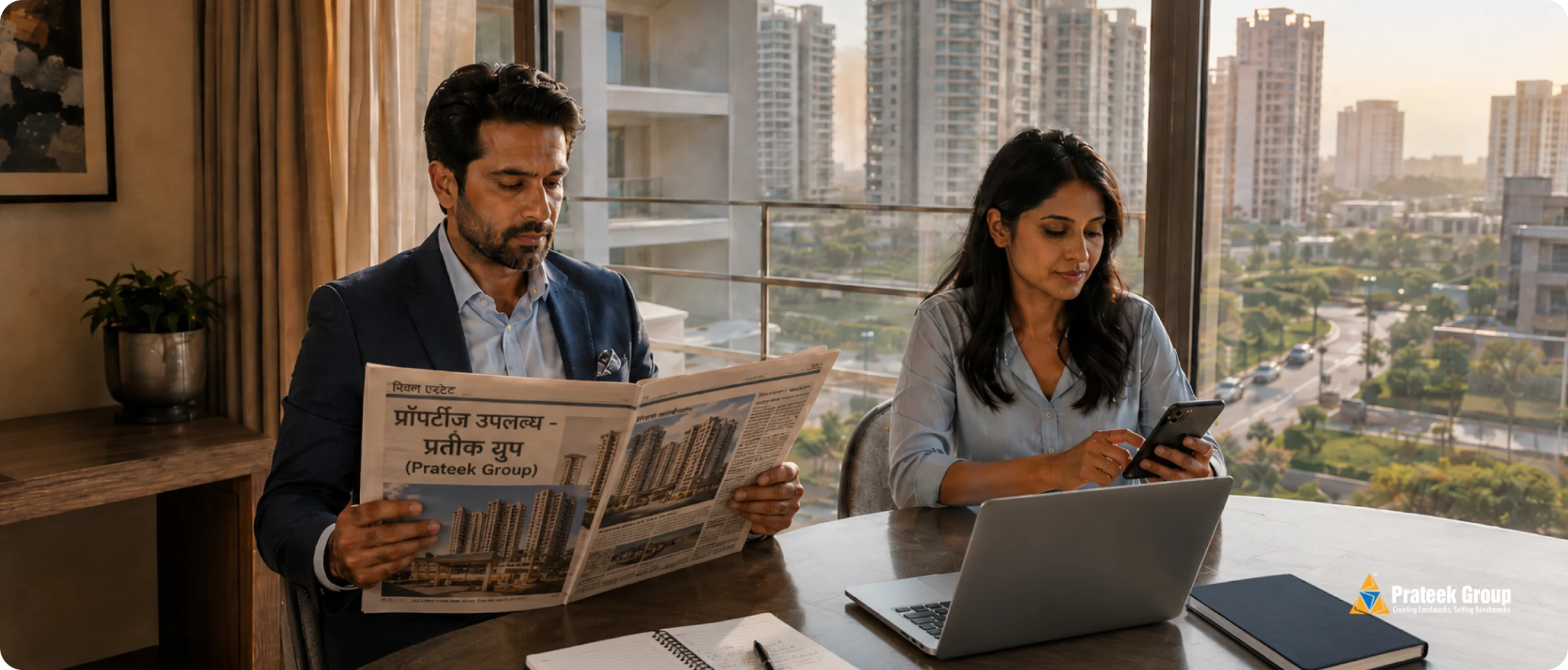
The layer that reaches the actual buyer
A homebuyer in Siddharth Vihar or Sector 150 isn’t reading Moneycontrol. They’re reading Dainik Jagran over breakfast, or catching a Navbharat Times piece on their phone, or seeing an Amar Ujala photo of a health camp in their own neighbourhood.
This is the fifth and final piece in a five-part series on Prateek Group’s 2026 press record, and it covers the layer that gets counted last and matters most locally: wire services and syndication, Hindi and regional dailies, and the CSR coverage the Aakar Foundation earned on its own merits.
ANI and the syndication engine
Almost every major Prateek announcement in 2026 went out through ANI, and each one turned into a spread of live URLs within 48 hours.
The Q4 FY26 sales release on 10 June went to Business Standard, The Tribune, Punjab Kesari English and CNC 24 the same day.
The Forbes India recognition on 29 July ran even wider, reaching The Tribune, Punjab Kesari and Calcutta News, among others.
The two-decade brand story on 21 July, carrying the “Creating Landmarks, Setting Benchmarks” framing, ran through ANI and The Tribune.
ANI also carried the corridor pieces: the luxury rush on Noida Expressway on 5 May, luxury projects on the Expressway on 21 May, and the Ghaziabad infrastructure advantage on 9 July.
Alongside ANI, a set of business syndication sites carried the group’s market pieces repeatedly. PNI News ran the new luxury belt of NCR piece and the evolution of luxury housing in Noida and Ghaziabad on 22 June, then Ghaziabad’s real estate makeover on 20 July. Business News This Week and Global Biz News Room carried the same package.
Daily Hunt carried the Grand Begonia ₹1,200 crore milestone on 19 June, and again for the Labour Day CSR story in May.
One release routinely producing eight to twelve live URLs is what gives the group its search footprint. It’s also the part of the record most likely to be over-counted, so it’s worth reading alongside the independently reported stories in Moneycontrol, Financial Express and Construction Week India rather than instead of them.
CNC 24: the local business channel
CNC 24 covered Prateek four separate times in 2026 and deserves its own note, because it sits between trade and local news.
It ran the Q4 FY26 sales figure on 9 June, the ₹20 crore Edifice transaction on 10 July, the Aakar Foundation Independence Day stationery distribution to over 150 children on 17 August, and the ₹500 crore mall announcement on 18 August, the group’s biggest addition to its commercial portfolio.
It also ran a sector piece in June on how realty developers turned World Environment Day into year-round sustainability work, with Prateek among the developers cited.
The Hindi press: where the buyers are
The Hindi coverage in 2026 was heavier than the English coverage in print, and it moved on completely different hooks.
Navbharat Times ran the biggest one in June, asking whether property prices across NCR would rise again now that flights from Jewar are operational, and mapping which zones carry the most demand. That’s the highest-intent property question in the region this year.
News18 Hindi reported in July that Noida and Greater Noida luxury home prices had risen up to 28%, pulling ahead of Mumbai and Gurugram. NDTV Hindi ran the Ghaziabad 2.0 mapping piece in May covering Raj Nagar Extension, Siddharth Vihar, Vaishali and the airport corridor, then followed in June with the Delhi to Varanasi bullet train corridor and its investment implications across Uttar Pradesh.
Aaj Tak ran a May piece weighing real estate against gold as an investment channel. Navodaya Times covered Noida Expressway becoming the new luxury housing hub on 7 May.
Dainik Bhaskar covered Noida’s Independence Day observance in August, and Amar Ujala and Hindustan both ran the Mother’s Day work with elderly women in May.
The 2026 print record
The print archive shows the year’s physical newspaper footprint, and Hindi dailies carry most of it.
January opened with Army Day coverage in The Indian Express on 15 January. Hindustan Times followed on 23 February. April was the busiest month: The Indian Express, Dainik Jagran and NDTV Hindi on 17 April, Times Property on 18 April, then a four-paper cluster across Amar Ujala, Dainik Jagran, Hindustan and Navbharat Times on 23 April.
May brought Navodaya Times, Dainik Bhaskar and Amar Ujala on 3 May, then Hindustan on 11 May. June carried Navbharat Times on 6 June and Business Standard on 10 June for the sales milestone.
The standout is 22 June, when the Yoga Day activity ran simultaneously in Navbharat Times, Dainik Jagran, Hindustan, Navodaya Times, Punjab Kesari and CSR Today. Six papers on one CSR event is a strong result.
August closed with Hindustan on 5 August, Dainik Bhaskar and Navodaya Times on 16 August, and Times of India’s Times Property on 22 August.
Aakar Foundation: CSR that earns its own coverage
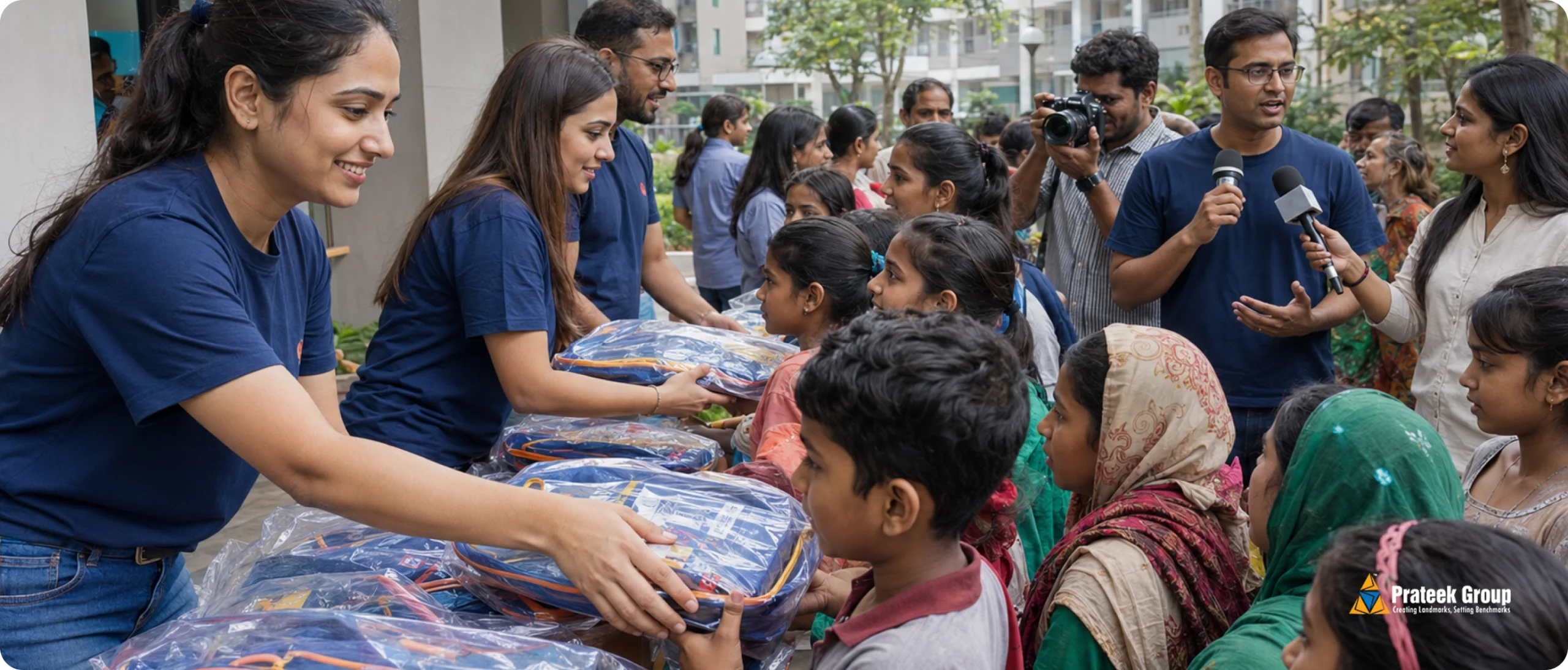
Most developer CSR gets a company post and nothing else. Prateek Foundation Aakar generated genuine third-party coverage three times in 2026, which is rare enough to be worth spelling out.
Labour Day, May. A health camp for more than 120 workers in Ghaziabad. Covered by RealtyNMore, Business News This Week, Business News Profit, Daily Pioneer and Daily Hunt. The Daily Pioneer framing was the sharpest, running it as a piece on how realty developers marked Labour Day with on-ground health interventions.
Mother’s Day, May. A celebration with elderly women at the SHEOWS care centre in Delhi. This one travelled furthest: India CSR, Amar Ujala, Hindustan, RealtyNMore, Media Mart India, Smart Business News and Business News This Week.
Getting into India CSR specifically matters, because that publication is read by CSR heads and foundation teams rather than by property buyers. It’s a credibility signal in a completely separate ecosystem.
Independence Day, August. Stationery distributed to more than 150 children, covered by CNC 24.
Add the June Yoga Day print cluster and the World Environment Day mention, and the foundation generated coverage in five separate months of 2026. The full programme is documented under CSR activities.
Why the Hindi hooks are different
Something worth noticing about the Hindi coverage is that it almost never leads with a project. It leads with a question the reader already has.
Will Jewar flights push prices up, and where? Have Noida prices really passed Mumbai and Gurugram? Which Ghaziabad pockets will grow next? Is property still better than gold? Where will the bullet train corridor create opportunity?
Those are search-intent questions, and the developer quote sits inside the answer rather than at the top of a promotional piece. That placement is far more persuasive than a project feature, because the reader arrived looking for information rather than for a home.
The English-language coverage tends to run the opposite way, leading with the project or the milestone and adding market context afterwards. Both approaches work, and running both is what gives the group coverage at two very different points in a buyer’s journey.
The regional and local reporting
Beyond the national Hindi outlets, the group’s activity gets covered by regional and local press that rarely shows up in any media report.
Navodaya Times, Punjab Kesari, Desh Bandhu and Dainik Bhaskar’s Noida edition all ran Prateek stories in 2026. So did local business channels like CNC 24. Historically the reach has gone further, with the 2014 Grand City launch picked up in Allahabad and Agra editions of Amar Ujala, Dainik Aaj, Samachar Dhara and Samachar Jyoti.
That regional footprint matters more than it looks. A meaningful share of NCR homebuyers are first-generation migrants from elsewhere in Uttar Pradesh, and family opinion in the home town often shapes a purchase decision made in Noida.
Reading the record honestly
One caveat belongs in any assessment of this layer.
A large part of the 2026 online volume runs through ANI’s press release feed and branded content sections rather than through independent newsroom reporting. That’s standard practice across Indian real estate and it doesn’t make the underlying facts wrong. It does mean the raw URL count overstates the editorial weight.
The way to read it properly is to separate the two. The ₹1,200 crore milestone, the ₹20 crore transaction and the ₹500 crore mall commitment were all independently picked up by Moneycontrol, Financial Express, Construction Week India and Indian Retailing in their own reporting. That’s the evidence layer. The syndication network around it is the amplification layer.
Both are real. Counting them separately gives a more useful picture than counting them together.
What this layer tells you
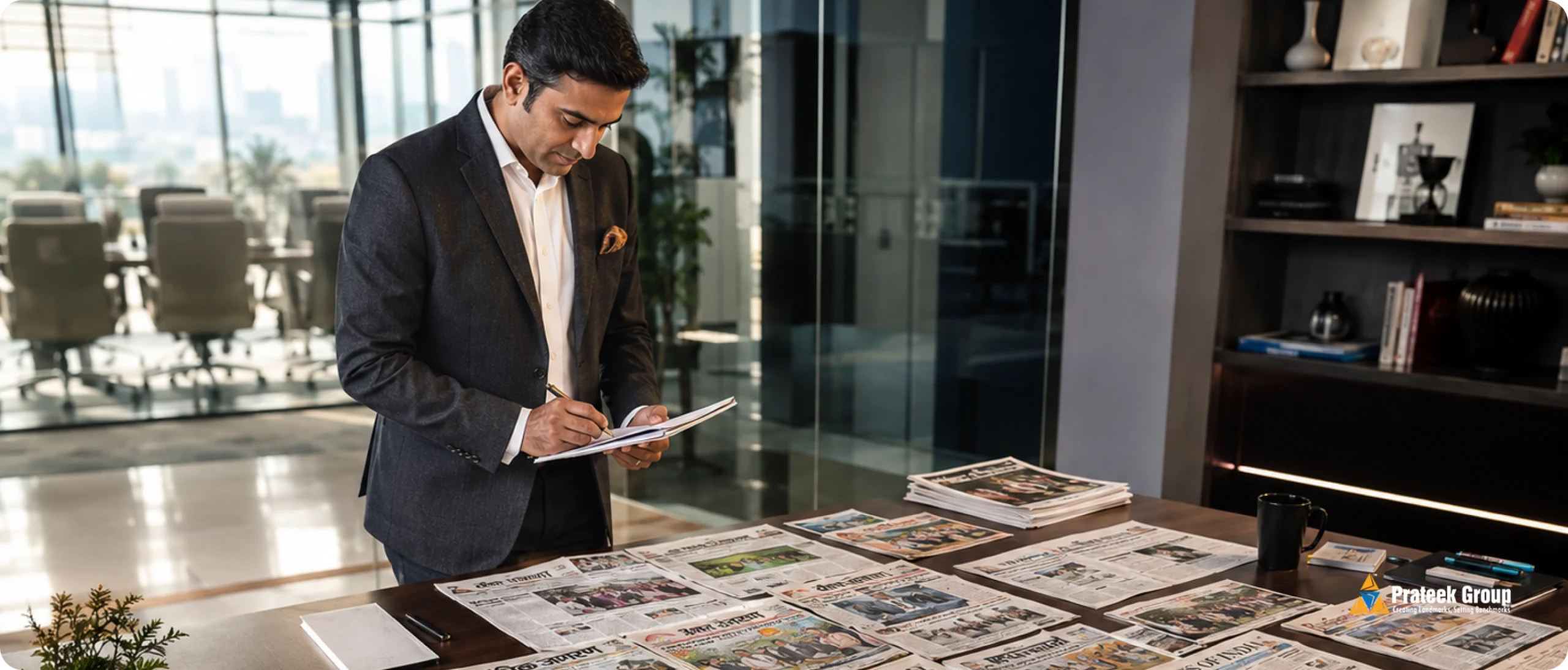
Three observations from reading the ground-level record.
Hindi outperforms English in reach for this brand. More print placements, higher-intent topics, and closer to the actual catchment. Anyone assessing Prateek’s press by English-language domain authority alone is measuring the wrong thing.
CSR isn’t decorative here. It generated more distinct print placements in 2026 than any single commercial announcement did. The Yoga Day cluster alone hit six papers on one day. That builds local goodwill in Noida and Ghaziabad in a way a sales milestone doesn’t.
Syndication provides volume, independent reporting provides proof. Both are real, and they do different jobs. The ANI network gives the group reach and search presence. The Moneycontrol, Financial Express, Construction Week India and Indian Retailing pieces give it evidence. A serious read of the record uses both, and doesn’t mistake one for the other.
Taken with the business press, the national news layer and the trade press covered earlier in this series, 2026 gave Prateek Group its widest press year to date: four financial milestones, a Forbes India listing, a move into commercial annuity assets, a first-of-its-kind brand showcase, and a CSR programme that stood on its own across five months.
For the full primary record, the group maintains its online coverage archive, a year-filterable print archive, a press release page and an awards page.
The CSR record and the wider archive
Aakar Foundation’s programme is documented under CSR initiative and CSR activities.
The complete media record sits across four archives: print coverage, press releases, online coverage and TV coverage, with company announcements under news and alerts and events.
To see the projects behind it all, start with the residential portfolio or get in touch.