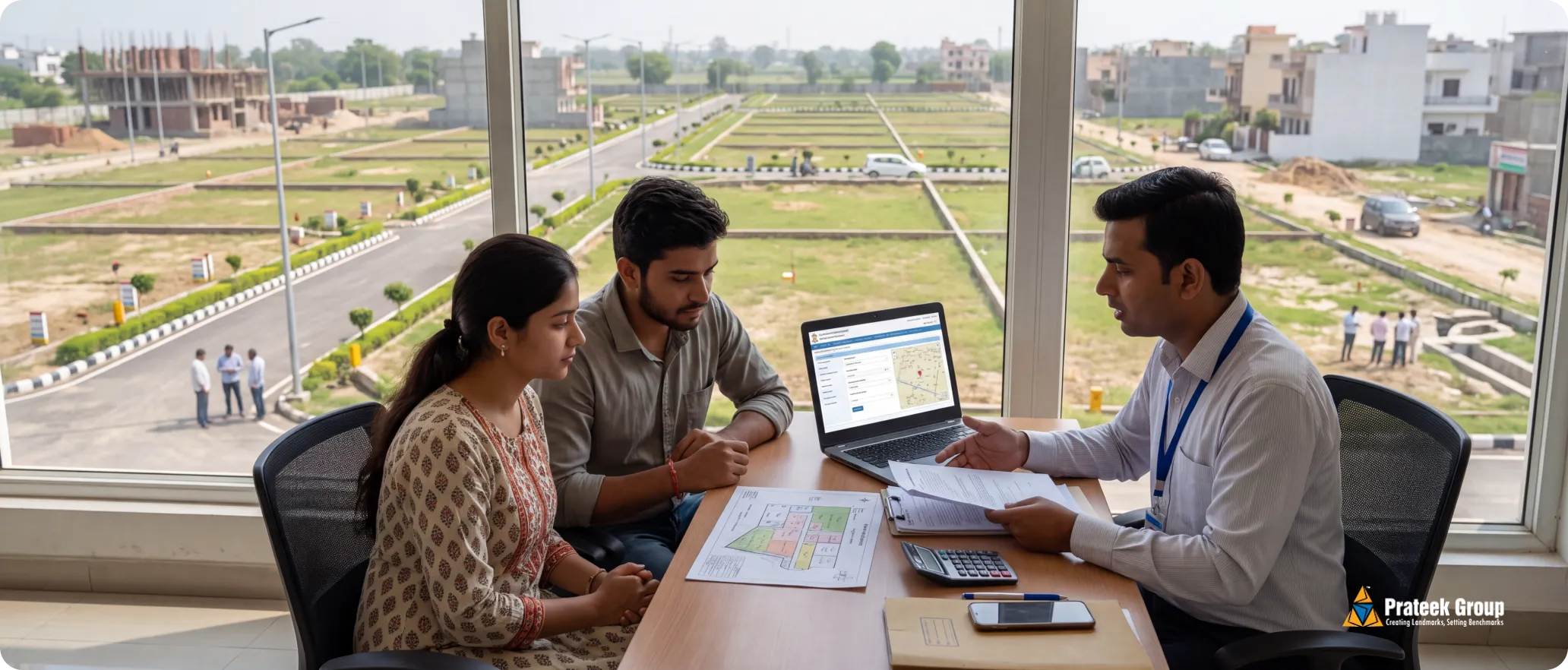
The Madhuban Bapudham plot scheme 2026 drew more attention than any Ghaziabad Development Authority housing scheme in years. It offered 350 freehold residential plots at a fixed rate near the Duhai rapid rail station, and the response far outstripped the number of plots. The e-lottery was held on 19 and 20 August 2026, and allottees are now moving through payments and paperwork.
This guide covers what the scheme offered, how the draw worked, what happens next for successful and unsuccessful applicants, and how to check GDA property details online. It also explains what the Ghaziabad Development Authority does, how it differs from the Nagar Nigam and the Awas Vikas Parishad, and what to consider if you missed out this time.
Madhuban Bapudham plot scheme 2026: the key facts
Detail | What was offered |
Scheme name | Madhuban Bapudham Residential Plot Scheme, under the Apni Zameen Apna Aasman initiative |
Authority | Ghaziabad Development Authority |
Scheme code | 935 |
Total plots | 350 freehold residential plots |
Plot sizes | 40, 60, 90, 112.5, 115, 120, 150 and 200 sq m |
Rate | ₹35,000 per sq m, the same across categories |
Starting price | About ₹14 lakh for a 40 sq m plot |
Registration | Opened 11 May 2026, extended to 4 June 2026 |
Registration fee | ₹1,100 including GST |
Earnest deposit | 10% for general and OBC applicants, 5% for SC and ST applicants |
Allotment | Computerised e-lottery |
Draw dates | 19 and 20 August 2026, at Hindi Bhawan, Lohia Nagar, with live streaming |
Lump-sum discount | Up to 6% for full early payment, as reported |
Location advantage | About 1.5 km from the Duhai rapid rail station |
*Details are as reported in published coverage of the scheme. Check the official GDA brochure for the terms that apply to your application.*
Why the scheme drew so much interest
The Madhuban Bapudham plot scheme stood out for a few reasons, and price came first. At ₹35,000 per sq m, a 40 sq m plot cost about ₹14 lakh and a 60 sq m plot about ₹21 lakh, which put land ownership within reach of families who couldn’t consider a flat in most of the NCR.
Ownership mattered too. The plots were offered freehold, so allottees own the land outright rather than holding it on a lease, which simplifies future sale and inheritance.
Then there was location. Madhuban Bapudham sits near the Duhai station on the Delhi-Ghaziabad-Meerut rapid rail corridor, which was completed in February 2026 and now carries more than 125,000 passengers a day. A plot within reach of a fast rail link to Delhi and Meerut is rare at that price.
Published reports put the number of applications anywhere from over 9,000 to more than 42,500, depending on the stage at which they were counted. Either way, applicants far outnumbered the 350 plots, which is why GDA chose to live-stream the draw rather than ask people to attend.
Plot sizes and prices by category
At a flat rate of ₹35,000 per sq m, the price of each category follows directly from its size. Here’s what each plot works out to, with the approximate size in sq ft for comparison with flats.
Category | Plot size | Approximate size in sq ft | Plot price at ₹35,000 per sq m |
A | 200 sq m | About 2,153 sq ft | ₹70 lakh |
B | 150 sq m | About 1,615 sq ft | ₹52.5 lakh |
C | 120 sq m | About 1,292 sq ft | ₹42 lakh |
D | 115 sq m | About 1,238 sq ft | ₹40.25 lakh |
E | 112.5 sq m | About 1,211 sq ft | ₹39.38 lakh |
F | 90 sq m | About 969 sq ft | ₹31.5 lakh |
G | 60 sq m | About 646 sq ft | ₹21 lakh |
H | 40 sq m | About 431 sq ft | ₹14 lakh |
*Prices are simple arithmetic on the published rate and exclude stamp duty, registration and any other charges in the brochure.*
Plot area isn’t the same as the home you can build. Building rules limit how much of the plot you can cover and how many floors you can add. A 60 sq m plot, for example, may allow a home with a total built area larger than the plot itself once you add a first floor, but the exact limits come from GDA’s building bye-laws for the scheme.
How the e-lottery worked
After registration closed, GDA verified documents and published lists of qualified and disqualified applicants. The computerised e-lottery then ran over 2 days. Categories A to D, covering the 200, 150, 120 and 115 sq m plots, were drawn on 19 August. Categories E to H, covering the 112.5, 90, 60 and 40 sq m plots, were drawn on 20 August. Results for each category were published on GDA’s official portal.
A computerised draw removes any advantage from applying early or knowing someone, and the live stream let applicants watch the process for themselves. Every qualified applicant in a category had the same chance. GDA also warned applicants against middlemen claiming they could influence the result, which is a warning worth repeating: nobody can.
What happens next if you were allotted a plot
If you were successful, the next few months matter. The broad sequence is as follows, but the exact timelines and amounts are set out in your allotment letter.
- Download your allotment letter. GDA issues it digitally, and the digitally signed letter is valid without a separate hard copy.
- Check every detail. Confirm your name, category, plot size and the payment schedule. Report any error straight away.
- Pay on time. The allotment letter sets deadlines for the next instalments or the full payment. Missing a deadline can mean interest or cancellation.
- Consider the lump-sum discount. Reports noted a discount of up to 6% for paying in full early. Compare that with your cost of borrowing before deciding.
- Arrange any loan early. Banks lend against allotted plots from public bodies, but approval takes time.
- Register the lease or sale deed. Once payment is complete, GDA executes the deed and you register it at the sub-registrar’s office, paying stamp duty and registration fees.
- Plan construction. Before you build, you’ll need building plan approval under GDA’s rules, including limits on coverage and height.
Budget for stamp duty and registration on top of the plot price. In Uttar Pradesh, stamp duty is 7% for a male buyer, with a 1% concession for women on property worth up to ₹1 crore, and registration is 1%. Our guide to stamp duty and registration charges in Noida and Ghaziabad explains the calculation.
What it costs to build on a plot
The plot price is only the start. Building a home on it is often the bigger cost, and many allottees underestimate it.
Industry estimates for home construction in the NCR in 2026 run from roughly ₹1,900 per sq ft for basic construction to ₹4,500 or more for premium finishes, before architect fees, approvals and utility connections. The quality of materials, the design and labour costs drive most of the difference.
Here’s an illustration for a 60 sq m plot with a ground and first floor, assuming a total built area of about 1,000 sq ft. These are estimates, not quotes.
Construction standard | Rough cost per sq ft | Rough cost for 1,000 sq ft |
Basic | About ₹1,900 to ₹2,400 | About ₹19 lakh to ₹24 lakh |
Standard | About ₹2,500 to ₹3,200 | About ₹25 lakh to ₹32 lakh |
Premium | About ₹3,200 to ₹4,500 | About ₹32 lakh to ₹45 lakh |
Add the plot price, stamp duty and registration, and a family that paid ₹21 lakh for a 60 sq m plot might need ₹45 lakh to ₹70 lakh in total to move into a finished home. That’s still competitive with a flat of similar size in many parts of the NCR, but it’s a very different budget from the headline plot price.
Financing a plot and construction
Buying a plot and building on it is financed differently from buying a flat. Banks offer plot loans for the land alone and composite loans that cover both the plot and construction. A composite loan releases money in stages as construction progresses.
The tax treatment differs too. Interest and principal on a loan for a plot alone generally don’t qualify for the home loan tax benefits available on a house. With a composite loan, the benefits usually apply once construction is complete and you have a house. Speak to your bank and a tax adviser about which option suits your plans.
Whichever loan you choose, get approval before your payment deadlines under the allotment letter, so a slow sanction doesn’t put your allotment at risk.
From draw to moving in: a realistic timeline
For an allottee who builds soon after allotment, the journey usually looks something like this:
- Months 1 to 3: allotment letter, payment of instalments or the full amount, loan approval.
- Months 3 to 6: execution and registration of the deed, possession of the plot.
- Months 6 to 9: architect’s design, building plan approval from GDA, utility applications.
- Months 9 to 21: construction of the home.
- After that: completion, utility connections and moving in.
Timelines vary with payment choices, approvals and construction pace, but it’s sensible to plan for 18 months to 2 years from the draw to a finished home.
What happens if you weren’t selected
If you weren’t allotted a plot, your registration money and earnest deposit should be refunded to the bank account you gave in your application. Reported refund timelines range from about 30 to 90 days after the draw. If your refund hasn’t arrived within the period stated in the scheme brochure, contact GDA with your application number.
Missing out on a lottery is disappointing, but it isn’t the only route to a home in Ghaziabad. The sections below cover other GDA and public schemes, and the private market options worth comparing.
Rules worth knowing before the next scheme
Public plot schemes come with conditions that don’t apply in the private market. Reports on the 2026 scheme highlighted a few that are likely to appear again.
- Income limits for smaller plots. The smallest categories, such as 40 and 60 sq m, are generally meant for lower-income families and may carry income limits. Reports on this scheme cited annual income bands for those categories.
- Joint applications by married couples. Reports noted specific rules for married applicants, including joint registry in the names of both spouses where they applied together.
- 1 application per family. Public schemes usually limit applications to prevent the same family entering several times.
- Restrictions on resale. Allotted plots can come with a lock-in or conditions on transfer. Read these before you apply if you might need to sell.
- Construction timelines. Some schemes require you to build within a set period after possession.
Always read the official brochure for the scheme you’re applying to. Secondary summaries, including this guide, can miss details that affect your eligibility.
What the Ghaziabad Development Authority does
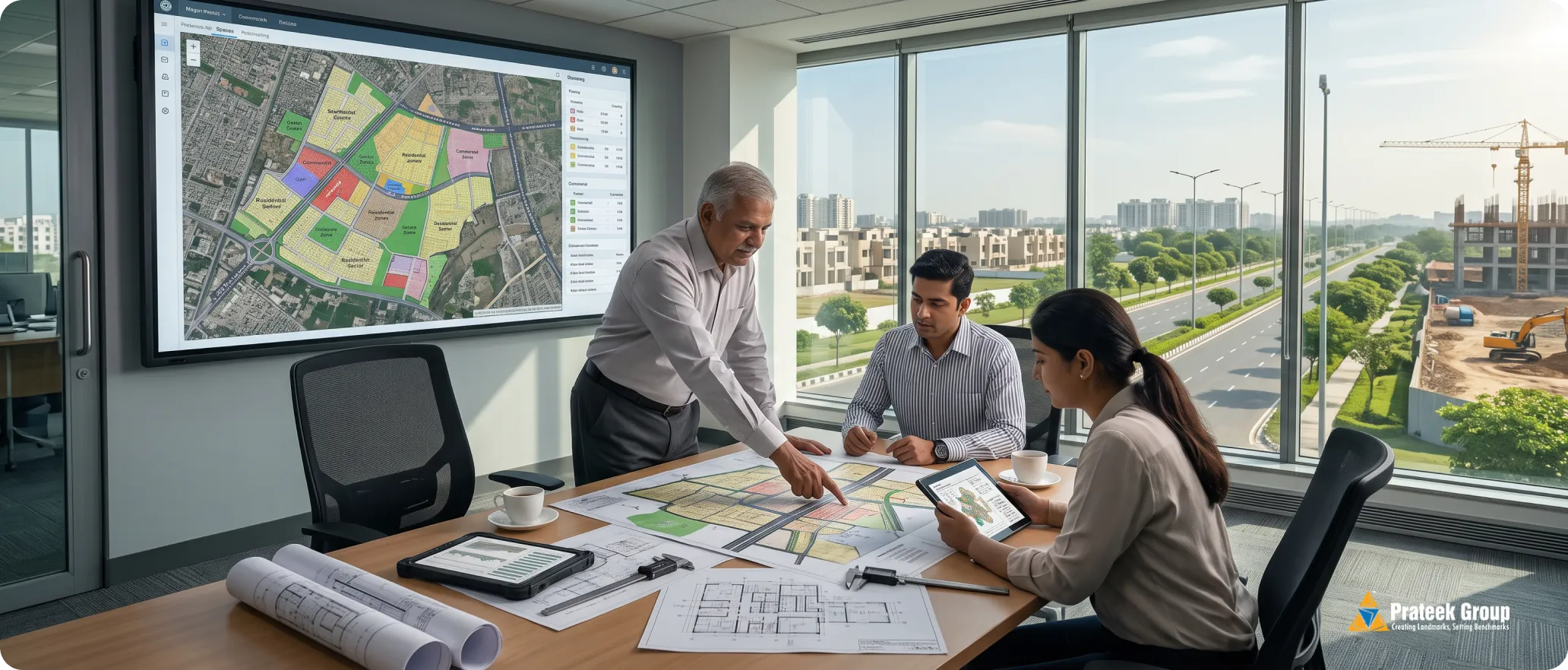
The Ghaziabad Development Authority, or GDA, is the city’s planning and development body. It prepares Ghaziabad’s master plan, approves building plans and layouts, develops land and housing schemes, and allots plots and flats through schemes like Madhuban Bapudham. It has developed housing in the city since the late 1960s, and its master plan has shaped how areas such as Indirapuram and Vaishali grew.
Ghaziabad authority: who does what
People searching for “Ghaziabad authority” are often trying to work out which body handles their issue. Ghaziabad has several, and they do different jobs.
Body | What it handles | When you’d deal with it |
Ghaziabad Development Authority | Master plan, building plan approval, land development, GDA housing and plot schemes | Applying for a GDA scheme, getting a building plan approved, checking land use |
Ghaziabad Nagar Nigam | House tax, civic services, sanitation, local roads within its limits | Paying house tax, mutation, civic complaints |
UP Awas Vikas Parishad | State housing board schemes, including the Siddharth Vihar Yojana | Applying for a Parishad scheme or plot |
Sub-registrar’s office | Registering sale deeds and other documents | Registering a purchase or transfer |
UP RERA | Registration and regulation of real estate projects | Checking a project, filing a complaint |
Knowing which body to approach saves a lot of time. A house tax question goes to the Nagar Nigam, not GDA. A building plan goes to GDA, not the Nagar Nigam.
How to check GDA property details online
GDA property details online can mean several different things, so start by deciding what you need.
For scheme applications and results
GDA publishes scheme notices, brochures, applicant lists and draw results on its official website, gdaghaziabad.in. Applications for recent schemes, including Madhuban Bapudham, were made through the Janhit UPDA portal, which handles online applications for development authorities in Uttar Pradesh. Log in with the details you used to apply to see your application status and documents.
For an allotted property
If you’ve been allotted a GDA plot or flat, your allotment letter, payment schedule and payment receipts are available through the portal you applied on. Keep a copy of each document offline as well.
For a resale property that was originally GDA-allotted
If you’re buying a resale plot or flat that GDA originally allotted, ask the seller for the original allotment letter, the lease or sale deed and GDA’s no-dues or transfer documents. GDA can confirm whether any dues are pending and whether the property has been transferred correctly. Registered deeds for the property can also be searched through the state’s registration portal.
For a private project
For a private project in Ghaziabad, check its registration and filings on the UP RERA portal. GDA approves building plans for private projects, but RERA is where you’ll find the project’s registration, completion date and progress reports.
Other GDA and public schemes in 2026
Madhuban Bapudham wasn’t the only public housing opportunity in Ghaziabad in 2026. Several other schemes gave buyers options.
GDA launched a residential plot scheme in Nandgram, near Raj Nagar Extension, early in 2026, offering 77 plots of about 60 to 221 sq m, which reports described as GDA’s first major plot scheme in about 14 years. In Madhuban Bapudham itself, GDA has also offered 2 BHK flats, which Outlook Money reported at about ₹3,700 per sq ft near the rapid rail corridor, along with auctions of commercial plots.
The UP Awas Vikas Parishad separately offered 157 freehold plots in Sector 10 of its Siddharth Vihar Yojana in March 2026, allotted by lottery. For a wider view of GDA schemes, see our guide to GDA housing schemes and property investment in 2026.
Madhuban Bapudham as a location
Madhuban Bapudham is a large GDA township on the northern side of Ghaziabad, near the Delhi-Meerut Expressway and the Duhai end of the rapid rail corridor. It was planned years ago but was slow to fill, partly because connectivity and utilities took time to arrive. That’s now changing. The rapid rail line, the Expressway and GDA’s continuing work on roads, drains, sewer and water lines in the township’s pockets have made it far more practical to live in.
Ghaziabad’s Master Plan 2031 also marks a special development area around the Duhai rapid rail depot and transit-oriented zones along the corridor, where more intensive, mixed-use development is allowed. Over time, that should bring more services and jobs within reach of Madhuban Bapudham. Our guide to property along the rapid rail corridor looks at how the line is changing the areas around its stations.
Living in Madhuban Bapudham today
For allottees, the practical question is what daily life in Madhuban Bapudham will be like. The township is still filling in. Some pockets have roads, drainage, water and sewer lines in place, while others are still being developed. GDA has continued to tender works for the remaining roads, drains, sewer and water lines in the township’s pockets in 2026.
That means early residents should expect some construction around them for a few years, and shops, schools and clinics that follow the population rather than lead it. On the other hand, the rapid rail station, the Expressway and the relatively low price of land give Madhuban Bapudham a strong base, and townships in this position tend to become much more liveable as families move in. If you’re allotted a plot, visit it, see which services are already running nearby and plan your construction timing around the state of your pocket.
How to prepare for the next GDA scheme
Public schemes often open for a few weeks at most, and the paperwork trips up many applicants. If you plan to apply next time, get these ready now:
- Identity and address proof for every applicant, with names matching exactly across documents.
- PAN card for each applicant.
- Income proof, such as salary slips, income tax returns or an income certificate, especially if you’re applying in a category with income limits.
- Category certificates, if you’re applying under a reserved category.
- Marriage certificate or joint documents, if you’re applying as a couple.
- A bank account in the applicant’s name for the deposit and any refund.
- Funds for the earnest deposit, which was 10% of the plot value for general applicants in 2026.
Keep scanned copies ready in the formats the portal accepts. When the next scheme opens, you’ll be able to apply in the first days rather than rushing near the deadline.
Plot or flat: which suits you?
The heavy demand for Madhuban Bapudham plots reflects a real appetite for land ownership. Still, a plot isn’t the right choice for everyone.
A plot gives you freehold land, control over the design of your home and no society maintenance charge. You’ll also have to fund and manage construction, which can take a year or more and adds a significant cost on top of the plot price, and you’ll handle your own security, power backup and water.
A flat in a completed society is ready to move into, comes with security, backup and shared facilities, and is easier to rent or sell. You pay a monthly maintenance charge and share decisions with the residents’ association.
If you want to build your own home and are ready for the time and effort, a plot scheme is worth trying for. If you need to move soon or want a home that’s easy to manage, a flat in a well-run society may suit you better. Prateek’s overview of property in Ghaziabad covers the flat options across the city.
If you missed out: your options now
- Watch for the next scheme. GDA and the Awas Vikas Parishad announce schemes on their websites and in newspapers. Keep your documents ready so you can apply quickly.
- Look at resale plots carefully. Resale plots in established GDA areas come up on the market. Check the original allotment, transfer conditions and dues before paying anything.
- Consider a flat. A completed flat in a well-run society may meet your needs sooner than waiting for another lottery.
- Compare nearby areas. Raj Nagar Extension, Siddharth Vihar and the NH-9 corridor each offer different price points and connectivity.
Whatever you choose, use our list of documents you must verify before paying a token amount as your checklist.
Is a public plot a good investment?
Many applicants saw the Madhuban Bapudham plot scheme 2026 as an investment as well as a future home. There’s a reasonable case for that: public plots are often priced below the private market, the land is freehold, and the rapid rail station nearby gives the township a clear long-term draw.
There are limits, though. Allotted plots can carry conditions on resale or construction deadlines, which reduce flexibility. A vacant plot earns no rent until you build, and you’ll still need to budget for its upkeep and any municipal charges in the meantime. And growth depends on the township filling in, which takes time. If your main aim is rental income soon, a completed flat usually works better. If you’re buying land for your own future home and can wait, a well-located public plot can be a sound choice.
Common mistakes with public housing schemes
- Relying on agents who promise allotment. Draws are computerised. Nobody can guarantee a result.
- Missing payment deadlines after allotment. Late payment can mean interest or cancellation.
- Not reading the transfer conditions. Some allotments restrict resale for a period.
- Underestimating construction costs. Building a home on a plot adds a large cost on top of the plot price.
- Ignoring stamp duty and registration. These add about 8% to the cost of a plot.
Frequently asked questions
What was the Madhuban Bapudham plot scheme 2026?
The Madhuban Bapudham plot scheme 2026 was a Ghaziabad Development Authority scheme offering 350 freehold residential plots of 40 to 200 sq m at ₹35,000 per sq m, starting at about ₹14 lakh. It ran under the Apni Zameen Apna Aasman initiative, with registration from 11 May to 4 June 2026 and allotment by e-lottery on 19 and 20 August 2026.
When was the Madhuban Bapudham e-lottery held?
The Madhuban Bapudham e-lottery was held on 19 and 20 August 2026 at Hindi Bhawan, Lohia Nagar, Ghaziabad, with live streaming for applicants. Categories A to D, covering 200, 150, 120 and 115 sq m plots, were drawn on 19 August, and categories E to H, covering 112.5, 90, 60 and 40 sq m plots, on 20 August.
How many people applied for the Madhuban Bapudham plots?
Reports put applications for the Madhuban Bapudham plot scheme 2026 anywhere from over 9,000 to more than 42,500, depending on the stage at which they were counted. Either way, applicants far outnumbered the 350 plots available, which is why the Ghaziabad Development Authority live-streamed the e-lottery rather than asking people to attend.
What should I do if I was allotted a Madhuban Bapudham plot?
If you were allotted a Madhuban Bapudham plot, download your digitally signed allotment letter, check every detail and pay each instalment by the deadline. Consider the reported lump-sum discount of up to 6%, arrange any loan early and budget for stamp duty and registration. Before building, get your plan approved by the Ghaziabad Development Authority.
How do I get a refund if I wasn’t selected?
If you weren’t selected in the Madhuban Bapudham e-lottery, your registration money and earnest deposit should be refunded to the bank account in your application. Reported timelines range from about 30 to 90 days after the draw. If your refund hasn’t arrived within the period in the scheme brochure, contact the Ghaziabad Development Authority with your application number.
How can I check GDA property details online?
To check GDA property details online, use the Ghaziabad Development Authority’s website, gdaghaziabad.in, for scheme notices, brochures and draw results, and the Janhit UPDA portal for application status and allotment documents. For a private project, check its registration on the UP RERA portal. For a resale GDA property, ask the seller for the allotment letter and GDA’s no-dues documents.
What does the GDA Development Authority do?
The Ghaziabad Development Authority, often searched as GDA Development Authority, is Ghaziabad’s planning and development body. It prepares the city’s master plan, approves building plans, develops land and runs housing and plot schemes such as Madhuban Bapudham. House tax and civic services are handled separately by the Ghaziabad Nagar Nigam.
Which Ghaziabad authority handles house tax?
House tax in Ghaziabad is handled by the Ghaziabad Nagar Nigam, the municipal corporation, not the Ghaziabad Development Authority. GDA handles planning, building approvals and its own housing schemes. The UP Awas Vikas Parishad runs state housing board schemes such as the Siddharth Vihar Yojana, and the sub-registrar’s office registers property documents.
Are GDA plots freehold or leasehold?
The Madhuban Bapudham plot scheme 2026 offered freehold residential plots, so allottees own the land outright once payment and registration are complete. Terms can differ between schemes, so check the official brochure for each. Freehold ownership generally makes future sale and inheritance simpler than leasehold, though transfer conditions may still apply.
What other public housing schemes ran in Ghaziabad in 2026?
Besides Madhuban Bapudham, the Ghaziabad Development Authority ran a plot scheme in Nandgram near Raj Nagar Extension early in 2026, offered 2 BHK flats in Madhuban Bapudham and auctioned commercial plots. The UP Awas Vikas Parishad offered 157 freehold plots in Sector 10 of the Siddharth Vihar Yojana in March 2026, allotted by lottery.