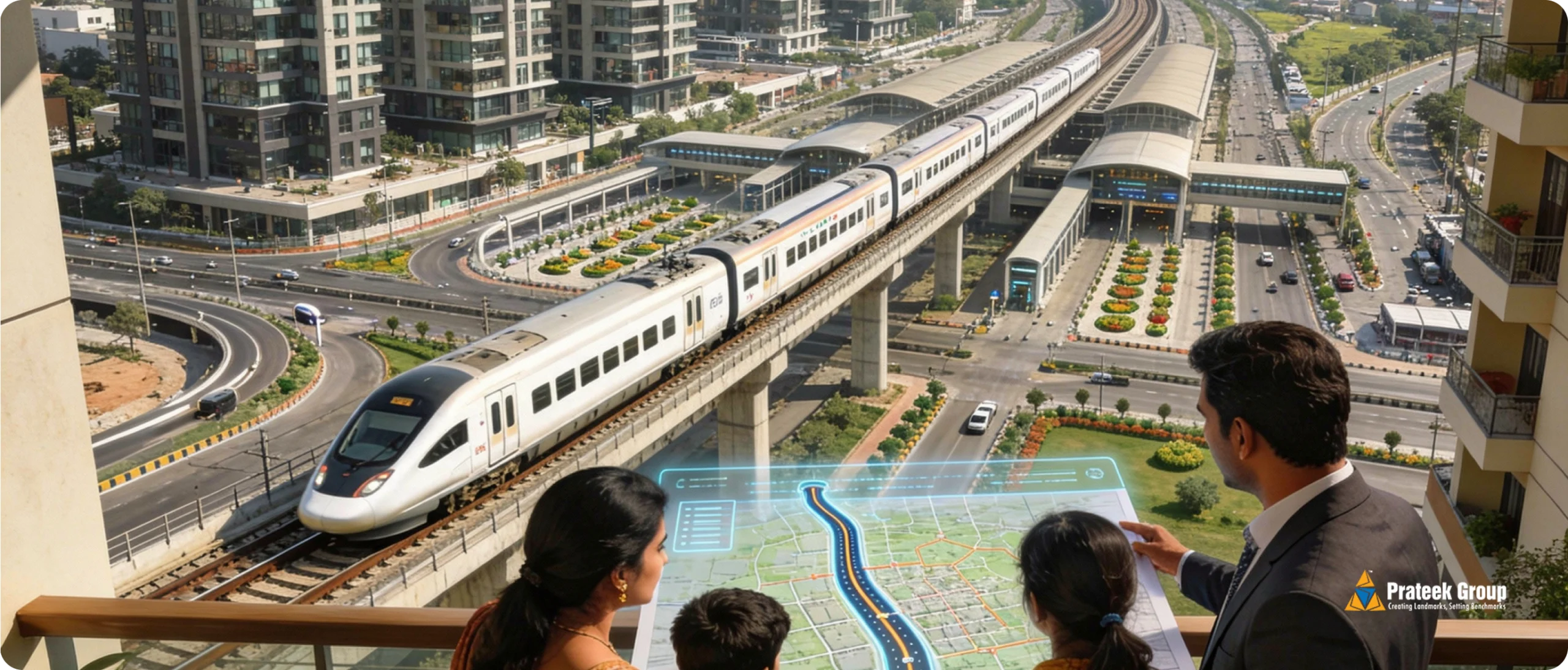
When the full Namo Bharat RRTS corridor went live on 22 February 2026, it didn’t just shorten a commute, it redrew the property map of the Ghaziabad belt. A region that used to be judged purely on road distance to Delhi is now judged on how close it sits to a station, because proximity to rapid rail has become the single clearest predictor of where prices move next. This guide walks the corridor station by station, from Sahibabad inward to the Siddharth Vihar belt, so you can see exactly where transit-oriented value is concentrated and what to look for before you buy.
What the RRTS actually changed
The Delhi-Meerut RRTS is an 82 km semi-high-speed corridor running from Sarai Kale Khan in Delhi to Modipuram in Meerut, with trains travelling up to around 160 km/h. It cuts the Delhi-to-Meerut journey to under an hour, from the 2.5 to 3 hours it took by road. The whole line is operational, daily ridership had crossed roughly 92,000 by April 2026 and is projected to climb toward 8 lakh at maturity, and standard fares run from about 20 to 210 rupees.
For the property market, the important detail is the interchange. The Ghaziabad stations connect to Delhi’s metro network, with Sahibabad and New Ashok Nagar linking to the Blue Line, which means a buyer in the Ghaziabad belt now has fast, predictable access to central Delhi without touching the road. That’s what turns a peripheral locality into a genuine bedroom community.
Why transit proximity drives property value
This is the transit-oriented development, or TOD, effect, and it’s well documented worldwide. Three things happen near rapid-rail stations. Property within roughly a 2 km radius of a station tends to appreciate faster than the city-wide average. Planning rules typically allow higher FAR and mixed-use development along the corridor, so stations attract integrated townships, retail, and offices. And buyer preference shifts: as one major research view puts it, for many homebuyers a shorter commute outweighs a higher price, which pulls demand toward transit-linked addresses.
The numbers bear it out. Ghaziabad has seen roughly 131% appreciation over four years, with micro-markets close to RRTS stations recording 30 to 60% gains, and the localities specifically flagged as RRTS winners, Siddharth Vihar and Raj Nagar Extension, have risen 30 to 67% since 2023. We unpack the locality itself in our Siddharth Vihar property value in 2026 analysis.
The corridor, station by station
Here’s the Ghaziabad belt that matters for a Siddharth Vihar-area buyer, working inward from Delhi:
Station | Catchment localities | What it offers |
Sahibabad | Siddharth Vihar, Vasundhara, Vaishali | First Ghaziabad node, Blue Line link to Delhi, highest connectivity |
Ghaziabad | Raj Nagar Extension, city centre | Central, established social infrastructure, strong demand |
Guldhar | NH-9 belt | Emerging value entry along the highway |
Duhai | Duhai, Modinagar side | Plotted and villa supply, affordable early-stage |
Sahibabad: the gateway station
Sahibabad is the first Ghaziabad node and the most strategically connected, with a Blue Line interchange that puts central Delhi within easy reach. It was the very first RRTS station to open back in 2023, so its catchment has had the longest run of transit-driven demand. The localities feeding it, Vasundhara, Vaishali, and crucially Siddharth Vihar, are the prime beneficiaries of this connectivity.
Ghaziabad station: the central node
The Ghaziabad city-centre station anchors established social infrastructure and is the main catchment for Raj Nagar Extension, the other locality consistently named as an RRTS winner. For buyers who want a more central, fully built-out neighbourhood with the transit upside layered on top, this node is the reference point.
Guldhar and Duhai: the value end
Further out, Guldhar along the NH-9 belt and Duhai toward the Modinagar side offer a lower entry point and more plotted and villa supply. These are earlier-stage TOD plays, more upside if the surrounding development matures, more dependent on that development actually arriving. Suitable for patient, value-oriented buyers.
Where Siddharth Vihar sits in all this
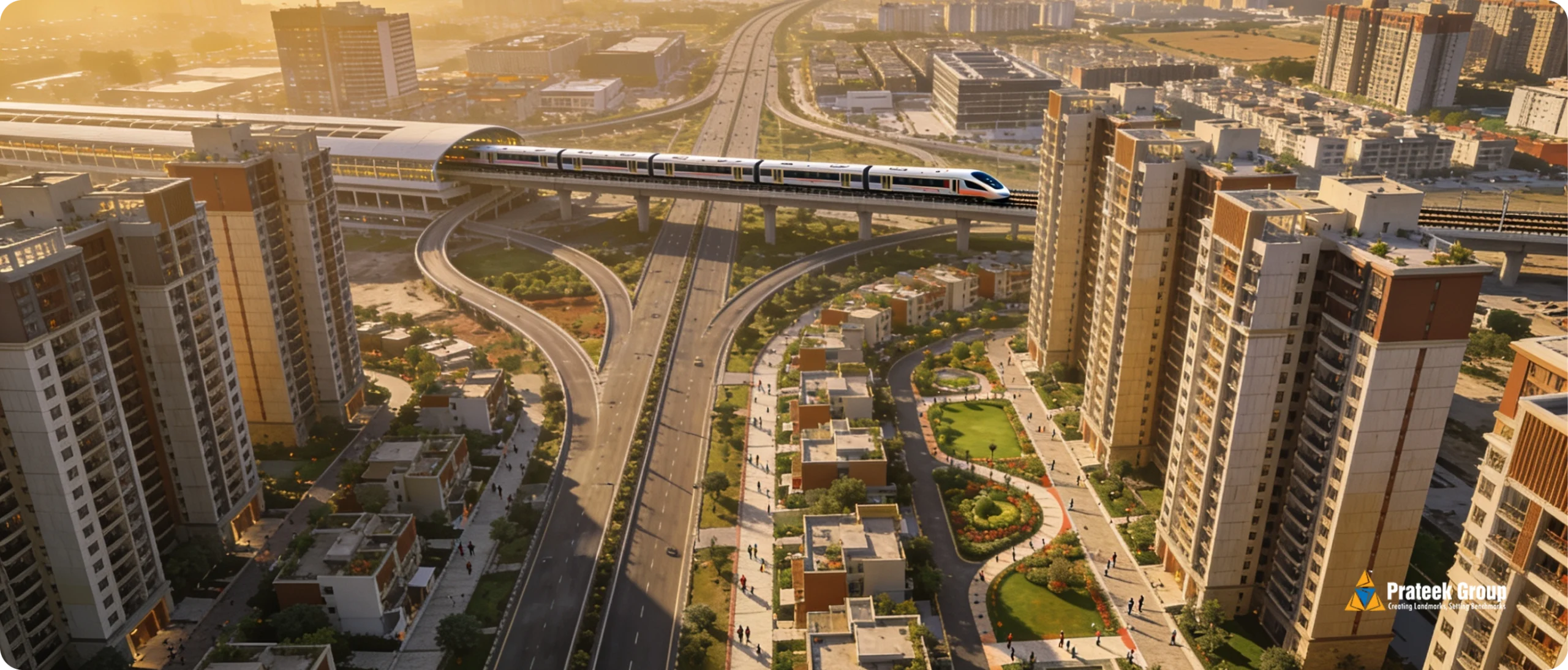
Siddharth Vihar is the standout TOD beneficiary of the Sahibabad catchment. It sits on the Delhi-Meerut Expressway, roughly 5 km from the Sahibabad RRTS station, which gives it the corridor’s connectivity without being right on top of the tracks. Combined with the Delhi-Dehradun Expressway and the new Jewar airport, that makes it one of the most connectivity-rich addresses on the Ghaziabad side. For how it compares with the Noida side, see our Greater Noida West vs Siddharth Vihar breakdown, and for the wider airport picture, our guide on which corridors benefit from the airport.
The TOD investment lens: what to look for
Distance to the station. The premium concentrates within about 2 km. Confirm the real walking or driving distance, not the marketing distance.
Last-mile connectivity. A station 2 km away only helps if you can actually reach it easily, via feeder bus, auto, or a short drive with parking.
Mixed-use upside. TOD zones with higher FAR attract retail and offices over time, which supports both rent and resale.
Rental demand. Transit nodes draw professional tenants, so RRTS-linked stock often rents well, as we cover in our rental yield near transit nodes analysis.
Looking ahead, the corridor’s importance is only set to grow: four new Namo Cities have been proposed along the RRTS network under the Regional Plan 2041, reinforcing the long-term thesis that stations, not just roads, will anchor the next decade of NCR growth.
The honest caveats
- Don’t overpay for the RRTS tag. Some of the appreciation is already priced in. Pay for genuine proximity, not just a corridor mention.
- Appreciation depends on new supply. Analysts note that future price movement hinges on the pace of new supply entering the market near stations.
- The 2 km rule is real. A project loosely described as near the RRTS but 6 km from a station won’t capture the same premium.
- Verify the project, as always, using our how to verify a project before booking checklist, and budget the full cost with our total cost of buying a flat guide.
Where Prateek fits the corridor
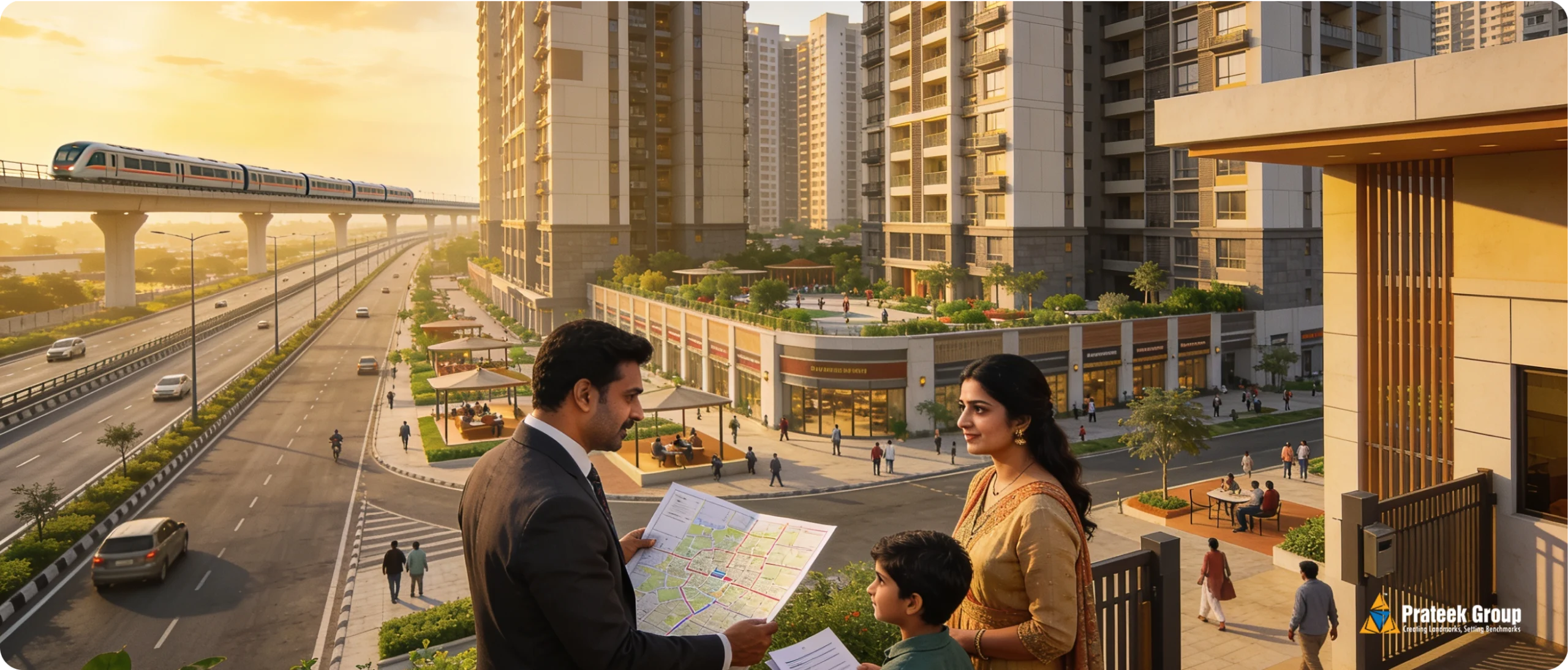
For a buyer who wants the Sahibabad-catchment connectivity in a ready-to-move, integrated township, Prateek Grand City, Siddharth Vihar is the natural fit, a roughly 40-acre development on the Delhi-Meerut Expressway, within the Sahibabad station’s catchment, that captures the corridor’s upside without the construction-timeline risk of a fresh launch on raw land.
The bottom line
The Namo Bharat RRTS has made station proximity the new currency of the Ghaziabad property market. Sahibabad is the best-connected node and the gateway for Siddharth Vihar, Vasundhara, and Vaishali; Ghaziabad station anchors Raj Nagar Extension; Guldhar and Duhai are the value plays. Stay within the 2 km premium zone, confirm real last-mile access, verify the project, and you’re buying into the clearest infrastructure-led growth story on the Ghaziabad side.
Want a transit-linked, ready-to-move option in the Sahibabad catchment? Talk to our team about Prateek Grand City and how its location maps to the corridor.
Note: Distances, fares, and appreciation figures are indicative and change over time. This is general guidance, not investment advice. Verify station distance, project details, and rates before buying.