
Homebuyers often begin with a project brochure. They compare towers, sample flats, clubhouses, payment plans and launch offers before they decide whether the address itself works for their family.
That order creates expensive mistakes.
A flat can be redesigned. Interiors can change in 5 years. The location stays fixed through every school run, office commute, grocery trip, hospital visit and resale discussion. A strong project in the wrong place can still become a tiring home.
Sector 150 Noida deserves to appear early in a serious Noida search because its location has a clear identity. It sits on the southern end of the Noida-Greater Noida Expressway corridor, close to the Aqua Line, Greater Noida and the Yamuna Expressway side. The sector was planned around open land, sport and lower residential density. It now benefits from an operating Noida International Airport and an approved metro extension toward Botanical Garden.
The sector also asks buyers to accept real trade-offs. Entry prices are high. Daily retail is thinner than in mature central Noida. A regular commute to Delhi or Sector 62 can become long. Rental yield can look modest against the purchase price. Sports City Noida approvals and registry status still need project-level checks.
We are Prateek Group, and Prateek Canary sits in Sector 150. We have a commercial interest in this micro-market. We will state that plainly. The useful way to read this guide is as a location test: where Sector 150 works, where another Noida sector may fit better, and which checks still matter after the location makes your shortlist.
TL;DR
Location controls more than the project brochure
Your address decides travel time, access to schools and hospitals, neighbourhood noise, daily convenience and future resale demand. A location-first search removes unsuitable sectors before sales presentations start shaping the decision.
Sector 150 has a rare planning base
The sector was planned as a low-density residential sector with a large share of land reserved for green, open and sports use. That planning is visible in the wider roads, longer views and lower sense of crowding across many parts of the micro-market.
Connectivity is becoming easier to verify
The Noida-Greater Noida Expressway already supports travel toward major office sectors. Sector 148 Metro Station serves the Aqua Line. The Union Cabinet approved the 11.56 km Sector 142 to Botanical Garden extension in February 2026, and Noida International Airport started commercial flights on 15 June 2026.
Sector 150 suits a defined buyer
Families seeking a larger long-term home, professionals working along the expressway belt, Greater Noida-based households and buyers who value greenery should start here. Buyers needing a low entry price, high rental yield, dense walkable retail or a short daily Delhi commute should compare other locations before deciding.
Location selection is the first filter
A good sector cannot rescue weak paperwork, poor construction progress, heavy project density or an inefficient unit. The buyer still needs to check RERA, authority dues, registry position, carpet area, total cost, tower orientation and the developer’s delivery record.
Why location comes before project selection
A home purchase works across several layers. The upper layers are difficult or impossible to change after booking. The lower layers can be repaired, replaced or improved.
Decision layer | What it shapes | Can you change it later? |
City and corridor | Regional travel, employment access and long-term demand | No |
Sector | Roads, density, schools, retail and neighbourhood character | No |
Project | Maintenance, amenities, construction and community | Rarely |
Tower and unit | Light, heat, view, noise and resale appeal | No |
Interiors | Storage, finishes and furniture | Yes |
Buyers usually spend the most time on the layer they can change. They discuss flooring shades and kitchen finishes while accepting a commute they have never tested on a weekday morning.
The best location to buy property in Noida depends on the buyer’s actual week. A family working in Sectors 125 to 142 can read Sector 150 very differently from a family travelling to Connaught Place or Gurugram every day. Parents whose school is in central Noida will have a different calculation from parents choosing a school after they move.
A location-first search starts with routine. Write down every place the household reaches at least twice a week. Include offices, schools, parents’ homes, medical care, sports classes and regular social visits. Test those routes before choosing a project.
The location also shapes the exit. A future buyer will ask the same questions you are asking now. A practical address with clear roads, usable public transport and healthy project supply usually has a deeper resale pool than an isolated project that depends on one future promise.
The location-first test: 6 questions before a site visit
Where do the earning members work? Measure the complete gate-to-desk journey during working hours. Include local roads, parking and metro changes.
Which school routes matter? School travel happens twice a day for years. Ask whether buses already serve the project or nearby societies.
How often does the household need Delhi? Occasional weekend travel and a five-day office commute create different location choices.
What does the family value at home? Open views, active streets, walkable markets, larger rooms and central access do not appear equally in every sector.
What total budget stays comfortable? Include stamp duty, registration, GST where applicable, interiors, maintenance deposits and loan costs.
Who may buy this home later? A widely usable 3 BHK usually has more exit demand than a highly specialised large unit, though the exact project and price still decide the outcome.
These questions reduce the search area quickly. They also prevent a sales desk from setting the buyer’s priorities.
Why Sector 150 enters the first Noida shortlist
Sector 150 earns attention through a combination of planning, access and product choice. Buyers reviewing why Sector 150 attracts buyers will see the same pattern across family demand: the sector has a clear residential purpose, and that purpose is easier to feel on the ground than on a map.
The address sits near the point where Noida’s established expressway office belt begins meeting Greater Noida and the Yamuna Expressway growth side. Northbound travel connects toward Sectors 125, 126, 132, 135, 137, 142 and central Noida routes. Southbound travel connects toward Pari Chowk, Greater Noida institutions and the airport corridor.
Sector 150 Noida also has a full cluster of projects. Buyers can compare large 3 and 4 BHK homes, smaller 2 BHK units, golf-facing inventory, ready homes, under-construction towers and senior living within the same broad micro-market. That variety helps buyers keep the location fixed while changing the product.
There is another reason the sector enters the shortlist early: comparable low-density land inside Noida is scarce. Older sectors can improve roads, parks and maintenance, though their basic building pattern has already been set. Sector 150’s wider open setting came from the original planning decision.
This creates a location premium. The buyer needs to decide whether the daily benefit justifies that premium.
The planning decision behind the sector
Sector 150 is commonly described as a roughly 600-acre sports-led micro-market with about 80 percent of the wider sector area reserved for green, open and recreational use. Buyers should treat every marketing percentage carefully, then inspect what the planning produces in daily life.
The physical effects include:
Longer sightlines across several parts of the sector
Broad internal roads and clearer tower separation
Large park and sports allocations outside individual projects
Fewer old commercial lanes pressing against residential towers
A quieter visual setting than many high-density pockets
More scope for walking, cycling and outdoor time
The planning base supports the phrase greenest sector in Noida, though the phrase alone proves very little about a specific apartment.
A home gets the benefit only when the tower, floor and direction capture it. A unit facing another tower at short distance may receive less daylight than a well-positioned home in a denser sector. A project beside open land may lose the view if that land has future construction rights.
Ask for the approved site plan. Check adjoining plots. Visit the exact tower location as well as the sample flat.
Density deserves the same care. A sector can be low density while one project has a large unit count on a small parcel. Calculate approximate units per acre and compare that number across the shortlist.
Sector 150 Noida connectivity: what works now and what comes later

150, the benefit would come through the route from Sector 148 toward Sector 142 and then Botanical Garden. The extension can reduce transfer friction once it operates. Construction and commissioning still sit ahead.
Buyers should price the current home around today’s network and treat the future line as added support.
Yamuna Expressway and airport access
Noida International Airport began commercial flight operations on 15 June 2026. Its first phase has one runway, one terminal and capacity for about 12 million passengers a year. Initial routes are domestic, with later growth tied to airline schedules, passenger use, cargo and surrounding business activity.
Sector 150 gains through road access to the Yamuna Expressway side. It functions as a road-connected residential corridor, while the airport-adjacent markets sit farther south. Residents can reach the airport without crossing central Noida.
Readers comparing the regional effect can study which airport corridors benefit most because the airport’s property effect will vary sharply by distance, road quality, jobs and existing housing demand.
Noida International Airport connectivity helps frequent travellers and supports the longer regional case. Daily travel to North Delhi still follows a much longer route.
Connectivity scorecard for a buyer
Link | Status in July 2026 | Direct buyer use | Main check |
Noida-Greater Noida Expressway | Operating | Offices, central Noida and Greater Noida | Gate-to-expressway time |
Sector 148 Aqua Line | Operating | Metro travel across Noida and Greater Noida | Last-mile route |
Sector 142-Botanical Garden extension | Approved | Future Blue and Magenta interchange | Construction progress |
Yamuna Expressway | Operating | Airport and southern corridor travel | Route from chosen project |
Noida International Airport | Operating | Air travel and regional economic activity | Real drive time and route growth |
FNG corridor | Incomplete in parts | Future cross-NCR movement | Treat as future support |
The scorecard shows why Sector 150 Noida connectivity is credible without pretending every link has reached its final form.
Sector 150 Noida location advantages, tested against other areas
A good micro-market comparison keeps the household need fixed. Price alone creates false winners because each location sells a different daily routine.
Location | Strongest reason to start there | Daily strength | Main caution |
Sector 150 | Green planning and premium end use | Quiet setting with expressway access | High entry price and thinner walkable retail |
Sectors 137 and 143 | Office and metro access | Practical for expressway workers and tenants | Several projects have higher density |
Sectors 75 to 79 | Mature central Noida life | Markets, schools, hospitals and metro | More traffic and less open land |
Sectors 93A and 128 | Established premium housing | Strong central and expressway access | Expensive inventory and limited new supply |
Sector 107 | Central premium address | Better Delhi-side reach | Busy surrounding roads |
Greater Noida West | Budget and broad supply | More choices across price bands | Traffic, density and civic quality vary |
Sectors 151 and 152 | Newer expressway inventory | Similar corridor access | Social infrastructure is still maturing |
Sector 150 versus central Noida
Central sectors win on established convenience. Pharmacies, markets, schools, clinics and restaurants are easier to reach. Metro options and Delhi access can also be better.
Sector 150 wins when the buyer values open surroundings, tower spacing and a quieter home. The trade is simple to measure: convenience outside the gate against space and calm inside the residential setting.
Families moving from Sector 62, Indirapuram or central Noida should spend a full day in Sector 150 before deciding. The quieter roads may feel refreshing. The extra driving for daily needs may feel irritating. Both reactions matter.
Sector 150 versus Sectors 137 and 143
Sectors 137 and 143 are practical for IT and office workers. Occupied societies, direct metro access and smaller apartment formats can support rental demand.
Sector 150 usually has a stronger premium identity and more large-format stock. It can work better for long-term family use, while Sectors 137 and 143 may produce a simpler work-and-rent calculation.
Sector 150 versus Greater Noida West
Greater Noida West has a much wider mid-budget market. A family may get more internal space for the same total amount. Retail and schools have expanded across several occupied pockets.
Sector 150 asks buyers to pay for its expressway position, planning and lower-density character. Our comparison of Sector 150 versus Noida Extension works through the budget pressure because the lower purchase price can be cancelled by a longer commute or higher daily travel cost.
Sector 150 versus Sectors 151 and 152
The neighbouring sectors attract buyers through newer launches and fresh inventory. Some projects may have modern specifications or an earlier pricing window.
Sector 150 has a more established cluster of premium projects and a stronger green-sector identity. Buyers should compare approach roads, RERA status, project density and current social infrastructure. A neighbouring sector number does not guarantee the same daily experience.
What a normal weekday looks like
A location becomes real on an ordinary Tuesday.
At 7:00 AM, school buses enter the society. The buyer needs to know whether the chosen school already runs a route through the sector. A school that appears 12 km away can work well with an organised bus. A closer school can become difficult when the route has repeated choke points.
At 8:30 AM, office traffic begins. A resident working in Sector 135 may have a comfortable expressway journey. A resident working in Connaught Place will face a much longer chain of local road, expressway and city traffic or metro transfers.
At 11:00 AM, daily convenience starts to matter. Grocery delivery covers much of the sector, and project-level convenience stores help. Physical markets, casual dining and small clinics remain less dense than in mature Noida.
At 4:00 PM, children need outdoor time and classes. Sector 150’s open setting supports walking, cycling and sport inside many gated communities. Travel to specialised classes may still require a car.
At 9:30 PM, healthcare access becomes the test. Large hospitals are available toward Sector 128 and Greater Noida. Buyers should identify the quickest emergency route before booking.
This rhythm explains why the best sector to live in Noida changes from one family to another. Sector 150 performs strongly for households that value home environment and whose weekly routes match the corridor.
Schools, healthcare, retail and social life
Schools
The wider expressway and Greater Noida corridor has established schools, though most are reached by road. Ask 3 practical questions: Does the school bus enter the society? How long is the morning route? What happens during rain or road work?
A 15-minute difference each way becomes 2.5 hours across a five-day school week. That cost compounds for years.
Healthcare
Jaypee Hospital in Sector 128 and hospitals on the Greater Noida side provide larger medical options. Day-to-day clinics and pharmacies are increasing as occupancy grows, though central Noida still has greater density.
Buyers with elderly parents should check emergency time, lift backup, ambulance access and the project’s medical room arrangements.
Retail
Retail is Sector 150’s clearest daily weakness. Some projects have internal convenience stores and nearby commercial development is increasing. The sector still does not provide the street-level choice found in Sectors 75 to 79 or older Noida.
Households that rely on delivery and drive for planned shopping may accept this easily. Buyers who enjoy walking to a market, cafe or clinic should test the experience before paying the premium.
Social life
Large gated communities create their own weekend pattern through clubs, pools, sports courts and resident events. This suits families who spend leisure time inside the society.
People whose social life sits mainly in Delhi may find the return journey tiring. Count real trips rather than assuming weekends will change after the move.
Buyer suitability matrix
Buyer profile | Sector 150 fit | Why it works | What to watch |
Family buying for 7+ years | Strong | Larger homes, open setting and community life | School and retail routes |
Expressway office professional | Strong | Practical access to Sectors 125-142 | Peak-hour project exit |
Greater Noida professional | Strong | Comfortable southbound movement | Exact office route |
NRI buying for family | Strong with checks | Premium projects and long-hold appeal | Construction and document verification |
Buyer seeking 3 or 4 BHK | Strong | Broad large-format supply | Carpet area and total ticket size |
First-time buyer on strict budget | Limited | Some smaller units exist | Entry price and EMI pressure |
Rental-yield investor | Moderate to weak | Tenant demand exists | High capital value lowers yield |
Daily Delhi commuter | Route-dependent | Weekend access is manageable | Five-day travel fatigue |
Buyer needing walkable markets | Developing fit | Delivery and internal stores help | Street retail remains thin |
The matrix is a starting point. A project beside a strong route can improve the fit. A poor last-mile road can weaken it.
Why invest in Sector 150 Noida: the honest case
Buyers searching why invest in Sector 150 Noida usually receive a list of future infrastructure. The stronger case starts with current end-use demand.
Families already pay for larger homes, better tower spacing and a quieter environment. That creates a resident base that can support resale when the project is maintained and the paperwork is clear. Infrastructure adds depth to that demand, while current end-use value should carry the purchase decision.
Scenario 1: The family buys for self-use
The return appears through daily life. More light, open views, a shorter office journey and larger rooms carry direct household value. Price appreciation and daily benefit deserve equal weight.
This is the strongest Sector 150 case because the buyer receives the benefit while holding the property.
Scenario 2: The investor holds for 7 to 10 years
The investor depends on project delivery, registry clarity, airport growth, metro construction, commercial expansion and future buyer demand. A practical 3 BHK in a well-kept project can have a wider exit pool than a rare penthouse.
Entry price matters more now because Sector 150 has already recorded strong gains. The next cycle may be slower and more selective.
Scenario 3: The buyer expects quick resale
Short holding periods carry stamp duty, registration, brokerage, loan costs and market timing risk. Under-construction inventory can also face transfer restrictions or a crowded resale window near possession.
Sector 150 is a weaker choice for a buyer depending on a fast exit.
Scenario 4: The investor wants monthly cash flow
Rental demand can rise with occupancy and office activity. The purchase price remains high, so percentage yield may stay modest. Investors should compare net rent after maintenance, vacancy and furnishing costs with the full acquisition cost.
The location is better read as a long-hold capital market than a high-yield market.
Prices: what the location premium looks like
Property portal data for April-June 2026 places average asking rates for multistorey apartments in Sector 150 near Rs 12,961 per sq ft, with a broad listed range around Rs 10,538 to Rs 15,384 per sq ft. Individual projects and towers can sit outside that band.
Portal rates record asking prices, and registered transaction values can differ. They mix ready, resale and under-construction supply. Use them to understand direction, then check recent deals in the exact project.
The premium comes from several sources:
- Planned open land and lower-density identity
- Expressway and Aqua Line access
- Branded project concentration
- Larger apartment formats
- Scarcity of similar new land inside Noida
- Airport corridor access
- Strong end-user interest
A buyer should ask what personal benefit the premium buys. A shorter commute, permanent open view or larger carpet area can justify it. A generic sector label cannot.
Total cost comparison
Cost item | Often shown early? | Buyer action |
Base price | Yes | Compare on the same area basis |
Floor and view charge | Sometimes | Check tower-by-tower difference |
Parking and club | Sometimes | Ask whether optional or mandatory |
Power backup | Late in discussion | Compare rate and sanctioned load |
GST | Depends on status | Confirm with a tax adviser |
Stamp duty and registration | Usually excluded | Add before setting budget |
Maintenance deposit | Often near booking | Ask for monthly estimate too |
Interiors | Rarely included | Keep a separate cash buffer |
Loan and legal cost | Rarely included | Add processing and review fees |
Two flats with the same quoted rate can differ by several lakh once every charge is included.
The project field: how location becomes a product
Once Sector 150 makes the shortlist, buyers should compare projects through the same filters: density, usable area, construction status, tower spacing, legal position, maintenance and resale depth.
Wellness-led large-format projects
Buyers seeking large 3 and 4 BHK homes often examine the official ATS Kingston Heath project page during their research. The project is presented around golf-course views, a wellness theme and large green areas, so the buyer should compare its exact tower, construction progress and registered timeline with other large-format choices.
Completed branded inventory
A buyer who wants to inspect the finished environment may review Godrej Nest Sector 150 because the project page lists 3 and 4 BHK residences and September 2024 possession. A physical visit can reveal lift performance, parking, maintenance quality and actual views that no brochure can show.
Smaller entry configurations
The official Tata Eureka Park project page lists the development in Sector 150 with separate RERA registrations for its phases. Its 2 and 3 BHK formats can suit buyers seeking a lower total entry amount, though project scale and density need to be compared with the low-density options.
Family and child-focused positioning
Families sometimes place amenities around children near the top of their list, and the Godrej Nurture Sector 150 page presents a child-focused concept. The buyer should still compare room sizes, school routes, maintenance and the amount of open space that remains usable after full occupancy.
Ready golf-facing supply
Buyers who prefer a mature project can inspect ATS Le Grandiose project details before a visit. The official page describes golf-facing homes, low density and 2 apartments per floor in parts of the project, giving buyers clear points to verify in the completed setting.
Mid-size homes near greens
A buyer prioritising 2 and 3 BHK formats may also review Eldeco Live By The Greens while comparing total cost and phase status. Project pages describe smart-home features and open surroundings, though buyers should confirm all claims against UP RERA and the latest construction or possession record.
These links help define the product range. Rank the projects through budget, timing, unit efficiency and document position.
Where Prateek Canary fits
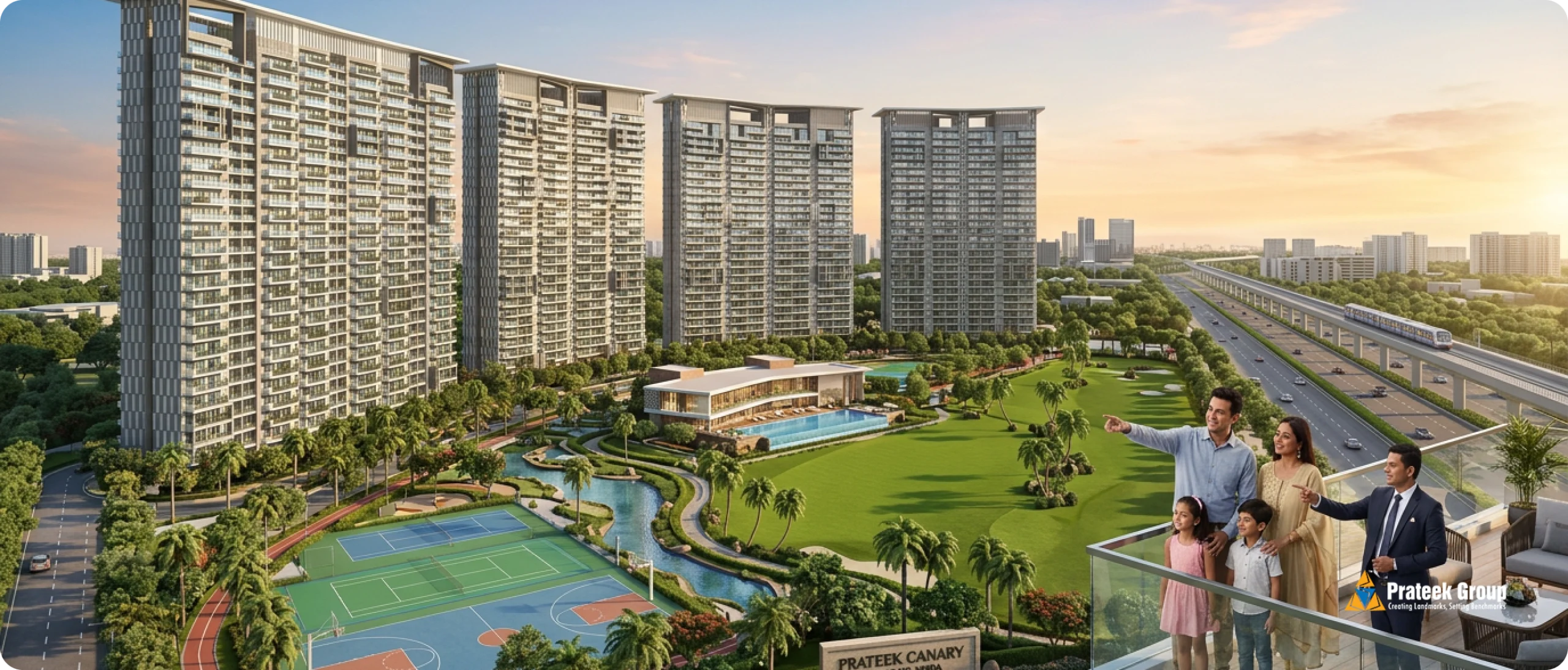
Prateek Canary is built around a clear reading of Sector 150: the sector’s open character is most useful when the project keeps density controlled inside its own boundary.
The official Prateek Canary project details list 664 units across 12.55 acres, with 3 BHK, 4 BHK and duplex penthouse formats. That works out to roughly 53 units per acre before any adjustment for project planning.
The project has large private party decks, green-facing views and a broad size range. It suits buyers who want more space and plan to hold the home for several years.
The limitations should be equally clear. The ticket size is premium. Larger formats require more money for stamp duty, interiors, furnishing and maintenance. The project is under construction, so buyers should read the latest UP RERA progress reports and verify tower-wise status.
Prateek Canary is also part of the wider Sports City framework. Buyers should ask for the current written position on authority dues, occupancy certification and registry steps that apply to their tower.
The project is a weaker fit for buyers whose first target is rental yield or the lowest entry price in Sector 150. Smaller ready units elsewhere may suit those goals better.
Project selection after the location passes
A location-first approach makes the project decision more disciplined. Every shortlisted development needs to answer the same 8 questions.
Is the RERA record active and consistent? Match land area, unit count, promoter and completion date with the sales presentation.
What do the last 2 quarterly reports show? Read tower-wise progress and compare photographs across quarters.
How dense is the project? Divide registered units by registered acres, then consider tower height and homes per floor.
What is the carpet efficiency? Compare room dimensions, usable space and the stated super area together.
What does the chosen unit face? Confirm the adjoining plot, service road, club, school, utility area or future tower.
What is the complete cost? Add every compulsory charge before ranking projects.
What is the registry and authority-dues position? Request the answer in writing for the specific phase and tower.
Who will buy the unit later? Judge the depth of demand for that exact size, price and floor.
The sequence matters. Legal and delivery checks come before amenities.
Sports City Noida and registry checks
Several Sector 150 developments sit within Sports City land parcels. The wider scheme reserved a major share of land for sports and recreational infrastructure, with residential and commercial development supporting that use.
Approvals and registries faced years of uncertainty because of authority dues, land-use questions and incomplete sports commitments. A Supreme Court-led revival process moved forward in late 2025, and the Noida Authority issued conditional approvals in early 2026 for parts of the SC-02 framework.
This movement helps the sector. Each project still needs its own written answer.
Before paying a token amount, buyers should verify a project before booking and ask for these items in writing:
- UP RERA registration and current status
- Sanctioned plan for the exact phase
- Authority dues and payment status
- Occupancy or completion certificate position
- Registry eligibility for the chosen tower
- Land title and encumbrance record
- Sports infrastructure obligations tied to the parcel
- Builder-buyer agreement and delay clauses
Use an independent property lawyer. A large purchase deserves a professional document review.
A full site-visit format
Before the visit
Download the RERA summary, note the registered completion date, request the cost sheet and mark office, school, hospital and metro routes on the map.
Choose 2 competing projects for the same day. Comparing sites while the details are fresh is more useful than visiting one project each weekend for a month.
On the approach road
Time the journey from the expressway exit. Check road width, lighting, waterlogging signs, pedestrian safety, construction traffic and public transport.
The last 2 km can weaken a strong corridor. Test it during peak time.
At the sales office
Ask for documents before discussing discounts. Request the registered unit count, project acreage, homes per floor, lift count, parking terms, power backup rate and estimated maintenance.
Ask the sales representative to write the possession guidance and registry position in an email.
Inside the sample flat
Measure every room. Check wardrobe walls, bed clearance, dining space, kitchen utility, balcony depth and shaft placement.
Sample flats can use small furniture, wide mirrors and removed doors. A tape measure is more reliable than the visual impression.
Around the tower
Stand at the approximate tower position. Check morning sun, afternoon heat, road noise, clubhouse activity and future construction.
A green view can carry a large charge. Confirm whether it is protected by an approved plan.
After the visit
Drive to Sector 148 Metro Station, a grocery point, one hospital and the preferred school route. The visit should test the location the family will use and the flat the developer has prepared.
Common mistakes location-first buyers still make
Choosing through a map pin
A map shows kilometres. It misses service roads, U-turns, unsafe crossings, project exits and school-time traffic. Drive the route.
Paying twice for future infrastructure
Current prices may already include years of airport and metro expectation. Compare the premium with completed nearby projects before assuming each future milestone will produce another large increase.
Treating all Sector 150 projects as low density
Sector planning and project density are separate numbers. Calculate units per acre and homes per floor.
Buying a BHK label
A 3 BHK can range from a compact family flat to a large premium residence. Carpet area and room dimensions reveal the usable product.
Ignoring the weekday retail gap
A quiet Sunday visit can hide the friction of daily errands. Spend time in the sector on a weekday evening.
Stretching to the lender’s maximum
The purchase continues after booking. Registration, interiors, school fees, maintenance and changing interest rates need room in the household budget.
Choosing the project and accepting any unit
Tower, floor, facing and lift distance shape daily comfort and resale. The unit choice can matter as much as the project name.
Claims buyers hear and the check that settles them
Claim | What to verify |
“The sector has 80 percent green space” | Identify sector-level open land and project-level usable open space separately |
“The metro is nearby” | Measure gate-to-station travel and feeder availability |
“The airport will raise prices” | Check current price, route growth and how much expectation is already priced in |
“Possession is next year” | Read the UP RERA completion date and quarterly progress |
“The view is permanent” | Check approved adjoining land use |
“The project is low density” | Calculate units per registered acre |
“Registry is open” | Confirm tower-level eligibility and authority dues in writing |
“Rental demand is strong” | Compare actual rents with full acquisition cost and vacancy |
This table turns broad sales claims into questions that can be answered.
What to watch between 2026 and 2032
- Airport route growth
The airport opening is settled. The next signal is usage: destination count, international services, cargo activity and airport-linked jobs. Sustained traffic matters more to housing demand than opening-week excitement.
- Metro construction
The Sector 142 to Botanical Garden extension has central approval. Buyers should track tendering, construction pace, station work and commissioning across the full schedule.
- Sports infrastructure delivery
Completion of sports facilities would strengthen the identity of the sector and reduce a long-standing source of uncertainty. Delays would keep project-level scrutiny high.
- Retail and healthcare depth
The sector’s lived experience will improve when more everyday services sit inside or beside the residential cluster. Grocery, clinics, casual dining and school access can change resident satisfaction quickly.
- Office absorption along the expressway
New office leases and employment in Sectors 125 to 142 can deepen rental and resale demand. A home near a working employment corridor has a clearer buyer base than one depending only on future jobs.
- Supply exhaustion
Sector 150 is close to fully allocated, so large new residential parcels are limited. Restricted supply can support prices when demand stays healthy. Scarcity cannot compensate for weak documents or poor maintenance.
- Project maturity
As more societies reach full occupancy, buyers will judge actual maintenance, traffic, resident life and resale performance. The micro-market will become easier to compare through lived evidence.
A decision framework for narrowing to one home
Step 1: Confirm the location fit
Test office, school, hospital, metro and family routes. Remove Sector 150 when 2 essential journeys feel unsustainable.
Step 2: Set a complete ceiling
Add all charges and keep a cash buffer for interiors and rate changes. Set the EMI at a level the household can carry comfortably.
Step 3: Choose the product type
Decide between ready certainty, late-stage construction, smaller entry size, low density, large format or specialised senior living.
Step 4: Remove document risk
Reject projects with unclear RERA records, inconsistent completion guidance, weak progress reports or vague authority-dues answers.
Step 5: Compare 2 projects deeply
Visit both on the same weekday. Compare unit density, carpet efficiency, maintenance, tower spacing and complete cost.
Step 6: Choose the exact unit
Study direction, heat, light, noise, view, lift distance and future construction. Request the unit plan and location in writing.
Step 7: Run the exit test
Ask who would buy this home in 7 years and why. A clear answer usually points toward the more liquid choice.
Conclusion
Location-first buying brings the biggest decisions to the beginning of the search.
Sector 150 Noida belongs near the top of a Noida shortlist because its planning, open setting, expressway access, Aqua Line connection and Greater Noida position create a distinct residential case. The airport is operating. The Botanical Garden metro extension has approval. The sector has a mature cluster of premium projects across several formats.
The strengths carry a price. Buyers pay more than in several neighbouring locations. Daily retail is still developing. Delhi travel needs a real route test. Rental yields may remain modest against current capital values. Sports City and registry questions require written project-level answers.
Families whose work and school routes match the corridor can receive a daily benefit from the premium. They gain open views, larger formats, quieter roads and a home environment that is hard to reproduce in older dense sectors.
Prateek Canary fits that location through controlled density, larger homes and green-facing planning. Buyers should compare it with completed and under-construction competitors using the same standards: RERA, progress, total cost, carpet area, authority dues and unit position.
Start with the map of your real life. Test the location on a weekday. Read the documents. Compare the exact unit.
Then choose the project.
FAQs
Why should homebuyers start their Noida search in Sector 150?
Sector 150 combines a planned open setting, lower residential density, Noida-Greater Noida Expressway access, Aqua Line connectivity and a practical route toward Greater Noida and Noida International Airport. It deserves an early shortlist for families seeking a long-term premium home.
Is Sector 150 the best location to buy property in Noida?
It can be the best fit for buyers who value greenery, larger homes and expressway access. Central Noida may work better for walkable retail, shorter Delhi travel and mature local services. The answer depends on the household’s weekly routes.
What are the main Sector 150 Noida location advantages?
The main advantages are open planning, broad roads, premium residential supply, access to the Noida-Greater Noida Expressway, Sector 148 Metro Station, Greater Noida and the Yamuna Expressway airport side.
Is Sector 150 the best sector to live in Noida for families?
It is a strong family location when school and office routes fit. Families often value the quieter setting, large apartment formats, sports facilities and gated communities. Buyers should still check daily retail and healthcare travel.
How far is Sector 148 Metro Station from Sector 150 projects?
The road distance varies by project and gate. Many projects require a short drive or feeder ride. Buyers should time the complete route and check auto, cab, parking and night access.
Does Sector 150 have direct Delhi Metro access?
The operating Aqua Line currently requires a transfer between Sector 51 and Sector 52 for the Blue Line. The approved Sector 142 to Botanical Garden extension is planned to connect with Blue and Magenta Line services at Botanical Garden.
How does Noida International Airport connectivity help Sector 150?
Sector 150 has road access toward the Yamuna Expressway and the operating airport. This helps air travellers and supports the regional growth case. The size of the property effect will depend on routes, jobs, cargo and surrounding business activity.
Are flats in Sector 150 Noida expensive?
Sector 150 sits in a premium price band. Portal asking-rate data for April-June 2026 placed the average near Rs 12,961 per sq ft, while individual projects, views, floors and construction stages can produce much higher or lower quotes.
Is property in Sector 150 Noida good for rental income?
Rental demand exists, especially in completed, well-kept projects near usable routes. The purchase price is high, so percentage yield may remain modest. The sector suits end use and long holding better than a cash-flow-only strategy.
Which apartment configurations are available in Sector 150?
The sector has 2 BHK, 3 BHK, 4 BHK, penthouse, villa and senior-living options. The exact choice varies by project, phase and resale inventory.
What should buyers check before booking in Sports City Noida?
Check the RERA record, authority dues, sanctioned plan, occupancy or completion certificate position, registry eligibility, land title and the Sports City obligations tied to the parent parcel. Get the answers reviewed by an independent lawyer.
Is Sector 150 better than Greater Noida West?
Sector 150 usually suits buyers paying for a premium, greener and lower-density address. Greater Noida West usually has more mid-budget choices and broader daily retail in occupied pockets. Budget and commute decide the stronger fit.
Is Sector 150 suitable for a daily Delhi commute?
Hybrid or occasional Delhi travel can work. A five-day commute to central or northern Delhi may become tiring. Test the door-to-door journey during weekday peak hours before booking.
Is Prateek Canary a low-density project?
The official project page lists 664 homes across 12.55 acres, which is roughly 53 homes per acre. Buyers should also compare tower spacing, homes per floor, current construction progress and their chosen unit’s outlook.
Who should avoid buying in Sector 150?
Buyers with a strict entry-level budget, a need for dense walkable markets, a high rental-yield target or an exhausting daily route to work may find a better match in another Noida micro-market.