
On 15 June 2026, an IndiGo flight from Lucknow touched down at 7:55 AM and Noida International Airport at Jewar stopped being a promise. After more than two decades of planning and a string of missed deadlines, NCR finally has its second international gateway. Every developer in the region now has a press release about it, and almost all of them say the same thing: prices are going up everywhere.
That’s the part worth questioning. An airport doesn’t lift every corridor equally, and the marketing rarely tells you which markets gain first, which gain most, and which are simply riding the headline. This guide does. It ranks the NCR corridors by how directly they benefit from Jewar, backed by current price and leasing data, so you can match the right corridor to your own goal rather than buy the hype.
First, the airport itself, in plain numbers
Phase 1 of Noida International Airport (IATA code DXN) opened with a single 3,900-metre runway, a terminal of about 101,590 square metres, and capacity for 12 million passengers a year, built at a cost of roughly ₹11,200 crore. It was inaugurated on 28 March 2026 and began commercial operations on 15 June 2026.
The launch network is domestic and growing fast. IndiGo opened with a handful of routes including Lucknow, Bengaluru, Hyderabad, Jammu, Amritsar, and Navi Mumbai, Akasa Air joined the next day, and the airport handled 62 scheduled flight movements in its first five days. IndiGo plans to expand to more than 16 destinations, and international routes to destinations like Dubai and Singapore are expected to ramp up later in 2026.
The scale is what matters for property. The airport sits on 1,334 hectares and is being built in four phases, scaling toward 70 million passengers a year by around 2040 and far higher long term, with future runways planned. Job projections run from 12,000-plus in early operations to 50,000-plus within five years and over 1 lakh direct and indirect jobs long term. Airports of this size historically create sustained housing, logistics, and hospitality demand within a 20 to 30 km radius. That radius is the real map of who benefits.
The honest connectivity caveat nobody leads with
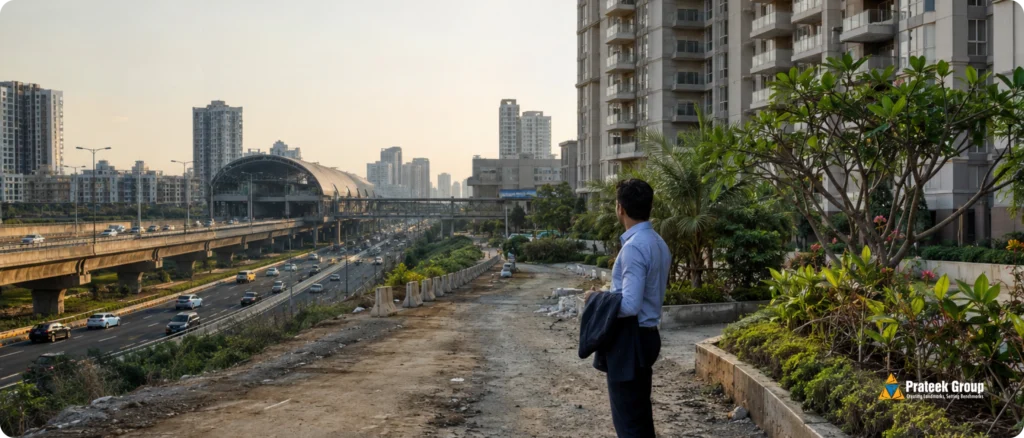
Before ranking corridors, one fact has to be on the table, because it changes the timing of every prediction below: as of June 2026, no metro, no RRTS, and no rail link of any kind reaches the airport. Access is entirely road-based for now.
The rail is coming, but not soon. The Noida Metro Aqua Line extension from Sector 142 to the airport has a finalised DPR but construction hasn’t started, with the earliest realistic completion around 2028. The Ghaziabad-Jewar RRTS, a planned 71 km corridor, is being revised and targets roughly 2030 to 2031. A new 31.42 km road corridor approved in March 2026 will improve access from South Delhi, Faridabad, and Gurugram, and YEIDA has approved a ₹1,700 crore, 25 km eastern access road from the Greater Noida West side. So the road network is being widened aggressively, but anyone buying purely on rail connectivity is buying a 2028-plus story, not a today story.
The corridor ranking
Here’s the framework, from most directly exposed to the airport to least. The right tier for you depends on whether you want ready rental income, a long-horizon capital play, or a home to live in.
Tier | Corridor | Distance to airport | Who it suits |
1 | Yamuna Expressway / YEIDA sectors (18, 20, 22A, 22D, 28-29) | 5 to 15 km | Plot and long-horizon investors, hospitality and commercial |
2 | Greater Noida West / Noida Extension | 35 to 40 min | End-users wanting ready homes plus rental demand |
3 | Noida-Greater Noida Expressway / Sector 150 | 45 to 55 min | Premium end-users, office-led, low-density living |
4 | Ghaziabad (Siddharth Vihar, NH-24 belt) | Road-linked, second order | Value-seeking end-users with Delhi and Noida commutes |
Tier 1: Yamuna Expressway and the YEIDA sectors
This is the direct catchment, the 5 to 15 km belt around the airport, and it’s where the headline appreciation has happened. According to Square Yards’ Runway to Realty analysis, apartment values along the Yamuna Expressway rose 158% between 2020 and 2025, from about ₹3,950 to ₹10,200 per square foot, while plot values in select micro-markets appreciated over 500%. Critically, all of that happened before a single commercial flight operated.
Now that operations have begun, analysts forecast a further 20 to 30% upside through 2027, and Colliers projects 15 to 20% compound annual value growth near the airport over the next four to five years. Sector 22D, roughly 10 minutes from the terminal, is the most-flagged premium residential address, with launched projects around ₹8,999 to ₹9,500 per square foot. Sectors 28 and 29 are zoned as the airport hospitality district, and Sectors 20 and 22A are approved for commercial and retail.
The catch: much of Tier 1 is plotted land and pre-launch inventory, not ready homes. The upside is real but the horizon is long, the rail isn’t here yet, and the easy announcement-driven gains are behind us. This is an investor corridor, best suited to a 5-year-plus hold. If you’re going this route, our guide on how to verify a project before booking is worth reading first, since title and zoning verification matter more on plots than anywhere else.
Tier 2: Greater Noida West and Noida Extension
Roughly 35 to 40 minutes from the airport, Greater Noida West is the practical end-user beneficiary. It’s a ready-made, high-density residential market with established social infrastructure and the strongest rental demand in the belt, and it’s set to gain directly from the new ₹1,700 crore eastern access road that shortens its run to the airport.
Greater Noida rose about 98% between Q1 2020 and Q1 2025, and the area keeps drawing mid-segment families who want affordability without losing connectivity. If rental income is your goal, this is the corridor to study, and our breakdown of the best sectors for rental yield in Noida and Greater Noida goes deeper on where the numbers work.
Tier 3: Noida-Greater Noida Expressway and Sector 150
This corridor benefits less from the airport directly and more from the broader economic story the airport reinforces. The Noida-Greater Noida Expressway has matured into NCR’s most active office belt, absorbing roughly a quarter of Delhi-NCR’s Grade A office leasing in recent quarters and a large share since 2022. Colliers expects Noida’s annual office leasing to reach 2 to 3 million square feet from 2026 onward, about one-fourth of the region’s total, with airport-driven global occupier interest adding to it.
On the residential side, Sector 150 has built a reputation for low-density, amenity-rich premium living, pulling buyers from Delhi and Gurugram who want larger homes at NCR prices. Colliers expects capital values along the Noida Expressway to rise at a 15 to 20% CAGR over the next four to five years, led by middle-income and luxury segments. This is the corridor for premium end-users who want a job-hub address with room to breathe. It’s also where Prateek Canary in Sector 150 sits, giving buyers a low-density option right on this belt.
Tier 4: Ghaziabad and the NH-24 belt
Ghaziabad is a second-order beneficiary, and that’s not a knock. It gains through road links to the airport corridor and from the future Ghaziabad-Jewar RRTS, while offering noticeably better value than the Noida side. Localities like Siddharth Vihar already stack the Namo Bharat RRTS and the Delhi-Dehradun Expressway, and the airport adds a third regional tailwind. For a buyer who wants a Delhi-and-Noida commute, a clean road link toward Jewar, and a lower entry price, this is the value corridor. We cover it in depth in our analysis of Siddharth Vihar property value in 2026.
What this means for the three big buyer types

If you want rental income now. Tier 2 (Greater Noida West) and parts of Tier 3 give you ready, tenant-ready stock today. Tier 1 studios near the airport are pitched at high yields, but they depend on flight volumes and crew or business demand that will build over 24 to 36 months, so treat those projections cautiously.
If you want long-horizon capital growth. Tier 1 is the purest play, provided you can hold 5 years or more and you buy RERA-clean, well-zoned inventory. The operational premium phase is genuinely different from the old announcement premium, but it’s still front-loaded with risk.
If you want a home to live in. Tier 3 and Tier 4 win. You get job-hub access, mature social infrastructure, and ready-to-move options, and you’re not betting your family’s housing on a rail line that opens in 2028. NRIs and long-distance buyers in particular should lean here, and our NRI guide to buying property in Noida and Greater Noida walks through the remote-purchase checklist.
The risks to price in
- The rail gap is real. Metro and RRTS to the airport are years away. Buy on today’s road access, not tomorrow’s rail map.
- Operational, not magical. Full occupier and passenger demand builds over 24 to 36 months. The airport is live, but the economic multiplier takes time.
- Plot and pre-launch risk. Tier 1’s biggest gains sit in land and unbuilt projects, where title, zoning, and possession risk are highest. Verify everything.
- Prices have moved. Much of the corridor already tripled before flights began, and a proposed circle rate revision could lift registration costs. Your return now depends on corridor and project selection, not the headline.
The bottom line
Jewar is the single biggest infrastructure catalyst NCR has seen in a decade, but it doesn’t reward every corridor the same way or on the same timeline. The Yamuna Expressway gets the biggest long-term capital story and the highest near-term risk. Greater Noida West gets the cleanest rental and end-user case today. The Noida Expressway and Sector 150 get the office-led premium story. Ghaziabad gets a strong value position with stacked connectivity.
Match the corridor to your goal, verify the project, and you’re positioned well. If you want a ready, low-density home on the Noida Expressway, look at Prateek Canary in Sector 150. If you want stacked-connectivity value on the Ghaziabad side, look at Prateek Grand City in Siddharth Vihar.