
Few NCR road projects have been talked about for as long as the Faridabad-Noida-Ghaziabad Expressway, better known as the FNG. Planned to link 3 of the region’s biggest satellite cities without passing through Delhi, it has moved in fits and starts for years. In the last couple of years, it has regained momentum, with the Noida and Haryana authorities agreeing to share the cost of the crucial bridge over the Yamuna.
This guide explains FNG Expressway connectivity as it stands in 2026: the route, what’s built and what’s pending, which Noida sectors it serves, including Sectors 143, 165 and 168, and what it means for buyers weighing a 4 BHK in Faridabad against a home in Noida. Where status depends on recent reports, we give dates and sources, since the project is still moving.
What the FNG Expressway is
The FNG Expressway is a planned 6-lane road of about 56 km connecting Faridabad in Haryana with Noida, Greater Noida and Ghaziabad in Uttar Pradesh. Its purpose is simple: let people and goods travel between these cities without going through Delhi’s congested roads. Once complete, it’s expected to cut travel times between the 3 cities significantly, with estimates of up to 40 minutes saved on some journeys.
The FNG Expressway runs through several authorities’ areas, which is part of why it’s taken so long. The Noida Authority handles the stretch in Noida, while Haryana’s agencies handle the Faridabad side, and the 2 states have had to agree on shared elements such as the Yamuna bridge.
A long road: how the FNG got here
The FNG has been on planning maps for decades. Reports in 2025 described the Yamuna bridge as part of a project first announced nearly 30 years earlier. Progress has been slow for several reasons: the route crosses 2 states, involves several authorities, needs land from many owners and requires a costly river crossing that neither side wanted to fund alone.
Over time, parts of the Noida stretch were built and opened, and the Noida Authority took on more of the work in its area. The breakthrough on the bridge came when the Haryana government agreed to share its cost equally with Uttar Pradesh, resolving the funding question that had held up the most important link. That’s why the project is now seen as more likely to be completed than at any point in its long history, even though timelines remain uncertain.
The Ghaziabad end of the FNG
The FNG’s northern end connects with NH-9, the old NH-24, on the Ghaziabad side, and the Noida stretch runs south from there through Noida’s sectors. For Ghaziabad residents, a completed FNG would offer a direct route south through Noida towards Greater Noida, the airport corridor and, once the bridge is built, Faridabad, without using Delhi’s roads.
That matters for households with members working in different cities, and for businesses moving goods across the region. It also makes southern Noida more accessible from Ghaziabad, widening the pool of people who might live in 1 city and work in another.
Route and status at a glance
Section | What it covers | Status, based on public reports |
Noida section from NH-9 | Runs south through Noida’s sectors | Largely built and partly in use, with some sections pending |
Raised flyover stretch in Noida | Planned between Sectors 98 and 143 | Planned as part of the remaining work |
Crossing of the Noida-Greater Noida Expressway | Interchange near Sectors 141 and 143 | Underpass work reported as pending |
Southern Noida stretch | Through the Sector 150 belt towards Sector 168 | Partly built |
Yamuna bridge | Links Noida’s Sector 168 area with Faridabad | Cost-sharing agreed by UP and Haryana, construction to follow |
Faridabad section | Links the bridge with Faridabad’s road network | Being taken forward by Haryana’s agencies |
*Status is based on public reports up to 2025 and may have moved since. Check current updates before relying on any timeline.*
Reports in 2025 put the Noida section at around 70% complete and partly used. A 2025 report in The Daily Jagran described Haryana’s agreement to share the cost of a bridge of about 550 m linking Noida Sector 168 with Faridabad, at an estimated ₹460 crore, with completion targeted for around 2027. Until the bridge is built, the FNG can’t deliver its main benefit of a direct Noida-Faridabad link.
FNG Expressway connectivity: which Noida sectors gain
The FNG runs north to south through a large part of Noida, and its main benefit is to the sectors along its route and near its interchanges. Our post on where to invest near the FNG Expressway looks at the investment angle in more detail.
Sector 143 and the Expressway interchange
Sector 143 sits on the Noida-Greater Noida Expressway, near the planned FNG interchange between Sectors 141 and 143. It’s an established part of the Expressway corridor, with office and IT buildings nearby and an Aqua Line station at Sector 143. Flats in Sector 143 Noida already benefit from the Expressway and the metro. A completed FNG crossing would add a direct north-south route towards Ghaziabad and, once the bridge is built, towards Faridabad.
Sector 165
Sector 165 lies in the southern part of Noida along the Expressway corridor, close to the Sector 150 belt. Like its neighbours, it’s part of the newer, lower-density southern Noida, with more open land than central sectors. Better FNG connectivity would give Sector 165 a more direct link towards Faridabad and Ghaziabad, adding to its access via the Noida-Greater Noida Expressway and the Yamuna Expressway.
Sector 168
Sector 168 is where the FNG is planned to meet the Yamuna bridge to Faridabad. That makes flats in Sector 168 Noida among the most directly affected by the bridge. Once built, residents would have a short crossing into Faridabad rather than the long detour through Delhi or the Kalindi Kunj route used today. Sector 168 also sits close to the southern Expressway sectors and the Sector 150 belt.
The Sector 150 belt
The Sector 150 belt benefits from the FNG as 1 of 3 major routes serving the area, alongside the Noida-Greater Noida Expressway and the Yamuna Expressway. Our post on Sector 150’s 3-expressway advantage explains how the routes combine.
What changes when the bridge opens
Today, travelling between Noida and Faridabad usually means going through south-east Delhi via Kalindi Kunj or using other long routes, and the drive can take well over an hour at peak times. The Yamuna bridge on the FNG would offer a far shorter crossing from southern Noida into Faridabad.
For residents, that means:
- Shorter commutes for people living in 1 city and working in the other.
- Easier family and social trips between the 2 cities.
- Better access to the airport for Faridabad residents, alongside the planned Faridabad spur to the Yamuna Expressway.
- Less traffic on some Delhi routes, as through-traffic shifts to the FNG.
For property, it’s likely to widen the pool of buyers and tenants for southern Noida sectors near the bridge, and give Faridabad buyers a practical alternative in Noida, and vice versa.
Faridabad and the airport link
Separately from the FNG, a spur of about 31 km has been planned from the Faridabad side towards the Yamuna Expressway and Noida International Airport, as part of the DND-KMP Expressway network. Once built, it would give Faridabad a direct road to the airport. Together, the FNG and this spur would make Faridabad much better connected to the Noida side of the NCR than it has been.
4 BHK homes in Faridabad: what buyers should know
Buyers searching for 4 BHK apartments in Faridabad are often weighing them against larger homes in Noida, and the FNG is 1 reason those comparisons are becoming more common. Here’s what to know.
Why Faridabad draws 4 BHK buyers
Faridabad offers large homes at prices generally below those in Gurugram and much of Noida. It has a long-established industrial base, a metro connection to Delhi on the Violet Line and newer residential sectors, often called Greater Faridabad, with large gated societies. For families who need a 4 BHK, the extra space for the money is the main attraction.
Faridabad’s housing market has also been active. ANAROCK’s Q1 2026 NCR report noted that Faridabad accounted for about 10% of NCR housing sales in the quarter, with a sharp year-on-year rise even as activity moderated from the previous quarter.
4 BHK flats in Faridabad
4 BHK flats in Faridabad are found mainly in the newer sectors of Greater Faridabad and in premium societies in established parts of the city. When comparing them, look at carpet area, the number of bathrooms, servant or utility rooms, parking for 2 or more cars, the society’s density and management, and the commute to your workplace. Prateek’s page on 4 BHK flats in Faridabad outlines what buyers in this segment usually look for.
A 4 BHK house in Faridabad
A 4 BHK house in Faridabad, meaning an independent house or a large builder floor, is another option, particularly in the older planned sectors developed by Haryana’s urban development authority. Houses offer privacy, independence and often a small garden or terrace. They also need more upkeep and don’t come with the security and amenities of a gated society. Check the sanctioned building plan, the occupancy certificate and the title carefully.
Checks for any 4 BHK in Faridabad
- RERA. For projects still being sold, check registration with Haryana’s regulator on the Haryana RERA portal.
- Occupancy certificate. For completed homes, ask for it.
- Title and approvals. Trace the chain of documents and confirm approvals.
- Stamp duty. Haryana sets its own stamp duty rates, which differ from Uttar Pradesh’s and depend on the buyer and the area. Confirm current rates before you budget.
- Commute. Test the drive or metro journey to work at peak hours.
Where 4 BHK buyers look in Faridabad
Without naming projects, Faridabad’s larger homes are concentrated in a few areas.
- Greater Faridabad, the newer sectors east of the old city, has many large gated societies with 3 and 4 BHK homes, often at lower prices than older parts of the city.
- Established sectors near the Delhi-Mathura road have a mix of older societies, builder floors and independent houses, with easier access to the metro.
- Areas near the Aravalli hills, on the western side, offer greener surroundings and some premium homes and houses.
Each area has trade-offs between price, age of buildings, access to the metro and the drive to Delhi, Gurugram and, in future, Noida via the FNG. As on the Noida side, start with your commute and then compare specific societies.
What large families need from a 4 BHK
A 4 BHK is usually bought by a large or multi-generational family, and it needs to work for everyone.
- 4 usable bedrooms, each large enough for a bed and wardrobe, including the smallest.
- A bathroom for each bedroom, or at least 3 bathrooms, so mornings aren’t a queue.
- Separate living and family areas, so guests and daily family life don’t clash.
- A staff room and utility area, since many large households employ help.
- Parking for 2 or more cars, with space for visitors.
- Lift access and step-free routes, for older family members.
- A layout that gives privacy, with bedrooms away from the main living area.
Whether you buy in Faridabad or Noida, compare 4 BHK homes on these points before you compare prices. A slightly smaller home that works well for your family is better than a larger home that doesn’t.
Faridabad or Noida for a 4 BHK?
For a family that needs a 4 BHK and could live on either side of the Yamuna, the FNG makes the comparison more real. Here’s how the 2 compare.
Point | Faridabad | Noida |
Price for a large home | Generally lower | Higher, varies widely by sector |
Choice of 4 BHK homes | Large societies in Greater Faridabad, houses in older sectors | Wide range, including low-density luxury societies |
Metro to Delhi | Violet Line | Aqua and Blue Lines |
Link to Noida offices | Long today, much shorter once the FNG bridge opens | Direct |
Link to Gurugram | Relatively easy | Longer |
Airport access | Planned spur to the Yamuna Expressway | Direct via expressways |
Stamp duty | Haryana rates | Uttar Pradesh rates |
Your workplace matters most, followed closely by where your children go to school and where the rest of your family lives. If you work in Gurugram, south Delhi or Faridabad itself, Faridabad can be a strong choice. If you work in Noida’s Expressway office clusters, a southern Noida sector may suit you better, especially until the FNG bridge is built. Prateek’s page on 4 BHK flats in Noida covers the options on the Noida side, and our page on buying a flat in Faridabad covers the Faridabad side.
Commuting scenarios once the FNG is complete
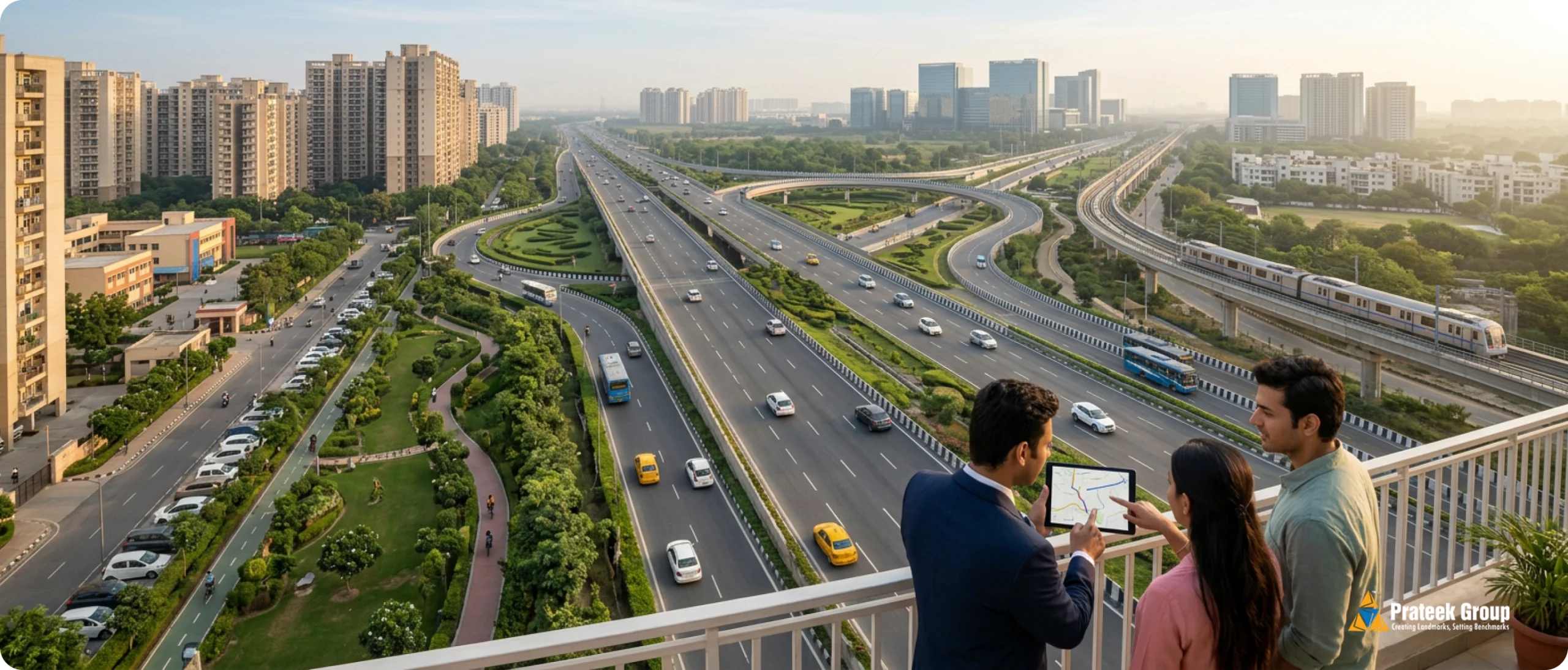
It helps to picture how daily journeys could change once the FNG and its bridge are finished. These are general scenarios, not promised travel times.
A family living in Sector 168 with 1 partner working in Faridabad could cross the Yamuna directly on the new bridge rather than travelling through south-east Delhi, turning a long, unpredictable drive into a much shorter trip.
A Ghaziabad resident working along the Noida Expressway could use the FNG to travel south through Noida without joining the busiest junctions near the Delhi border.
A Faridabad family flying often could reach the airport via the planned Faridabad spur to the Yamuna Expressway, or via the FNG bridge and southern Noida.
A business moving goods between Faridabad’s industrial areas and Greater Noida could avoid Delhi’s roads entirely, which also helps ease traffic for everyone else.
None of these will happen overnight, and actual times will depend on traffic and how the connecting roads are built. But they show why the FNG matters to so many households across the region.
Delhi traffic and the wider benefit
Much of the traffic between Faridabad, Noida and Ghaziabad currently passes through south-east and east Delhi, adding to congestion on routes such as the DND Flyway and the Kalindi Kunj corridor. A completed FNG would give that traffic an alternative. Even residents who never use the FNG could see some benefit from lighter traffic on these routes, though new roads often attract new traffic over time.
For Noida and Faridabad, the bigger long-term effect may be on how people choose where to live. When the journey between 2 cities becomes shorter and more predictable, families can weigh homes on both sides more freely, choosing on price, space and lifestyle rather than being tied to 1 side of the river by the commute.
Should you buy now because of the FNG?
Infrastructure news moves property sentiment, and it’s easy to overpay for a road that isn’t finished. The FNG has been delayed many times, and even with the bridge funding agreed, construction takes time. A sensible approach:
- Buy for what the location offers today, with the FNG as a future benefit.
- Don’t pay a large premium based on promised travel times.
- Check the status on the ground before you buy, as well as in news reports.
- Look at homes near the bridge end, such as the Sector 168 area, for the most direct benefit when it opens.
Roads that are operating add value now. Roads that are approved and funded are likely to arrive, but often later than planned. Roads that are only proposed may take much longer.
Renting and resale near the FNG
For investors, homes near the FNG’s completed stretches and the planned bridge could see growing interest as the road takes shape. In southern Noida, rental demand already comes from professionals working along the Expressway and families drawn to the lower-density sectors. A completed bridge would add tenants who work in Faridabad but prefer to live in Noida, and vice versa.
Resale interest usually follows infrastructure that people can actually use. Homes near an opened bridge and interchange tend to attract more buyers than those near roads still under construction. If you’re buying partly for resale, a home in an established part of the corridor, rather than at its unfinished edges, is usually the safer bet.
Living in southern Noida near the FNG
The southern Noida sectors along the FNG and the Expressway, including Sectors 143, 150, 165 and 168, offer newer, lower-density living, with more open land and quick access to the Expressway office clusters and the airport. Daily conveniences are still growing in some of these sectors, so many residents drive to neighbouring sectors for bigger shopping or specialist care.
For families who value space and calm, and who work along the Expressway, these sectors are a strong option. They also suit buyers who fly often, since the airport is closer from here than from almost anywhere else in Noida, and families who want a newer society with generous open space around the towers. The FNG bridge, when it opens, will add a direct link to Faridabad and make the area more connected still.
Costs of buying a 4 BHK on either side
Large homes carry large transaction costs, and the rules differ between the 2 states. In Noida, stamp duty is 7% for a male buyer, with a 1% concession for women on property worth up to ₹1 crore, plus 1% registration, and resales on Authority-leased land carry a transfer charge. In Faridabad, Haryana’s own stamp duty rates apply, which vary by the buyer and by whether the property is in an urban or rural area, and the registration fee follows Haryana’s rules.
On both sides, under-construction homes carry GST at an effective 5% for homes that aren’t affordable housing, completed homes with an occupancy certificate carry none, and 1% TDS applies to purchases of ₹50 lakh or more. For a 4 BHK costing several crore rupees, these charges run into lakhs, so confirm the exact figures for your purchase before you agree a price.
Running costs matter too. A 4 BHK in a premium society carries a large monthly maintenance charge, and GST at 18% applies if it exceeds ₹7,500 a month per member. Add utilities, staff and upkeep of a large home to your monthly budget alongside the EMI.
Home loans for a 4 BHK
Most 4 BHK buyers use a home loan for part of the price. Under the Reserve Bank of India’s rules, banks can lend up to 75% of a property’s value for loans above ₹75 lakh, so you’ll need to fund at least a quarter of the price, plus stamp duty and registration, yourself. Banks value large homes carefully, and the valuation can come in below the agreed price. Ask for an indicative valuation early, especially for a large or unusual home.
If you’re buying across the state line, from Noida to Faridabad or the other way, your bank will apply the relevant state’s rules for registration and title checks. That’s rarely a problem, but it’s worth mentioning when you apply so the bank’s legal team knows what to expect.
How to track the FNG’s progress yourself
Because the FNG’s timeline has shifted so often, it’s worth tracking progress directly rather than relying on marketing claims. A few simple habits help.
- Follow news from the authorities. The Noida Authority and Haryana’s agencies announce tenders, approvals and milestones, which are usually reported in local news.
- Visit the route. Drive past the bridge site near Sector 168 and the interchange near Sectors 141 and 143 every few months. Visible construction is the best evidence of progress.
- Watch for tenders and contracts. A contract awarded for the bridge is a stronger signal than an announcement of intent.
- Be wary of fixed dates in adverts. Treat any promised opening date as an estimate until the road is actually open.
A few minutes of checking every few months will give you a far better sense of the FNG’s timing than any brochure. It also helps you spot the moment when the bridge work begins in earnest.
Common mistakes buyers make
- Treating the FNG as finished. Parts of it are, but the key bridge isn’t yet.
- Relying on travel-time claims in advertisements. Test routes yourself.
- Forgetting the state difference. Faridabad is in Haryana and Noida in Uttar Pradesh, with different stamp duty and regulators.
- Comparing super area. Use carpet area for 4 BHK homes on both sides.
- Overlooking maintenance. Large homes carry large monthly charges.
Frequently asked questions
What is FNG Expressway connectivity?
FNG Expressway connectivity refers to the planned 56 km Faridabad-Noida-Ghaziabad Expressway, which will link Faridabad in Haryana with Noida, Greater Noida and Ghaziabad in Uttar Pradesh without passing through Delhi. Once complete, it’s expected to cut travel times between the cities significantly, with estimates of up to 40 minutes saved on some journeys.
What is the current status of the FNG Expressway?
Public reports in 2025 put the Noida section of the FNG Expressway at around 70% complete and partly in use, with sections such as a raised flyover stretch and an underpass pending. Uttar Pradesh and Haryana agreed to share the cost of a Yamuna bridge of about 550 m linking Noida Sector 168 with Faridabad, targeted for around 2027. Check current updates.
Which Noida sectors benefit most from the FNG Expressway?
Noida sectors along the FNG route and near its interchanges benefit most, including Sector 143 near the Expressway interchange, the Sector 150 belt, Sector 165 and Sector 168, where the Yamuna bridge to Faridabad is planned. The route also passes through sectors in the 120s and 140s. Sector 168 gains most directly once the bridge opens.
Are flats in Sector 168 Noida a good buy because of the FNG?
Flats in Sector 168 Noida sit where the FNG is planned to meet the Yamuna bridge to Faridabad, so they stand to gain directly once the bridge opens. Buy for what the location offers today, with the bridge as a future benefit, and don’t pay a large premium for travel times that depend on unfinished work.
What are flats in Sector 143 Noida like?
Flats in Sector 143 Noida sit on the Noida-Greater Noida Expressway, near office and IT buildings and the Aqua Line’s Sector 143 station, and close to the planned FNG interchange between Sectors 141 and 143. The sector already benefits from the Expressway and metro, and the completed FNG crossing would add a direct north-south route.
Where is Sector 165 in Noida?
Sector 165 is in the southern part of Noida along the Noida-Greater Noida Expressway corridor, close to the Sector 150 belt. It’s part of the newer, lower-density southern Noida, with access to the Expressway and the Yamuna Expressway, and it stands to gain from better FNG connectivity towards Faridabad and Ghaziabad.
Are 4 BHK apartments in Faridabad good value?
4 BHK apartments in Faridabad often offer more space for the money than similar homes in Gurugram or much of Noida, mainly in Greater Faridabad’s large gated societies. ANAROCK’s Q1 2026 data showed Faridabad taking about 10% of NCR housing sales. Check RERA registration, the occupancy certificate, the society’s management and your commute.
What should I check before buying a 4 BHK house in Faridabad?
Before buying a 4 BHK house in Faridabad, check the sanctioned building plan, the occupancy certificate, the title chain and any dues. Houses offer privacy and independence but need more upkeep and lack a gated society’s security and amenities. Confirm Haryana’s current stamp duty rates, and test your commute at peak hours.
Should I buy a 4 BHK in Faridabad or Noida?
Choose a 4 BHK in Faridabad if you work in Gurugram, south Delhi or Faridabad and want more space for the money. Choose Noida if you work in Noida’s Expressway office clusters, want low-density luxury options or direct airport access. The FNG bridge, once open, will make living in 1 city and working in the other much easier.
When will the FNG Yamuna bridge open?
A 2025 report described the FNG Yamuna bridge, linking Noida Sector 168 with Faridabad, as targeted for completion around 2027, after Uttar Pradesh and Haryana agreed to share its estimated ₹460 crore cost. Large bridge projects often take longer than planned, so check the latest status before relying on any date.