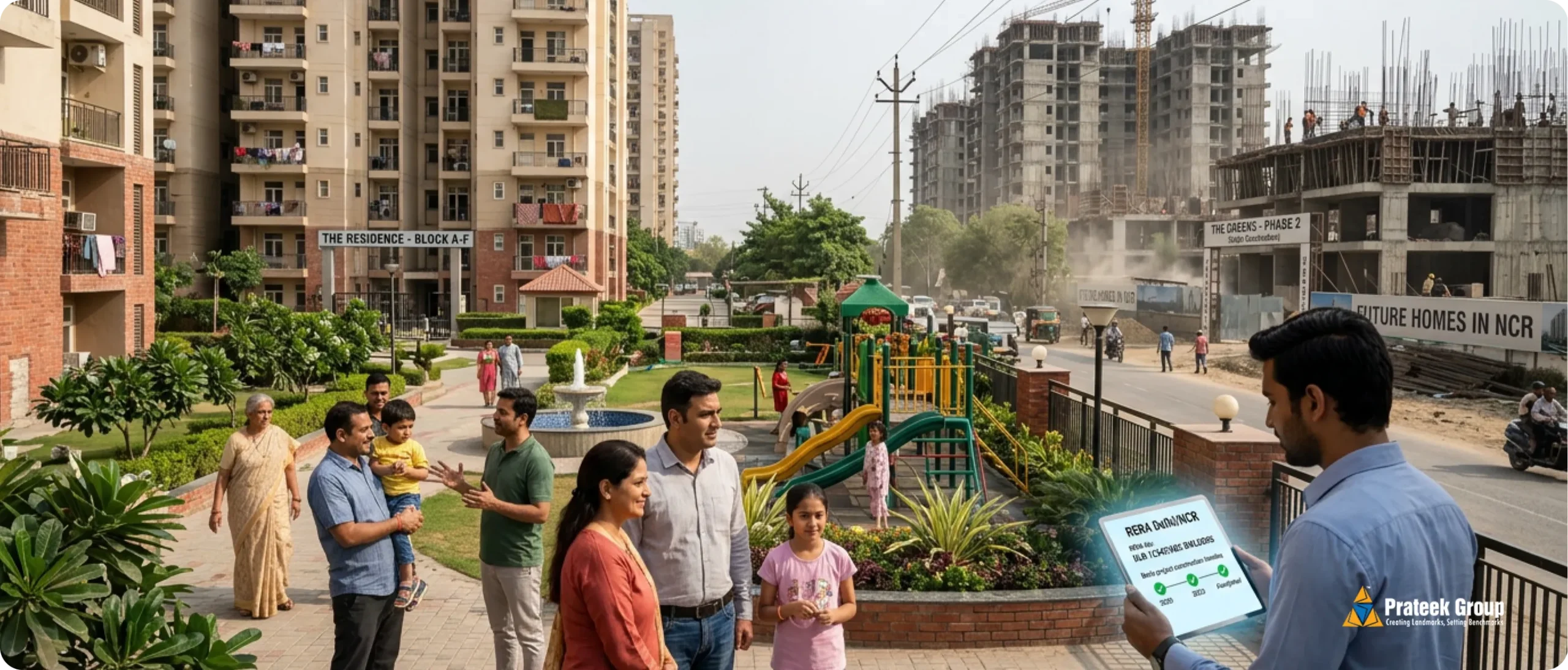
Search for the top 10 builders in Delhi NCR and you’ll find dozens of lists, each with a different order and few with any explanation of how the ranking was made. Some are paid placements. Some are years out of date. Almost none tell you what you actually need to know: whether a particular developer is likely to deliver your home on time, to a good standard, with clean paperwork.
This guide takes a different approach. Instead of another list of real estate builders in Noida, it gives you a 10-point framework for judging any developer yourself, using public records and your own site visits. It works for Noida, Greater Noida, Ghaziabad, Gurugram and Delhi, and it works whether you’re buying a new launch or a completed home.
Why top-10 lists mislead
Lists of builders are popular because they seem to save time. In practice, they often mislead in a few ways.
- No criteria. Most lists don’t say how they ranked developers, so you can’t tell whether size, quality or advertising spend decided the order.
- Paid placement. Some lists are sponsored, and the ranking reflects who paid.
- Outdated information. A developer’s position can change quickly, and lists are rarely updated.
- Size over quality. The biggest developer isn’t always the best for your purchase. A smaller developer with a strong local record can be the better choice.
- The wrong unit of analysis. You’re not buying a brand. You’re buying a specific home in a specific project, often built by a specific company under that brand.
A more useful question is whether a particular developer is right for the purchase you’re making. The framework below helps you answer it.
The 10-point builder framework
Check | What good looks like | Where to check |
1. RERA record | Registered projects, few extensions, few complaints | UP RERA portal and other state portals |
2. Delivery history | Completed projects close to promised dates | RERA filings, residents, visits |
3. Construction quality | Older societies still in good shape | Visit a 5 to 10 year old project |
4. Financial health | Stable funding, no insolvency proceedings | Insolvency records, credit ratings, news |
5. Legal history | No pattern of serious disputes | eCourts and tribunal records |
6. Land and approvals | Clear title and approved plans | RERA filings and documents |
7. Handover and after-sales | Timely handover to residents’ associations | Residents and associations |
8. Transparency | Clear cost sheets and agreements | Your own dealings with the developer |
9. Customer feedback | Consistent, recent, specific reviews | Residents, forums, review platforms |
10. Specialisation | A record in the type of home you want | The developer’s portfolio |
Let’s go through each.
RERA record
Start with the UP RERA portal, or the portal for the state where the project is. Search the developer’s name and review every project they’ve registered. For each, note the registered completion date, whether it’s been extended, the latest quarterly progress report and any complaints. A developer with many completed projects, few extensions and few complaints is a good sign. A pattern of extensions and complaints across several projects is a warning.
The Real Estate (Regulation and Development) Act, 2016 requires developers to register projects and file regular updates, so this record is public for anything launched or ongoing since 2017.
Delivery history
Delivery history matters more than anything a developer promises. Ask for a list of completed projects with their original promised dates and actual occupancy certificate dates. Check what you can against RERA filings, and ask residents when they actually moved in. A developer that has delivered several projects close to their promised dates is more likely to deliver yours.
Construction quality
Visit a society the developer completed 5 to 10 years ago. That’s where quality shows. Look at the exterior paint, waterproofing marks, the condition of lifts and common areas, the basement and the landscaping. Talk to residents about leaks, lift breakdowns and how problems were handled. A new show flat tells you little about how a building ages.
Financial health
A developer’s finances affect its ability to finish your project. Look for signs of stable funding: institutional investors or lenders, credit ratings from rating agencies where available and steady progress across projects. Check whether the company or its group has faced insolvency proceedings. The Insolvency and Bankruptcy Board of India publishes information on corporate insolvency processes, and news searches often surface financial stress early.
Legal history
Every large developer faces some litigation, so the question is whether there’s a pattern of serious disputes. Search the developer’s company names on the eCourts services portal for cases, and note consumer forum and RERA complaints. A few disputes across many projects is normal. Many disputes about delay or quality on a single project, or across several, is a warning.
Land and approvals
For any project, check that the developer owns the land or has clear rights to develop it, and that building plans are approved. RERA filings include these documents. In Noida and Greater Noida, where much land is leased from development authorities, check that the lease is in order and that dues to the authority are being paid.
Handover and after-sales
A good developer hands over common areas and records to the residents’ association on time and fixes defects promptly. Ask residents of completed projects how the handover went, how long defect repairs took and how the developer responded to complaints. Under RERA, developers are responsible for fixing structural defects reported within 5 years of possession.
Transparency
How a developer deals with you before you buy is a good guide to how it’ll deal with you after. Look for a clear, itemised cost sheet, an agreement for sale that states the carpet area and possession date, straight answers to questions and no pressure to book before you’ve checked the documents.
Customer feedback
Read reviews, but read them fairly. Look at dates, since old reviews may describe problems that have since been fixed. Look for specific, consistent points rather than vague praise or anger. Give more weight to residents you meet in person than to anonymous comments online. A pattern across many reviews matters more than any single 1.
Specialisation
Developers often do some things better than others. A developer may have a strong record in large townships, another in low-density luxury, another in affordable housing. Look for a record in the type of home you want. A developer that has delivered several successful luxury societies is a better bet for a luxury purchase than 1 that’s mainly built mid-market housing.
How to read a developer’s RERA filings
The RERA portal holds more useful information than most buyers realise. Here’s how to get the most from it.
Start with the promoter
Search the developer’s name and each company it uses. The promoter details page usually lists the directors, the company’s past projects and its contact information. Note every company name, since you’ll use them for the other checks.
Review past and current projects
For each registered project, look at the registered completion date and any extensions granted. A project extended once for a clear reason is different from a project extended several times. Compare the number of completed projects with the number still under construction, which tells you how stretched the developer is.
Read the quarterly progress reports
Developers file quarterly updates showing construction progress, bookings and money received. Look at how progress has moved over several quarters. Steady progress is a good sign. Long periods with little change can signal trouble.
Check approvals and land documents
Registered projects upload their approvals and land documents. Check that the plans are approved and that the land title or development rights are in the promoter’s name or clearly documented.
Look at complaints
Many portals show complaints filed against a project and their outcomes. A few complaints on a large project are normal. Many complaints about delay, quality or refunds are a warning.
Talking to residents: what to ask
Residents of a developer’s completed projects are the most honest source of information you’ll find. A short conversation in the park or at the gate can tell you more than a sales presentation. Ask:
- When did you move in, compared with the promised date?
- Were there any problems at handover, and how quickly were they fixed?
- How has the building held up, especially waterproofing and lifts?
- How did the developer handle the handover to the residents’ association?
- Would you buy from this developer again?
Talk to 3 or 4 residents if you can, in different towers. Consistent answers tell you a lot, and so do mixed ones. If residents in 1 tower are happy and those in another are not, ask why, since it can point to differences in construction or handover between phases.
Checking finances without being an analyst
You don’t need to read balance sheets to get a sense of a developer’s financial health. A few simple signs help.
- Construction pace across projects. A developer that keeps building steadily on several sites usually has funding in place. Sites that stall are a warning.
- Institutional backing. Funding from established lenders or investors, often reported in the news, suggests the developer has passed outside checks.
- Credit ratings. Some developers and their companies are rated by rating agencies, and these ratings and rating changes are published.
- Insolvency checks. Search the company names for any insolvency proceedings through the insolvency regulator’s records.
- News coverage. A news search for the developer’s name alongside words like “delay”, “dues” or “insolvency” surfaces problems quickly.
None of these is conclusive on its own, but together they give a reasonable picture of whether a developer can see your project through.
When a smaller developer is the right choice
Bigger isn’t always better. A smaller developer with a focused, strong record in 1 city can deliver an excellent home, sometimes with more attention to detail than a large company stretched across many markets. Smaller developers are often more accessible, and senior people may be directly involved in each project.
The framework applies equally to small and large developers. For a smaller developer, give extra weight to its completed projects and residents’ experiences, since there are fewer data points. For a large developer, look closely at the specific company and team handling your project, since quality can vary between projects under the same brand.
Builders and resale value
The developer’s reputation affects your home’s value long after you move in. Societies built by developers with a strong delivery record and good estate management tend to hold value better and sell more easily, because future buyers trust them. A society with a history of disputes, poor upkeep or unfinished common areas can weigh on resale prices for years.
That’s another reason to judge developers on evidence. The same checks that protect you as a buyer also protect the value of your home when you come to sell.
Brand vs company: who you’re really buying from
Real estate companies in Noida and across the NCR often build different projects through different companies under 1 brand. The project you buy may be developed by a special purpose company, with the brand’s name on the hoardings and a different legal entity on the RERA registration and your agreement.
That’s normal and legal, but it matters. Check the promoter’s name on the RERA registration and on your agreement for sale, and make sure you know which company is responsible for your project. Then look at that company’s record as well as the brand’s. If a Noida real estate company can’t clearly explain which entity is developing the project and how it’s funded, ask more questions.
How long the checks take
The full framework sounds like a lot of work, but it’s manageable. Searching the RERA portal for a developer’s projects takes an hour or 2. A news and court records search takes another hour. Visiting a completed society and talking to residents takes a morning. Reading a cost sheet and agreement for sale carefully takes an evening.
In total, you’re looking at 2 or 3 days of effort spread over a week or so. Set against a purchase that may cost several crore rupees and shape your family’s life for decades, it’s time well spent. It also tends to make the decision easier, because you’re choosing on evidence rather than on advertising.
Real estate builders in Delhi vs the wider NCR
Searches for top builders in Delhi and real estate builders in Delhi often come from buyers who want to live in the city itself. It helps to know how Delhi’s market differs.
Delhi has limited land for new large-scale group housing, so much of its new supply comes from builder floors on redeveloped plots, redevelopment of older colonies and a smaller number of larger projects. Builder-floor developers are often small local firms. For these, the checks above still apply, but with extra attention to the sanctioned building plan from the municipal body, completion certificates and the title of the plot.
Most large-scale new housing near Delhi is in Noida, Greater Noida, Ghaziabad and Gurugram, which is why many “Delhi NCR” builder lists are really about these cities. Apply the same framework wherever you buy.
Premium residential projects in the NCR: what sets developers apart
For premium residential projects in the NCR, a few things separate the best developers from the rest:
- Low density and generous planning, with fewer homes per acre and more open space.
- Consistent specifications, where what’s promised matches what’s delivered.
- Professional estate management after handover, with clear accounts.
- A record of delivering premium projects, with completed societies you can visit.
- Transparency on pricing, with clear cost sheets and no hidden charges.
Applying the framework: a worked example with Prateek Group
Here’s how you might apply the framework to Prateek Group, the developer behind this blog. We use it as an example of the process rather than a verdict, and we’d encourage you to run the same checks yourself.
Prateek Group was founded in 2005. In a June 2026 announcement reported by The Tribune, the company said it had delivered more than 20 million sq ft of real estate and served more than 50,000 customers. Those are the company’s own figures. The framework says to check them against the record.
- Delivery history. Prateek’s completed societies include Prateek Stylome in Sector 45, Prateek Edifice in Sector 107, Prateek Wisteria in Sector 77, Prateek Laurel in Sector 120 and Prateek Fedora in Sector 61 in Noida, and Prateek The Royal Cliff and Prateek Grand City in Ghaziabad. Visit them and ask residents when they moved in.
- Construction quality. Several of these societies are more than 10 years old, which makes them useful for judging how Prateek’s buildings age.
- RERA record. Search the company’s registered projects on the UP RERA portal and review their filings.
- Customer feedback. Read resident reviews with their dates in mind, and speak to residents directly.
Prateek’s corporate profile sets out the company’s history and leadership. Treat it, like any developer’s own material, as a starting point for your checks.
New launch or ready home: adjusting the framework
The framework applies to every purchase, but the weight you give each check depends on whether you’re buying a new launch or a completed home.
For a new launch, the developer’s record is almost everything. You’re trusting them to build, finish and hand over a home that doesn’t exist yet. Give the most weight to the RERA record, delivery history, financial health and transparency. Check the specific project’s registration, approvals and progress reports, and read the agreement for sale carefully.
For a ready home, you can see the building, so construction quality and estate management come first. The developer’s record still matters, especially for defect repairs and the handover of common areas, but the society itself is now your main concern. Check the occupancy certificate, the residents’ association’s accounts and how the building has aged.
For a resale home in an older society, the developer may have long since handed over. The society’s management, the building’s condition and the title chain matter more than the developer’s current activities.
Builder floors and smaller developments
Builder floors, where each floor of a low-rise building on a plot is sold separately, are common in parts of Noida, Ghaziabad, Gurugram and Delhi. They’re often built by small local developers, and some fall below the size thresholds for RERA registration.
For builder floors, add these checks to the framework:
- The sanctioned building plan from the development authority or municipal body, and whether the building matches it.
- The completion or occupancy certificate for the building.
- Title to the plot and how your floor’s share of the land is recorded in your deed.
- Structural quality, since small projects may not have the same oversight as large societies.
- Shared services, such as parking, water tanks and the roof, and who maintains them.
Builder floors offer more privacy and a more independent feel than a large society, but they need more careful checking because regulatory protections can be thinner.
Questions to ask the developer directly
- Which company is the promoter on the RERA registration for this project?
- Which of your completed projects can I visit, and can I speak to residents?
- What were the promised and actual completion dates of your last 3 projects?
- How is this project funded, and who are the lenders?
- When will common areas be handed over to the residents’ association?
- How do you handle defect complaints after possession?
A developer that answers these clearly and without hesitation is showing you the transparency the framework looks for.
A list of builders in Noida: how to build your own
Rather than rely on someone else’s list of builders in Noida, build your own shortlist for the specific purchase you’re making.
- Start with the location and type of home you want.
- Note which developers have projects there, new or completed.
- Run the 10-point framework on each.
- Visit a completed project by each shortlisted developer.
- Compare the specific projects as well as the developers behind them.
The result is a short list that reflects your needs, based on evidence you’ve seen yourself. Prateek’s overview of top real estate developers in Noida sets out what buyers usually look for when comparing developers. Our guides on how homebuyers can identify a trusted builder in the NCR and what makes a real estate developer in Noida reliable go deeper into specific checks.
Awards, advertising and what they tell you
Developers often highlight awards, celebrity endorsements and large advertising campaigns. These aren’t meaningless, but they deserve less weight than the checks above.
Awards vary widely in how they’re judged. Some are rigorous. Others are closer to paid recognition. Advertising tells you a developer has marketing budget, not that it delivers well. Neither tells you how a building will age or how quickly a defect will be fixed.
Treat awards and publicity as a minor signal. If a developer has a strong record on delivery, quality and transparency, recognition is a pleasant extra. If the record is weak, no award should reassure you.
Using the framework as a family
Choosing a developer is often a family decision, and the framework helps keep the discussion grounded. Share the 10 points with everyone involved, divide the checks among you and bring the findings together before you decide. For example, 1 person might search the RERA portal while another talks to residents and a third reviews news coverage and court records.
Keep notes in 1 place, with dates and sources. When you’re weighing 2 or 3 developers, the notes will show clearly where each is strong and where you still have questions. And if you’re paying a large booking amount, that written record of your checks is worth having.
Red flags when choosing a builder
- Taking bookings or “expressions of interest” before RERA registration.
- A pattern of RERA extensions and complaints across projects.
- Unwillingness to show completed projects or introduce residents.
- Vague cost sheets or agreements without carpet area and a possession date.
- Pressure to book immediately.
- Unclear ownership of the land or the developing company.
- Delays in handing over completed societies to residents’ associations.
Frequently asked questions
How do I choose among real estate builders in Noida?
To choose among real estate builders in Noida, check each developer’s RERA record, delivery history, construction quality in older societies, financial health, legal history, land and approvals, after-sales service, transparency, customer feedback and specialisation. Visit a completed project by each shortlisted developer, and compare the specific projects you’re considering rather than the brands alone.
Where can I find a reliable list of builders in Noida?
The most reliable list of builders in Noida is 1 you build yourself for your purchase. Start with the location and type of home you want, note which developers have projects there, then check each on the UP RERA portal and visit their completed societies. Published lists often lack criteria, can be sponsored and are rarely up to date.
Who are the top 10 builders in Delhi NCR?
Rankings of the top 10 builders in Delhi NCR vary widely because they rarely state their criteria and some are sponsored. A better approach is to judge each developer on delivery history, RERA record, construction quality, financial health, legal history and after-sales service for the specific project and location you’re considering. The best builder for you depends on your purchase.
How do I check a real estate company in Noida before buying?
To check a real estate company in Noida, search its projects on the UP RERA portal, note completion dates, extensions and complaints, and look up the promoter company named on the registration. Search court records on the eCourts portal, check for insolvency proceedings and read recent news. Then visit a completed project and speak to residents.
What should I know about top builders in Delhi?
Delhi has limited land for new large-scale housing, so much new supply comes from builder floors on redeveloped plots, often by smaller local firms. For top builders in Delhi, check the sanctioned building plan, the completion certificate and the plot’s title carefully. Most large new projects near Delhi are in Noida, Greater Noida, Ghaziabad and Gurugram.
Why are top real estate builders in Delhi NCR lists unreliable?
Lists of top real estate builders in Delhi NCR are often unreliable because they rarely explain their ranking criteria, some are paid placements, many are out of date and they tend to reward size over quality. They also judge brands, while you’re buying a specific home in a specific project, often developed by a separate company under that brand.
What makes a good real estate developer in Delhi NCR?
A good real estate developer in Delhi NCR has a strong record of delivering projects close to their promised dates, buildings that age well, stable finances, few serious disputes, clear land titles, prompt handover to residents’ associations and transparent pricing. Its RERA filings should be up to date, and residents of its completed projects should speak well of it.
What sets premium residential projects in NCR apart?
Premium residential projects in NCR stand apart through low density, generous planning, consistent specifications, professional estate management after handover and transparent pricing. The developer should have a record of delivering premium projects as well as launching them. Visit a completed premium society by the same developer before you buy, and speak to residents about upkeep and management.
Does it matter which company builds my project under a brand?
Yes. Many NCR developers build projects through separate companies under 1 brand. The company named as promoter on the RERA registration and in your agreement for sale is legally responsible for your project. Check that company’s record, funding and registration as well as the brand’s overall reputation, and ask the developer to explain the structure if it isn’t clear.
What are the red flags when choosing a builder?
Red flags when choosing a builder include taking bookings before RERA registration, a pattern of extensions and complaints, reluctance to show completed projects, vague cost sheets, agreements without carpet area or a possession date, pressure to book immediately, unclear land ownership and delays in handing over completed societies to residents’ associations.