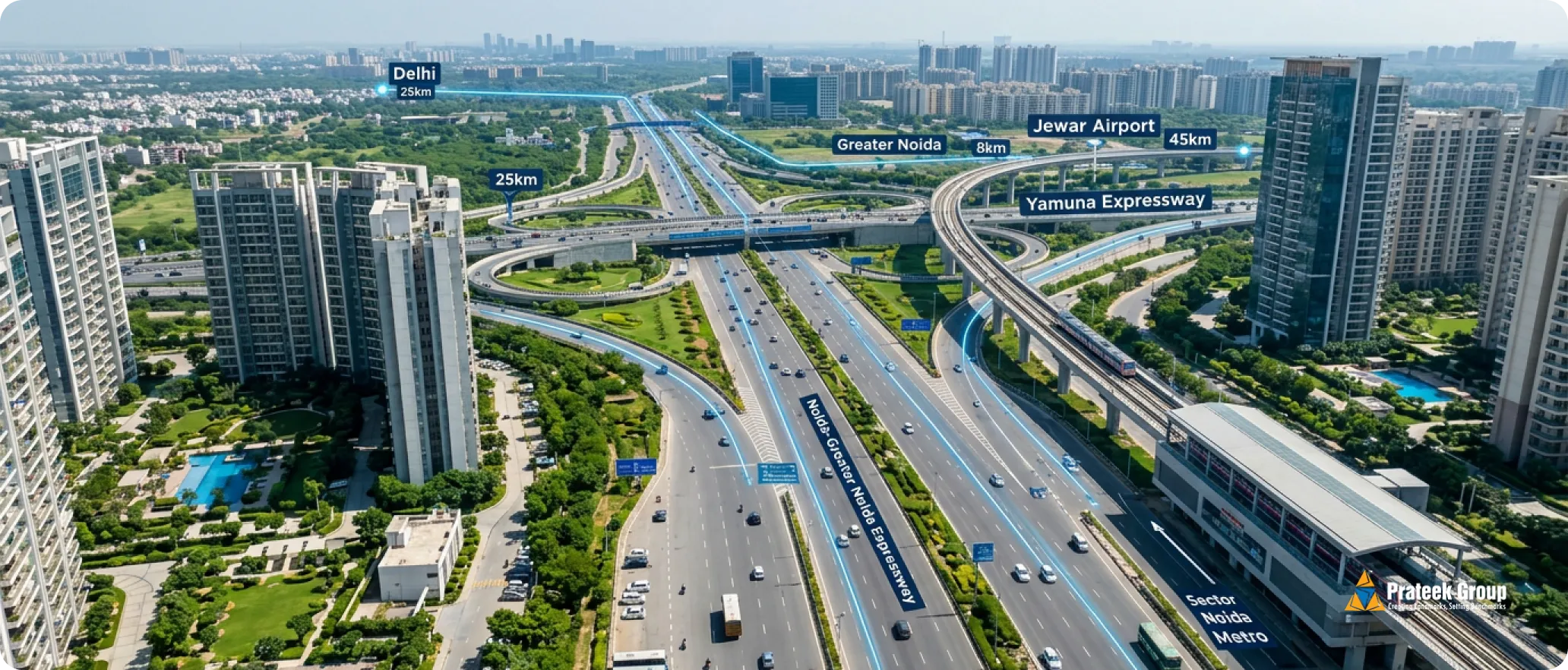
A road map can make almost any Noida project look well connected. The brochure draws a bold line to an expressway, adds a metro icon, places an airport symbol nearby and leaves the buyer to assume the daily journey will be easy.
Homebuyers need a stricter test.
Connectivity matters when the route works from the project gate, at the hour the family travels, through the junctions and service roads that people actually use. A six-lane expressway 4 km away can save time. The same expressway can add little value when the final approach is slow, the U-turn is badly placed or the route depends on a future link.
Sector 150 sits in an unusual position on Noida’s southern edge. The Noida-Greater Noida Expressway provides its main daily road spine. The Yamuna Expressway opens the southbound route toward the airport, the industrial belt and Agra. The Faridabad-Noida-Ghaziabad corridor is meant to create an east-west NCR connection, although large parts of that road remain incomplete in July 2026.
That distinction shapes this entire guide. Two expressways are operating roads. The third is a future network benefit with partial stretches on the ground. Buyers should value each one according to its present use, rather than paying the same premium for all three.
We are Prateek Group, and Prateek Canary is located in Sector 150. Our commercial interest is clear. The useful way to discuss the sector is to show what each road does, who gains from it, where the claims become overstated and how a buyer can test the routes before paying a booking amount.
This guide examines Sector 150 Noida connectivity from the perspective of a family, an investor and a future seller. It covers weekday travel, airport access, the Noida office belt, Greater Noida, Delhi, Faridabad, Ghaziabad and the road projects that may change the network through 2032.
TL;DR
The Noida-Greater Noida Expressway carries the daily case
This is the operating road that matters most for residents. It connects Sector 150 with Noida’s office sectors, Greater Noida, Pari Chowk and the wider expressway belt. A buyer working between Sectors 125 and 142 receives the clearest day-to-day benefit.
The Yamuna Expressway carries the regional case
The Yamuna Expressway supports travel toward Noida International Airport, the YEIDA industrial belt, the Buddh International Circuit, Mathura and Agra. Commercial flights from the airport began in June 2026, so airport access has moved from a brochure promise to a usable road journey.
The FNG corridor carries future cross-NCR potential
The proposed 56 km Faridabad-Noida-Ghaziabad road is designed to connect the three cities without pushing every trip through Delhi. Only part of the Noida stretch is complete. FNG Expressway connectivity should sit in the future-upside column until missing links, the Yamuna crossing and the Haryana side are finished.
Expressway access does not remove last-mile problems
Project exits, local roads, U-turns, merging points, traffic enforcement and road safety still decide the commute. Buyers should drive every important route on a weekday before they shortlist a tower.
The strongest fit is route-dependent
Sector 150 suits Noida Expressway professionals, Greater Noida workers, frequent airport users and families who travel south or east across the NCR. Daily Gurugram, central Delhi or Ghaziabad commutes need a harder test because the network still has gaps.
What “three expressways at your doorstep” actually means
The phrase sounds simple. The road network is not.
Sector 150 does not have three finished expressways running along the project boundary. It sits close to one operating urban expressway, connects onward to a second operating intercity expressway and lies near the planned path of a third regional corridor.
A buyer should read the claim this way:
- Noida-Greater Noida Expressway: Operating and central to daily travel.
- Yamuna Expressway: Operating and reaching through Greater Noida’s road network.
- FNG corridor: Partly built, with major missing sections and cross-state work still pending.
- DND Flyway: A supporting Delhi-side link reached through the Noida road network.
- Eastern Peripheral Expressway: A regional bypass reached farther south and east, useful for selected freight and intercity routes rather than ordinary daily movement from Sector 150.
The first two roads can be tested today. The FNG route needs milestone tracking. This is the safest way to interpret Sector 150 Noida expressway connectivity without turning a future road into a current amenity.
The network still gives Sector 150 an advantage. Few Noida residential sectors sit between the established Noida office spine, Greater Noida, the Yamuna corridor and the airport side. The address lets a household travel in several directions without first crossing central Noida.
The road network at a glance
|
Road or corridor |
Status in July 2026 |
Main direction |
Real value for a Sector 150 buyer |
Main caution |
|---|---|---|---|---|
|
Noida-Greater Noida Expressway |
Operating |
North and south |
Office access, Greater Noida, DND-side movement |
Service-road and merge delays |
|
Yamuna Expressway |
Operating |
South-east |
Airport, YEIDA, BIC, Mathura and Agra |
Access is onward, not at the project gate |
|
FNG corridor |
Partly complete |
East and west |
Future Faridabad and Ghaziabad movement |
Major missing links remain |
|
DND Flyway |
Operating |
Delhi side |
Delhi entry through the Noida corridor |
Peak traffic beyond the flyway |
|
Eastern Peripheral Expressway |
Operating |
Regional bypass |
Selected airport, freight and intercity routes |
Farther from normal daily travel |
|
Yamuna Pushta road |
Existing, upgrades planned |
Parallel Noida-Greater Noida movement |
Possible relief route and airport traffic support |
Capacity work remains under development |
This table explains why the sector can be called one of the candidates for the best connected sector in Noida, yet the phrase needs context. These Sector 150 location advantages come from network breadth. Direct public transport, cross-river links and peak-hour road performance remain uneven.
Expressway 1: The Noida-Greater Noida Expressway is the daily spine
The Noida-Greater Noida Expressway does most of the practical work in the Sector 150 location story.
It links the sector toward Noida’s commercial and institutional belt, then continues north toward Mahamaya Flyover, the DND side and Delhi routes. Southbound, it reaches Greater Noida and the interchange network around Pari Chowk.
This is why Noida-Greater Noida Expressway property attracts office-going buyers. The road runs beside a long line of employment sectors, including areas around Sectors 125, 126, 127, 132, 135, 137, 142 and adjoining pockets. A resident whose office sits on this belt can avoid many internal city roads.
The commute advantage is strongest for a specific office map
Sector 150 works naturally for people travelling to:
- Sector 125 and the institutional belt
- Sector 126 and Sector 127 offices
- Sector 132 business parks
- Sector 135 corporate campuses
- Sector 137 residential and office areas
- Sector 142 and nearby commercial sites
- Greater Noida’s Knowledge Park and institutional zones
The road becomes less convincing when the job lies in Sector 62, Delhi’s northern districts or Gurugram. Distance and cross-city movement begin to outweigh the expressway benefit.
Our guide on how transport links affect value explains the property side of this equation, although a buyer should begin with personal travel time. A route that saves 25 minutes twice a day can justify a location premium for an end user. The same premium carries less meaning for someone working from home or travelling twice a month.
The final 2 km decide more than the brochure admits
The expressway itself is broad and controlled. The journey between the society gate and the carriageway can create delays.
Check the following points:
- Which side of the expressway does the project sit on?
- Where is the nearest legal U-turn?
- Does the route use a service road or an internal sector road?
- How many school buses and construction vehicles use the same exit?
- Does water collect near the approach during heavy rain?
- Is the road lit after 9 PM?
- Can an ambulance enter and leave without a long diversion?
A buyer should run this test at 8:30 AM and 6:30 PM. The quiet Sunday drive used by many sales teams gives a weak picture of weekday travel.
The road also supports resale depth
Future buyers understand the Noida Expressway corridor. The employment belt, metro line, schools and completed housing give the location a recognisable market identity.
This helps resale when the exact unit also works. A clean 3 BHK with sensible carpet area, usable parking, clear title and a reasonable maintenance bill can attract families who already work on the corridor.
Road access cannot rescue an overpriced or poorly documented unit. It can widen the pool of people willing to consider it.
Expressway 2: The Yamuna Expressway changes the regional map
The Yamuna Expressway begins from the Greater Noida side and runs 165.5 km toward Agra. For a Sector 150 resident, it is reached through the adjoining Greater Noida road network rather than from a ramp outside the society.
That difference matters. Yamuna Expressway connectivity from Sector 150 is real, though it is an onward connection. Buyers should time the journey from their exact project to the expressway entry instead of quoting the distance between two map points.
The road creates four useful travel patterns.
First, it gives residents a direct south-east route toward Noida International Airport. Commercial passenger flights began on 15 June 2026. The airport’s first phase is designed for 12 million passengers a year, and route growth will determine how quickly that capacity becomes relevant to nearby housing markets.
Second, the expressway connects Sector 150 with the YEIDA industrial and institutional belt. Manufacturing, logistics, warehousing, data centres, education and aviation-linked activity can create a larger employment base over time.
Third, it supports leisure and intercity travel toward the Buddh International Circuit, Mathura and Agra. A family does not use this route every day, yet weekends and business travel become simpler.
Fourth, the road connects into a wider regional system that includes the Eastern Peripheral Expressway and developing airport-side roads. This can spread traffic across more than one corridor as the area matures.
The airport effect needs restraint. Readers comparing the wider region can study which airport corridors benefit most because an operational airport does not raise every nearby property by the same amount. Direct airport markets depend on aviation jobs and business activity. Sector 150 depends more on its established residential demand, Noida office access and the convenience of reaching the airport by road.
For a frequent flyer, this is a daily-life gain. For an investor, it is one part of the demand story. For a buyer who rarely flies, the office and school routes should carry more weight.
Expressway 3: The FNG corridor remains a future route
The Faridabad-Noida-Ghaziabad corridor was planned as a six-lane, roughly 56 km east-west road. Its purpose is easy to understand. A completed link would let traffic move between Faridabad, Noida and Ghaziabad without routing every journey through Delhi or other crowded junctions.
The July 2026 position is less simple.
Noida Authority has completed only part of the road under its jurisdiction. Recent reporting placed the completed portion at about 11.6 km out of Noida’s 23 km stretch. Land acquisition, funding, the Yamuna crossing and coordination with Haryana remain unresolved across parts of the full corridor.
What the completed FNG would change
A finished route could support:
- Faster access toward Faridabad employment areas
- A cleaner east-west link toward Ghaziabad
- Less dependence on central Delhi routes
- Better distribution of regional road traffic
- A stronger connection between residential and industrial pockets
- Wider resale interest from households with cross-NCR work patterns
What a buyer can use today
A buyer can use completed local stretches where they connect to the current road network. The full Faridabad-to-Ghaziabad journey promised by the corridor is not available as a continuous expressway.
This is where brochure language needs discipline. FNG Expressway connectivity can support future value once missing segments are built. It should not be used to calculate today’s office commute to Faridabad or Ghaziabad.
Milestones worth tracking
|
FNG milestone |
Why it matters |
Buyer response |
|
Completion of Noida’s missing stretch |
Creates a more usable local corridor |
Test the exact project approach |
|
Final Yamuna bridge plan |
Makes Faridabad connection possible |
Wait for sanctioned alignment and work |
|
Haryana-side road progress |
Completes the westward route |
Track land and construction, not announcements |
|
Ghaziabad-side integration |
Improves eastward movement |
Check connection with existing urban roads |
|
Traffic opening date |
Converts future value into current use |
Re-test weekday travel times |
The buyer should pay for roads according to stage. Operating roads deserve the most weight. Roads under construction deserve partial weight. Unbuilt links deserve none in the base budget.
Supporting links: DND, EPE and the metro
The three-expressway headline leaves out several links that affect the real journey.
DND Flyway
DND provides one of the established road connections between Noida and Delhi. Sector 150 residents reach it through the Noida-Greater Noida Expressway and the Mahamaya side.
The route works well outside severe peak traffic. Delhi-side congestion still decides the final arrival time. A smooth expressway drive can end in a slow city journey after the flyway.
Eastern Peripheral Expressway
The Eastern Peripheral Expressway circles around the eastern NCR and connects with routes toward Ghaziabad, Kundli, Palwal and other regional corridors. Sector 150 does not sit directly on it. Residents can reach it through the wider Greater Noida and Yamuna network.
Its main buyer value comes from selected intercity trips, freight distribution and the larger airport-region road system. It should not be described as an everyday doorstep road for most households.
Sector 148 Metro Station
Road access becomes stronger when a household has a second travel option. Sector 148 Metro Station sits on the operating Aqua Line and serves the southern expressway sectors.
Most Sector 150 projects still need a feeder trip to the station. Buyers should check auto availability, parking, lighting and the journey from the project gate. The station helps Noida and Greater Noida travel; Delhi journeys currently include a transfer between the Aqua Line and Blue Line network.
The approved Sector 142 to Botanical Garden extension is planned as an 11.56 km elevated corridor with eight stations. Once operational, it should improve interchange with the Blue and Magenta lines at Botanical Garden. Construction still lies ahead, so the current purchase should work without it.
Doorstep connectivity is measured from the society gate
A homebuyer often receives distance claims measured from the sector boundary. The family travels from a tower parking space.
Use this route equation:
Lift time + basement exit + project gate + local road + merge point + main corridor + destination exit + final road = actual commute
Every part counts.
A large society can take 6 to 10 minutes to clear during school-bus time. A badly placed U-turn can add several kilometres. A service road can slow sharply when commercial traffic grows. A metro station can appear close and still require a 20-minute feeder journey.
Test these six trips before booking:
- Project to the office at weekday peak time
- Project to the preferred school during the morning run
- Project to the nearest emergency hospital
- Project to Sector 148 Metro Station
- Project to Noida International Airport
- Project to the family destination visited most often
Record the time, route, toll, fuel use and difficult junctions. Repeat the two most important trips on another day.
A home is held for years. Two site visits are cheap.
Commute matrix: who gains from Sector 150’s road position?
|
Regular destination |
Likely fit |
Main route |
What to test |
|
Noida Sectors 125 to 142 |
Strong |
Noida-Greater Noida Expressway |
Peak merge and office exit |
|
Greater Noida and Pari Chowk |
Strong |
Expressway and local Greater Noida roads |
Event-day traffic |
|
Noida International Airport |
Strong for road users |
Greater Noida and Yamuna Expressway |
Actual terminal drive time |
|
Central Noida |
Moderate |
Expressway plus internal roads |
Final 5 to 10 km |
|
South Delhi |
Moderate and time-dependent |
Expressway and DND/Mahamaya routes |
Morning peak congestion |
|
Central Delhi |
Weak to moderate for daily travel |
Expressway plus Delhi roads or metro |
Full door-to-door time |
|
Faridabad |
Future improvement case |
Current roads, later FNG |
Cross-river bottleneck |
|
Ghaziabad |
Route-dependent |
Noida roads, EPE or future FNG |
Peak traffic and distance |
|
Gurugram |
Weak for daily travel |
Multiple NCR corridors |
Toll, cross-city time and fatigue |
This matrix should shape the home search before project amenities enter the discussion.
A buyer working near Sector 135 can gain 250 or more hours a year compared with a route that adds 30 minutes each way. A Gurugram commuter can lose the same amount, even inside a better apartment.
How expressway access changes the property case
Roads affect residential property through use, perception and future demand.
Daily use
An operating expressway can reduce commute time, make airport travel simpler and widen access to jobs. End users feel this return every week.
Market perception
Buyers recognise certain corridors. “Noida Expressway” is a clear search category on property portals and among brokers. That identity helps projects reach people outside the immediate neighbourhood.
Future demand
New offices, industrial activity, education and airport-linked business can bring more households into the corridor. This demand builds over years rather than arriving on the day a road or terminal opens.
Supply response
Connectivity can trigger new launches in adjacent sectors. More supply gives buyers options and can limit price growth when too many similar units enter the market.
Price already paid
A road benefit may already sit inside the current price. Sector 150 rates have risen sharply over the last cycle. Buyers entering in 2026 are paying for a large part of the expressway, airport and green-sector story.
This is why investing in Sector 150 Noida needs a better answer than “three expressways.” The project must have clean approvals, a realistic possession date, a sensible density and a unit that future families can afford.
Three realistic value scenarios
Scenario 1: The operating-road case holds
The Noida-Greater Noida Expressway continues to support office demand. Airport flights and YEIDA employment grow steadily. The FNG corridor remains delayed.
In this scenario, completed and registry-clear homes with good road access can hold demand. Buyers who paid a fair rate receive the strongest outcome. Projects sold mainly on FNG expectations gain less.
Scenario 2: The wider network improves
FNG construction advances, the metro extension reaches commissioning and airport routes expand. Sector 150 becomes easier to reach from more NCR job centres.
Resale demand can widen beyond current Noida Expressway and Greater Noida buyers. Projects with clean documentation, lower density and practical unit sizes benefit most.
Scenario 3: Traffic grows faster than capacity
Airport and office traffic rise, but local road upgrades, service roads and alternative routes lag. Peak congestion increases on the Noida-Greater Noida Expressway.
Projects with poor exits suffer more. Buyers begin paying extra for smoother gate access, better U-turn positions and reliable metro feeders. The sector remains desirable, but travel time varies sharply from one plot to another.
The three scenarios show why the exact project entrance matters. A sector-level map cannot predict tower-level convenience.
Sector 150 against nearby buying zones
Connectivity should be compared with a fixed destination and budget. A lower price can lose its advantage through a longer daily route. A premium location can become wasteful when the family rarely uses its roads.
|
Location |
Road strength |
Metro position |
Main buyer type |
Main drawback |
|
Sector 150 |
Noida Expressway plus Yamuna side |
Aqua Line through Sector 148 |
Premium end users and corridor professionals |
Entry price and daily retail |
|
Sectors 137 and 143 |
Direct expressway office belt |
Strong Aqua Line access |
Professionals and rental investors |
Higher density in several projects |
|
Sector 128 |
Central premium expressway position |
Road-led |
Senior professionals and premium buyers |
High pricing |
|
Greater Noida |
Yamuna and Noida Expressway access |
Aqua Line in key zones |
Families, institutions and businesses |
Distance from central Noida |
|
Greater Noida West |
Road network toward Noida and Ghaziabad |
Future metro expansion |
Budget-led families |
Traffic and varying civic quality |
|
Sectors 151 and 152 |
Similar southern corridor position |
Aqua Line nearby in parts |
New-launch buyers |
Social infrastructure still forming |
Families comparing budgets can read Sector 150 versus Noida Extension because a lower booking price can be offset by fuel, tolls, school travel and time. The decision should come from the household’s weekly map.
Project choice: which homes preserve the connectivity benefit?
Once the location works, the project needs to preserve that advantage.
A project with a direct, safe exit can outperform one that appears closer on the map but requires a long loop. A completed society may have working feeder services and local retail. A new project may promise a better future layout and carry a longer wait.
Several Sector 150 competitors show how different project formats use the same road story.
The ATS Kingston Heath project places the project near the Noida Expressway, Sector 148 Metro and the airport route, and its low-density wellness format targets buyers who value longer holding periods. The homebuyer still needs to test the site-office route at peak time and confirm the exact tower’s access.
The Godrej Nurture official project presents a family-focused product in Sector 150. Families comparing it should place school-bus movement, child activities and daily retail beside expressway travel rather than judging connectivity only through office distance.
The Godrej Nest official project refers directly to the Noida-Greater Noida, Yamuna and FNG expressways. Buyers can inspect the finished or mature environment, then compare actual road performance with the marketing claim.
The Tata Eureka Park project describes a smart-home project with smaller configurations than several luxury projects in the sector. Compact units can attract a wider rental and resale audience, although project density and final gate access need separate checks.
The ATS Le Grandiose project positions the development on the Noida Expressway side with golf-facing, lower-density homes. Ready or mature inventory lets buyers inspect the route, resident traffic and maintenance before deciding.
The ATS Pristine Golf Villas shows the other end of the market, a very low-density villa format tied to the same corridor. Scarcity can support value, though the future buyer pool for large villas is smaller than the pool for efficient apartments.
These projects share the sector. Their road access, density, completion stage, total cost and exit audience differ.
Where Prateek Canary fits

Prateek Canary sits on Plot SC-02/A7 in Sector 150 and is registered under UPRERAPRJ591510. The project has 664 homes across 12.55 acres, with 3 BHK, 4 BHK and duplex penthouse formats.
The project’s connectivity argument begins with the Noida-Greater Noida Expressway. The route supports travel toward the Noida office belt and Greater Noida. The Yamuna side supports airport and southbound travel. FNG remains a future supporting corridor.
Buyers can review Prateek Canary in Sector 150 inside the same framework used for every competing project. Time the gate-to-expressway journey, check the route to Sector 148 Metro, drive to the airport, read the RERA record and ask about the current registry and authority-dues position.
Who is likely to value the location
- Families working along the Noida Expressway
- Business owners travelling between Noida and Greater Noida
- Frequent flyers using Noida International Airport
- NRI families wanting a premium NCR base
- Buyers planning a seven-year or longer hold
- Households seeking larger homes and lower project density
Who should test the decision harder
- Daily Gurugram commuters
- Buyers working in North Delhi
- Investors relying on high rental yield
- Households stretching to maximum loan eligibility
- Families needing a walkable market outside the gate
The project is a premium purchase. The expressway case should improve the family’s routine enough to justify that premium.
Airport access: useful today, economic effect later
Noida International Airport is operating. This changes the road discussion.
Before June 2026, buyers were pricing a completion promise. Residents can now drive to a working passenger terminal, book flights and assess the journey under real conditions. Noida International Airport connectivity has become measurable.
The first phase has one runway and one terminal, with capacity for 12 million passengers a year. IndiGo began the first commercial service, with additional airline and route growth expected over time.
The residential effect arrives in stages:
- Travel convenience: Frequent flyers gain immediately.
- Airport employment: Operations, security, retail, cargo and services build direct jobs.
- Business clustering: Hotels, logistics, offices and suppliers can increase demand around the corridor.
- Regional reputation: The wider Noida and Greater Noida market gains another national transport asset.
- Longer-term housing demand: Workers and businesses choose homes based on job location, budget and social infrastructure.
The fourth and fifth stages take time. Jewar Airport property growth should be judged through passenger numbers, airline routes, cargo volumes, business occupancy and actual residential demand.
Sector 150 carries a balanced airport case. It is close enough for road access and established enough to function as a family market without depending entirely on airport jobs.
Road capacity, traffic and safety
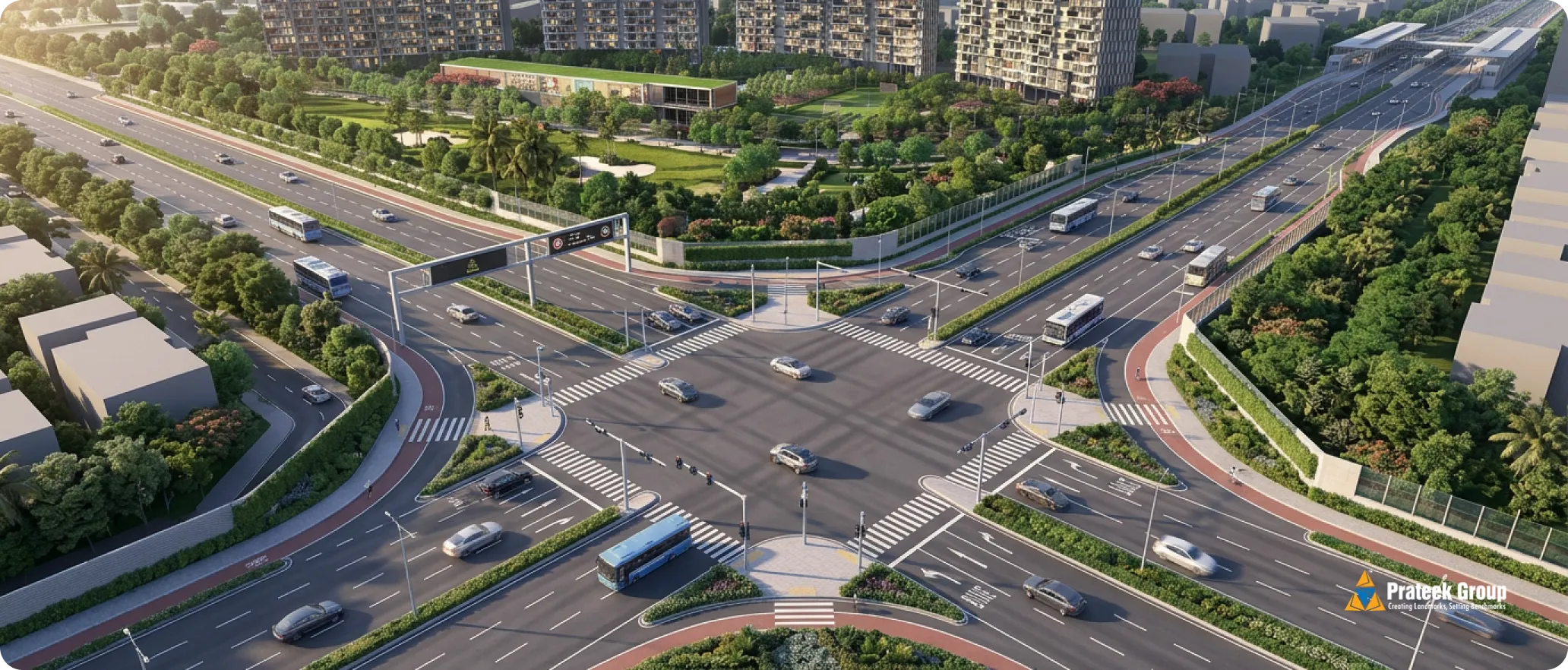
Expressways move traffic quickly. They also concentrate on it.
The Noida-Greater Noida Expressway already carries office commuters, residents, freight and Greater Noida traffic. Airport use adds another stream. Planned widening and alternative road work, including upgrades around the Yamuna Pushta road, show that public agencies expect heavier movement.
A buyer should inspect more than travel time.
Merge safety
Check whether vehicles enter the main road through a marked lane. Sudden local-road merges create risk, especially at night.
Service-road maintenance
Broken edges, waterlogging, construction debris and parked trucks can turn a short approach into the weakest part of the journey.
Emergency response
Ask the project team and nearby residents how ambulances reach the site. Identify the nearest hospital route and test it once.
Pedestrian movement
Many expressway sectors are built for cars. A metro station or market can be physically close and unsafe to reach on foot.
Construction traffic
Sector 150 and neighbouring sectors still have active building sites. Heavy vehicles can affect dust, road damage and peak-hour flow.
Connectivity quality includes safety, lighting, enforcement and maintenance. Lane count alone gives an incomplete answer.
Toll, fuel and time: the ownership cost hidden in the route
A lower property price can produce a higher monthly travel bill. A premium property can save time and still cost more through tolls, fuel and car dependence.
Use a simple yearly calculation.
|
Cost item |
Example buyer check |
|
Daily distance |
Round trip from project to office |
|
Working days |
Use the real office schedule |
|
Vehicle mileage |
Use city and expressway average |
|
Fuel rate |
Add a buffer for future increase |
|
Toll |
Include airport or intercity routes used regularly |
|
Cab use |
Include late-night and airport travel |
|
Parking |
Office and metro parking |
|
Time |
Value the hours lost each month |
A route that adds 20 km a day creates roughly 5,000 extra kilometres across 250 working days. Fuel and maintenance costs rise. The family also loses time that never appears in the purchase agreement.
A buyer studying property in Sector 150 Noida should add this travel budget beside EMI, maintenance and school fees. Location affordability is a monthly calculation.
Buyer suitability matrix
|
Buyer profile |
Sector 150 road fit |
Reason |
Main warning |
|
Noida Expressway professional |
Strong |
Direct daily road spine |
Project exit still matters |
|
Greater Noida business owner |
Strong |
Easy north-south movement |
Event traffic around Pari Chowk |
|
Frequent airport traveller |
Strong |
Yamuna-side airport route |
Public transport to airport is limited |
|
NRI family |
Strong with checks |
Airport access and premium housing |
Remote document verification |
|
Hybrid Delhi professional |
Moderate |
Fewer weekly commutes |
Peak-hour route remains long |
|
Daily central Delhi commuter |
Moderate to weak |
Expressway helps part of trip |
Final city journey is tiring |
|
Faridabad professional |
Future case |
FNG could help later |
Full corridor is incomplete |
|
Ghaziabad professional |
Route-dependent |
EPE and future FNG options |
Distance and traffic remain high |
|
Rental-yield investor |
Selective |
Tenant demand from office belt |
Premium price lowers percentage yield |
|
Long-hold end user |
Strong |
Road network and residential setting |
Buy only with budget comfort |
The table makes one point clear. Sector 150 has broad connectivity. Personal usefulness changes by destination.
Site-visit road audit
A serious site visit should include a road audit before the sample flat.
Before the visit
Save the project gate location, not the sales office pin.
Choose one weekday morning and one weekday evening.
Map the office, school, hospital, metro and airport routes.
Download the RERA summary and project layout.
Ask the sales team which road residents are expected to use after possession.
During the visit
Start from your office or current home.
Follow normal navigation rather than the sales route.
Note every U-turn, bottleneck and broken road section.
Time the last 3 km separately.
Check street lighting and visible drainage.
Drive from the gate to Sector 148 Metro.
Visit a nearby occupied society and ask residents about traffic.
After the visit
Compare the route with at least one project in another sector. Use total weekly travel time rather than the shortest single journey.
Before paying a token, use our guide to verify a project before booking and have an independent property lawyer review the documents. A good route cannot correct a title, registry or possession problem.
Common mistakes buyers make
Paying for the FNG as though it is complete
The corridor may improve future access. The missing sections remain a real constraint in 2026.
Measuring from the sector boundary
The family starts from the basement. Gate exit and local roads belong in every distance claim.
Testing roads on Sunday
Weekend traffic can hide school, office and construction pressure.
Treating airport distance as an investment forecast
Airport access supports demand. Purchase price, project quality and holding period still decide returns.
Ignoring the return journey
A morning route can be easy and the evening route slow because of merge patterns and traffic direction.
Forgetting public transport
A car-dependent location becomes difficult when a household has one vehicle, a driver is unavailable or a senior resident needs independent movement.
Buying the sector instead of the unit
Two towers inside the same project can have different road noise, dust, light and resale appeal.
Myths and reality
Myth: Three expressways mean three direct ramps
Reality: Sector 150 directly depends on the Noida-Greater Noida Expressway network. Yamuna Expressway is an onward connection. FNG remains incomplete.
Myth: Expressway living guarantees a short Delhi commute
Reality: The expressway covers only part of the trip. Delhi-side roads decide the final time.
Myth: The airport will remove all travel problems
Reality: The airport improves air-travel access. It adds road traffic and does not improve every office route.
Myth: FNG completion is close because local stretches exist
Reality: Cross-state coordination, land and the Yamuna bridge remain major pieces of the corridor.
Myth: A project closest to the expressway is automatically best
Reality: Noise, dust, unsafe merging and a poor service road can reduce the benefit.
Myth: Connectivity guarantees appreciation
Reality: Roads support demand. Price, documents, delivery, maintenance and future supply decide the property outcome.
What to watch from 2026 to 2032
2026 to 2027: Airport ramp-up
Track airline count, route frequency, cargo activity and passenger use. These figures reveal whether the airport is creating repeated travel and employment demand.
2026 onward: Yamuna Pushta road work
The proposed capacity expansion can create an alternative movement corridor and reduce pressure on the main expressway when completed.
Metro construction milestones
The Sector 142 to Botanical Garden extension should be judged through tenders, construction progress, station work and commissioning rather than the approval date alone.
FNG missing links
Watch the sanctioned bridge plan, Haryana-side construction and completed Noida sections. A continuous traffic opening is the milestone that matters to residents.
Sector occupancy
More occupied homes support retail, school routes, clinics, cab availability and local services. They also add traffic. The balance will shape daily life.
Office and industrial absorption
New jobs along the Noida Expressway and YEIDA side create real housing demand. Announced land parcels carry less weight than occupied offices and operating factories.
Project-level registry progress
Sector-wide road growth does not remove project-level paperwork risk. Track authority dues, occupancy certificates and registry eligibility for the exact tower.
A seven-filter buying framework
Filter 1: Route fit
Remove the location when the office or school route feels unsustainable during peak time.
Filter 2: Current-road value
Base the purchase on the Noida-Greater Noida and Yamuna roads available now. Treat FNG as future support.
Filter 3: Total travel cost
Add fuel, toll, cab, parking and time to the monthly housing calculation.
Filter 4: Project access
Compare gate exits, service roads, U-turns, lighting and waterlogging across the final two projects.
Filter 5: Legal and delivery status
Check RERA, authority dues, construction reports, occupancy certification and registry position.
Filter 6: Unit liquidity
Choose a layout, size, floor and view that a future family can understand and afford.
Filter 7: Financial comfort
Model the EMI at a higher interest rate and keep money for registration, interiors, maintenance and delays.
Readers still deciding on timing can review buying a flat in 2026 after the route and project pass these filters. Market timing matters less than household readiness and clean paperwork.
Conclusion
Sector 150’s connectivity is strong because it sits between several working parts of the NCR road network.
The Noida-Greater Noida Expressway carries the daily employment and city-access case. The Yamuna Expressway carries the airport, industrial and southbound case. The FNG corridor carries future east-west potential, with major work still needed before it functions as a continuous Faridabad-Noida-Ghaziabad route.
This combination gives Sector 150 a broad travel map. It does not give every buyer the same commute.
A professional working in Sector 135 can receive a clear daily gain. A business owner moving between Noida and Greater Noida can use the location well. A frequent flyer can reach Noida International Airport through an operating road network. A daily Gurugram or North Delhi commuter may find the journey tiring despite the expressway label.
The next stage is project selection. Gate access, service roads, tower orientation, density, possession, registry and total cost decide how much of the sector’s road advantage reaches the home.
Prateek Canary is built for buyers who want a premium, lower-density home on this corridor. Its location makes sense for long-hold families whose weekly routes match the Noida Expressway and airport side. The same project becomes a weaker fit when the household must stretch its finances or cross the NCR every day.
Three roads can support a purchase. They cannot make the purchase for you.
Drive the routes. Time for the last 3 km. Price operating infrastructure fully, construction partly and proposals cautiously. Then choose the project, tower and unit that keep the commute easy after the sales office closes.
FAQs
1. Which three expressways connect Sector 150 Noida?
Sector 150 is commonly marketed through the Noida-Greater Noida Expressway, Yamuna Expressway and FNG corridor. The first two are operating roads. The FNG corridor remains incomplete across major sections.
2. Does Sector 150 have direct access to the Noida-Greater Noida Expressway?
Sector 150 connects to the Noida-Greater Noida Expressway through local and service roads. The exact gate-to-expressway time varies by project, tower exit and U-turn location.
3. How useful is the Yamuna Expressway from Sector 150?
The Yamuna Expressway supports travel toward Noida International Airport, YEIDA sectors, the Buddh International Circuit, Mathura and Agra. Buyers should measure the full route from the project gate to the expressway entry.
4. Is the FNG Expressway complete in 2026?
No. Parts of the Noida stretch are built, but major missing sections, the Yamuna crossing and Haryana-side work prevent the corridor from operating as a continuous Faridabad-Noida-Ghaziabad expressway.
5. Is Sector 150 good for Noida Expressway professionals?
Yes. The strongest commute fit is for people working around Noida’s Sectors 125 to 142 and nearby office areas. Peak-hour travel should still be tested from the exact project.
6. How far is Noida International Airport from Sector 150?
Distance and drive time vary by route and project. The journey uses the Greater Noida and Yamuna Expressway network. Buyers should drive to the terminal rather than relying on brochure estimates.
7. Does Sector 150 have metro connectivity?
Sector 148 Metro Station on the Aqua Line serves the area. Most projects require a feeder ride. The approved Sector 142 to Botanical Garden extension is expected to improve future Delhi Metro interchange.
8. Is Sector 150 suitable for a daily Delhi commute?
It can work for South Delhi or hybrid commuters, depending on timing. A five-day central or North Delhi commute may become long because city traffic continues after the expressway.
9. Is Sector 150 suitable for Faridabad commuters?
The location has future potential through the FNG corridor. Current Faridabad travel still depends on existing bridges and roads, so buyers should test today’s route without assuming FNG completion.
10. Does expressway access guarantee property appreciation?
No. Roads can support demand and resale interest. Purchase price, project documents, delivery, maintenance, density, unit choice and future supply decide the final return.
11. What should buyers check during a road audit?
Check gate exit time, service-road condition, U-turn distance, merge safety, lighting, waterlogging, school traffic, construction vehicles, metro access and the route to the nearest hospital.
12. Which Sector 150 buyers gain the most from airport connectivity?
Frequent flyers, aviation-linked professionals, business owners and NRI families can gain directly. Investors should track route growth, jobs and passenger use before assuming a price jump.
13. Is Prateek Canary connected to the three expressway network?
Prateek Canary uses the Sector 150 road network, with access toward the Noida-Greater Noida Expressway, the Yamuna side and the future FNG corridor. Buyers should time each route from the project gate.
14. Should I buy near the expressway or deeper inside the sector?
A project closer to the expressway can save time. A deeper plot may reduce road noise and dust. Compare actual gate travel, tower view, air movement and service-road quality.
15. How should I value an incomplete expressway when buying property?
Treat an incomplete road as future upside. Do not base today’s EMI or commute decision on it. Increase its weight only after sanctioned work, construction and continuous traffic movement become visible.