
Walk into any project launch in Noida today and you will notice two very different types of buyers in the room. One group is crunching rental yields and asking about resale timelines. The other is discussing school proximities, commute times, and clubhouse facilities. Both matter to the market. Both are shaping Noida’s property landscape in 2026. But understanding who is driving demand and why is essential before you make your own decision.
At Prateek Group, we interact with hundreds of buyers across our projects every month. The patterns we observe on the ground align closely with broader market research: Noida’s buyer mix in 2026 is evolving, and neither investors nor end-users are going away. What has changed is the balance between the two, and the factors influencing each side.
This blog breaks down that dynamic honestly, so you can read the market clearly and make a well-informed property decision.
The Two Demand Drivers: Who Is Buying in Noida in 2026?
The Investor Profile
Investors buying in Noida are motivated primarily by capital appreciation and rental returns. They track infrastructure announcements, compare price-per-square-foot trends across sectors, and enter the market with a 3 to 7 year exit strategy in mind. Key investor priorities:- Price appreciation potential in emerging or infrastructure-linked zones
- Rental demand from working professionals and IT sector employees
- Low vacancy risk due to healthy occupier demand
- RERA-compliant projects from reputed developers to protect against delays
- Proximity to Jewar International Airport and expressway corridors
The End-User Profile
End-users are buying to live. Their decision is rooted in everyday practicality: how far is the office, which school is closest, what are the maintenance standards, and will this project actually be delivered on time? Key end-user priorities:- Connectivity to workplace and daily essentials
- School and hospital proximity for families
- Apartment configuration and space efficiency
- Builder track record on quality and possession timelines
- Community lifestyle, amenities, and security
- Long-term liveability rather than short-term returns
What the 2026 Buyer Mix Actually Looks Like
Let us move beyond general statements and look at what the buyer mix signals in concrete terms. The table below summarises the core differences between investor-led demand and end-user-led demand across key parameters:
Parameter | Investor Demand | End-User Demand | 2026 Market Status |
Primary Motivation | Capital appreciation, rental yield | Lifestyle, family comfort | End-users gaining share |
Decision Timeline | Fast; opportunity-driven | Slower; research-intensive | Both active simultaneously |
Price Sensitivity | Focused on per sq ft value | Focused on total cost and EMI | Premium segments seeing both |
Location Preference | Emerging corridors with upside | Established, connected sectors | Overlap at Expressway belt |
Configuration Preference | 2 BHK for rental ease | 3 BHK and 4 BHK for family use | 3 BHK most in demand overall |
Key Risk Concern | Project delay, oversupply | Builder credibility, possession | RERA compliance as assurance |
Holding Period | 3 to 7 years typically | 10 plus years or permanent | Both planning long term in 2026 |
What this table reveals is not a competition between the two buyer types, but a convergence. In 2026, both groups are frequently targeting the same well-planned, amenity-rich developments in Noida, though for different reasons. That convergence is a sign of market maturity rather than imbalance.
Infrastructure and Connectivity: The Force Behind Both Buyer Segments
No single factor has reshaped Noida’s buyer demand more decisively than infrastructure development. It influences investor confidence and end-user preference with equal force, though through different lenses.
What Investors Are Watching
Investors in 2026 are tracking Noida’s infrastructure pipeline very closely. The upcoming Noida International Airport at Jewar has emerged as arguably the single biggest demand amplifier in the region. Property queries for areas within the Expressway belt surged significantly after the airport’s progress became publicly visible. Some market analysts suggest that residential and commercial queries in adjoining zones rose sharply in 2025 into 2026, with Greater Noida West among the areas expecting sustained appreciation.
The Yamuna Expressway Development Authority (YEIDA) region, the Noida-Greater Noida Expressway, and the FNG (Faridabad-Noida-Ghaziabad) Expressway are all on investor radars. For a comprehensive overview of current market pricing, Noida property rate trends in 2026 show sectors like 150, 74, and the Noida Extension seeing 10 to 24 percent annual growth in select pockets, driven directly by infrastructure activation.
What End-Users Are Feeling
For families and professionals buying to live, infrastructure improvements translate into a simpler equation: easier daily life. The Aqua Line metro extension, approved for an 11.56 km link at Rs 2,254 crore, improves connectivity between Greater Noida West, Delhi, the railway station, and the airport corridor. For end-users working in Noida or commuting to Delhi, this matters enormously.
Sector 150 on the Noida Expressway is a strong example of where infrastructure serves both audiences simultaneously. The sector offers over 100 acres of sports and green facilities, a 9-hole golf course, and three expressway connections including the DND Flyway and Yamuna Expressway. Investors see capital upside. End-users see a future-ready address with exceptional liveability.
Our project Prateek Canary in Sector 150, Noida is designed precisely for this dual appeal. With 664 low-density units across 12.55 acres, RERA No. UPRERAPRJ591510, and features including panoramic green views, a grand clubhouse, and direct expressway access, it attracts both the lifestyle buyer and the long-term investor who understands what Sector 150 represents in 2026.
Employment, Rental Demand, and the Investment Case
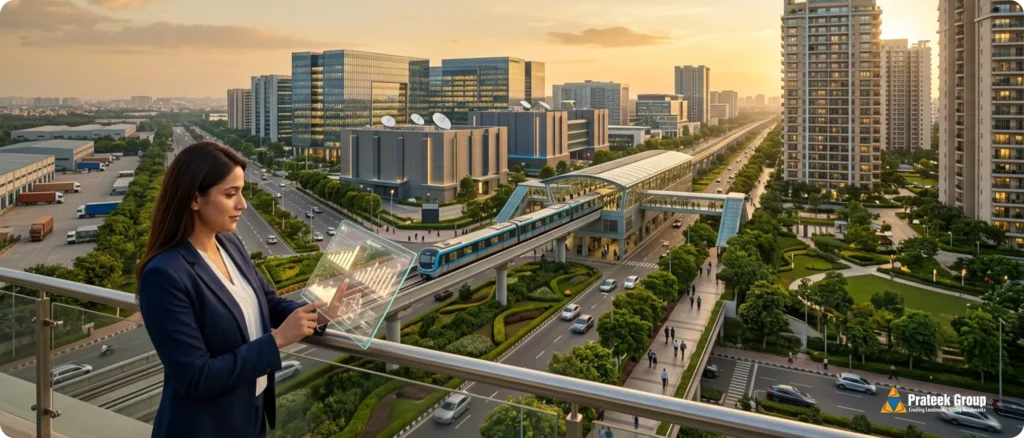
For investors, the strength of any property market ultimately rests on the employment ecosystem underneath it. Noida has built one of the strongest employment bases in North India, and 2026 is seeing that ecosystem expand further.
Employment Drivers Powering Investor Demand
Noida and the broader NCR corridor host major IT parks, MNC campuses, and an expanding startup ecosystem. The planned Noida Film City is expected to create thousands of direct and indirect employment opportunities. Data centres, logistics hubs, and IT expansion along the Noida-Greater Noida Expressway are already attracting mid to senior professionals who need quality rental housing nearby.
For investors, this translates into rental demand that is both consistent and growing. Flat rental rates in Noida are rising steadily due to increasing demand from professionals and students, with yields in well-located sectors improving compared to previous years. A 3 BHK apartment in a RERA-compliant project near an employment cluster or metro station commands a premium both on rent and eventual resale.
A Practical Investor Checklist for Noida in 2026
- Is the project located within 15 minutes of a major employment hub or metro station?
- Does the sector have confirmed or near-operational infrastructure connectivity?
- Is the developer RERA-registered and do they have a verifiable delivery record?
- Is rental demand in the sector supported by actual occupier presence, not speculation?
- Is the configuration (2 BHK or 3 BHK) aligned with what tenants actually seek in that location?
- Is the project in a low to mid-density zone, which typically maintains rental value better?
Investors looking at North Noida or the Ghaziabad belt may also consider our Prateek Grand City township in Siddharth Vihar, Ghaziabad, which offers a 40-acre integrated township with 2.5 BHK, 3 BHK, and 3+1 BHK apartments (RERA Nos. UPRERAPRJ1133 and UPRERAPRJ723). The township’s position on NH-24, next to Indirapuram, ensures strong rental interest from professionals who work in the Noida-Ghaziabad belt.
Lifestyle Shift and the Growing End-User Momentum
Perhaps the most significant story in Noida’s 2026 buyer market is not what investors are doing, but what end-users are deciding.
For years, luxury properties in Noida were purchased largely as investment assets. The buyer would hold the flat, rent it out, and exit in a few years. That pattern has not disappeared, but it is no longer dominant in the premium segment. Multiple developers active in Noida’s luxury corridors report that buyers are increasingly purchasing for self-use, with South and East Delhi residents upgrading to larger, amenity-rich homes in Noida’s greener sectors.
Why End-Users Are Choosing Noida Now
As noted in a recent analysis on end-user demand trends in Noida’s luxury segment, buyers are placing greater emphasis on long-term liveability over pure capital appreciation. They are asking practical questions about connectivity, neighbourhood development, construction quality, maintenance standards, and lifestyle amenities.
This shift is visible across multiple buyer sub-groups:
End-User Type | What They Are Seeking | Why Noida Fits in 2026 |
Delhi Upgraders | Larger space, better amenities | Competitive pricing vs Delhi, premium projects |
IT/Corporate Professionals | Metro access, modern community | Expressway belt and metro expansion |
NRIs Returning | Privacy, green surroundings, trusted developer | Low-density luxury projects, RERA compliance |
Young Families | Schools, hospitals, play spaces | Planned sectors with social infrastructure |
Senior Executives | Spacious homes, security, lifestyle | Premium sectors offering gated community living |
These are buyers who evaluate a project very differently from an investor. For them, the quality of the lobby, the reliability of water supply, the attentiveness of facility management, and the sense of community within the project matter as much as the address. Developers who understand this are building accordingly.
Our newest project, Prateek Grand Begonia at Siddharth Vihar, NH-24, reflects this design philosophy directly. With 2 BHK and 3 BHK homes within a 40-acre integrated township (RERA No. UPRERAPRJ790651), the project combines classical architecture, an eco-friendly green environment, a lavish clubhouse, mini-Olympic swimming pool, and fast EV charging. It speaks directly to the end-user who wants to come home to an experience, not just an address.
Is Current Demand Genuine or Speculative? Reading the Market Honestly
This is the question every serious buyer, investor or end-user, should ask before committing to a property decision in any market.
Signs of Genuine Demand in Noida’s 2026 Market
Several data points support the view that demand in Noida in 2026 is substantially real rather than speculative:
- Rental demand is active and growing. Sectors near employment hubs, metro stations, and expressway corridors are seeing consistent tenant interest from verified professionals. This suggests that properties purchased as investments are actually being occupied.
- End-user share is rising. Multiple developers and market research reports confirm that self-use buying has increased significantly in the mid-premium and luxury segments. Buyers who live in a property are a structural support for values, because they do not exit in panic the way pure speculators sometimes do.
- RERA compliance has raised market credibility. The UP RERA framework, which mandates transparent disclosures, delivery timelines, and developer accountability, has restored buyer confidence that was eroded during the delay-heavy years of the previous decade. Buyers are more willing to commit when they can verify RERA registration and track construction progress.
- Infrastructure investment is verified, not promised. Jewar Airport is under active construction. Metro expansions are approved with funding. Expressway upgrades are ongoing. Unlike speculative demand driven by vague future plans, demand in 2026 is backed by infrastructure that buyers and investors can physically see advancing.
Areas Where Caution Is Still Warranted
Not every pocket of Noida is equally insulated from risk. Some considerations that buyers should evaluate carefully:
- Oversupply risk exists in certain micro-markets where new launches have outpaced verified occupier demand. Buyers should check inventory absorption rates before committing.
- Price appreciation forecasts, however well-argued, remain estimates. No market outcome is guaranteed, and projections from 2025 into the 2026 to 2030 period should be treated as informed expectations rather than certainties.
- Projects without verified RERA registration or with delayed timelines should be approached with due diligence, regardless of how attractive the pricing may appear.
For buyers looking to understand the broader real estate regulatory environment, UP RERA’s official project registry allows you to verify registration status, developer details, and project progress before committing to any purchase.
What Should You Evaluate Before Making Your Property Decision?

Whether you are an investor or an end-user, the quality of your decision depends on asking the right questions. The two buyer types need different frameworks.
For Investors: A Clear-Headed Evaluation
- Define your investment horizon before anything else. Are you holding for 3 years, 5 years, or longer? Your sector choice, configuration preference, and expected returns should all follow from this answer.
- Verify rental demand independently. Do not rely solely on developer claims. Check active rental listings, speak to property management firms operating in the sector, and assess vacancy rates.
- Focus on developer delivery record. A project from a builder with a strong RERA compliance history and on-time delivery track record carries materially lower risk than an attractively priced option from an unknown entity.
- Choose sectors with employment and infrastructure backing, not just proximity to a future project. Confirmed infrastructure activation drives real demand. Proposed projects that are still years from breaking ground carry more uncertainty.
For End-Users: Practical Questions That Matter
- Visit the site at different times: morning commute, school run time, and weekends. The experience you have during those visits reflects your daily reality more accurately than any brochure.
- Check the actual carpet area, not just the super built-up area quoted in marketing material. Understanding what you are actually paying for per usable square foot matters enormously over the long term.
- Evaluate the builder’s maintenance record in delivered projects. How well-maintained are their existing communities? Speak to residents if possible.
- Assess your financing position realistically. EMI affordability over the full loan tenure, not just at current interest rates, should inform how much you commit.
- Confirm school and hospital proximity on a live map, not an artist’s impression. Distances in marketing materials are sometimes measured as the crow flies.
For buyers interested in understanding more about our completed and ongoing residential offerings across Noida and NCR, our full residential project portfolio covers configurations, locations, amenities, and availability across the Prateek Group range.
Conclusion: Two Buyer Types, One Maturing Market
Noida’s 2026 property market is not a binary choice between investor-driven speculation and end-user organic demand. It is a market where both forces are present, both are active, and both are responding to the same underlying fundamentals: strong infrastructure growth, rising employment, improving regulatory environment, and a genuine lifestyle shift that makes Noida a first-choice address rather than a second option to Delhi.
For investors, the market offers real opportunity, particularly in well-connected sectors backed by infrastructure activation. The rewards are available, but so are the risks if you enter without homework.
For end-users, Noida in 2026 offers something it has not always been able to: quality homes in planned environments with the social infrastructure, connectivity, and developer accountability that make a real difference to daily life.
The best property decisions in this market, whether you are buying to invest or buying to live, will come from understanding which buyer category you belong to, and evaluating every option through that lens with honesty and rigour.
At Prateek Group, we have spent over two decades building homes across Noida and NCR for both types of buyers. If you would like to know more about who we are and what we stand for, our about us page offers a full picture of our legacy, values, and commitment to quality.
FAQs
- What is driving Noida’s property demand in 2026?
Noida’s property demand in 2026 is being driven by both investors and end-users. Infrastructure growth, employment opportunities, improved connectivity, RERA compliance, and demand for better lifestyle communities are shaping buyer decisions across residential segments.
- Is Noida real estate more investor-driven or end-user-driven in 2026?
Noida’s 2026 market is seeing a balance between investors and end-users. While investors focus on appreciation and rental potential, end-users are increasingly buying for lifestyle, connectivity, and long-term living, making demand more stable.
- Should I buy property in Noida for investment or personal use?
The right choice depends on your goal. Investors should evaluate appreciation potential, rental demand, and infrastructure growth, while end-users should focus on location, amenities, commute convenience, builder reputation, and long-term liveability.
- Why are end-users choosing Noida over Delhi?
End-users are choosing Noida due to larger homes, planned sectors, better green spaces, modern amenities, improved connectivity, and relatively competitive pricing compared to Delhi. The city is increasingly becoming a preferred lifestyle destination.
- Is Noida a good real estate investment in 2026?
Noida remains attractive for investors due to infrastructure development, corporate expansion, rental demand, and upcoming projects like Jewar Airport. However, investors should select locations carefully and evaluate developer credibility before investing.
- What type of properties do investors prefer in Noida?
Investors generally prefer properties with strong rental potential, infrastructure connectivity, and future appreciation opportunities. Apartments near employment hubs, metro stations, expressways, and RERA-compliant projects are commonly considered attractive investment options.
- What type of homes do end-users prefer in Noida?
End-users in Noida increasingly prefer spacious homes like 3 BHK and 4 BHK apartments with better amenities, security, green surroundings, and community facilities. Their decisions are based more on lifestyle value than short-term returns.
- Is Noida property demand genuine or speculative?
Current Noida property demand shows stronger signs of genuine growth due to increasing end-user purchases, active rental markets, infrastructure development, and improved regulations. However, buyers should still evaluate individual projects instead of relying only on market trends.
- Which Noida areas are best for property investment in 2026?
Areas with strong connectivity, employment access, and infrastructure development are preferred in 2026. Locations like Noida Expressway, Sector 150, and selected Greater Noida corridors attract interest from both investors and end-users due to their growth potential.
- How does infrastructure impact Noida property demand?
Infrastructure plays a major role in shaping Noida’s property demand by improving connectivity, attracting businesses, increasing employment opportunities, and enhancing daily convenience. Projects like Jewar Airport, metro expansion, and expressway development influence both buyers and investors.
- Is buying a luxury flat in Noida a good decision?
Luxury flats in Noida can be a suitable choice for buyers seeking premium amenities, better surroundings, and long-term lifestyle benefits. Buyers should evaluate location advantages, developer track record, construction quality, and community facilities before purchasing.
- How important is RERA approval when buying property in Noida?
RERA approval helps buyers verify project details, registration status, timelines, and developer accountability. While it does not replace due diligence, choosing a RERA-registered project with a reliable delivery history can reduce purchase-related risks.
- What factors should investors check before buying property in Noida?
Investors should evaluate rental demand, employment hubs, infrastructure connectivity, developer reputation, RERA compliance, project absorption, and holding period expectations. A strong investment decision depends on actual market fundamentals rather than only future projections.
- Why are 3 BHK apartments popular in Noida?
3 BHK apartments are popular because they appeal to both families and investors. Families prefer the additional space and comfort, while investors consider them attractive due to rental demand from professionals and long-term resale potential.
- How should buyers decide between investing and buying for self-use?
Buyers should first identify their purpose. Investors should focus on returns, liquidity, and market growth, while end-users should prioritise comfort, location, amenities, and daily convenience. Understanding personal goals leads to better property decisions.