
If you have spent any time comparing investment options across the National Capital Region, you have likely noticed that Sector 150, Noida, keeps appearing at the top of shortlists. Not because of marketing claims. Not because of brochure photographs. Because of numbers.
Between 2020 and 2025, average residential prices in Noida rose by approximately 92 percent, according to ANAROCK Research data. Within that broader market, Sector 150 moved even faster. Flat prices in this sector appreciated 121.2 percent over five years and 197.6 percent over a decade, according to 99acres market data. That is not a coincidence. It is the result of deliberate planning, constrained supply, multi-corridor infrastructure investment, and a structural shift in buyer preference toward premium, low-density living.
At Prateek Group, we have spent years studying this micro-market, building within it, and guiding buyers who want to make genuinely informed investment decisions. We are not going to tell you that every corner of Noida is equally attractive. It is not. What we will do is walk you through seven specific financial reasons, backed by verifiable data, that explain why Sector 150 has consistently outperformed competing NCR locations and why that pattern looks durable into the decade ahead.
Whether you are a first-time buyer, a seasoned investor, or an NRI evaluating your options from abroad, this analysis is designed to give you a clear picture of why this particular sector commands the attention it does.
TL;DR
Why Sector 150 Continues to Outshine NCR Investment Hotspots
Sector 150 has consistently delivered stronger long-term returns than many NCR micro-markets thanks to sustained capital appreciation, limited residential supply, premium urban planning, and major infrastructure developments. This article explains the financial drivers behind its performance and why investors continue to prioritize this location.
What Gives Sector 150 a Lasting Competitive Edge?
Many investors assume appreciation slows once an area matures, but Sector 150 challenges that belief. Its low-density master plan, operational Jewar Airport, expanding connectivity, and growing luxury housing demand continue to strengthen both buyer interest and long-term property values while reducing oversupply risks.
How to Evaluate Sector 150 as a Long-Term Investment
Instead of focusing only on current property prices or rental yields, investors should assess capital appreciation potential, infrastructure growth, supply constraints, developer quality, and end-user demand. These combined factors position Sector 150 as one of the strongest long-term residential investment opportunities in the NCR.
Financial Reason 1: A Decade of Uninterrupted Capital Appreciation
Financial Reason 1: A Decade of Uninterrupted Capital Appreciation
The numbers that make the case
The most straightforward argument for any investment is what happens to your money over time. In Sector 150, that story has been remarkably consistent. 99acres market data tracks property price movements at the locality level, and the figures for Sector 150 are striking:
Timeframe | Appreciation in Flat Prices | Benchmark Context |
1 Year (to 2026) | +5.5% to +9.5% | All-India House Price Index: +3.58% YoY (RBI, Q3 2025-26) |
3 Years | +48.8% | Greater Noida overall: +98% over 5 years (ANAROCK) |
5 Years | +121.2% | Noida overall: +92% over 5 years (ANAROCK) |
10 Years | +197.6% | Nearly 3x growth on original capital invested |
To put this in concrete terms: an investor who purchased a 3 BHK apartment in Sector 150 for approximately Rs 60 lakh in 2016 was sitting on a property worth close to Rs 1.8 crore by mid-2026. That is capital nearly tripled without accounting for any rental income received during the holding period.
Current pricing band (2026): Average flat prices in Sector 150 range between Rs 12,000 and Rs 14,500 per square foot, with premium and luxury developments trading above Rs 15,000 per sq ft, based on aggregated market data from 99acres market data.
How this compares with competing NCR micro-markets
Micro-Market | Avg. Price (2026) | 5-Year Appreciation | Development Profile |
Sector 150, Noida | Rs 12,000 – 14,500/sq ft | +121.2% | Low-density, Sports City, green |
Greater Noida West | Rs 4,500 – 6,500/sq ft | +40-60% | High-density, developing infrastructure |
Dwarka Expressway, Gurgaon | Rs 9,500 – 14,000/sq ft | +70-90% | Mixed density, improving connectivity |
Noida Extension (Sectors 1-12) | Rs 5,500 – 7,500/sq ft | +50-65% | Affordable mid-segment |
Sectors 137, 143B Noida | Rs 7,500 – 9,500/sq ft | +75-90% | IT corridor, corporate proximity |
Sector 150 entered the decade at a significant price advantage over Gurgaon while still delivering comparable or superior percentage appreciation. Today it sits at a premium over most comparable Noida sectors, which is precisely what long-term investors expected when they entered early.
Investment Insight: A 6-year CAGR of 13 percent in Sector 150 means an investment roughly doubles in approximately 5.5 years at that pace. Few listed financial instruments in India have delivered that consistently over the same period. According to Reserve Bank of India, the All-India House Price Index rose just 3.58% YoY in Q3 2025-26, making Sector 150’s performance exceptional by national standards.
One common misconception worth addressing: some investors assume that because prices have already risen significantly, the appreciation window has closed. The data does not support that view. Limited new land supply within the sector, ongoing infrastructure completion, and the Jewar Airport effect continue to create genuine upward pressure on values. Our blog on Is Sector 150 Still the Best Place to Buy in Noida in 2025 explores this dynamic in full detail.
Financial Reason 2: Jewar Airport Converts Future Potential Into Present Value
From announcement to operational reality
For years, the Noida International Airport at Jewar existed as a promise that shaped property prices without yet delivering tangible benefits. That phase has ended. On March 28, 2026, Prime Minister Narendra Modi inaugurated Phase 1 of the Noida International Airport, built on 1,300 hectares in Jewar, Gautam Budh Nagar. Commercial flight operations commenced on June 15, 2026, with IndiGo launching the first routes, followed by Akasa Air. Phase 1 is designed to handle 12 million passengers annually. The full project envisions five runways and capacity for approximately 300 million passengers per year across future phases.
What this means for Sector 150 specifically
Sector 150 sits at the intersection of the Noida-Greater Noida Expressway and the Yamuna Expressway, making it one of the most naturally connected sectors to the Jewar corridor. A drive from Sector 150 to the airport via the Yamuna Expressway takes approximately 30 to 40 minutes under normal traffic conditions.
According to Outlook Money / ANAROCK, average residential prices in Noida stood at approximately Rs 4,795 per sq ft in 2020 and had risen to Rs 9,200 per sq ft by Q1 2025. Properties along the Yamuna Expressway corridor appreciated 40 to 60 percent just in anticipation of the airport opening, before a single commercial flight departed. Now that operations are live, market experts forecast an additional 20 to 30 percent price upside along the corridor in 2026-2027, representing a shift from speculative premium to operational premium.
The economic multiplier beyond residential
Jewar Airport anchors a broader economic corridor that will drive residential demand in Sector 150 over the next decade. Specifically:
- 1 lakh+ direct and indirect employment opportunities expected from the airport project, generating a sustained pool of high-income residents who will seek quality housing nearby.
- AISATS has established a multi-modal cargo hub adjacent to the airport, creating a logistics and warehousing cluster that will attract corporate occupiers.
- The Dedicated Freight Corridor running alongside the Yamuna Expressway strengthens the industrial and logistics investment case for the entire belt.
- A proposed Film City in the Yamuna Expressway zone will add an entertainment and creative industry anchor to the corridor.
Investment Insight: Sector 150 is positioned in the sweet spot: close enough to Jewar Airport to benefit from its economic multiplier effect, yet established enough to offer completed residential infrastructure and livability today. For a comprehensive view on how this affects property decisions, read our blog on Is Sector 150 Still the Best Place to Buy in Noida in 2025.
Financial Reason 3: Supply Scarcity Protects Your Investment
Why low density is a financial feature, not just a lifestyle one
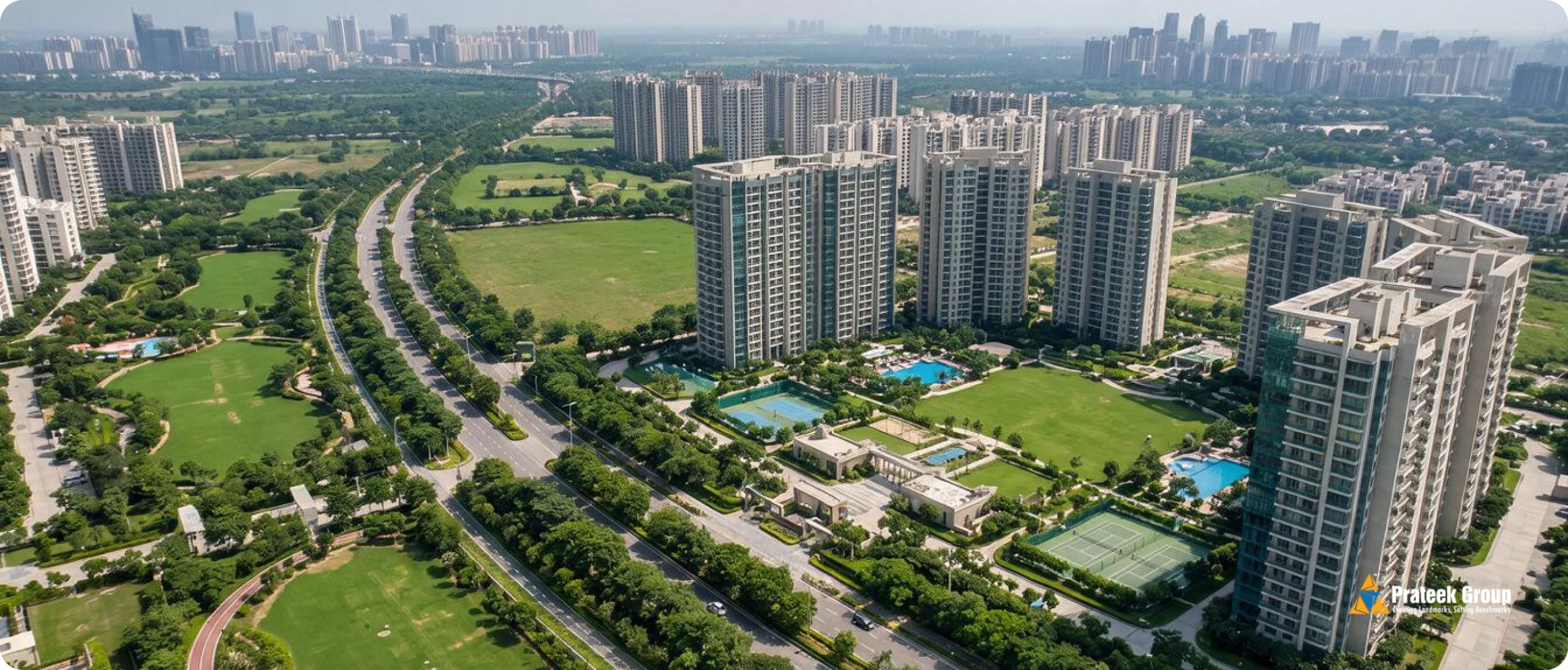
Sector 150 was master-planned as India’s first Sports City-inspired residential zone under the Noida Authority’s development framework. The defining characteristic of this plan is that approximately 80 percent of the sector’s land area is dedicated to green cover, open spaces, and sports infrastructure. Residential development is constrained to the remaining portion, which means the supply of new homes in this sector is structurally limited by design.
This matters enormously from an investment perspective. In most NCR micro-markets, sustained price appreciation is eventually eroded by new supply. In Sector 150, that pattern is significantly restrained because there is simply not much land left to develop. The sector has approximately 1,661 registered properties, concentrated among established projects by premium developers including Godrej, Tata, ATS, Mahagun, Eldeco, Sobha, Max Estates, and Prateek Group. For buyers exploring Flats in Sector 150 Noida, this constrained inventory is one of the most compelling reasons to act decisively rather than wait.
Supply constraint versus demand acceleration
While supply remains constrained, demand drivers are simultaneously accelerating. This imbalance is the single most reliable predictor of sustained price appreciation in any asset class. Consider what is driving demand into this supply-constrained micro-market:
Demand Driver | Current Status | Near-Term Impact |
Jewar Airport operations | Live since June 15, 2026 | High – immediate employment and connectivity premium |
Luxury buyer migration from Delhi/Gurgaon | Ongoing, accelerating | High – price-driven displacement toward Noida |
NRI investment interest | Rising, driven by INR depreciation | Moderate-High – NRI desk demand increasing |
IT and corporate professional influx | Sustained by Noida IT corridor | Moderate – professional tenant/buyer base |
Greater Noida Authority infrastructure | Active investment phase | Moderate – improving peripheral services |
The regeneration cycle: how limited supply compounds value
In markets with constrained supply, resale activity becomes the primary mechanism of value discovery rather than new project launches. This is significant for investors because it means price signals are driven by genuine buyer competition rather than developer pricing decisions. When a seller in Sector 150 lists a property today, they are competing with a very small pool of comparable units, which structurally supports pricing power.
For context, in sectors like Greater Noida West or Noida Extension, where supply has historically been abundant, investors have occasionally watched new project launches undercut their resale value. That risk is substantially lower in Sector 150.
Practical Takeaway: Before investing in any NCR micro-market, calculate the ratio of undeveloped land to existing residential stock. In Sector 150, that ratio strongly favors existing owners because the master plan itself limits future competition. Data sourced from ANAROCK Research confirms this supply-demand structural advantage.
Financial Reason 4: Multi-Corridor Connectivity Multiplies Location Value
The infrastructure arithmetic of expressway confluence
Location value in real estate is ultimately a function of connectivity. The more efficiently a location connects residents to employment, commerce, education, and transport hubs, the more durable its price appreciation becomes. Sector 150 sits at a confluence of infrastructure that very few NCR micro-markets can replicate. Our in-depth analysis on How Urban Infrastructure Is Reshaping Property Prices in Delhi-NCR demonstrates how each infrastructure milestone directly translates into property value uplift across Delhi-NCR.
The sector is positioned along the Noida-Greater Noida Expressway, a 24.53-kilometer six-lane corridor that provides direct access to Delhi via the DND Flyway to the north and to Greater Noida and the Yamuna Expressway to the south. This dual-expressway positioning means Sector 150 residents can reach:
- Central Delhi (Connaught Place) in approximately 45 to 55 minutes under normal conditions.
- Gurgaon’s Cyber City in approximately 75 to 90 minutes via the DND-NH-48 corridor.
- Greater Noida’s knowledge and industrial zones in 20 to 30 minutes.
- Jewar International Airport in approximately 30 to 40 minutes via the Yamuna Expressway.
Metro accessibility and the Aqua Line
The Noida Metro’s Aqua Line station at Sector 148 is approximately 3 kilometers from Sector 150, providing multi-modal commuting options that reduce dependency on road travel. The Aqua Line connects to the Blue Line of the Delhi Metro at Sector 51, giving residents access to the broader Delhi Metro network and, from there, to virtually every major employment and commercial center across NCR.
A February 2026 launch of the Aqua-Blue Line Skywalk, a 420-meter air-conditioned walkway with travelators connecting Sector 51 (Aqua) to Sector 52 (Blue), further improved interoperability between the two lines. Additionally, planned extensions of the Aqua Line toward Greater Noida and the airport zone are at the DPR stage, which will eventually bring metro connectivity closer to Sector 150’s southern boundaries.
The FNG Expressway: upside that is not yet priced in
The Faridabad-Noida-Ghaziabad (FNG) Expressway, when complete, will create a direct east-west corridor linking three major NCR cities without requiring transit through Delhi. For Sector 150, this represents significant connectivity upside that is not yet fully reflected in property prices. As covered in detail in our blog on Is Sector 150 Still the Best Place to Buy in Noida in 2025, treating the FNG as an upside scenario rather than a core assumption is the prudent analytical approach for current buyers.
Investment Insight: Each new infrastructure completion in the vicinity of Sector 150 does not merely improve convenience. It expands the effective employment catchment area, bringing more potential buyers and tenants into the market for homes in this location. That is a structural demand multiplier. Read our full analysis at How Urban Infrastructure Is Reshaping Property Prices in Delhi-NCR to see how metro and expressway corridors have driven 15-25% appreciation in Delhi-NCR areas.
Financial Reason 5: The Luxury Housing Tailwind Is Strongest Here

NCR’s premium segment is where the money is moving
The NCR real estate market has undergone a structural shift in the past three years that permanently alters the investment calculus for different price segments. Affordable and mid-segment housing has faced persistent headwinds: rising construction costs, interest rate sensitivity among first-time buyers, and reduced affordability in well-connected locations. Premium and luxury housing has experienced the opposite.
According to ANAROCK Research, average luxury housing prices in Delhi-NCR increased nearly 72 percent between 2022 and 2025, rising from approximately Rs 13,450 per sq ft to over Rs 23,000 per sq ft. Knight Frank India separately reported a 19 percent year-on-year increase in capital values across NCR during 2025. NCR accounted for the highest share of luxury home sales among India’s top seven cities in 2025, led by Gurgaon and Noida, as buyers increasingly shifted toward homes priced above Rs 1.5 crore.
CBRE India noted that luxury housing sales in Delhi-NCR continued to outpace most other cities, supported by rising disposable incomes, rapid infrastructure development, and growing demand for larger homes.
Sector 150 is where Noida’s premium demand concentrates
Within Noida’s premium segment, Sector 150 has emerged as the default address for buyers who want luxury lifestyle amenities, low-density living, and expressway connectivity in a single package. The sector’s planning framework, with its sports facilities, park infrastructure, and green cover mandate, creates a living environment that is genuinely difficult to replicate in more established, denser sectors of Noida.
The buyer profile in Sector 150 reflects this. The market is dominated by end-users: actual families buying homes to live in, which is a stronger signal of sustained demand than investor-led buying. The proportion of end-users has risen meaningfully in recent years compared to the investor-heavy launches of earlier cycles.
Premium amenities as financial differentiators
Our project Prateek Canary luxury 3/4 BHK apartments in Sector 150 Noida exemplifies what the premium buyer expects today. Situated on 12.55 acres in Sector 150, the project offers only 664 units, maintaining a low residential density that is rare in the NCR market. The community features world-class sports facilities, a high-end clubhouse, a swimming pool with a dedicated children’s pool, and wall-to-wall windows that deliver unobstructed panoramic views of the 40-acre Shaheed Bhagat Singh Park. The project is RERA-registered under number UPRERAPRJ591510, with 3 BHK residences starting at Rs 2.63 crore, 4 BHK options from Rs 5.53 crore, and duplex penthouse configurations available on request.
These specific features directly influence resale values and rental demand over a project’s lifecycle. More information on what our luxury residences offer is available through our Prateek Canary luxury 3/4 BHK apartments in Sector 150 Noida page, and buyers exploring premium Flats in Sector 150 Noida can compare options across the full spectrum of the sector’s developer ecosystem.
Financial Reason 6: Rental Demand Is Stable, Tenants Are Quality, and Vacancy Is Low
Understanding Sector 150’s rental yield profile
Investors evaluating rental income in Sector 150 need to understand a fundamental trade-off that characterizes premium micro-markets globally. According to 99acres market data, annual rental yields in Sector 150 range between 2.0 and 3.0 percent. To some investors, that number looks modest compared to the 4 to 5 percent yields available in parts of Gurgaon or central Noida. But yield comparison in isolation misses the full picture. The financial case for Sector 150’s rental market rests on three characteristics that the raw yield number does not capture:
- Tenant quality: The low-density, premium environment attracts senior professionals, corporate executives, and families who treat properties with care, maintain longer tenancy periods, and rarely default on rent. Lower churn means lower vacancy and lower re-letting costs.
- Rental growth trajectory: As Jewar Airport operations deepen and the corridor’s employment base expands, rental demand from airport-adjacent professionals is expected to increase, supporting gradual yield improvement over the coming years.
- Total return equation: When appreciation of 121.2 percent over five years is combined with even a 2 percent annual yield, the annualized total return significantly outpaces most alternative asset classes available to Indian investors.
The yield-versus-appreciation calculation for Sector 150
Metric | Sector 150 | IT Corridor (Sec 137, 143) | Affordable Zones (GN West) |
Gross Rental Yield | 2.0 – 3.0% | 3.0 – 4.0% | 2.5 – 4.0% |
5-Year Capital Appreciation | +121.2% | +75 – 90% | +40 – 60% |
Tenant Profile | Senior executives, families | IT/corporate professionals | Mixed, first-time renters |
Average Vacancy Period | Low (quality tenant retention) | Low (strong IT demand) | Moderate (higher supply) |
Total Return Advantage | Appreciation-led | Balanced | Yield-led |
Our detailed analysis of rental yields across Noida and Greater Noida, published in our blog on Best Sectors for Rental Yield in Noida and Greater Noida (2026), covers this trade-off comprehensively. The conclusion is consistent: for investors prioritizing wealth creation over income, Sector 150’s appreciation-dominated total return profile is difficult to match in the NCR.
NRI investors: a growing demand segment in Sector 150
The NRI buyer segment is particularly relevant for Sector 150. As ANAROCK Research data shows, NRI investment in NCR luxury housing has been accelerating, driven by favorable exchange rates for dollar and dirham earners, India’s economic growth momentum, and the aspirational pull of returning to a premium home environment.
Sector 150 checks every box on the NRI investment checklist: RERA compliance, established developer reputation, quality tenant demand for rental income during the holding period, and long-term capital appreciation potential. For NRI buyers specifically interested in understanding how to navigate property investment in India, our NRI Property Investment Options in India provides a step-by-step framework covering documentation, financing, and remittance considerations.
Financial Reason 7: Master-Planned Urban Design Creates Irreplaceable Long-Term Value
Why planned sectors appreciate faster than organic ones
Real estate value is not created by properties in isolation. It is created by neighborhoods. And not all neighborhoods are created equal. The most durable property value appreciation occurs in locations where the surrounding environment is deliberately planned, consistently maintained, and regulated to prevent quality degradation over time.
Sector 150 is one of the few NCR micro-markets where this planning principle has been applied rigorously. The Noida Authority’s master plan for the sector mandates:
- Low-density residential development with a minimum of 80 percent land dedicated to green and open spaces.
- Sports infrastructure as a core planning element, including cricket academies, football grounds, tennis courts, and cycling tracks.
- Underground electrical cabling and wide internal roads with dedicated landscaping that prevent the visual clutter of older NCR sectors.
- Strict construction regulations that prevent the organic densification that erodes property values in older sectors over time.
The result is an environment that is fundamentally difficult to replicate once land is allocated and development is underway. You cannot retroactively underground cables in Sector 44, or create 40 acres of continuous parkland in a sector where residential towers already occupy that footprint. The planning decisions made for Sector 150 a decade ago are now permanent competitive advantages for property owners within the sector.
Sports City: a unique planning differentiator
Sector 150’s designation as Noida’s Sports City reflects a specific land-use framework under which approximately 70 percent of the sector is dedicated to sports amenities and green spaces. This includes the Shaheed Bhagat Singh Park, one of India’s largest urban parks at approximately 40 acres, along with shared sports infrastructure accessible to all residents.
For buyers evaluating Flats in Sector 150 Noida, this infrastructure represents a genuine quality-of-life improvement that increasingly influences purchasing decisions. For investors, it means that the homes they purchase are situated in an environment that continues to attract the highest-quality end-users, which sustains both occupancy rates and resale premiums.
Before and after: what infrastructure investment has delivered
Indicator | Sector 150 (circa 2016) | Sector 150 (2026) |
Road infrastructure | Under development, partially complete | Wide roads, underpasses, expressway access |
Green cover | Designated but partially developed | Functional, maintained park ecosystem |
Metro access | No metro, road-only connectivity | Sector 148 Aqua Line station operational |
Airport proximity | IGI only, long distance | Jewar Airport operational (30-40 min drive) |
Developer presence | Early entrants only | Godrej, Tata, ATS, Mahagun, Prateek, Max |
Average price (flat) | Approximately Rs 4,500 – 5,500/sq ft | Rs 12,000 – 14,500/sq ft |
Buyer sentiment | Cautious, early-mover | Confident, established premium market |
The transformation over this decade illustrates how planned urban design compounds investment returns. Every infrastructure completion, from the metro station to the expressway underpasses to the park development, added value not just to the properties adjacent to that improvement but to the entire sector.
The investor misconception about “already developed” markets
A common hesitation among investors looking at Sector 150 in 2026 is the assumption that because the sector is already well-developed, the best appreciation has already occurred. This reasoning has a logical flaw: it confuses the completion of infrastructure with the exhaustion of value creation.
In reality, the operational phase of infrastructure is when demand from end-users peaks. End-users do not buy on promise; they buy on proof. The fact that Sector 150’s infrastructure is now proven rather than promised means it is entering the phase of peak end-user demand, which historically drives some of the most sustained price appreciation in any residential market. For investors who want data to support this view, the Reserve Bank of India House Price Index and Knight Frank India research both confirm that well-connected, premium localities in NCR continue to appreciate even after their infrastructure is complete.
For buyers evaluating Prateek Canary luxury 3/4 BHK apartments in Sector 150 Noida specifically, the current window represents a transition from speculative premium to operational premium. The risk-reward profile shifts but does not disappear; it evolves from infrastructure risk to market risk, which is a materially more comfortable position for conservative investors.
How Sector 150 Scores Against Key NCR Micro-Markets: A Consolidated View
Investment Factor | Sector 150, Noida | Gurgaon DXP | Greater Noida West | Noida Exp (Sec 137/143) |
5-Year Appreciation | 121.2% | 70-90% | 40-60% | 75-90% |
Current Avg. Price/sq ft | Rs 12,000-14,500 | Rs 9,500-14,000 | Rs 4,500-6,500 | Rs 7,500-9,500 |
Residential Density | Very Low (by master plan) | Medium-High | Very High | Medium |
Airport Connectivity | Excellent (Jewar, 30-40 min) | Moderate (IGI, 40-55 min) | Good (Jewar, 25-35 min) | Good (Jewar, 35-45 min) |
Metro Access | Sec 148 Aqua Line (3 km) | Multiple stations | Under development | Multiple stations |
Green Cover Mandate | 80%+ by master plan | Varies, no mandate | Limited | Limited |
Developer Quality | Tier-1 dominant | Tier-1 dominant | Mixed | Tier-1 present |
Rental Yield | 2.0-3.0% | 2.5-3.5% | 2.5-4.0% | 3.0-4.0% |
Future Supply Risk | Low (constrained land) | Medium | High (large landbank) | Medium |
Long-term Value Protection | High | High | Moderate | Moderate-High |
Conclusion: The Financial Case Is Built on Structure, Not Sentiment
Real estate investment decisions are too significant to rest on market excitement or developer marketing. The seven financial reasons we have explored in this analysis are grounded in verifiable data: ANAROCK Research research on price appreciation, CBRE India and Knight Frank India data on luxury market trends, Reserve Bank of India house price index figures, Noida Authority planning documentation, and live transaction data from 99acres market data.
What these sources collectively tell us is that Sector 150, Noida is not outperforming most NCR micro-markets by accident. It is outperforming them because of deliberate choices: a master plan that constrained supply while mandating quality, infrastructure investments that compounded connectivity over a decade, and a market positioning that has successfully captured the structural shift toward premium living that is now the dominant trend in Indian residential real estate.
The inauguration and operationalization of Jewar Airport has converted the final major “future catalyst” for this micro-market into present reality. The sector’s infrastructure is now proven. Its developer ecosystem is established. Its buyer base is shifting increasingly toward end-users, the most durable foundation of sustained property values.
At Prateek Group, we believe that informed buyers make better long-term decisions. Our developments in Sector 150, including Prateek Canary luxury 3/4 BHK apartments in Sector 150 Noida with its 664 low-density residences, are designed for buyers who prioritize long-term value over short-term convenience. NRI buyers can explore their specific options through our NRI Property Investment Options in India, and investors seeking to understand the full rental and appreciation picture can review our Best Sectors for Rental Yield in Noida and Greater Noida (2026).
FAQs
Why do investors consider Sector 150 Noida a premium real estate destination?
Sector 150 stands out due to its planned infrastructure, limited residential density, extensive green spaces, and strong connectivity. Combined with sustained demand from end-users and investors, these factors have helped the sector consistently outperform many competing NCR micro-markets.
Is Sector 150 Noida suitable for long-term real estate investment?
Yes. Sector 150 is widely considered a long-term investment destination because of its limited future land supply, continuous infrastructure development, premium residential positioning, and increasing demand from families, professionals, and NRIs seeking quality housing.
How does low-density planning contribute to higher property values?
Low-density development limits future housing supply while improving overall living standards. Fewer residential units, larger open spaces, and better community planning help preserve exclusivity, support stronger resale demand, and reduce the risk of oversupply affecting property values.
Does the operational Jewar Airport improve investment potential?
The operational airport significantly enhances the region’s accessibility and economic prospects. Improved connectivity, employment generation, business expansion, and increased residential demand collectively strengthen the long-term investment outlook for properties located near the airport corridor.
How does Sector 150 compare with Gurgaon for property investment?
Sector 150 offers a different investment proposition focused on lower density, greener surroundings, planned infrastructure, and long-term appreciation. While Gurgaon remains a strong commercial hub, many buyers prefer Sector 150 for its lifestyle advantages and future growth potential.
Is buying property in Sector 150 mainly for end-users or investors?
The market attracts both end-users and investors. Families appreciate the lifestyle benefits and planned environment, while investors value the area’s appreciation potential, infrastructure growth, and limited residential supply that support long-term capital growth.
What types of buyers are driving demand in Sector 150?
Demand comes from professionals, entrepreneurs, high-income families, NRIs, and investors seeking premium residential communities. The area’s modern infrastructure, green environment, and improving connectivity continue attracting buyers looking beyond traditional NCR locations.
Does limited land availability affect future property prices?
Yes. Since Sector 150 has limited scope for additional residential development, future supply remains constrained. When demand continues to increase while supply stays limited, existing properties generally benefit from stronger long-term price appreciation.
Is Sector 150 a better option than affordable housing markets?
The answer depends on investment goals. Affordable markets may provide higher rental yields, while Sector 150 focuses more on wealth creation through premium housing demand, capital appreciation, and long-term value preservation rather than short-term rental income.
How important is infrastructure when evaluating property investments?
Infrastructure plays a major role in determining long-term property performance. Expressways, metro connectivity, airports, schools, healthcare, and commercial development improve accessibility, increase buyer demand, and positively influence future property appreciation.
Can first-time investors consider Sector 150 for property investment?
Yes. First-time investors with a long-term investment horizon may find Sector 150 suitable due to its established infrastructure, reputable developers, transparent regulatory framework, and strong potential for steady capital appreciation over the coming years.
What risks should investors evaluate before purchasing property?
Investors should review project approvals, developer reputation, construction progress, legal documentation, financing options, maintenance costs, and future infrastructure timelines. Conducting proper due diligence helps minimize risks and supports better investment decisions.
Does premium housing perform better during market fluctuations?
Premium residential markets often demonstrate greater resilience because they attract financially stable buyers with long-term ownership intentions. While market cycles affect every segment, high-quality projects generally recover faster and retain stronger resale demand.
What role does master planning play in long-term appreciation?
Master-planned communities benefit from organized infrastructure, controlled development, efficient road networks, green spaces, and better civic amenities. These factors enhance overall livability and help maintain consistent demand, supporting long-term property value growth.
What should investors compare before choosing an NCR micro-market?
Investors should evaluate infrastructure growth, historical appreciation, developer quality, future supply, rental demand, connectivity, legal transparency, planned developments, and overall lifestyle offerings instead of relying solely on current property prices.