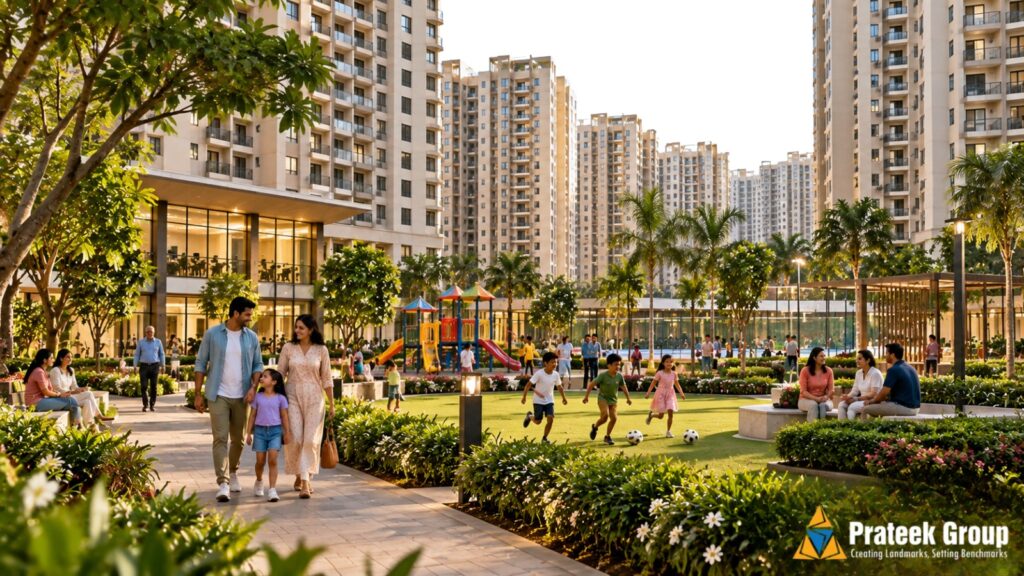
Why 40 acres changes the conversation
There is a point at which a residential project stops feeling like a collection of apartment towers and starts functioning more like a neighbourhood.
At Prateek Grand City, that point is 40 acres.
Located in Siddharth Vihar, Ghaziabad, the development was planned as a 40-acre integrated township, bringing residences, landscaped greens, recreation, retail convenience and social infrastructure together within one larger plan.
That scale matters.
In a standalone residential development, most of the planning naturally revolves around the apartment and the amenities immediately around it. In a township, the question becomes wider: what does everyday life look like once thousands of people begin living in the same place?
Where do children play? Where do residents meet? What happens when someone needs something for the house? How much of daily life can happen without repeatedly stepping outside the community?
Prateek Grand City was designed around those questions.
Today, with thousands of families making the township their home, it also offers a useful example of how Siddharth Vihar real estate has evolved from simply adding housing inventory to creating larger residential ecosystems.
The township idea is really about everyday life
The phrase “integrated township” is used often in real estate, but its value becomes clearer when viewed through an ordinary weekday rather than a brochure.
A family does not experience its home only from inside the living room.
There is the morning walk. A school run. Children coming down to play in the evening. A quick trip for daily essentials. Weekend recreation. A celebration that needs a larger space. Time spent outdoors after work. The simple comfort of knowing that many of these things exist within the community itself.
That is the practical case for township living NCR.
At Prateek Grand City Ghaziabad, residential towers sit within a larger environment planned with parks, playgrounds, recreation areas, commercial and retail spaces, clubhouses and other social infrastructure.
The result is not that residents never need to leave the township. They do.
The difference is that every small requirement does not have to become a journey.
That distinction matters more than it sounds, particularly for families balancing office commutes, school schedules, household responsibilities and personal time.
Why Siddharth Vihar works for a project of this scale
Prateek Grand City also needs to be understood in the context of Siddharth Vihar itself.
The location sits next to Indirapuram and connects into the wider Ghaziabad, Noida and Delhi ecosystem. Over time, improved road infrastructure and the growth of surrounding residential and commercial pockets have changed the way the micro-market is perceived.
Siddharth Vihar is no longer discussed only as an extension of established Ghaziabad neighbourhoods. It has increasingly developed an identity of its own.
Prateek Group entered that story at township scale.
Rather than placing a single residential complex in the area, Prateek Grand City created a larger address capable of supporting its own internal community. That difference becomes more visible as the population grows.
Once thousands of families live in one development, amenities stop being decorative additions. The clubhouse, green areas, play zones, retail conveniences and common spaces become part of daily routines.
That is where the idea of an integrated township Ghaziabad becomes tangible.
The ground plane matters as much as the skyline
High-rise developments are usually photographed from a distance. The towers dominate the frame, which makes sense visually.
But residents experience them from the ground.
That is one of the more interesting planning ideas behind Prateek Grand City. Its ground-level environment has been used for parks, playgrounds, circulation, recreation and community spaces rather than residential apartments.
It changes how the township feels when you move through it.
Landscaped greens are not simply something visible from a balcony. They become part of the way residents walk, spend time outdoors and use the spaces between buildings.
For families with children, those spaces matter for obvious reasons. For older residents, they create opportunities to step outside without needing to leave the safety of the larger residential environment. For everyone else, they provide something increasingly valuable in dense urban regions: breathing room.
This is where the idea of purposeful luxury becomes more convincing.
Luxury does not always have to mean adding another feature inside the apartment. Sometimes it is having more space outside it.
The clubhouse is not just an amenity
Every premium residential development has an amenity list.
Swimming pools, sports facilities, fitness spaces, banquet areas and clubhouses have become expected features across the category.
What changes in a township is the number of people those spaces bring together.
At Prateek Grand City, the clubhouse and recreation facilities work as social spaces as much as lifestyle amenities. They give residents places to meet, exercise, celebrate and spend time beyond their individual homes.
That matters because community living cannot really be manufactured through architecture alone.
You can design common areas, but people have to use them for a community to emerge.
A clubhouse full of residents on a weekend, children meeting regularly in the play areas, families gathering during festivals, neighbours recognising each other on walking routes and residents sharing recreational spaces are what gradually turn a development into a lived neighbourhood.
That is a different proposition from simply offering premium amenities.
The physical facility is only the starting point. Its real value comes from how it becomes part of residents’ routines.
A township has to work for different generations
One of the harder things about designing premium homes in Ghaziabad is that the same residential environment often needs to work for several generations at once.
Children need space to play.
Teenagers need sports and activity areas.
Working adults value fitness facilities, convenience and spaces to unwind.
Parents and senior citizens often look for greenery, walkability, security and places where they can spend time comfortably outside the home.
A large township has the advantage of being able to accommodate more of these needs without forcing one type of lifestyle on everyone.
Prateek Grand City uses its scale for precisely that.
The landscaped greens, sports facilities, clubhouse, recreation spaces and everyday conveniences allow different age groups to experience the same development differently.
That is particularly relevant to family living.
A home may be purchased by one or two individuals, but over time its usefulness is tested by birthdays, children growing up, visiting grandparents, celebrations, changing routines and years of ordinary daily life.
Modern comfort is ultimately about how well the environment adapts to all of it.
Social infrastructure is what makes a township different
There is another layer to Prateek Grand City that is easy to overlook because it does not photograph as dramatically as towers or landscaped gardens.
Social infrastructure.
The township plan incorporates facilities and provisions that go beyond recreation, including commercial and retail spaces and other community-supporting infrastructure.
This is an important distinction.
A development can have an impressive swimming pool and still require residents to leave the premises for every practical requirement. A true township has to think about how people actually live once the initial excitement of moving in has passed.
Daily needs are repetitive.
That is exactly why access to them matters.
The more a residential community can support those everyday routines, the less friction residents experience in the small things they do repeatedly.
Over years, that becomes part of quality of life.
Peace and security are part of the luxury equation
Luxury lifestyle is often presented visually through interiors, architecture and amenities.
Families tend to define it more broadly.
Peace and security matter.
So does having spaces where children can spend time outdoors, knowing that entry into the larger community is controlled and that shared areas are part of a planned residential environment.
Prateek Grand City has been developed as a gated community with security infrastructure supporting the township.
That sense of enclosure is particularly important at this scale. A 40-acre community has its own movement patterns, common areas and internal activity. Managing that environment well becomes as important as designing it.
For residents, the benefit is less dramatic but more useful: the ability to participate in community life with greater peace of mind.
Why scale creates a different kind of community
There is a social effect to township development that does not appear on a floor plan.
Population creates activity.
With thousands of families living in Prateek Grand City, the township develops its own rhythm. Children find other children of similar ages. Clubs and common spaces gain regular users. Festivals become community events. Retail has a natural catchment. Parks remain active. Residents have more chances to build connections beyond the people living on their own floor.
None of this happens simply because a project is large.
But scale gives it room to happen.
That is why community living becomes one of the strongest arguments for a development like Grand City.
The value is not merely having access to a park. It is having a park that forms part of an active neighbourhood.
It is not merely having a clubhouse. It is having enough residents for the clubhouse to function as a genuine social centre.
A township begins to work when its spaces acquire a life of their own.
From Grand City to a larger Siddharth Vihar story
Prateek Grand City has also played a role in how the larger area is perceived.
As Siddharth Vihar real estate has moved toward larger and more premium residential developments, Grand City has provided an existing example of what township-scale living can look like in the micro-market.
This matters particularly as the next phase of development arrives.
Prateek Grand Begonia, which forms part of the larger 40-acre township ecosystem, takes the residential proposition further into the premium segment while remaining connected to the planning logic already established at Grand City.
That continuity is important for Prateek Group Ghaziabad.
Instead of treating each residential development as an isolated address, the Group has been able to build within a location where the residential ecosystem, community and supporting infrastructure already have a history.
It gives new development something greenfield projects cannot immediately create: context.
Long-term value is also about what remains useful
Property value is usually discussed through price appreciation.
That is only one way to look at long-term value.
For someone living in the property, value is also determined by whether the development remains useful after the novelty wears off.
Does the landscaping continue to matter five years later?
Do the common spaces still serve the family?
Can children use the outdoor environment as they grow?
Does the clubhouse continue to function as a social space?
Are everyday requirements supported nearby?
Does the larger location continue to become more connected?
These are the quieter questions behind long-term value.
A well-planned township has an advantage because its proposition is not dependent on a single amenity or architectural feature. Its value comes from the combined environment.
For Prateek Grand City, that combined environment is the real product.
What Prateek Grand City actually represents
Prateek Grand City is often described as a world-class township and as an example of purposeful luxury.
The more interesting description may be simpler.
It is a residential development that was planned at the scale of everyday life.
The 40 acres matter because they allow homes, landscaped greens, premium amenities, recreation, a clubhouse, retail convenience and social infrastructure to exist as parts of the same system.
Siddharth Vihar matters because the township sits inside a micro-market that has grown alongside it.
And the thousands of families living there matter because they turn the master plan into something no render can show: an actual community.
That is ultimately what separates township development from a collection of towers.
Buildings provide the address.
People, routines and shared spaces give the address a life.
For Prateek Grand City, that life has been taking shape for years, and it is a significant part of the larger story of how Siddharth Vihar, Ghaziabad, is changing.