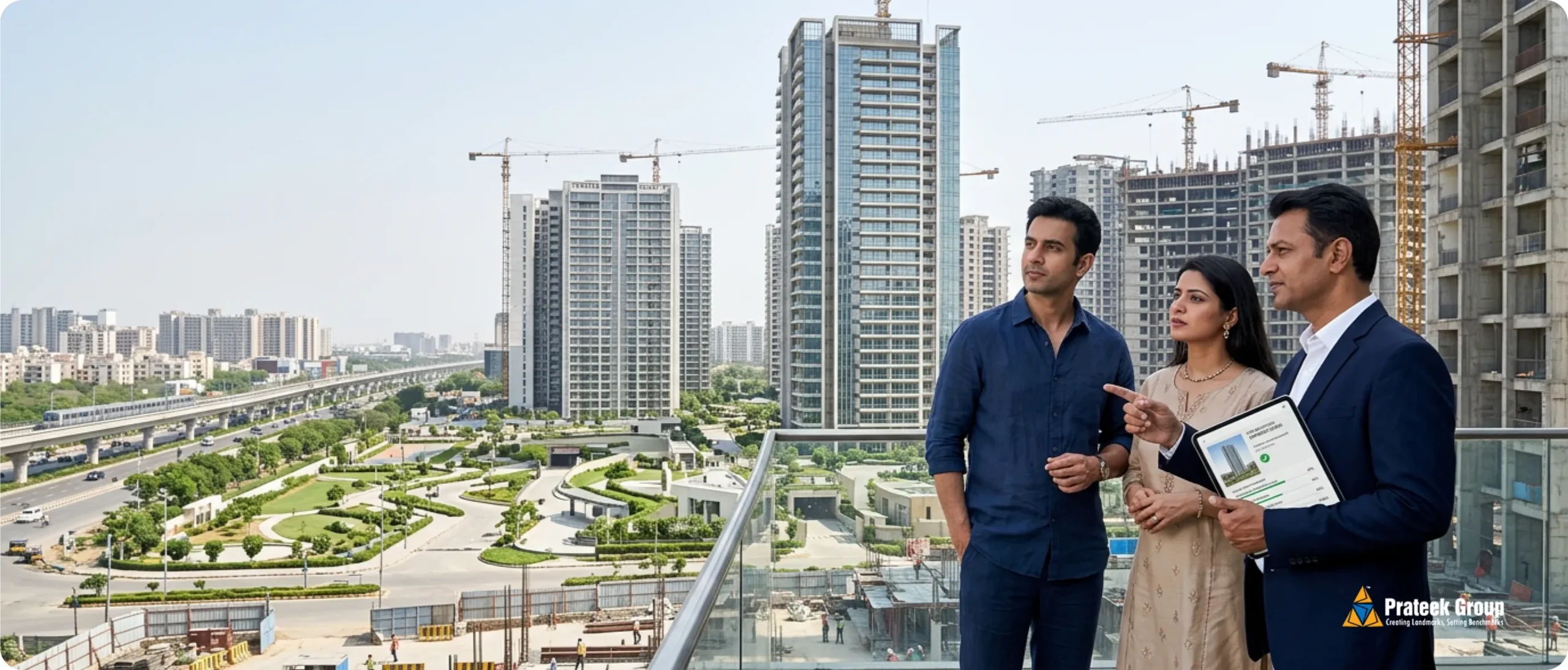
Searches for upcoming projects in Noida have jumped in 2026, and it’s easy to see why. The Noida International Airport opened in June, the Aqua Line extension to Botanical Garden was approved in February and demand for new homes along the Expressway remains strong. Yet the supply of new launches has fallen sharply. That combination makes it more important than ever to know how to judge a new project before you pay anything.
This guide doesn’t list projects. Instead, it explains what’s happening to new launches in Noida, where new projects are coming up, what “pre-launch” really means under the law, how to evaluate any upcoming residential project and what your RERA rights are if possession is delayed. It also covers commercial projects, for buyers weighing a shop or office.
New launches in Noida in 2026: the numbers
Noida’s new supply has tightened dramatically this year. ANAROCK’s Q2 2026 data, reported by Outlook Money, showed the combined Noida and Greater Noida market recording a 72% year-on-year fall in new launches, with only 2,140 units introduced in the quarter. Housing sales in the same market fell 20%.
Measure | What the data shows | Period |
New launches, Noida and Greater Noida | 2,140 units, down 72% year on year | Q2 2026 |
Housing sales, Noida and Greater Noida | Down 20% year on year | Q2 2026 |
New launches, all NCR | 11,205 units, down 40% year on year | Q2 2026 |
Housing sales, all NCR | 13,365 units, down 6% year on year | Q2 2026 |
*Source: ANAROCK data as reported by Outlook Money, August 2026.*
For buyers, fewer launches mean less choice among new projects and more competition for the ones that do come to market. It also means that ready and resale homes in completed societies are worth a serious look alongside anything new. Our analysis of new launch projects in Noida in 2026 looks at what’s driving developers’ decisions.
Why new projects in Noida are scarce
Several factors explain why there are fewer new projects in Noida this year.
- Land is expensive and limited. Most of central Noida is built out, and new group housing land comes mainly through the Noida Authority’s allotments and auctions, which are infrequent and costly.
- Legacy issues took time to clear. Some developers spent recent years resolving dues and stalled projects under the state’s rehabilitation package for legacy projects, which slowed new launches.
- Developers are selective. With land costs high, developers are launching fewer, larger and more premium projects rather than many smaller ones.
- Approvals take time. A new project needs planning approval, environmental clearance where applicable and RERA registration before it can be marketed.
The practical result is that a genuine new launch in Noida is a significant event, and the ones that come to market tend to be premium and priced accordingly.
Where new projects are coming up
Without naming individual projects, it’s possible to describe where Noida’s new residential supply is concentrated.
The Noida Expressway corridor
The sectors along the Noida-Greater Noida Expressway, from the 90s through to the 150s and 160s, account for much of Noida’s recent and upcoming supply. Noida Expressway projects benefit from the Aqua Line, the office clusters along the corridor and the drive to the new airport. The approved Aqua Line extension from Sector 142 to Botanical Garden will add stations at Sectors 93, 97, 105 and 108 and connect directly to the Delhi Metro, which strengthens the corridor further once built.
The southern sectors near Sector 150
The low-density southern sectors, including the Sector 150 belt, have drawn premium launches in recent years. Much of their appeal comes from open space, sports and green land in the sector plans and proximity to the airport. Our guide to pre-launch property in Sector 150 covers what to check in that belt.
Central Noida infill
Occasional launches come up in central Noida on smaller plots or redeveloped land. These are rare, usually premium and benefit from established infrastructure.
What “pre-launch” means under the law
Buyers hunting for upcoming projects in Noida often come across “pre-launch” offers: bookings or expressions of interest taken before a project is formally launched, usually at a lower price. It’s important to understand the law here.
Under Section 3 of the Real Estate (Regulation and Development) Act, 2016, a developer can’t advertise, market, book, sell or offer for sale any apartment in a project that needs registration until the project is registered with the state RERA authority. Regulators have treated expressions of interest, “coming soon” campaigns and soft launches as marketing. A project that takes money before its RERA registration is breaking the law, and the penalty can run up to 10% of the project’s estimated cost.
Pre-launch property prices in Noida
Pre-launch property prices in Noida are often advertised as a chance to buy early at a discount before the “official” price rises. The risk is that you’re paying money for a project that has no RERA registration, no approved plan you can check, no escrow protection and no enforceable agreement for sale. If the project is delayed, changed or never launched, your options are limited.
The legitimate version of “buying early” happens after registration. Once a project is registered, developers often price the first phase attractively and raise prices in later phases as construction progresses. That’s where early buyers can genuinely benefit, with the full protection of RERA.
How to evaluate an upcoming residential project in Noida
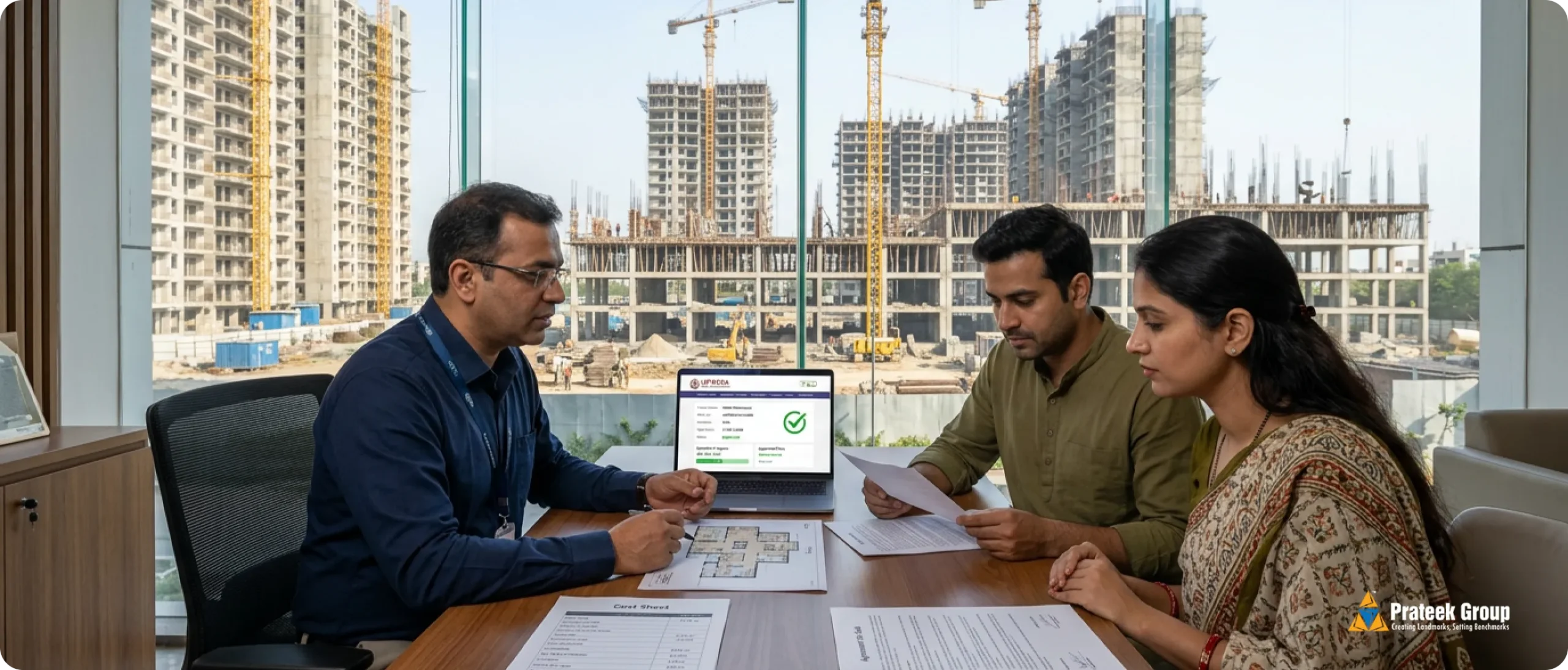
Whatever project you’re considering, run the same checks. They take a few hours and can save years of trouble. Our step-by-step guide on how to verify a real estate project on RERA walks through the portal.
Check the RERA registration
Search the project on the UP RERA portal. Note the registration number, the promoter’s name, the registered completion date and the approved plans. If the project isn’t on the portal, don’t pay.
Read the quarterly progress reports
Registered projects file quarterly progress reports on RERA. Compare what’s reported with what you see on site. A project whose site matches its reports is a far safer bet than a project where the 2 don’t line up.
Check the land and approvals
RERA filings include the land title and approvals. Check that the promoter holds the land or has clear rights to develop it, and that building plans are approved.
Look at the developer’s completed work
Visit a finished society by the same developer and talk to residents. Delivery history, construction quality and after-sales service tell you more than any brochure.
Understand the escrow protection
Under RERA, a developer must deposit 70% of the money collected from buyers into a separate project account, to be used only for construction and land costs of that project. It’s an important protection against funds being diverted to other projects.
Get a full cost sheet
Ask for every charge on top of the base price: parking, club, preferential location charges, maintenance deposits and GST at an effective 5% for homes that aren’t affordable housing. Compare projects on total cost.
Read the agreement for sale
Under Section 13 of RERA, a developer can’t take more than 10% of the price as an advance without first signing a registered agreement for sale with you. Read it carefully, especially the possession date, the carpet area and the clauses on delay.
RERA rules for possession: your rights
The biggest risk with any upcoming project is delay. RERA gives buyers clear rights, and knowing them helps you judge an agreement and act if things go wrong. Our explainer on possession delays and RERA compensation covers them in more depth.
A fixed possession date in the agreement
The agreement for sale must state the date by which the developer will hand over possession. That date, along with the completion date registered on RERA, is the benchmark for any delay claim.
Refund or interest if possession is delayed
Under Section 18 of RERA, if the developer fails to give possession by the agreed date, you can choose to withdraw from the project and get a full refund of what you’ve paid with interest, or stay in the project and receive interest for every month of delay until possession. In Uttar Pradesh, the interest rate applied under the state rules is based on SBI’s marginal cost of lending rate plus a margin, commonly cited as 1%. In 2021, the Supreme Court held in Newtech Promoters v State of UP that a buyer’s right to withdraw with a refund when possession is delayed is unconditional.
No changes to the plan without consent
Under Section 14, the developer can’t make major changes to the approved plans without the written consent of at least 2 out of every 3 buyers. Minor changes are allowed only within limits.
Possession with an occupancy certificate
The developer should hand over possession with the occupancy certificate in place. Don’t take possession of a home in a tower without it, since it affects utilities, loans and resale.
Structural defects covered for 5 years
Under Section 14(3), if you find a structural defect or poor workmanship within 5 years of possession, the developer must fix it without charge, generally within 30 days.
Conveyance and handover to the association
The developer must execute the conveyance or sale deed in your favour and hand over common areas and documents to the residents’ association, within the time set by the Act and state rules.
Force majeure
Agreements usually allow extensions for events beyond the developer’s control, such as natural disasters. Regulators have granted extensions in some situations, but routine delays in approvals or funding generally don’t qualify. Read the force majeure clause carefully before you sign.
A worked example: what a delay costs, and what RERA pays
Numbers make the delay rules easier to weigh. Suppose you book a ₹1.5 crore home in an upcoming project and have paid ₹1 crore by the promised possession date. The developer hands over possession 12 months late.
If you stay in the project, RERA entitles you to interest on the ₹1 crore you’ve paid for each month of delay. At an annual rate of around 9.5% to 10%, which is roughly where a rate based on SBI’s lending rate plus a small margin has sat recently, that’s about ₹9.5 lakh to ₹10 lakh for the year. Against that, you’ve probably paid a year’s extra rent and a year’s extra home loan interest on the amount disbursed.
If you withdraw, the developer must refund the ₹1 crore with interest from the date of each payment. You get your money back, but you lose the home and have to start your search again, possibly at higher prices.
Neither outcome is ideal, which is why checking a developer’s delivery record and a project’s progress before you book matters so much. RERA softens the blow of a delay. It doesn’t remove it.
*This is an illustration. Actual interest depends on the rate applied by UP RERA, your payment dates and the terms of your agreement.*
How to read an agreement for sale for a new launch
The agreement for sale is the document that protects you through construction. Read these parts closely before you sign:
- Carpet area. It must be stated. Check how the price relates to it.
- Possession date. A specific date, not a vague period.
- Payment plan. Which instalments fall due at which construction stages.
- Delay clauses. What interest the developer pays you for delay, and what you pay if you’re late. Under RERA, the rates should match.
- Force majeure. How narrowly or broadly it’s defined.
- Specifications. A list of fittings and finishes you’re entitled to.
- Cancellation. What happens to your money if you cancel, and how much can be deducted.
- Common areas. What’s included in the project and when it’ll be handed to the residents’ association.
If any clause seems to take away a right RERA gives you, ask about it. A lawyer’s review of the agreement for sale costs little compared with the value of the home.
What the airport and metro mean for new launches
Infrastructure is 1 of the main reasons buyers are drawn to upcoming projects in Noida. Noida International Airport at Jewar began commercial flights on 15 June 2026, which has sharpened interest in the southern sectors and the Yamuna Expressway belt. The approved Aqua Line extension will link the Expressway corridor directly to the Delhi Metro. Together, they strengthen the long-term case for the areas where most new projects are coming up.
It’s worth keeping 2 things in mind. First, infrastructure that’s operating adds value now, while infrastructure that’s approved but not built adds value later and with some uncertainty about timing. Second, developers price these benefits into new launches, so part of the advantage is already in the price you’re offered. Judge a project on its own merits first, and treat infrastructure as a supporting reason for buying rather than the main reason.
Questions to ask at a new launch
- What’s the RERA registration number, and can I see the registered completion date?
- What’s the carpet area of this home, and how is the price worked out?
- What’s the full cost, including every charge and GST?
- What does the latest quarterly progress report say?
- Which of your completed projects can I visit, and can I speak to residents?
- What does the agreement say about delay, both ways?
- When will common areas be handed over to the residents’ association?
Noida building projects: which need RERA registration
A Noida building project needs RERA registration if the land proposed for development is more than 500 sq m or the number of apartments across all phases is more than 8. Almost every group housing project meets that test. Very small projects below both limits are exempt, which is 1 reason to be careful with small builder-floor developments marketed as new projects. Check what protections apply before you buy.
Commercial projects in Noida
Commercial projects in Noida, including offices, shops and mixed-use developments, follow the same RERA rules as residential projects, and the same checks apply. A few things differ.
Office demand
Noida is a major office market. JLL’s data for Q2 2026, reported by Real Estate Asia, showed Delhi NCR gross office leasing rising 16% on the quarter to 3.55 million sq ft, with Noida contributing 30% of net absorption and the Noida Expressway among the leading corridors. Grade A rents in the region reached about ₹94.6 per sq ft a month, up 7.7% on the year.
GST and returns
Under-construction commercial property attracts GST at 12%, and the buyer is typically a business that may be able to claim input tax credit. Returns come from rent, so judge a commercial unit by its likely rental yield, tenant demand, lease terms and maintenance costs as well as the price.
Retail and mixed use
Retail units in residential townships and mixed-use projects depend on the footfall the development generates. Look at how many homes are occupied nearby, the tenant mix and the terms on which the developer will manage the space.
What happens if a project stalls
Most registered projects in Noida are completed, but buyers should know the options if a project stalls. Under RERA, if a project’s registration is revoked or lapses, the state authority can take steps to have the remaining work completed, including by the association of buyers or another developer. Buyers can also file complaints with UP RERA for refunds or interest, and RERA orders can be enforced as recovery.
If the developer company faces insolvency, homebuyers are treated as financial creditors under the Insolvency and Bankruptcy Code, which gives them a seat at the table in any resolution process. That doesn’t guarantee a quick outcome, but it does give buyers a voice.
The best protection is prevention: choose registered projects from developers with a clear record of completed work, and keep checking progress reports after you book. If a project falls behind, act early by joining other buyers and raising it with the developer and UP RERA.
Early phase or later phase?
Large projects are often launched in phases. Buying in an early phase can mean a lower price per sq ft and a wider choice of towers and floors. Buying in a later phase can mean less risk, because you can see the earlier towers going up or completed, and judge the developer’s progress for yourself.
There’s no single right answer. If the developer has a strong record and the first phase is moving well on site, a later-phase purchase at a somewhat higher price may still be good value for the added certainty. If you’re comfortable with more risk and have checked the developer thoroughly, an early-phase booking can pay off. Either way, the RERA checks above apply to every phase, since each phase is often registered separately.
Budgeting for a new launch
Buying an under-construction home spreads the cost over several years, but the total can surprise buyers. Plan for:
- The base price and extras, paid through the construction-linked schedule.
- GST at an effective 5% on each instalment before completion, for homes that aren’t affordable housing.
- Stamp duty and registration at possession, when the sale or conveyance deed is registered: 7% stamp duty for a male buyer, with a 1% concession for women on property worth up to ₹1 crore, plus 1% registration.
- Maintenance deposits and club charges at possession.
- Interiors, which can add a significant amount to a new home.
If you’re comparing a new launch with a ready home, compare total cost and timing, and factor in the rent you’ll keep paying while you wait for possession.
Home loans for under-construction homes
Most buyers of new launches use a home loan, and the way it works during construction affects your cash flow. The bank sanctions the loan upfront but disburses it in stages as construction progresses, paying the developer directly against each demand. You pay interest only on the amount disbursed, often called pre-EMI interest, until the full loan is released or possession is handed over, after which regular EMIs begin.
Before you book, check that the project is approved by your bank, since lenders run their own checks on the developer and the project. Keep an eye on construction progress through the RERA reports, because a stalled site means disbursements stop while your earlier interest keeps running. If you’re still paying rent, add the pre-EMI interest to your monthly budget for the whole construction period.
Upcoming vs ready: making the choice
Upcoming projects offer staged payments, a new building and sometimes a lower price in early phases. Ready homes offer certainty, no GST and immediate use. With new supply scarce in 2026, many Noida buyers are weighing both. The right choice depends on your timeline, your appetite for delay risk and your budget. If you’d like to see the kinds of new homes available, Prateek’s page on new flats in Noida is a starting point.
Choosing the right size of home in a new project
New launches in Noida in 2026 lean towards larger homes, with 3 and 4 BHK layouts dominating premium projects. Before you pick a size, think about how you’ll live in the home 5 and 10 years from now, since you may be waiting 3 or 4 years just to move in. A couple planning a family may find a 3 BHK makes more sense than a 2 BHK by the time of possession. A family expecting parents to move in may want a 4 BHK or a 3 BHK with a study.
Compare layouts on carpet area and room sizes as well as the number of bedrooms. A well-planned 3 BHK can feel larger than a poorly planned 4 BHK. Ask for the dimensions of each room, and check that bedrooms fit a bed and wardrobe comfortably with space to move around.
Red flags with new projects
- Asking for money before the RERA number is visible on the portal.
- “Pre-launch” or “expression of interest” offers with no registration.
- Pressure to book within hours.
- A cost sheet that shows only the base price.
- An agreement for sale without a clear possession date or carpet area.
- A site that doesn’t match the quarterly progress reports.
- Reluctance to show completed projects or introduce you to residents.
Frequently asked questions
Are there many upcoming projects in Noida in 2026?
There are fewer upcoming projects in Noida in 2026 than in recent years. ANAROCK’s Q2 2026 data showed new launches in Noida and Greater Noida falling 72% year on year to 2,140 units. The launches that do come to market tend to be premium and concentrated along the Noida Expressway and in the southern sectors near Sector 150.
How do I evaluate an upcoming project in Noida?
To evaluate an upcoming project in Noida, check its registration on the UP RERA portal, read its quarterly progress reports, confirm the land title and approvals, visit a completed project by the same developer and get a full cost sheet. Read the agreement for sale carefully, especially the possession date, carpet area and delay clauses, before paying more than 10%.
Is it safe to book a pre-launch project in Noida?
Booking a project before its RERA registration is risky and generally unlawful for the developer. Section 3 of RERA bars developers from advertising, booking or selling units before registration. Pre-launch property prices in Noida may look attractive, but without registration you lack escrow protection, approved plans you can check and an enforceable agreement for sale.
What are the RERA rules for possession?
The RERA rules for possession require a fixed possession date in the agreement for sale. Under Section 18, if possession is delayed, the buyer can withdraw with a full refund and interest or stay and receive interest for each month of delay. Developers must also fix structural defects reported within 5 years and hand over possession with an occupancy certificate.
What interest do I get for delayed possession in Uttar Pradesh?
In Uttar Pradesh, interest for delayed possession under RERA is applied at a rate based on SBI’s marginal cost of lending rate plus a margin, commonly cited as 1%. It’s paid for every month of delay until possession if you stay in the project, or on the full amount refunded if you withdraw. Check the current rule with UP RERA.
Which areas have the most new projects in Noida?
Most new projects in Noida are coming up along the Noida-Greater Noida Expressway, from the sectors in the 90s through the 150s and 160s, and in the low-density southern sectors around Sector 150. Occasional launches also come up in central Noida on smaller or redeveloped plots, usually at premium prices.
Why are Noida Expressway projects in demand?
Noida Expressway projects are in demand because the corridor combines the Aqua Line, large office clusters, the drive to Noida International Airport and planned improvements such as the approved Aqua Line extension to Botanical Garden. Much of Noida’s new residential supply is concentrated here, along with a significant share of the region’s office leasing.
Do commercial projects in Noida need RERA registration?
Yes. Commercial projects in Noida, including offices, shops and mixed-use developments, need RERA registration if they meet the size thresholds, just like residential projects, and buyers get the same protections. Under-construction commercial property attracts GST at 12%. Judge a commercial unit by its likely rental yield, tenant demand, lease terms and maintenance costs.
Which Noida building projects are exempt from RERA?
A Noida building project is exempt from RERA registration only if the land proposed for development is 500 sq m or less and the number of apartments across all phases is 8 or fewer. Almost all group housing projects need registration. Be careful with very small developments, since buyers there don’t get RERA’s full protections.
Should I choose a new launch or a ready home in Noida?
Choose a new launch in Noida if you’re comfortable waiting several years, want staged payments and value a new building. Choose a ready home if you want certainty, no GST and immediate use. With new launches scarce in 2026, compare total cost, timing and the rent you’d keep paying while waiting before deciding.