
Choosing between Sector 150 and Sector 128 is one of the most common dilemmas we hear from premium homebuyers in Noida today. Both addresses sit along the Noida-Greater Noida Expressway, both attract serious money, and both have delivered impressive returns over the last five years. Yet the two sectors could not be more different in character. One is a low-density, green, master-planned sports city built for the next thirty years. The other is a mature luxury township anchored by a golf course and some of the most expensive apartments in Uttar Pradesh.
As a developer that has spent two decades building homes across Noida and the NCR, we work with buyers on both sides of this decision every week. In this guide, we compare the two sectors honestly, parameter by parameter, using the latest market data, infrastructure updates and practical buyer logic.
Our stand is simple. We will show you where Sector 128 genuinely wins, where Sector 150 pulls ahead, and what each difference actually means for your family, your finances and your future.
TL;DR
Two Expressway Icons, One Defining Decade
Sector 150 and Sector 128 anchor opposite ends of the Noida-Greater Noida Expressway, and 2026 has redrawn the map between them. With Noida International Airport now operational and both sectors up over 100 percent in five years, this comparison has never carried higher stakes.
The ₹2 Crore Premium Every Buyer Must Question
Comparable premium homes cost roughly 35 to 40 percent more in Sector 128 than in Sector 150. Buyers must decide whether Delhi proximity, golf-township prestige, and mature social infrastructure justify that gap or whether they are paying yesterday’s premium while overlooking tomorrow’s growth corridor.
A Persona-Led Framework Pointing Toward Sector 150
Our parameter-by-parameter analysis, covering prices, appreciation runway, rental yield, green density, and airport exposure, shows Sector 128 suits Delhi-anchored, budget-unconstrained buyers. For most families, first-time premium buyers, and long-horizon investors, Sector 150 delivers stronger value, structural greenery, and the decade’s best appreciation case.
Why This Comparison Matters More in 2026 Than Ever Before
Timing changes everything in real estate, and 2026 is a genuine inflection point for the Noida Expressway corridor.
The Noida International Airport at Jewar was inaugurated on 28 March 2026, and commercial flights began on 15 June 2026. An entire aviation economy is now taking shape at the southern end of the expressway, and the sectors closest to this growth axis are being repriced by the market in real time.
At the same time, NCR housing prices have risen sharply since 2021. Portal data shows that both Sector 150 and Sector 128 have appreciated by more than 100 percent over the last five years. Entry prices are no longer casual, so choosing the wrong sector today carries a much higher opportunity cost than it did in 2020 or 2021.
In short, both sectors are excellent. But “excellent” is not the same as “right for you.” That is what the rest of this guide is designed to settle.
Sector 150 Noida at a Glance: The Green Sports City
Before we compare, it helps to understand what each sector was designed to be, because master planning explains almost everything that follows.
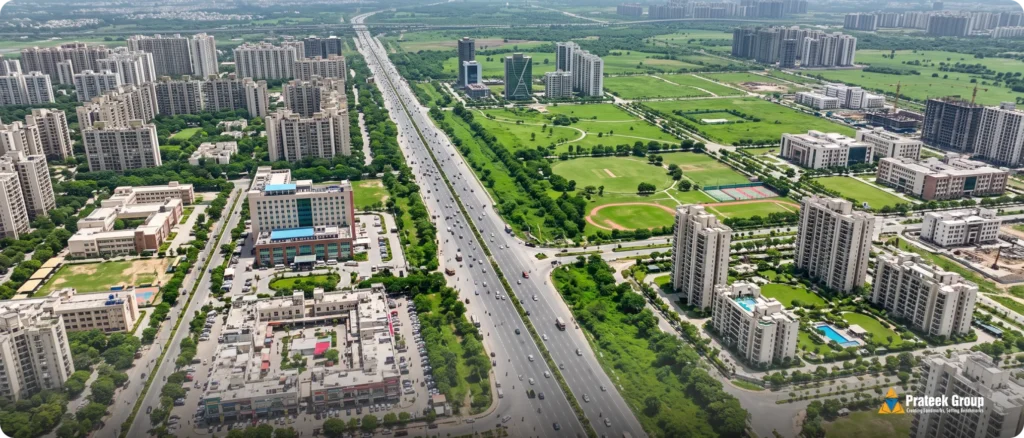
Sector 150 sits at the Noida end of the Noida-Greater Noida Expressway, adjacent to Sectors 149 and 151. It was conceived by the Noida Authority as a dedicated sports city, with roughly 80 percent of the sector reserved for green cover, sports infrastructure and open space. The practical result is the lowest population density among Noida’s premium sectors. Wide internal roads, underground cabling, a cricket stadium, a golf course, and the expansive Shaheed Bhagat Singh Park give the sector an openness that older parts of Noida simply cannot replicate.
The residential ecosystem here is dominated by branded developers. ATS, Godrej, Tata, Max Estates and our own Prateek Group have all chosen Sector 150 for flagship projects, which tells you how the industry itself rates this land. As of mid-2026, average apartment prices in Sector 150 hover around Rs 12,000 to Rs 12,500 per sq ft, with a broad range of roughly Rs 9,700 to Rs 14,500 per sq ft depending on the project, floor and construction stage.
Sector 128 Noida at a Glance: The Established Luxury Township
Sector 128 sits at the Delhi end of the same expressway, barely 9 to 10 km from the DND Flyway and South Delhi. The sector is essentially synonymous with Jaypee Wish Town, a township of over 1,000 acres planned around an 18-hole plus 9-hole golf course. Over the last few years, the arrival of Max Estates, L&T Realty, Kalpataru and M3M has pushed the sector’s luxury ceiling dramatically higher.
Social infrastructure here is genuinely mature. Jaypee Hospital, Jaypee Public School, the Jaypee Institute of Information Technology, and established retail complexes are already operational, not promised. That maturity commands a price. As of 2026, average rates in Sector 128 sit around Rs 16,700 to Rs 17,000 per sq ft, with new-age luxury projects trading between Rs 20,000 and Rs 25,000 per sq ft in the resale market.
Quick Comparison: Sector 150 vs Sector 128 at a Glance
Here is the summary picture before we go parameter by parameter. Treat this as a map, not the verdict.
Parameter | Sector 150 | Sector 128 |
Character | Low-density green sports city | Mature golf-township luxury hub |
Avg. price (2026) | Rs 12,000 to 12,500 per sq ft | Rs 16,700 to 17,000 per sq ft |
Luxury ceiling | Up to ~Rs 17,000 per sq ft | Up to ~Rs 25,000 per sq ft |
5-year appreciation | 110 percent plus | 100 to 126 percent (project dependent) |
Green cover | ~80 percent of sector area | Golf course and township greens |
Density | Very low, capped by master plan | Moderate, township-scale |
Metro access | Aqua Line Sectors 147, 148, 149 | Aqua Line Sector 137 (nearby) |
Distance to Jewar Airport | ~30 to 35 km | ~45 to 50 km |
Distance to South Delhi | ~25 to 30 km | ~10 to 15 km |
Rental yield | ~2 percent | ~2.1 percent |
Best suited for | Families, long-horizon investors | Delhi-centric professionals, ultra-luxury buyers |
The headline takeaway is that Sector 128 charges a 35 to 40 percent price premium over Sector 150 for comparable quality. Whether that premium is worth paying is exactly what the next sections examine.
How the Two Sectors Got Here: A Short History That Explains the Present
Understanding how each sector evolved explains why they feel so different today, and why their futures will likely diverge further.
Sector 128’s story began in the mid-2000s, when the Jaypee Group conceived Wish Town as an integrated golf township at the Delhi gateway of the new expressway. The vision was ahead of its time, and early residents enjoyed infrastructure that the rest of Noida envied. The subsequent financial troubles of the original developer slowed parts of the township for years, until resolution processes and the entry of new institutional developers such as Max Estates and Kalpataru reignited the sector, this time at ultra-luxury price points.
Sector 150’s story is younger and cleaner. The Noida Authority carved it out as a dedicated sports city in the 2010s, auctioning low-FAR plots to established developers under a plan that locked in green dominance. Because the sector’s entire residential stock was launched in or after the RERA era, its growth has been steadier and less dramatic, compounding quietly from affordable beginnings around Rs 4,000 to 5,000 per sq ft in the late 2010s to today’s Rs 12,000 plus.
The pattern is instructive. Sector 128 has lived one full boom, one crisis and one revival. Sector 150 is still inside its first long boom, with its biggest catalysts, led by the airport, only now switching on. Buyers are not just choosing between two locations; they are choosing between two points on two very different growth curves.
Location and Connectivity: Which Sector Moves You Faster?
Location debates usually collapse into one question: where do you spend your weekdays? So let us answer it honestly for both sectors.
Where Sector 128 Wins
Sector 128 is unbeatable for Delhi-facing commutes. South Delhi is 20 to 25 minutes away via the DND Flyway, and the sector sits at the entry point of the expressway, so professionals working in Delhi, Film City or the Sector 125 to 132 office belt save meaningful time every single day. The presence of corporate campuses within and around the sector, including major IT and media offices, means some residents effectively walk or drive five minutes to work. Very few NCR locations can offer that.
Where Sector 150 Wins
Sector 150 faces the future rather than the past. It sits closest to the Yamuna Expressway interchange, which puts the new Noida International Airport roughly 30 to 35 minutes away, against roughly 45 to 60 minutes from Sector 128 in normal traffic. The sector also enjoys cleaner access to Greater Noida’s institutional belt, the upcoming Film City in Sector 21 (YEIDA), and the industrial corridors being developed by the Yamuna Expressway Industrial Development Authority, which is driving one of the largest planned growth regions in North India.
What This Means for Buyers
If your income depends on Delhi, Sector 128 saves you 30 to 45 minutes of daily commuting, and that convenience is worth real money. If your life and investments point toward the airport economy, Greater Noida’s job centres, or a work-from-home or hybrid arrangement, Sector 150’s positioning is stronger, and it gets stronger every year as the southern corridor matures.
Metro and Public Transport: A Closer Race Than You Think
Metro access is often misunderstood in this comparison, so let us set the record straight with the actual network map. Both sectors are served by the Aqua Line operated by the Noida Metro Rail Corporation. Sector 150 residents use the Sector 147, 148, and 149 stations, which sit within a short drive of every major project in the sector. Sector 128 residents typically use the Sector 137 station across the expressway.
Neither sector has a metro station at its doorstep, and both depend on a 5- to 10-minute last-mile drive. The Aqua Line’s planned integrations with the Blue Line and future airport connectivity will benefit both corridors. The honest conclusion is that metro access is close to a tie. Sector 128 has a slight edge for Delhi-bound metro journeys today, while Sector 150 stands to gain more from future southern extensions toward the airport region. Buyers should not let metro marketing sway this decision either way.
The Jewar Airport Factor: The Single Biggest Growth Variable
No infrastructure project in North India will shape property values over the next decade like the new airport, so this deserves its own section.
The Noida International Airport began commercial operations on 15 June 2026 with a Phase 1 capacity of 12 million passengers a year, planned to scale to around 70 million passengers at full build-out. Aviation hubs of this scale historically pull jobs, hotels, logistics parks and premium housing demand toward themselves. Sector 150 is the closest premium residential sector in Noida proper to this growth engine. It effectively becomes the “first premium address” for airport-linked professionals, airline staff, and businesses setting up along the Yamuna Expressway.
Sector 128 will also benefit, because the entire expressway corridor gains from the airport. But the gradient of benefit favors the southern end, and Sector 150 sits precisely there. For a buyer thinking in 10-year horizons, this is arguably the strongest single argument in Sector 150’s favor. Airports reprice geography, and Sector 150 is on the right side of that repricing.
Green Spaces and Density: Two Different Definitions of Open Living
Both sectors market greenery heavily, but the source of that greenery is fundamentally different, and the difference matters for daily life.
Sector 128’s green identity comes from the golf course and the landscaped townships within Wish Town. It is beautiful, but it is private and project-led. Step outside the township gates and you are in a conventional, moderately dense urban corridor. Sector 150’s green identity comes from the master plan itself. With roughly 80 percent of the sector earmarked for greens, sports facilities and open areas, the low density is structural and permanent. The Noida Authority’s planning framework caps how much can ever be built here, which you can verify through the Noida Authority and its published sector plans.
Why Structural Green Cover Beats Project Green Cover
Project greenery depends on maintenance budgets and society management. Sector-level greenery is protected by planning law and shared by everyone. Low density also has second-order benefits that buyers only appreciate after moving in: less traffic inside the sector, quieter nights, better air quality relative to central Noida, and public parks like Shaheed Bhagat Singh Park that function as genuine community spaces. For families with children, senior citizens, and anyone prioritising wellness, Sector 150 wins this parameter clearly. Sector 128 offers curated greenery; Sector 150 offers a green sector.
Lifestyle and Social Infrastructure: Maturity vs Momentum
Social infrastructure is where the two sectors trade blows, and an honest guide has to acknowledge that maturity favors Sector 128 today.
Education
Sector 128 has operational schools inside the township, including Jaypee Public School, plus the Jaypee Institute of Information Technology for higher education. Sector 150 relies on a fast-growing ring of schools in the surrounding sectors and the Greater Noida institutional belt, with several campuses within a 10 to 15 minute drive.
For parents of school-going children who want a five-minute school run today, Sector 128 is more convenient right now.
Healthcare
Sector 128 again benefits from Jaypee Hospital, a large multi-speciality facility at its doorstep. Sector 150 residents typically use hospitals along the expressway corridor, including facilities in Sectors 110 to 137 and Greater Noida, most within 15 to 20 minutes.
Retail, Dining and Entertainment
Sector 128 has functioning high-street retail within the township. Sector 150’s retail ecosystem is younger but expanding quickly as thousands of delivered apartments create daily demand; new high-street and society retail is opening every quarter, alongside larger destination malls a short drive up the expressway. Our own experience across NCR, including our commercial projects, is that retail always follows rooftops with a two- to three-year lag, and Sector 150 is exactly in that catch-up phase now.
What This Means for Buyers
If you need every convenience operational on day one, Sector 128’s maturity is a genuine advantage, and we will not pretend otherwise. If you can accept 90 percent convenience today in exchange for a better environment and stronger appreciation runway, Sector 150’s social infrastructure is already past the critical threshold where daily life feels easy, and its trajectory is steeply upward.
Property Prices and Value for Money: The 40 Percent Question
Price is where this comparison becomes decisive for most buyers, so let us put the numbers side by side.
Metric (2026) | Sector 150 | Sector 128 |
Average rate | ~Rs 12,000 to 12,500 per sq ft | ~Rs 16,700 to 17,000 per sq ft |
Typical range | Rs 9,700 to 14,500 per sq ft | Rs 17,000 to 25,000 per sq ft |
3 BHK premium (~2,000 sq ft) | Rs 2.4 to 2.9 crore | Rs 3.4 to 5 crore |
4 BHK luxury (~3,300 sq ft) | Rs 4 to 5 crore | Rs 7 to 11 crore |
Entry point for premium living | ~Rs 2 crore | ~Rs 3 crore plus |
The pattern is unmistakable. A comparable premium 3 BHK costs roughly Rs 1 to 2 crore more in Sector 128 than in Sector 150, and the gap widens dramatically in the 4 BHK and penthouse segment.
Is Sector 128’s Premium Justified?
Partly, yes. You are paying for Delhi proximity, golf frontage and operational infrastructure. For ultra-high-net-worth buyers to whom Rs 2 crore is not a constraint, that premium buys real convenience and prestige. For everyone else, the value equation tilts toward Sector 150. You get comparable construction quality, a better sector-level environment, and newer building stock, and you keep Rs 1 to 2 crore of capital either invested elsewhere or off your loan burden entirely. With home loan rates still meaningfully affecting affordability, as tracked through the Reserve Bank of India’s policy rate decisions, a Rs 1.5 crore smaller loan translates into roughly Rs 1.2 to 1.3 lakh lower EMI every month. That is not a rounding error; it is a lifestyle in itself.
Price Appreciation: Where Will Growth Come From Next?
Past appreciation tells you what happened; the drivers behind it tell you what happens next. Both matter, so let us look at both.
Over the last five years, portal data shows Sector 150 flats appreciating by roughly 110 to 120 percent, with around 48 percent growth in the last three years alone and healthy year-on-year momentum continuing into 2026. Sector 128 has delivered comparable five-year numbers, with certain luxury launches appreciating 34 to 60 percent from their launch prices as the ultra-luxury wave swept the sector.
The Base Effect Argument
Here is the mathematics most buyers miss. Sector 128 already trades at Rs 17,000 to 25,000 per sq ft. For it to double, it must reach Rs 34,000 to 50,000 per sq ft, which would place it among the most expensive apartment markets in India outside South Mumbai and Central Delhi. Possible, but a stretch.
Sector 150 trades at Rs 12,000 to 14,500 per sq ft. For it to double, it needs Rs 24,000 to 29,000 per sq ft, which is simply where Sector 128’s best projects already trade today. That is a far more achievable journey, especially with the airport economy compounding in its favor.
The Supply Argument
Sector 150’s master plan permanently restricts density, so supply cannot flood in to cap prices. Sector 128’s remaining land parcels within Wish Town are being actively developed by multiple large developers, which adds premium supply over the next few years.
Independent research houses such as ANAROCK have repeatedly highlighted the Noida Expressway corridor among NCR’s fastest-appreciating markets, driven by infrastructure and end-user demand. Within that corridor, the combination of a low base, restricted supply and airport proximity gives Sector 150 the stronger appreciation case for the 2026 to 2035 window.
Rental Demand and Yield: A Near Tie With Different Tenants
Rental yield rarely decides a premium purchase in NCR, but it matters for investors, so here are the honest numbers.
Both sectors deliver gross rental yields of roughly 2 to 2.1 percent, which is typical for premium NCR housing. The difference lies in tenant profile rather than yield.
Sector 128 attracts senior corporate tenants working in Delhi and the adjacent office belt, with monthly rents for premium 3 and 4 BHKs commonly between Rs 60,000 and Rs 1.4 lakh.
Sector 150 attracts families and professionals seeking green, low-density living, with premium 3 BHK rents typically between Rs 45,000 and Rs 80,000 and rising steadily as delivered supply gets absorbed. The airport’s operational ramp-up is expected to add a new tenant class of aviation-sector professionals over the next three to five years, and Sector 150 is the closest premium catchment for them.
Verdict: treat rentals as a tie today, with Sector 150 holding the more interesting growth option on future tenant demand.
Builder Ecosystem and Luxury Projects: Track Records Matter
A location is only as good as the buildings on it, so the developer ecosystem deserves scrutiny in both sectors.
Sector 128’s Developer Story
Sector 128’s new wave is genuinely impressive, with Max Estates, L&T Realty, Kalpataru and M3M delivering some of NCR’s finest luxury products.
But an honest guide must also note the sector’s legacy. Parts of the original Jaypee Wish Town development went through prolonged insolvency proceedings, and thousands of homebuyers waited years for stalled units before resolution processes began delivering possession. The new developers are excellent, but buyers in the resale township segment should do careful project-level due diligence, and every buyer should verify registrations on the UP RERA portal before committing funds.
Sector 150’s Developer Story
Sector 150 attracted branded developers from day one: ATS, Godrej, Tata Housing, Max Antara and Prateek Group among them. Because the sector developed after RERA came into force, its project pipeline carries cleaner title and compliance histories on average, with fewer legacy disputes.
For a sense of our own track record behind our Sector 150 commitment, our delivered portfolio includes Prateek Edifice in Sector 107, designed by architect Hafeez Contractor, and the 40-acre township of Prateek Grand City in Siddharth Vihar, where all towers stand delivered. We believe buyers should judge developers by possession certificates, not brochures, and we invite exactly that scrutiny.
Prateek Canary: How Sector 150’s Strengths Come Together
When we chose the land for our flagship Sector 150 project, we effectively ran the same comparison this article walks you through, and the conclusion shaped everything about the design.
Prateek Canary is a low-density development of just 664 residences across 12.55 acres, spread over nine towers, in the heart of Noida’s greenest sector. The project offers spacious 3 and 4 BHK homes and duplex penthouses, is registered with UP RERA (UPRERAPRJ591510), and is scheduled for possession in 2027.
Every major decision in the project mirrors the sector’s own logic. Low unit count echoes the sector’s low density. Wall-sized windows and large decks exist because the sector guarantees green views worth framing. A double-decker clubhouse, swimming pool and extensive sports amenities extend the sports-city character into the community itself, and the Sector 148 Aqua Line station sits a short drive away.
We have written separately about how Prateek Canary is changing the way of living for buyers who want the design detail. For the purposes of this comparison, the relevant point is simpler: Canary-grade homes in Sector 150 are priced meaningfully below equivalent luxury stock in Sector 128, while sitting on the side of the corridor with the stronger decade-long growth drivers.
Future Growth Potential: Reading the Next Ten Years
Buyers do not live in the present alone; they live in the future their sector is heading toward. So let us map the visible pipeline for each. Sector 128’s future is about premiumization of a mature area: new luxury towers, upgraded retail, and continued strength from Delhi proximity. It is a consolidation story and a reliable one.
Sector 150’s future is about an entire growth axis maturing around it: the airport scaling from 12 million toward 70 million passengers, the YEIDA industrial and Film City belt creating jobs to the south, expressway upgrades, and its own retail and social infrastructure filling in. It is an expansion story with more moving parts and more upside. Consolidation stories protect wealth. Expansion stories build it. Your choice between the sectors is, at heart, a choice between those two financial personalities.
Three Investment Scenarios: Putting Real Numbers on the Choice
With Rs 2.5 crore, a buyer gets a premium 2,000 sq ft 3 BHK in a branded Sector 150 project, often with green views and full amenities. In Sector 128, the same budget buys either a compact unit in the older township stock or nothing at all in the new luxury launches, where 3 BHKs frequently start above Rs 3.5 crore. The practical meaning: at this budget, the comparison is not really a comparison. Sector 150 delivers the full premium experience; Sector 128 delivers a compromise.
Scenario Two: The Rs 5 Crore Budget
At Rs 5 crore, both sectors open up. Sector 128 offers entry into genuine luxury towers with golf proximity. Sector 150 offers a large 4 BHK of 3,300 sq ft plus a duplex penthouse with roughly Rs 1 crore left over. If that residual Rs 1 crore is invested at even a conservative 10 percent annual return, it grows to about Rs 2.6 crore in ten years. Add that to the home’s own appreciation, and the Sector 150 route very likely produces higher total wealth while also delivering more square footage to live in today. Sector 128 wins this scenario only if the buyer places high personal value on the golf-township address itself.
Scenario Three: The Pure Investor With Rs 3 Crore
An investor deploying Rs 3 crore purely for returns should think in terms of entry price, exit liquidity and growth drivers. Sector 150’s lower per sq ft entry means the same capital controls more area, and the sector’s buyer pool at exit is far deeper because homes priced between Rs 2 and 4 crore attract many times more buyers than homes priced above Rs 7 crore. Liquidity is a return, too.
Combined with the airport gradient and supply restriction discussed earlier, the investor case tilts clearly toward Sector 150, with Sector 128 reserved for investors specifically betting on NCR’s ultra-luxury boom continuing at its recent pace.
Common Mistakes Buyers Make When Comparing These Two Sectors
We see the same avoidable errors repeatedly in this exact comparison, so consider this section a quiet word of caution from people who watch these transactions daily.
Mistake one: comparing average prices without comparing product. Sector 128’s average is inflated by ultra-luxury stock; Sector 150’s is moderated by mid-premium supply. Always compare specific, comparable projects, tower positions and specifications rather than sector averages alone.
Mistake two: valuing today’s convenience as if it were permanent. Social infrastructure gaps close; master-plan density never changes. Buyers routinely overpay for a school that is five minutes closer and underpay for 80 percent green cover that lasts a lifetime.
Mistake three: ignoring holding costs. Higher-priced sectors mean higher stamp duty, higher maintenance on larger luxury areas, and higher property tax outgo. Over ten years, these quiet costs compound into many lakhs.
Mistake four: skipping the legal history in township resales. Given Sector 128’s insolvency legacy in parts of the older township, resale buyers must verify occupancy certificates, dues clearances and title chains with a lawyer, not just a broker.
Mistake five: timing the market instead of time in the market. Both sectors rewarded the buyers of 2020 and 2021 handsomely, and both punished those who waited for a correction that never came. In supply-restricted premium corridors, waiting is usually the most expensive decision of all.
Avoiding these five mistakes matters more to your outcome than almost any other factor in this guide.
Which Sector Fits Which Buyer? A Practical Persona Guide
Data becomes useful only when applied to a real life, so match yourself to the closest profile below.
The Delhi-anchored senior professional. You work in South Delhi or the Sector 125 office belt, value golf and prestige, and budget above Rs 5 crore. Sector 128 fits you best; the commute savings alone justify the premium.
The young family building a life. You want parks your children can actually use, clean air, space and a home that appreciates while they grow. Sector 150 is the clearer fit, at a price that leaves room for education and travel.
The first-time premium buyer. Entering premium living at Rs 2 to 3 crore is realistic in Sector 150 and difficult in Sector 128. Sector 150 lets you buy the sector’s future rather than paying for another sector’s past.
The long-horizon investor. You care about 2035 value, not 2027 convenience. The base effect, supply restriction and airport gradient all favour Sector 150.
The rental-income seeker. Yields are nearly identical at around 2 percent. Choose Sector 128 for immediate corporate tenants, Sector 150 for the growing airport-and-expressway tenant pool.
The ultra-luxury connoisseur. If only a golf-facing 4,000 sq ft residence will do and budget is unconstrained, Sector 128’s top-end inventory currently has no equal in Noida.
Our Verdict: The Honest Bottom Line
After weighing every parameter, here is how we would summarise the decision for the majority of buyers we meet.
Decision factor | Advantage |
Delhi commute | Sector 128 |
Operational social infrastructure | Sector 128 |
Ultra-luxury ceiling | Sector 128 |
Green cover and density | Sector 150 |
Value for money | Sector 150 |
Airport-era growth exposure | Sector 150 |
Appreciation runway (base effect) | Sector 150 |
Cleaner post-RERA project pipeline | Sector 150 |
Rental yield | Tie |
Metro access | Tie |
Sector 128 is the right answer for a well-defined minority: Delhi-centric, convenience-first, budget-unconstrained buyers.
Sector 150 is the stronger answer for most end-users and investors in 2026, because it combines premium living standards with a materially lower entry price, structurally protected green density, and front-row exposure to the airport decade. You are buying tomorrow’s blue-chip sector at today’s mid-premium price.
Smart Buyer Checklist Before You Sign Anywhere
Whichever sector you choose, protect yourself with the same discipline we apply to our own land purchases.
- Verify the project’s RERA registration number and quarterly progress reports on the state portal.
- Visit both sectors at 9 am on a weekday and 8 pm on a weekend; traffic and life feel different at each hour.
- Compare carpet area, not super area, when judging the price gap between sectors.
- Check the developer’s delivered projects in person, not just their upcoming ones.
- Model your EMI at one percent above today’s rate to stress-test affordability.
- For Sector 128 resale township units, review title history and possession documents with extra care.
- For under-construction homes in either sector, confirm the payment plan is construction-linked.
Ten careful days of diligence here protects a purchase you will live with for decades.
Ready to Experience Sector 150 for Yourself?
Reading about a sector is useful; standing inside it is decisive. We would be glad to walk you through Sector 150’s parks, the expressway access, the metro connectivity and, of course, Prateek Canary’s show residences, so you can test every claim in this guide against reality.
Visit Prateek Group to book a site visit, download the Canary brochure, or speak with our advisory team about payment plans and current availability. No pressure, no scripts; just the same evidence-first conversation you have read here.
Conclusion: Two Great Addresses, One Right Answer for You
Sector 150 and Sector 128 represent the two finest expressions of the Noida Expressway’s rise. Sector 128 offers maturity, Delhi proximity and an ultra-luxury pedigree that deserves genuine respect. Sector 150 offers green, low-density, master-planned living with a lower entry price and the strongest growth drivers of the coming decade.
For buyers whose lives orbit Delhi and whose budgets are unconstrained, Sector 128 remains a superb choice. For most families, first-time premium buyers and long-horizon investors, the evidence points consistently toward Sector 150: better value today, better environment every day, and better positioning for the airport-led tomorrow.
That is why we planted our flag there, and why we built Prateek Canary to embody everything the sector promises. Whichever address you choose, choose it with data, walk the ground yourself, and buy the home that fits the life you are actually building. If we can help you do that, our doors in Sector 150 are open.
FAQs
- Which sector has better resale liquidity: Sector 150 or Sector 128?
Resale demand depends on pricing, buyer segment and inventory availability. Sector 150 generally attracts a broader pool of premium buyers due to its comparatively lower entry price, while Sector 128 appeals more to luxury buyers looking for established golf-community living.
- Is Sector 150 more suitable for end-use or investment?
Sector 150 caters well to both. End-users appreciate its low-density planning and green surroundings, while investors often consider its long-term infrastructure pipeline and comparatively lower acquisition cost attractive for future capital appreciation.
- Which sector has better future commercial development potential?
Sector 150 is expected to benefit from expanding commercial activity along the Noida-Greater Noida and Yamuna Expressway corridors. Sector 128 already enjoys an established ecosystem but has comparatively limited room for large-scale commercial expansion.
- Which sector offers a better environment for children and senior citizens?
Families often evaluate factors such as open spaces, pedestrian-friendly roads, parks and recreational amenities. Sector 150’s master-planned low-density layout generally provides a quieter residential environment suited to children and senior citizens.
- How do maintenance costs compare between Sector 150 and Sector 128?
Maintenance charges vary by developer, project amenities and apartment size rather than by sector alone. Buyers should compare monthly maintenance, sinking fund contributions and clubhouse charges before making a final purchase decision.
- Which sector has more upcoming luxury residential projects?
Both sectors continue to witness premium residential launches. Sector 128 focuses on ultra-luxury developments, while Sector 150 continues expanding with branded premium projects that emphasize open spaces, wellness and contemporary community planning.
- Which sector is better for buyers upgrading from a mid-range apartment?
Many homebuyers upgrading to premium housing prefer Sector 150 because it offers larger homes, modern amenities and comparatively accessible pricing, making the transition into luxury living financially more comfortable.
- Are both sectors safe for long-term property ownership?
Both sectors are considered premium residential destinations. Buyers should still verify RERA registration, legal approvals, occupancy certificates, developer reputation and project documentation before investing in any residential property.
- Which sector is likely to witness more infrastructure upgrades in the coming years?
Infrastructure improvements are planned across the Noida Expressway corridor. Sector 150 is expected to benefit from ongoing regional developments linked to the airport corridor, while Sector 128 continues strengthening its mature urban ecosystem.
- Does apartment configuration differ significantly between Sector 150 and Sector 128?
Yes. Sector 150 offers a wider selection of spacious premium apartments with lower-density planning, whereas Sector 128 has a stronger concentration of luxury golf-facing residences and larger ultra-premium configurations.
- Which sector is better for buyers planning to stay for the next 15–20 years?
Long-term buyers should consider future infrastructure, lifestyle preferences, family requirements and investment objectives. Sector 150 appeals to those seeking long-term planned growth, while Sector 128 suits buyers prioritising established urban convenience.
- How important is developer reputation when comparing these two sectors?
Developer credibility is one of the most important purchase factors. Buyers should review completed projects, delivery timelines, construction quality, customer feedback and RERA compliance before selecting any property in either sector.
- Will future infrastructure affect property values in both sectors?
Major infrastructure projects generally improve accessibility and buyer demand over time. While both sectors may benefit, the overall impact will depend on project execution, market conditions and future residential demand across the corridor.
- Which sector offers more options for premium lifestyle amenities?
Both sectors provide premium amenities, including clubhouses, landscaped spaces, sports facilities and wellness features. The overall lifestyle experience ultimately depends on the individual project’s planning, density and community design.
- What should buyers compare before choosing between Sector 150 and Sector 128?
Beyond pricing, buyers should compare carpet area, developer reputation, construction quality, project amenities, legal approvals, future infrastructure, financing costs, maintenance expenses and how well the location supports their long-term lifestyle goals.