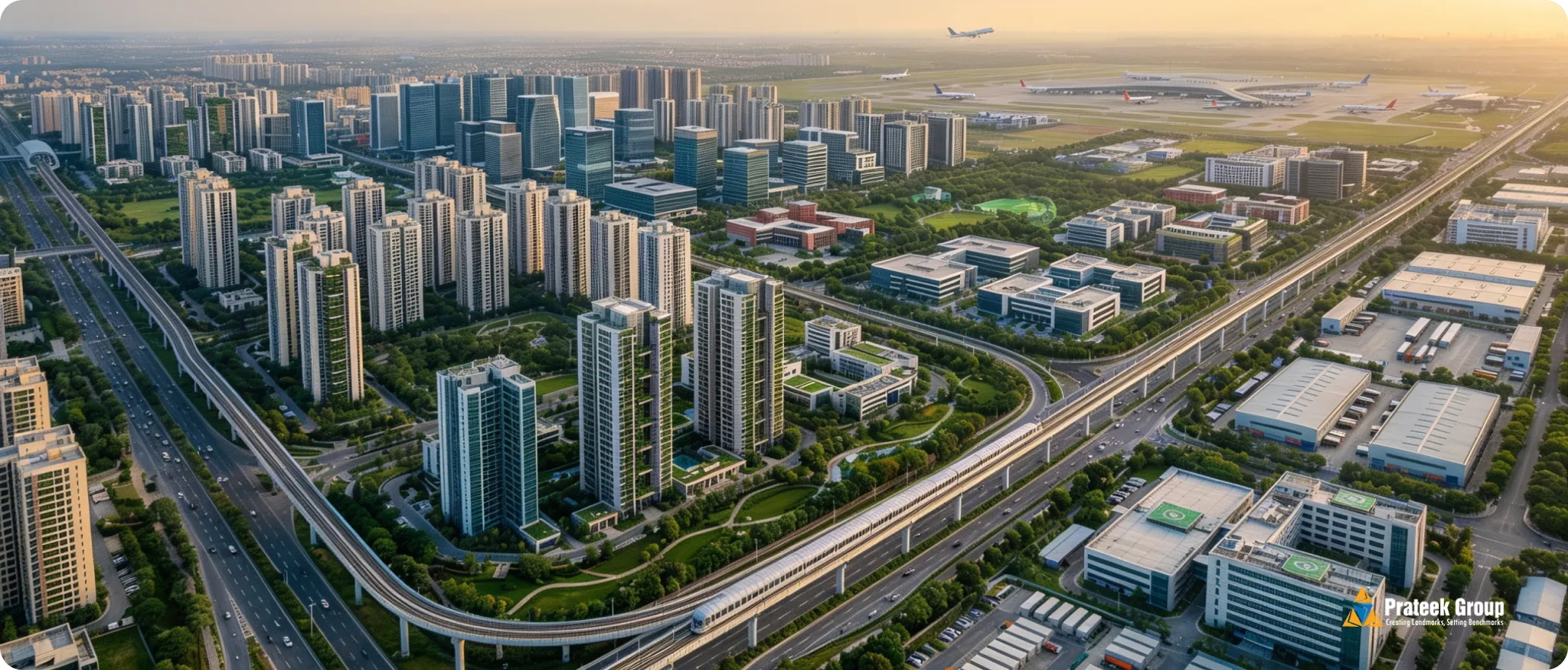
Every conversation about Greater Noida’s property market eventually circles back to the airport. And to be fair, the Noida International Airport at Jewar is a genuinely landmark development. Phase 1 was inaugurated by Prime Minister Narendra Modi on 28 March 2026, and commercial flights commenced on 15 June 2026, making it NCR’s second major operational airport. That alone is headline-worthy.
But focusing only on the airport does a disservice to buyers and investors who are trying to understand this market properly. Greater Noida’s growth in 2026 is being driven by a far wider set of factors: infrastructure that has matured over years, an expanding employment base, improving connectivity across multiple corridors, and a residential demand profile that reflects genuine homebuying rather than speculative positioning.
At Prateek Group, we have been building homes across the Noida and Greater Noida belt since 2005. Over that time, we have watched this market go from a developing alternative to Delhi to a fully formed residential and commercial destination in its own right. In this blog, we unpack what is actually shaping Greater Noida’s property market in 2026. If you are exploring luxury flats in Noida or evaluating investment opportunities across the NCR, we hope this gives you a clear, honest picture of where things stand.
A Market Built on Real Foundations, Not Just Future Promises
One of the most important questions any buyer or investor should ask right now is simple: Is Greater Noida’s growth supported by current market fundamentals, or is it primarily priced on expectations?
The honest answer is both, and the proportion matters depending on which part of the market you are looking at.
What the Numbers Actually Show
According to data tracked by Anarock Property Consultants, average residential prices in Greater Noida rose by approximately 98% between Q1 2020 and Q1 2025, moving from around Rs 3,340 per sq ft to approximately Rs 6,600 per sq ft. That is not speculative froth; it is sustained appreciation driven by real demand over a five-year period.
In Noida’s premium sectors along the expressway corridor, prices in areas like Sector 150 were tracking between Rs 11,900 and Rs 12,200 per sq ft by mid-2025, with the active transaction band running broadly between Rs 9,700 and Rs 14,300 per sq ft depending on project quality, possession status, and floor preference.
What is particularly notable about the current phase is the buyer composition. The proportion of end-users, actual families buying homes to live in, has risen meaningfully compared to the investor-heavy launches of earlier years. This is a healthier demand base. When buyers are moving in rather than holding and flipping, the market signals genuine liveability and not just speculative momentum.
Where Expectations Still Dominate
That said, certain sub-markets, particularly the YEIDA sectors immediately around Jewar Airport and the Film City corridor, remain more expectation-driven than fundamentals-driven. Prices in those pockets have moved sharply on the back of future project announcements and land activity. Buyers entering those zones today need to weigh the upside against longer delivery timelines and a thinner existing social infrastructure base. More on this later.
The Airport: What It Changes and What It Does Not
Let us be direct about Noida International Airport. It is a significant infrastructure achievement. With a Phase 1 capacity of 12 million passengers annually, a 3,900-metre runway capable of handling wide-body aircraft, and multimodal connectivity being planned around it, the airport positions the region on a genuinely different development trajectory.
As reported by Akashvani News, IndiGo operated the first commercial flight from the airport on 15 June 2026, with Akasa Air and Air India Express joining the network shortly after. International flights are projected to begin around September 2026, subject to regulatory timelines.
Genuine Impact vs Airport Hype
Here is what the airport demonstrably changes right now: it reduces travel times to southern and eastern destinations for residents of Greater Noida, Noida, and western UP who previously had to navigate to IGI in Delhi. For someone based near Pari Chowk in Greater Noida, the contrast is stark. A domestic departure from Jewar now involves a drive of roughly 28 km rather than a 70-plus km crawl through the city. The airport also anchors a broader economic corridor. Logistics parks, data centres, semiconductor clusters, and the planned International Film City near Jewar represent thousands of jobs in sectors that support sustained residential demand over the long term.
What the airport does not immediately change: property prices across the whole of Greater Noida do not reprice uniformly the day a new terminal opens. Real estate value creation from airports happens in waves and is most pronounced in the micro-markets closest to the aerotropolis. Residential areas in established Greater Noida sectors like Omega, Zeta, and the Knowledge Park corridor benefit, but through the second-order effects of employment growth and improved regional connectivity rather than direct airport adjacency. Buyers should separate the airport’s long-term structural impact, which is genuinely positive for the region, from short-term pricing movements in specific pockets that may already be factoring in future phases and timelines that remain uncertain.
Infrastructure Beyond the Airport: What Is Actually Moving
Greater Noida’s infrastructure story in 2026 extends well beyond Jewar. Several projects that have been discussed for years are now at a stage of tangible progress, and some are already delivering daily impact for residents.
Road and Expressway Connectivity
The Noida-Greater Noida Expressway remains the backbone of the region’s connectivity. It links the expressway corridor in Noida seamlessly to Pari Chowk, Greater Noida, and onward to the Yamuna Expressway. The 165-km Yamuna Expressway itself is a well-maintained, access-controlled corridor that connects Greater Noida to Agra in under two hours.
New underpasses along the expressway are in various stages of completion, and the 5.5 km Bhangel elevated road is improving east-west movement through Noida. The Faridabad-Noida-Ghaziabad (FNG) Expressway, which would create a critical new cross-NCR corridor for residents in Noida West and Greater Noida, remains under construction. Progress on the Haryana sections is reportedly ahead of the UP stretches. Treat FNG as a medium-term positive rather than an imminent certainty.
Metro and Rapid Rail
The Noida Metro Aqua Line currently provides connectivity across much of Noida, with the Sector 148 station serving as the closest metro access point for Sector 150 residents, approximately 3 to 5 km away. Proposals for an extension of the Aqua Line towards Greater Noida and eventually towards the airport zone are at the planning and DPR stage. Construction timelines will depend on statutory approvals and funding.
The Ghaziabad-Jewar RRTS corridor is a more significant proposal over the longer term. If executed on schedule, it would connect the region to Delhi and cut airport travel times sharply. But this, like most rapid rail proposals in NCR, should be treated as a horizon-level positive rather than a near-term infrastructure certainty.
Connectivity: Verified Status vs Projected Timelines
|
Infrastructure |
Current Status |
Direct Benefit Zone |
Certainty Level |
|
Noida-Greater Noida Expressway |
Fully operational |
Noida, Greater Noida |
Confirmed |
|
Yamuna Expressway |
Fully operational |
Jewar, YEIDA, Agra corridor |
Confirmed |
|
Noida International Airport (Phase 1) |
Operational from June 2026 |
Greater Noida, Yamuna belt |
Confirmed |
|
Aqua Line Metro (Sector 148) |
Operational |
Sector 150 and nearby |
Confirmed |
|
FNG Expressway |
Under construction |
Greater Noida West, Noida belt |
Medium certainty |
|
RRTS Ghaziabad-Jewar |
Planning / DPR stage |
Entire NCR-Jewar corridor |
Long-term projection |
|
Aqua Line Extension to Airport |
Feasibility stage |
Greater Noida, airport zone |
Projected, timeline unclear |
Residential Demand Trends and the Shift Towards End-User Buyers

The nature of homebuyer demand in Greater Noida has shifted considerably over the past three years. Earlier cycles of appreciation in the region were partly investor-driven, with buyers entering at launch prices and holding units ahead of possession. The 2026 picture is more nuanced and, frankly, healthier.
Who Is Buying and Why
A growing proportion of current transactions are being driven by genuine end-users: dual-income families making their first home purchase, professionals upgrading from rented accommodation in central Noida or east Delhi, and NRI buyers seeking quality housing with strong long-term fundamentals. The pandemic permanently changed how people think about their homes, and that shift is still playing out in purchase decisions.
Demand for larger configurations has increased noticeably. Buyers are not just looking at 2 BHK units; 3 BHK and 4 BHK apartments with dedicated work-from-home spaces, proper balconies, and premium community amenities are selling steadily across the expressway corridor. The definition of what counts as a liveable home has changed, and Greater Noida’s larger floor plates, at prices that remain more accessible than comparable Gurgaon or South Delhi options, are benefiting from this.
Luxury and Premium Segment Demand
Prateek Tiwari, Managing Director of Prateek Group, noted in a market commentary earlier in 2026: “What distinguishes luxury housing demand in locations like Sector 150 is the growing preference for balanced urban living. Buyers today are not evaluating projects only through the lens of premium specifications; they are equally focused on open spaces, lower density, wellness infrastructure, and overall quality of life.”
That observation aligns with what we see across our own portfolio. Sector 150, with its low-density planning, over 80% open space requirement across several projects, 9-hole golf course access, and triple expressway connectivity, has become one of the most clearly defined luxury micro-markets in all of NCR. Demand here is not speculative; it is from CXOs, senior professionals, and NRI buyers who are making long-term residential decisions.
Our upcoming project Prateek Canary in Sector 150, Noida is positioned within this mature micro-market. With 664 units across 12.55 acres, a double-decker clubhouse spanning 30,000 sq ft, panoramic views of the adjacent golf course, and RERA registration (UPRERAPRJ591510), Prateek Canary is designed for buyers who want the combination of green open living, low density, and strong long-term investment fundamentals that Sector 150 represents.
Rental Market and Yield Trends
The Noida-Greater Noida Expressway micromarket recorded rental value growth of 22% year-on-year in 2024, with Sector 150 delivering 12% rental appreciation in the same period. For investors considering rental income alongside capital appreciation, these are encouraging numbers. However, residential rental yields in NCR remain in the 3% to 4.5% range across most sectors, which means the investment case for this market is primarily built on appreciation rather than yield.
If steady rental income is your primary investment objective, that consideration should feature prominently in your decision. If you are an end-user or a long-term capital appreciation buyer, the fundamentals here are considerably stronger.
Emerging Growth Corridors: Where the Next Wave Is Forming
Greater Noida is not a monolithic market. Different micro-markets are at different stages of development, and understanding which corridor matches your timeline and risk profile is essential.
The Noida Expressway Corridor
This is the most mature zone in the wider Greater Noida ecosystem. Sectors 107, 128, 140A, 150, 151, and 152 along the expressway have established social infrastructure, credible developers, and a demonstrated track record of appreciation. Price points are higher here, but the risk profile is also substantially lower. Ready-to-move and near-possession inventory is available, allowing buyers to assess what they are actually getting before committing.
Our ready-to-move 3, 4, and 5 BHK apartments at Prateek Edifice in Sector 107 sit within this corridor. Prateek Edifice is a completed, low-density luxury project with just two apartments per floor, expansive landscaped grounds, and direct access to the Noida-Greater Noida Expressway. For buyers who want an established community with full social infrastructure and immediate possession, Sector 107 remains an extremely compelling address.
Greater Noida West (Noida Extension)
Greater Noida West has evolved from a budget alternative into a genuine mid-to-premium residential market. Flat prices here currently range between Rs 7,500 and Rs 10,700 per sq ft depending on the project and possession status, and appreciation over the past five years has been significant, with some data suggesting values have grown by over 45% in the last three years alone.
The corridor offers relatively larger floor plates at more accessible price points than the expressway’s prime sectors, and it is benefiting from improved road connectivity, a maturing social infrastructure, and ongoing migration of working professionals from east Delhi and central Noida. The FNG Expressway, when it delivers, will add another layer of value here.
The YEIDA and Yamuna Expressway Belt
This is the most forward-looking of the growth corridors and, correspondingly, the one that carries the most uncertainty. The YEIDA Master Plan 2041 framework envisions an aerotropolis around the airport, encompassing a Film City (approximately 1,000 acres), Medical Device Park, Electronics City, and a Central Business District. These are ambitious, government-backed plans with real land acquisition and tendering activity underway. But the delivery horizon for most of these components extends well into the late 2020s and beyond.
Buyers entering this belt today are making a long-term bet on infrastructure execution. Land prices in the Jewar area have already risen approximately 50% over the last five years. For those with a 7 to 10-year horizon and comfort with longer timelines, the YEIDA belt has interesting positioning. For buyers seeking near-term livability and established communities, the expressway corridor and Greater Noida West are more appropriate choices.
Employment, Commercial Development, and What Drives Housing Demand
No residential market can sustain long-term appreciation without an underlying employment base. Greater Noida’s strength, often underrated in airport-centric discussions, is its diverse and growing economic ecosystem.
The Knowledge Park and Education Corridor
The Knowledge Park area in Greater Noida is home to dozens of universities, engineering colleges, and management institutions. Galgotias University, Sharda University, and several other well-established campuses create a permanent demand base for rental housing and, as graduates settle into employment, eventual homeownership in the region. This is a steady, structural demand driver that does not fluctuate with infrastructure timelines.
IT Parks, MNCs, and Corporate Expansion
Noida’s Sector 62, 63, and the broader expressway commercial belt hosts major Indian and multinational technology and services companies. HCL, Infosys, Genpact, and Adobe maintain significant operations in the region, and the workforce from these campuses forms a substantial base of prospective homebuyers. Greater Noida’s relative proximity to these employment hubs, combined with better affordability and planning standards, continues to draw this working population.
The planned data centre parks and Electronic Manufacturing Clusters along the YEIDA corridor are expected to bring additional technology-sector employment to the region. While many of these facilities are in early stages, the direction of commercial investment is clearly towards this belt of NCR.
Logistics, Warehousing, and the Airport Economy
AISATS’ multi-modal cargo hub, inaugurated alongside the airport, anchors what is being built as a dedicated logistics and warehousing corridor in the Jewar area. This type of employment, warehouse supervisors, ground logistics workers, aviation support staff, generates mid-income housing demand rather than high-end residential demand. The workers employed in this sector will primarily seek mid-range and affordable housing in Greater Noida West, Noida Extension, and the Yamuna belt’s more modestly priced areas.
The premium residential demand driven by the airport will come primarily from its corporate and hospitality ecosystem, professionals in airport management, aviation-linked businesses, and ancillary service sectors. That demand materialises over time as those businesses establish and hire.
A Practical Buyer's Checklist: What to Evaluate Before Investing

Whether you are buying your first home or adding a second investment property to your portfolio, Greater Noida’s market in 2026 rewards those who do proper due diligence. Here is what we recommend evaluating carefully:
Before Finalising Any Project
- Verify RERA registration on the UP RERA portal and cross-check the project’s registration number with the authority’s database.
- Assess the possession timeline honestly. Under-construction projects along the YEIDA corridor may have completion dates in 2028 and beyond. Make sure your financial planning accounts for that gap.
- Check the developer’s track record on possession. Review completed projects, timelines delivered, and maintenance quality in existing societies.
- Evaluate social infrastructure within a 5 km radius: hospitals, schools, daily convenience, and commute access. Future promised infrastructure should not substitute for current livability if you plan to move in soon.
- Understand the pricing metric clearly. Ensure you compare like-for-like when evaluating super built-up area versus carpet area across different projects.
- Review the maintenance and management structure. Premium projects without professional management tend to degrade over time, affecting both liveability and resale values.
- For investors focused on rental yield, verify actual current rental transactions in the same sector, not projected rents from developer marketing materials.
- Study the micro-market’s appreciation over the past three years in terms of registered transactions, not just listed prices.
Specific to the Airport Corridor
- Distinguish between plots in sanctioned YEIDA sectors and unauthorised colonisation activity near the airport zone. The UP RERA portal and YEIDA official listings are the appropriate reference points.
- Do not price in future infrastructure such as RRTS, metro extension, or Film City as if they are already delivered. These are medium to long-term projections.
- Consider liquidity. Emerging corridors may have slower transaction volumes, making resale timelines longer than in mature markets.
Matching Your Profile to the Right Zone
|
Buyer Profile |
Most Suitable Zone |
Key Consideration |
|
End-user, ready to move in 2026 |
Noida Expressway corridor (Sectors 107, 128, 150) |
Established community, immediate possession |
|
First-time buyer, value-focused |
Greater Noida West / Noida Extension |
Larger floor plates at better price points |
|
Investor, 3 to 5-year horizon |
Sector 150, Yamuna belt established sectors |
Strong fundamentals, measured appreciation expected |
|
Long-term investor, 7-plus years |
YEIDA sectors near Jewar, FNG corridor |
Higher upside, higher uncertainty and wait time |
|
NRI buyer seeking professional management |
RERA-registered gated communities, mature sectors |
Developer credibility and maintenance record essential |
The Bottom Line for 2026 Buyers
Greater Noida’s property market in 2026 is a story of genuine structural improvement, not just headline-driven excitement. The Noida International Airport is real, operational, and will reshape this region’s economic identity over the coming decade. But the market’s strength is rooted in factors that predate the airport: planned infrastructure, expanding employment, a well-connected expressway system, and a residential supply that has steadily improved in quality and credibility.
For buyers and investors approaching this market, the right question is not simply whether Greater Noida will appreciate. The right question is which micro-market, which developer, and which timeline match your specific needs. The answers to those questions will vary significantly depending on whether you are an end-user wanting immediate possession, a mid-term investor seeking steady returns, or a long-term buyer positioning for a decade of growth.
For the latest official guidance on land allotments and residential planning along the Yamuna Expressway belt, the YEIDA residential plot scheme updates provide useful context for buyers evaluating the airport corridor zone. We also recommend exploring our blog on why Sector 150 Noida remains a top investment in 2025 and beyond for a deeper look at the expressway corridor’s strongest performing micro-market. The market is moving. Understanding exactly what is moving it, and why, is what separates good property decisions from reactive ones.
FAQs
- Is Greater Noida property market a good investment in 2026?
Greater Noida remains a promising real estate market due to improving infrastructure, employment growth, better connectivity, and increasing end-user demand. Investors should evaluate location, developer reputation, project timelines, and long-term growth potential before making a decision.
- How will Jewar Airport impact Greater Noida property prices?
Jewar Airport is expected to support long-term property growth by improving connectivity, attracting businesses, and creating employment opportunities. However, price appreciation will happen gradually and will depend on economic activity, infrastructure development, and demand in specific locations.
- Is Greater Noida property market growing because of the airport only?
No, Greater Noida’s growth is driven by multiple factors including planned infrastructure, expressway connectivity, corporate expansion, educational hubs, and residential demand. Jewar Airport adds another growth catalyst but is not the only reason behind market development.
- Which areas of Greater Noida have the best growth potential in 2026?
Areas like the Noida Expressway corridor, Sector 150, Greater Noida West, and selected YEIDA sectors have strong growth potential. The right choice depends on whether buyers prioritize immediate livability, affordability, rental demand, or long-term appreciation.
- Should I buy property near Jewar Airport?
Buying near Jewar Airport can benefit long-term investors who understand the development timeline. However, buyers should evaluate current infrastructure, social facilities, project credibility, and employment growth instead of investing only based on future airport expectations.
- Are Greater Noida property prices expected to increase in 2026?
Greater Noida property prices may continue experiencing gradual appreciation due to infrastructure improvements, increasing employment opportunities, and residential demand. However, growth will vary across micro-markets depending on connectivity, development stage, and buyer interest.
- Is Sector 150 Noida a good place to invest?
Sector 150 is considered attractive due to low-density planning, green spaces, expressway connectivity, metro access, and premium residential developments. Its demand is supported by lifestyle advantages and infrastructure connectivity rather than relying only on future appreciation expectations.
- What are the best areas to buy a flat in Greater Noida?
The best area depends on buyer requirements. Noida Expressway suits buyers seeking established infrastructure, Greater Noida West offers affordability and larger homes, while YEIDA sectors appeal to long-term investors comfortable with longer development timelines.
- Is Greater Noida better for end-users or investors?
Greater Noida currently supports both buyer categories. End-users benefit from planned communities, larger homes, and improving infrastructure, while investors find opportunities through appreciation potential, rental demand, and emerging growth corridors.
- What is driving residential demand in Greater Noida?
Residential demand is being driven by end-user buyers, professionals working in nearby employment hubs, better connectivity, affordable premium housing options, educational institutions, and improved lifestyle infrastructure across major residential corridors.
- Is buying property in YEIDA near Jewar Airport risky?
YEIDA properties offer long-term potential but carry higher uncertainty due to longer infrastructure timelines and developing social facilities. Buyers should verify approvals, project status, developer history, and their investment horizon before purchasing in emerging corridors.
- What should I check before buying property in Greater Noida?
Buyers should verify RERA registration, developer delivery history, possession timelines, connectivity, social infrastructure, maintenance standards, pricing comparisons, and actual transaction trends before finalizing any property purchase.
- Are luxury flats in Greater Noida worth buying?
Luxury flats in Greater Noida can offer strong lifestyle value due to larger spaces, premium amenities, green surroundings, and planned communities. Buyers should assess location quality, developer credibility, construction standards, and long-term usability before investing.
- How does employment growth affect Greater Noida real estate?
Employment growth supports real estate demand by creating more buyers and tenants. IT companies, educational institutions, logistics hubs, manufacturing clusters, and airport-linked businesses contribute to long-term residential demand across Greater Noida.
- Which is better for investment: Greater Noida West or YEIDA?
Greater Noida West offers relatively established demand, affordability, and improving infrastructure, while YEIDA provides higher long-term potential with greater uncertainty. The better choice depends on investment horizon, risk preference, and expected holding period.