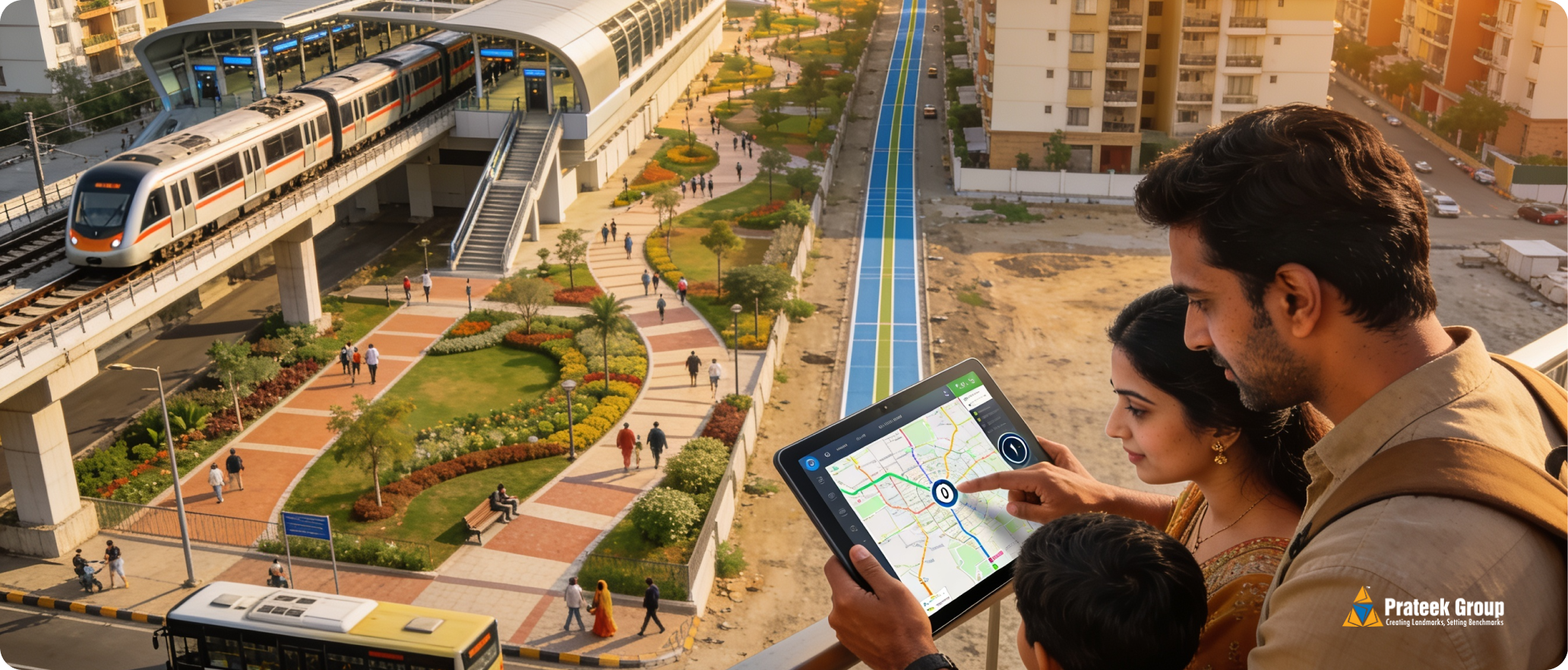
Metro access became the deciding factor only after one day a family timed its weekday commute.
They had shortlisted 2 apartments in Delhi NCR. The first home offered more space, an extra balcony, and a smaller monthly loan payment. The second cost ₹14 lakh more, though an operating metro station sat less than 1 kilometre from the society gate.
The cheaper project carried a future transport promise. Its brochure showed a proposed metro corridor passing close to the sector. The sales representative expected property values to rise once construction began.
The family had no station to test there. The route status, final station location, opening schedule, and feeder transport still needed verification.
This is the main concern when comparing properties near metro corridors. Metro access can improve travel to offices, schools, hospitals, shopping areas, and major transport hubs. Recent reporting on metro-led housing growth also shows how new routes are drawing residential interest across several Indian cities.
The value of that connection changes from one property to another.
A home may sit 700 metres from the tracks but 1.5 kilometres from the usable station entrance. Another project may be farther away yet have regular feeder buses outside the gate. Noise, peak-hour traffic, parking pressure, and construction work can also affect daily life.
Before choosing a property near metro station, the family needs 4 answers:
- Is the line operating, under construction, approved, or proposed?
- How long is the complete door-to-door commute?
- How much extra are they paying for metro access?
- Would the property still suit them if the future corridor were delayed?
The benefits of buying property near metro make sense when the connection saves enough time and money during the family’s expected ownership period.
Their property comparison now begins with the route they will use, rather than the metro symbol printed on the brochure.
What does “near a metro corridor” mean?
The family visits both locations again on a weekday morning.
The walk from the first society gate to the operating station takes 13 minutes. Most of the route has a footpath, though one busy junction has no safe crossing.
At the second project, the representative describes the proposed station as “5 minutes away.” That estimate assumes a car ride on an empty road. The final entrance has not been confirmed.
The phrase “near metro” therefore needs a practical test.
Distance or project status | What buyers should check | Common concern |
Up to 500 metres from an operating station | Walk from the society gate to the correct entrance | Noise, crowds, and traffic |
500 metres to 1.5 kilometres | Footpaths, lighting, crossings, and walking time | Difficult pedestrian access |
1.5 to 3 kilometres | Autos, buses, fares, and evening availability | Daily last-mile dependence |
Under-construction corridor | Approved route, station site, and work progress | Delays, dust, and diversions |
Proposed corridor | Official approval and funding stage | Route changes or cancellation |
Measure the full journey
Buyers looking at flats near metro station should time this route:
Apartment door → society gate → station entrance → platform
A brochure may measure from the project boundary. Large societies can add another 5 to 10 minutes before the buyer reaches the road.
Station entrances matter too. A home may sit beside the metro structure while the nearest usable gate lies on the opposite side of a highway or several blocks away.
Check the corridor stage
Use 4 labels:
- Operating: Trains already run.
- Under construction: Physical work has begun.
- Approved: The project has clearance, though work may be pending.
- Proposed: The route remains under planning or review.
A guide to buying near metro also treats transport access, prices, legal checks, and future routes as separate buyer concerns.
Test last-mile access
Good last-mile metro connectivity should work during office hours, evenings, rain, and weekends.
The family checks feeder buses, e-rickshaw fares, pickup space, street lighting, and the walking route. A ₹40 ride in each direction can cost one commuter about ₹2,080 across 26 working days.
Before buying property near metro station, buyers should visit during morning and evening peak hours. The test shows whether the metro connection works as well on the ground as it does on the brochure.
How much extra should buyers pay for metro access?
The family now compares the ₹14 lakh difference with the money and time the metro-connected home could save.
Their current monthly travel cost looks like this:
Travel expense | Current home | Metro-connected home |
Fuel and tolls | ₹6,500 | ₹1,500 |
Cabs | ₹3,500 | ₹1,200 |
Parking | ₹2,000 | ₹0 |
Metro and last-mile travel | ₹0 | ₹3,200 |
Estimated monthly total | ₹12,000 | ₹5,900 |
The expected saving is around ₹6,100 a month, or ₹73,200 a year.
At that rate, travel savings alone would take more than 19 years to recover the ₹14 lakh property premium. Home-loan interest, stamp duty, registration costs, and the larger purchase price would stretch that period further.
Time can still change the decision.
If both adults save 45 minutes each working day, the household gets back around 33 hours every month. The value of those hours depends on work schedules, family responsibilities, and how long they expect to live in the property.
The metro premium test
Before paying more for homes near metro stations, buyers should calculate:
Metro premium = Price of metro-connected home − Price of a similar home without the same access
Then compare that figure with:
- Monthly travel savings
- Time saved each week
- Expected ownership period
- Loan interest on the higher price
- Possible rental difference
- Likely resale demand
Research on metro connectivity and property prices often shows stronger demand around better-connected locations, though the result varies by city, station, housing supply, and project quality. Recent Bengaluru metro price projections reported a Colliers estimate of 20% to 40% growth in selected localities near new lines over 2 years. That figure is a forecast for specific areas, rather than a fixed return for every home near a station.
The family decides that metro access can support the purchase, but it cannot justify any asking price. They will compare recent registered transactions, similar projects, rental listings, and the complete loan cost before accepting the ₹14 lakh gap.
Which metro benefits will the family actually use?
The sales brochure lists faster travel, better rental demand, rising prices, and improved connectivity. The family tests each claim against its own routine.
The weekday commute
The operating line connects both offices with one interchange. Trains run during the hours they need, and the return trip remains practical after 8 PM. This benefit affects them several times each week.
Access to daily needs
The station route also reaches a hospital, shopping area, and railway interchange. School travel remains road-based, so metro access does little for the children’s weekday schedule.
Rental demand near metro stations
A future tenant working near the same office corridor may value the location. Rental interest will still depend on the apartment condition, society maintenance, local rents, and competition from newer projects.
Property appreciation near metro
An operating station can make the locality easier to reach and widen the buyer pool at resale. The family avoids treating appreciation as certain. The entry price matters, especially when the seller has already added a large metro premium.
Dependence on private vehicles
The household can reduce its use of 2 cars, though it cannot remove them completely. Weekend trips, school travel, grocery runs, and family visits still require road transport.
This gives the family a simple rule for buying property near metro station: Count the benefits they will use every week. Treat future rental or resale gains as supporting factors.
For this household, commute time carries the most weight. A buyer who works from home or travels outside the metro network may reach a different answer.
How should buyers judge an upcoming metro corridor?

The cheaper property depends on a future metro line, so the family creates a traffic-light test before assigning any value to it.
Green: the line is operating
The family can test the station, route, interchange, train frequency, and last-mile connection.
An operating line gives buyers the strongest evidence because the complete journey already exists. They can also inspect noise levels, station traffic, parking pressure, and the neighbourhood after dark.
Amber: construction has started
Visible pillars and barricades confirm physical work, though the opening date may still move.
Buyers should check:
- The sanctioned route and station names
- Distance from the project gate
- Current construction progress
- Expected completion period
- Road diversions around the project
- Effects on dust, noise, and access
An under-construction route may support a property investment near metro corridors, though the purchase should still work if completion takes longer than expected.
Amber: the corridor is approved
An approved line has passed a formal government stage, but tenders, land, funding, or utility work may remain pending.
The family gives an approved corridor less weight than active construction. It checks whether the advertised station appears in current authority documents and whether its location matches the project brochure.
Red: the corridor is only proposed
A proposed line may change route, station placement, funding, or schedule.
The family removes future appreciation from its calculation until official records show stronger progress. The home must suit its budget and travel needs under present conditions.
The delay test
Before paying for upcoming metro corridors, buyers should ask: Would we still purchase this property if the metro opened 5 years later than expected?
A “yes” means the home has enough value without the transport promise. A “no” shows that too much of the purchase depends on an uncertain date.
Which buyers gain the most from metro connectivity?
Metro access carries a different weight for each household. The family compares its needs with 5 common buyer profiles.
Daily office commuter
Main gain: Lower travel time and less dependence on traffic.
A working professional may benefit most when the line reaches an employment area with few interchanges. Train frequency and the distance from the final station to the office matter as much as the station near home.
Family with school-going children
Main gain: Easier access to hospitals, shopping areas, and other parts of the city.
School travel may still depend on buses or private vehicles. The parents should check road congestion around the station during school hours before choosing homes near metro stations.
Property investor
Main gain: A wider tenant and resale audience.
Rental demand near metro stations can be stronger among students and office workers. The investor still needs to compare purchase price, local rent, vacancy, maintenance charges, and competing supply.
A high entry price can weaken the return even when the property remains easy to rent.
Senior citizen household
Main gain: Access to hospitals and city services without driving.
The station needs lifts, escalators, safe crossings, seating, and manageable last-mile travel. A short distance on a map may still be tiring when the route has broken pavements or heavy traffic.
Work-from-home buyer
Main gain: Occasional city access.
This buyer may use the metro only a few times each month. More space, quieter surroundings, nearby markets, and a lower loan payment may carry greater weight than living beside a station.
The family’s profile
Both adults commute several days a week and plan to live in the home for at least 12 years. They expect to use the metro often enough for the time savings to matter.
Their decision now depends on 3 points:
- The operating line must reach both offices with manageable interchanges.
- The walking and last-mile route must feel safe after work.
- The property premium must fit the complete home-loan budget.
For this household, metro access has daily use. Another buyer may place it lower on the shortlist.
The 20-point metro site inspection
The family stops relying on brochure distances and scores both properties during separate morning and evening visits.
Each point receives:
- 2 points: Works well
- 1 point: Usable with a concern
- 0 points: Missing or difficult
Site check | Maximum score |
Safe walk from society gate | 2 |
Clear footpaths and crossings | 2 |
Working streetlights after dark | 2 |
Autos or feeder buses available | 2 |
Reasonable last-mile fare | 2 |
Station entrance is easy to reach | 2 |
Peak-hour crowding is manageable | 2 |
Road access remains open | 2 |
Noise inside the chosen tower is acceptable | 2 |
The complete commute saves time | 2 |
Total | 20 |
The operating-line property scores 16. Its main weakness is the busy junction outside the station. The cheaper project scores 8 under current conditions. The future corridor could improve that number, though the family keeps today’s score for the purchase decision.
Buyers comparing metro corridor real estate can also test an actual project location rather than judging the sector name alone. For example, the Prateek Canary project location details place the project in Sector 150 and refer to Sector 148 metro connectivity. The buyer should still travel from the project gate to the station during the hours they expect to use it.
Read the score carefully
A low walking score may be offset by dependable feeder transport. A high score can still lose value when the buyer rarely uses the metro.
The family sets its own minimum at 14 out of 20 because both adults expect to commute regularly. A work-from-home household may accept a lower score in return for more space or a smaller loan.
Which records should buyers check before booking?

The sales team gives the family 3 days to pay the token amount. They create a 4-part verification file before transferring any money.
File 1: Project and RERA records
Collect:
- Project name and registered phase
- RERA number
- Promoter name
- Declared completion date
- Sanctioned plans
- Construction status
- Approvals listed on the regulator’s portal
A project page is a useful starting point. Buyers reviewing the Prateek Grand City project page can see the stated location, project phases, RERA numbers, apartment details, and connectivity information before matching them with UP RERA records and the papers for the selected unit.
File 2: Metro corridor status
Ask for the source behind every metro claim:
- Operating route map
- Approved corridor report
- Station list
- Construction tender or work notice
- Expected completion statement
- Exact station location
A sales brochure should not be the only proof behind upcoming metro corridors.
File 3: Property and payment papers
Check the title chain, allotment documents, sale agreement, payment schedule, maintenance charges, parking rights, lender approval, and pending dues.
The higher price of a property near metro station should appear clearly in the full cost sheet.
File 4: Site evidence
Save photographs and notes covering:
- Walking route
- Station entrance
- Traffic at peak hours
- Noise from tracks or construction
- Feeder transport
- Waterlogging or broken roads
- Night-time lighting
The family adds one condition to the token agreement: the booking amount must remain refundable if the title, RERA details, lender review, or claimed metro status fails verification.
That condition keeps the transport promise tied to documents rather than sales talk.
Final thoughts: How Prateek Group property fits the family’s real week?
The family returns to the 2 homes with a clearer comparison.
The cheaper apartment gives them more space and a smaller loan. Its proposed metro corridor could improve access later, though the purchase still needs to work under today’s travel conditions.
The home near the operating station costs ₹14 lakh more. Both adults can use the line several days a week, and their trial commute saves around 45 minutes each way.
They decide to judge the higher price through 4 numbers:
Final measure | Metro-connected home |
Monthly travel saving | Around ₹6,100 |
Time saved each month | Around 33 hours |
Expected ownership period | At least 12 years |
Site inspection score | 16 out of 20 |
The metro-connected apartment fits their routine more closely, though they still negotiate the price and check the complete loan cost. The station supports the decision. It doesn’t settle the decision on its own.
Families comparing Ghaziabad properties can review the Prateek Grand Begonia project details before checking the actual route to nearby metro stations, office districts, schools, and hospitals. The official project page places it in Siddharth Vihar and refers to access to metro stations and major roads.
The right property near metro station should work across the full day:
- The walk or feeder trip is manageable.
- The line reaches useful destinations.
- The neighbourhood remains comfortable during peak hours.
- The price premium fits the holding period.
- The home remains suitable if future infrastructure is delayed.
A metro map shows the transport network. The buyer still has to test the life around it.
FAQs
1. Is buying property near a metro station a good idea?
It can suit buyers who use the metro regularly and expect to hold the property for several years. The station distance, route usefulness, neighbourhood conditions, and purchase premium should be checked together.
2. How close should a property be to a metro station?
A distance of 500 metres to 1.5 kilometres can be practical when the walking route is safe. Homes farther away may still work when feeder buses, autos, or e-rickshaws are dependable.
3. Do properties near metro corridors cost more?
Some properties near metro corridors carry a higher asking price because of their transport access. Buyers should compare similar homes nearby to see how much of the price comes from the metro location.
4. Does metro connectivity increase property prices?
Metro connectivity and property prices can move together when a new route improves access to employment and commercial areas. Project quality, local supply, entry price, station distance, and market demand still affect the result.
5. Are flats near metro stations easier to rent?
Flats near metro station locations may attract office workers, students, and households that prefer public transport. Rental performance also depends on rent levels, apartment condition, maintenance, and competing housing supply.
6. Is an operating metro better than an upcoming corridor?
An operating metro provides evidence that buyers can test. An upcoming line may carry future value, though construction schedules and station locations can change.
7. How should buyers verify a proposed metro line?
Check government announcements, approved route reports, tender documents, construction notices, and official station lists. A developer brochure should support the research rather than act as the only source.
8. What is last-mile metro connectivity?
Last-mile metro connectivity covers the journey between the station and the final destination. It may involve walking, feeder buses, autos, e-rickshaws, or pickup services.
9. What problems can come with living near a metro station?
Buyers may face traffic, station crowds, parking spillover, commercial activity, construction dust, or train noise. Visit the property during morning and evening peak hours before booking.
10. How can buyers calculate the metro premium?
Subtract the price of a comparable property without the same metro access from the price of the metro-connected home. Compare the difference with travel savings, time saved, loan interest, expected rent, and ownership period.
11. Is property investment near metro corridors safe?
A property investment near metro corridors needs the same title, RERA, pricing, and project checks as any other purchase. The metro should support the location rather than cover weaknesses in the property papers or construction quality.
12. Can a proposed metro route be delayed?
Yes. Funding, approvals, land acquisition, tenders, construction, and testing can affect the opening schedule. The property should remain useful and affordable during a delay.
13. What documents should buyers check?
Review the title chain, sale agreement, RERA registration, sanctioned plans, possession timeline, payment schedule, lender approval, and pending dues. Verify the claimed metro corridor through current official records.
14. Should buyers choose space or metro access?
The answer depends on how often the household will use the metro. Buyers comparing larger configurations can review 4 BHK homes in Noida and then test the route from each project gate to the relevant station before assigning value to connectivity. The Prateek Group page identifies Sector 148 Metro Station as a connection for Prateek Canary in Sector 150.
15. What should buyers do before paying the token amount?
Walk the route, test the commute, confirm the corridor stage, compare nearby prices, and review the project papers. Add written refund conditions when the purchase depends on title clearance, lender approval, RERA details, or a claimed infrastructure fact.