
Imagine you’re driving from Ghaziabad toward Noida on a weekday morning. Maps show several routes, but each one pulls you through traffic, city roads, or crowded junctions before you reach the other side of NCR.
Now picture the same journey after a direct road corridor joins Faridabad, Noida, and Ghaziabad.
That is the idea behind the Faridabad-Noida-Ghaziabad Expressway, better known as the FNG Expressway. The proposed 56-km, 6-lane corridor is meant to create a direct connection between 3 major NCR cities and reduce dependence on longer routes through Delhi. The project has faced repeated delays, but the latest FNG Expressway progress report shows that the Noida Authority is again reviewing incomplete stretches and asking its work circles for detailed updates.
For a homebuyer, this is where the property search becomes tricky.
A road under construction can create interest long before the full route opens. Buyers begin checking nearby sectors. Developers begin talking about future connectivity. Property owners adjust their expectations. And suddenly, an area that looked too far from the main city starts appearing in every FNG Expressway property investment discussion.
But future connectivity alone doesn’t make a location worth buying.
A buyer still has to check current roads, occupied housing, public transport, schools, offices, drainage, legal approvals, construction progress, and the price gap between neighbouring sectors. The strongest property near FNG Expressway may sit slightly away from the planned road while giving residents better access to daily services.
That distinction matters because the project still has unfinished sections. According to the recent Noida update, progress has been held back by land acquisition, funding, and coordination between Uttar Pradesh and Haryana. Any claim that prices will rise immediately should therefore be treated carefully.
The better question is practical:
Which locations near the FNG route already work today and may gain further interest as regional connectivity improves?
This guide will look at those locations through the eyes of an actual buyer. It will compare Noida, Greater Noida West, and Ghaziabad-side pockets based on road access, housing supply, current livability, employment links, and long-term development.
The goal is to help you find the best locations near FNG Expressway without basing the full decision on a future road promise.
Why the FNG Expressway matters to NCR property buyers
The FNG route matters because it could change how people travel between major residential and employment areas across eastern and southern NCR.
At present, many commuters moving between Faridabad, Noida, and Ghaziabad depend on combinations of internal city roads, the Noida-Greater Noida Expressway, NH-9, Delhi routes, and local bridges. A completed FNG corridor could create a shorter regional connection and support movement between housing areas, business zones, and industrial pockets.
It connects 3 large property markets
Faridabad, Noida, and Ghaziabad have separate housing markets, price bands, office clusters, and buyer groups. A direct corridor could bring some of these markets closer in practical travel terms.
The planned route passes through or near several Noida sectors before moving toward Ghaziabad and Faridabad. A published overview of the planned FNG Expressway route network places sectors such as 121, 122, 149, 150, and 168 around the broader corridor. Buyers should still verify the exact alignment and access road from the property they’re considering because being “near FNG” can mean very different things on a sales brochure.
It could support cross-city commuting
Someone working in Noida may consider living in Greater Noida West or Ghaziabad when the price difference is large enough. A Faridabad-based business owner may also look at Noida for a second home or rental property if travel becomes easier.
This wider commuting radius can affect demand around residential projects near FNG Expressway, especially in locations that already have schools, retail areas, metro access, and occupied housing.
It sits inside a larger road network
The FNG Expressway doesn’t work in isolation. Its investment value depends partly on how it joins other roads and transport projects across NCR.
The corridor has links or proposed links with NH-9, the Noida-Greater Noida Expressway, the Delhi-Mumbai Expressway side of Faridabad, and future regional routes. Greater Noida is also seeing fresh road and rapid-transit planning, including the Ghaziabad to Jewar rapid rail plan, which is expected to run through Greater Noida West and connect toward Noida International Airport.
That wider network can strengthen the case for NCR real estate investment, but buyers need to separate approved work from proposals, tenders, and early announcements.
What buyers hear | What they should verify |
The property is close to FNG | Exact driving distance to a usable entry point |
Prices will rise after completion | Current asking price compared with nearby sectors |
Travel time will fall sharply | Existing route, planned route, and pending construction |
The area will become a hotspot | Occupancy, rental demand, shops, schools, and offices |
Every nearby sector will benefit | Road access, local congestion, and project quality |
The expressway is coming soon | Latest authority update and work visible on site |
Current livability still comes first
Infrastructure can pull attention toward an area, but a buyer lives with the present condition of the neighbourhood.
A sector with functioning roads, occupied societies, local markets, schools, and public transport may carry a higher entry price. It can also carry lower day-to-day risk than a cheaper location where most development exists on paper.
Recent reporting on Greater Noida property growth locations points to Techzone 4 and Greater Noida Sector 1 among the areas drawing attention because of their housing supply and improving links to NH-24, the FNG corridor, metro proposals, and other regional projects.
So the FNG story should be used as one layer of the investment decision. The property, developer record, legal status, immediate neighbourhood, and purchase price still decide whether the deal makes sense.
Which locations near the FNG Expressway deserve a closer look?
The FNG corridor covers a wide stretch of NCR. So a flat advertised as “close to FNG” could sit in a developed Noida sector, an emerging Greater Noida West pocket, or a Ghaziabad neighbourhood that depends on several connecting roads.
Each location carries a different price, commute pattern, rental market, and level of daily development. Buyers should compare what already exists around the property before placing value on future connectivity.
Noida sectors 70 to 79
These sectors suit buyers who want established residential areas within Noida rather than a distant investment pocket.
Sectors 70, 71, 72, 73, 74, 75, 76, 77, 78, and 79 have a mix of occupied societies, local markets, schools, hospitals, and road connections toward central Noida. Their access to major employment areas also makes them relevant for buyers searching for flats near FNG Expressway.
The entry cost may be higher than in Greater Noida West. But buyers are paying for a neighbourhood that already supports daily life. Anyone comparing these sectors can also review Prateek Group homes across Noida while checking apartment sizes, locations, possession details, and project approvals.
These sectors may suit:
- End users working in Noida
- Families seeking occupied neighbourhoods
- Buyers who prefer existing social infrastructure
- Investors looking for established rental demand
Noida sectors 117 to 122
This belt sits closer to the Noida-Ghaziabad side of the proposed route. Sector 121 is frequently mentioned in discussions around property near FNG Expressway because it connects toward Greater Noida West and the Hindon side.
The location works best for buyers who travel between Noida, Ghaziabad, and Noida Extension. But short map distance doesn’t always mean a fast daily commute. Buyers should drive the route during office hours and check traffic near local junctions.
The recent review of unfinished FNG construction found that only part of Noida’s planned stretch had been completed. That makes present road access more important than a future travel-time estimate.
Greater Noida West and Techzone 4
Greater Noida West remains one of the most discussed areas in any FNG Expressway investment guide. It has a large housing supply, a broad range of apartment prices, active commercial pockets, and access toward Noida and Ghaziabad.
Techzone 4 attracts working professionals because of its office spaces, residential societies, and approach to NH-9 and the FNG side. A recent Greater Noida property hotspot report included both Greater Noida West and Techzone 4 among the locations drawing investment interest.
But buyers should check traffic, drainage, project completion, registry status, and maintenance before choosing a society. Greater Noida West has faced recurring congestion and waterlogging concerns in some pockets, so the project-level check matters as much as the location name.
Crossings Republik and nearby Ghaziabad pockets
Crossings Republik may appeal to buyers who want access to Ghaziabad, NH-9, and Greater Noida West at a lower entry cost than several Noida sectors.
Its value depends heavily on local traffic movement and the quality of the connecting roads. The proposed double-decker link near Shahberi is intended to connect Greater Noida West with Crossings Republik and ease pressure near busy junctions. Buyers should track its execution rather than pricing a property around the announcement alone.
This side may work for buyers with a tighter budget who regularly travel toward Ghaziabad or eastern Delhi.
How do the main FNG investment pockets compare?
There is no single best location near FNG Expressway for every buyer. Someone purchasing a family home may value schools and occupied societies. An investor may focus on entry price, rental demand, and future road access.
Use this comparison as a first filter.
Location | Current strength | Main concern | Better suited for |
Noida sectors 70 to 79 | Developed neighbourhoods, markets, schools, metro access in nearby sectors | Higher purchase price | End users and long-term buyers |
Noida sectors 117 to 122 | Access toward Ghaziabad and Greater Noida West | Traffic and incomplete FNG links | Cross-city commuters |
Greater Noida West | Wider apartment choice and lower entry prices in some pockets | Congestion, drainage, and project-level delays | Budget-conscious buyers and investors |
Techzone 4 | Residential and commercial activity | Busy roads during peak hours | Professionals and rental investors |
Crossings Republik | NH-9 access and comparatively accessible pricing | Dependence on congested connecting roads | Ghaziabad and Delhi commuters |
Noida Sector 150 side | Planned development, open areas, expressway access | Distance from the central FNG-Ghaziabad belt | Buyers with a longer holding period |
The comparison changes when registration costs and local prices move. Greater Noida’s authority approved a 3.58% circle-rate increase in 2026, which can raise stamp duty and registration expenses for buyers. The same Greater Noida circle-rate update also discussed proposed road connectivity toward the Ganga Expressway, adding another infrastructure factor to the region’s investment story.
A lower apartment price can lose its advantage if possession is delayed, registry remains pending, or daily travel costs rise. A costlier location can make more sense when it has stable occupancy, working roads, nearby offices, and stronger rental demand.
Before narrowing the list, ask these questions:
- How far is the property from an existing main road?
- Which part of the FNG route is actually usable today?
- Is the society occupied or mostly under construction?
- What rent are similar flats receiving nearby?
- Does the project have valid RERA registration?
- Are registry and possession available?
- How does the area behave during peak traffic and monsoon rain?
- Is the quoted price already carrying the full future-connectivity premium?
The answer should come from site visits, authority records, resident conversations, and recent transactions. Brochure maps can start the search. They shouldn’t finish it.
What could push property prices near the FNG Expressway?
Property prices rarely move because of one road announcement. Demand builds when road work, housing occupancy, employment access, public transport, and available supply begin working together.
For FNG Expressway real estate, buyers should watch 4 signals.
1. Visible progress on connecting roads
A proposed corridor carries more weight when nearby junctions, flyovers, service roads, and approach routes begin moving on the ground.
The Noida Authority has planned changes near Parthala Chowk, where traffic from Vikas Marg and FNG Road meets. The planned Parthala traffic redesign work includes new U-turns and changes to the roundabout to manage peak-hour congestion. These local improvements matter because a fast expressway loses much of its value when the entry road remains blocked.
Buyers should visit the area and check:
- Whether roadwork has started
- Which lanes are currently open
- Where traffic merges during office hours
- How far the society sits from a usable FNG entry
- Whether the route depends on narrow village roads
2. More occupied housing near the corridor
A large number of project launches can create attention. Occupied societies create daily demand for shops, schools, transport, clinics, and rental homes.
UP RERA registered 308 projects during 2025, including 122 in NCR. Noida accounted for 69 projects and Ghaziabad recorded 29, according to the latest UP RERA project figures. This level of development can deepen the residential market, though buyers still need to inspect each project separately.
For an investor, occupancy often tells a clearer story than launch volume.
A society with families already living there gives you a chance to check maintenance, actual rent, lift performance, parking, security, water supply, and resale activity. An empty project leaves more of those answers uncertain.
3. Shrinking supply at lower price points
Affordable housing supply has fallen across major Indian cities as developers shift towards higher-priced projects. A NAREDCO and Knight Frank study found that the affordable housing supply-to-demand ratio dropped from 1.05 in 2019 to 0.36 in the first half of 2025. The report on falling affordable supply suggests that buyers may have fewer choices in lower price brackets.
This can affect property investment near the FNG Expressway in 2 ways.
First, ready homes at accessible prices may attract more attention as fresh supply moves upward. Second, investors may overpay for weak projects because the cheaper options appear limited.
The right response is careful comparison. Check the price per square foot against nearby occupied societies rather than relying on the seller’s claim that inventory is running out.
4. Rising transaction costs
Purchase cost includes more than the apartment price.
Greater Noida approved a 3.58% rise in circle rates in 2026. The revised Greater Noida circle rates can increase registration expenses and stamp duty calculations for buyers.
A buyer waiting for a lower quoted price may still face a higher total purchase cost later. Use this calculation before making an offer:
Cost item | What to include |
Base property price | Agreed apartment or plot value |
Stamp duty | Rate applicable to the buyer |
Registration | Current registration charge |
Maintenance deposit | Advance amount collected by society or developer |
Parking | Included or charged separately |
Brokerage | Percentage or fixed fee |
Loan charges | Processing, valuation, and legal fees |
Renovation | Flooring, woodwork, appliances, and repairs |
Price growth near an infrastructure corridor is possible. It is never automatic. A strong purchase still begins with the right entry price.
How should buyers inspect a property before investing?
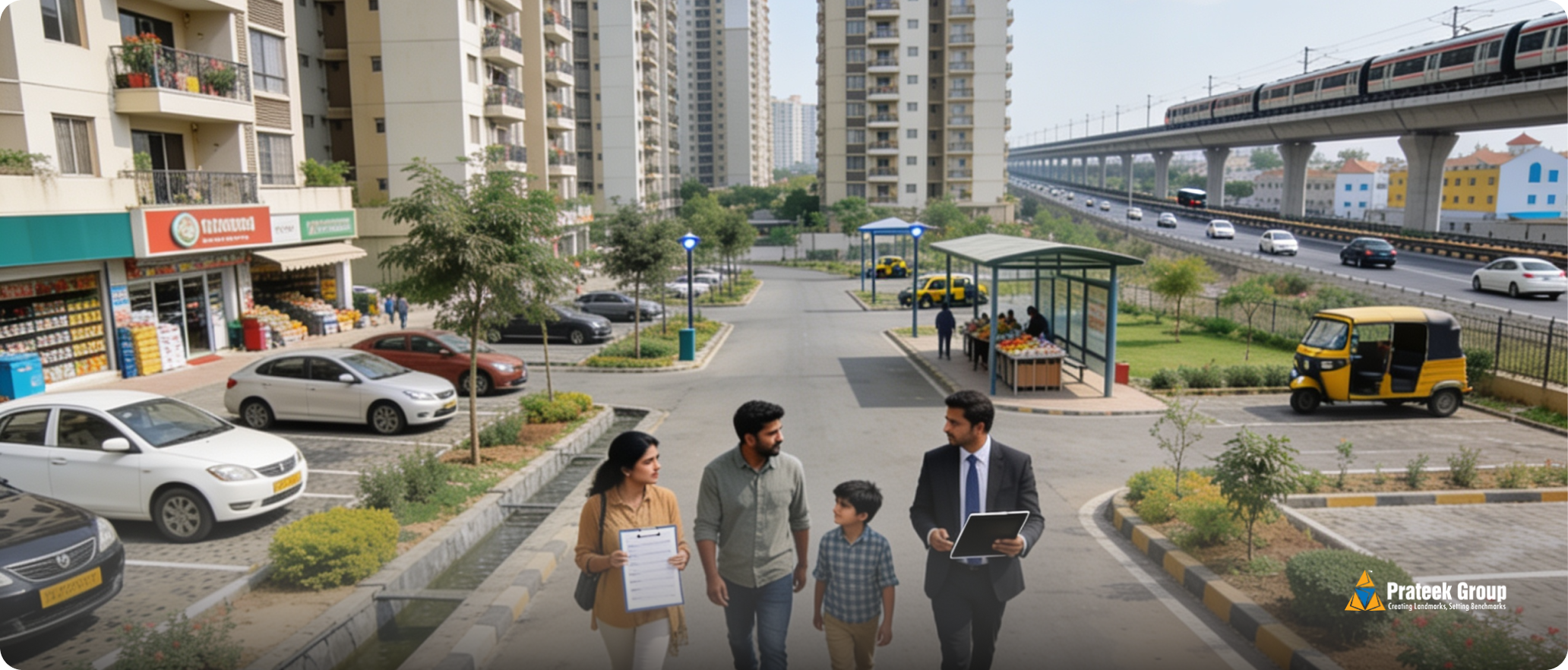
A listing may claim metro access, expressway frontage, high rental demand, and future price appreciation in the same paragraph.
The site visit is where those claims meet the road.
Use a 3-stage check before choosing residential projects near the FNG Expressway.
Before the site visit
Do the paperwork check before spending a Sunday touring sample flats.
- Search the project on the official UP RERA project portal.
- Match the registered project name with the marketing name.
- Check the registration number, promoter, completion date, and approved phase.
- Read available orders or complaints linked to the project.
- Compare the carpet area rather than the super built-up area.
- Ask whether registry, possession, and occupancy documents are available.
Noida recorded the highest number of newly registered projects in Uttar Pradesh during 2025, but registration alone does not confirm construction quality or timely delivery. It gives buyers a verified starting point for further checks.
During the site visit
Reach the project using the road you expect to use every day. Avoid letting the sales team choose a quieter route.
Check | What to observe |
FNG access | Driving time to the nearest usable section |
Peak traffic | Queue length at junctions and service roads |
Internal roads | Width, lighting, potholes, and illegal parking |
Occupancy | Lit apartments, parked cars, and active shops |
Water drainage | Low points, blocked drains, and basement entry |
Public transport | Metro feeder, autos, buses, and cab availability |
Daily services | Grocery shops, pharmacy, school, and clinic |
Construction | Active workers, completed towers, and site safety |
Monsoon conditions deserve special attention. Recent rain exposed waterlogging and drainage problems across parts of Noida, with roads and some residential areas affected. The report on Noida rain damage is a reminder to inspect basement slopes, surrounding drains, and access roads rather than judging the project only during dry weather.
After the site visit
Speak with residents or shopkeepers outside the sales office. Ask direct questions.
- How often does the road jam?
- Does water enter the basement?
- Are cabs available early in the morning?
- What is the monthly maintenance charge?
- How much rent does an occupied flat receive?
- How long do resale listings remain active?
- Are there power or water interruptions?
- Has the society received all required approvals?
Then compare at least 3 properties using the same criteria.
A buyer reviewing Noida options can also check Prateek Group projects in Noida while comparing location, apartment size, project status, and access to the wider road network. The final decision should come from verified documents, a physical visit, and a price comparison with nearby completed societies.
The best property near FNG Expressway should make sense before the entire corridor opens. Future connectivity can strengthen that decision later.
Which FNG location fits your buying purpose?
2 buyers can visit the same property and reach different conclusions.
One may need a home close to work within 6 months. The other may be willing to hold the property for 7 years. Their budgets may match, but the right location probably won’t.
Start with the reason behind the purchase.
The family buying a home to live in
A family moving within the next year should give more weight to occupied societies, schools, hospitals, local shops, and reliable roads.
Noida sectors 70 to 79 may suit this buyer because much of the surrounding social infrastructure already exists. Siddharth Vihar and other Ghaziabad-side locations can also work for families who travel through NH-9 or toward eastern Delhi.
Buyers comparing developers can review Prateek Group homes across Delhi NCR to study project locations, housing configurations, RERA details, and possession stages. The page includes projects in Siddharth Vihar and Sector 150, giving buyers 2 different NCR location types to compare.
This buyer should prioritise:
- A home ready for occupation
- Working lifts, water, power backup, and security
- School and office travel during peak hours
- Registry and possession status
- Monthly maintenance charges
- An active neighbourhood after sunset
The professional buying for rental income
Rental demand usually follows jobs, colleges, hospitals, commercial districts, and dependable transport.
Techzone 4 and parts of Greater Noida West may interest professionals looking for tenants who work in Noida or nearby office pockets. Noida’s established sectors may carry a higher purchase price, though they can offer a deeper tenant pool.
A rental investor should ask 3 local brokers for achieved rent, rather than relying on the rent quoted by the seller. They should also check how many similar flats are vacant in the same society.
A simple rental check
Annual rent ÷ total property cost × 100 = gross rental yield
Include stamp duty, registration, furnishing, brokerage, and repair costs in the total purchase amount. A lower flat price can still produce a weak return when vacancy stays high.
The buyer planning for a larger family home
A buyer moving from a smaller flat may care more about room size, privacy, storage, parking, and usable common areas.
Sector 150 may appeal to households looking for larger homes near the Noida-Greater Noida Expressway. People considering premium configurations can examine 4 BHK homes in Noida while comparing carpet area, construction stage, road access, and the time needed to reach offices or schools.
Prateek Canary is located in Sector 150 with access to the Noida-Greater Noida Expressway, Yamuna Expressway, and nearby metro routes, according to the developer’s project information. Buyers should test those travel routes at the hours they expect to use them.
The investor willing to wait
This buyer may consider an emerging pocket where current prices remain below more established Noida sectors.
Greater Noida West, selected Ghaziabad locations, and developing areas around major connecting roads may fit a longer holding period. But the purchase should survive delays in the FNG project.
Current reporting says only 11.6 km of Noida’s planned 23 km FNG stretch has been completed, with land acquisition, funding, and coordination still affecting progress. The recent FNG construction status review gives investors a reason to base their decision on present access and a patient holding plan.
Buyer type | Location traits to seek | Holding approach |
Family end user | Occupied society and daily services | Buy for present usability |
Rental investor | Jobs, transport, and tenant movement | Check achieved rent first |
Larger-home buyer | More space and dependable road links | Compare lifestyle with commute |
Long-term investor | Lower entry point and planned infrastructure | Prepare for delays |
Senior buyer | Hospitals, lifts, markets, and calm roads | Choose completed surroundings |
The right property near the FNG Expressway depends on who will use it, when they need it, and how much uncertainty they can carry.
Ready-to-move or under-construction: which works better near FNG?
A ready home lets you inspect what has already been built. An under-construction property gives you more time to pay, but asks you to judge what will exist later.
Near a delayed infrastructure corridor, that difference becomes serious.
Follow the buyer timeline
Month 1: Set the purchase deadline
A buyer who needs to move soon should focus on completed homes with registry and occupation documents. Waiting for both a project and an expressway can create 2 separate delays.
Month 2: Compare the complete cost
An under-construction quote may look lower at first. Add GST where applicable, floor charges, parking, club fees, maintenance deposits, registration, loan interest, and rent paid until possession.
A ready home can carry a higher asking rate, though the buyer can see the finished society and estimate immediate repair costs.
Month 3: Verify the project record
Check the project’s RERA entry, approved completion date, construction updates, promoter details, and past orders. When reviewing Prateek Group residential project options, buyers can see listed RERA numbers and completion years before confirming the same information through the official UP RERA portal.
Month 4: Visit at 3 different times
Visit once in the morning, once during office traffic, and once after dark.
A quiet Sunday visit won’t show weekday congestion. An evening visit will show whether shops are open, families use common spaces, and the approach road feels safe.
Use this decision sheet
Question | Ready-to-move home | Under-construction home |
Can you inspect the actual flat? | Yes | Usually limited |
Can rental income begin soon? | Possible after purchase | Only after possession |
Is construction delay a concern? | Low | Higher |
Can you check society management? | Yes | Not fully |
Is payment spread over time? | Usually less flexible | Often stage-linked |
Can you measure existing traffic? | Yes | Yes, but future access may change |
Does the buyer carry FNG delay risk? | Lower if the area already works | Higher when value depends on future roads |
Can final maintenance costs be known? | More easily | Often estimated |
A practical test before booking
Give each property 1 point for every “yes.”
- Can your family live there comfortably today?
- Is registry available or clearly scheduled?
- Does the current road handle weekday traffic?
- Are shops and healthcare within practical reach?
- Is the RERA completion date realistic?
- Can you afford a 12-month delay?
- Does the price compare well with completed homes nearby?
- Would you still buy it without the FNG promise?
A score of 7 or 8 suggests the property has support beyond a future road. A low score means the purchase may depend too heavily on assumptions.
Families looking at larger Noida apartments can compare Prateek Canary 4 BHK residences with completed alternatives, checking carpet area, possession timing, payment obligations, and current access to the Noida-Greater Noida Expressway.
For FNG Expressway property investment, ready-to-move homes usually give clearer evidence. Under-construction projects need stronger document checks, a realistic payment cushion, and enough time for the surrounding infrastructure to catch up.
What could weaken an FNG Expressway property investment?
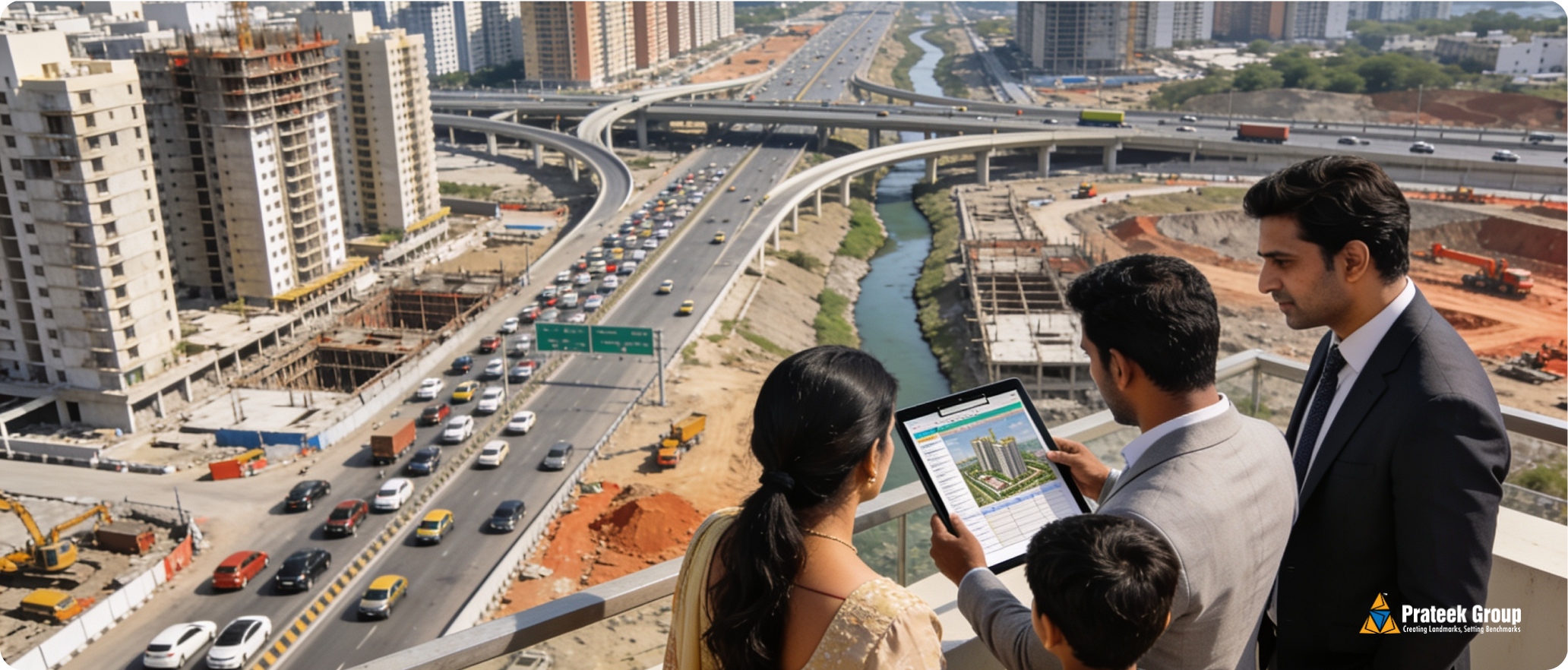
Infrastructure can draw buyers toward a location. The investment still has to survive construction delays, traffic problems, waterlogging, inflated pricing, and weak project records.
Before booking any property near FNG Expressway, watch for these warning signs.
Warning sign: the price already includes future growth
A seller may quote a premium because the expressway, metro, flyover, or rapid rail is expected nearby.
Compare that rate with completed societies in the same area. Check recent resale listings, achieved rents, circle rates, and the price per square foot in an occupied project.
Noida led Uttar Pradesh with 69 newly registered projects in 2025, while Ghaziabad recorded 29. The recent NCR project registration figures show strong development activity, but more launches also give buyers more properties to compare before accepting a high quote.
Buyer response: Ask the seller to explain the price using present features, current access, and comparable transactions.
Warning sign: everyday access depends on shortcuts
A property may sit close to an expressway on the map while residents depend on unauthorised cuts, narrow roads, or crowded service lanes.
NHAI recently closed 4 illegal access points along NH-9 and the Delhi-Meerut Expressway. The closure of unauthorised highway cuts affected local movement and showed how quickly an informal route can disappear.
Buyer response: Test the official route to the property. Check how residents enter and leave after barriers, road diversions, or construction work.
Warning sign: traffic improvements remain under construction
A flyover or underpass can improve an area after completion. During construction, it can make the daily commute harder for months.
Work on the Gaur City underpass has caused persistent congestion around a busy Greater Noida West junction. The report on delayed underpass construction shows why buyers should inspect present traffic instead of relying only on expected travel times.
Buyer response: Drive through the location between 8 am and 10 am, then return between 6 pm and 8 pm.
Warning sign: drainage gets ignored during the site visit
A clean approach road in winter may behave differently during heavy rain.
Recent monsoon rainfall caused waterlogging in parts of Noida and Ghaziabad, including Sector 62 and Vijay Nagar. The Delhi NCR waterlogging location report recorded traffic disruption across several parts of the region.
Buyer response: Look at basement ramps, stormwater drains, road height, empty plots, and marks left by earlier flooding.
Warning sign: every infrastructure proposal gets priced equally
Some projects have funding and active construction. Others are waiting for land, tenders, approvals, or coordination between authorities.
Greater Noida has announced a double-decker flyover connecting Greater Noida West with Crossings Republik near Shahberi. The new Crossings Republik flyover proposal may improve movement when delivered, though buyers should track tendering and construction milestones before adding its full expected benefit to the property price.
Buyer response: Sort each project into 1 of these stages:
Infrastructure stage | How buyers should treat it |
Operational | Test the route personally |
Under construction | Check work progress and expected disruption |
Tender awarded | Follow the start date and contractor activity |
Approved | Confirm funding and land availability |
Proposed | Treat it as a future possibility |
Mentioned by a seller | Find an authority or news source before relying on it |
A careful FNG Expressway property investment should work under current conditions. Road improvements can add support later, but the purchase price, project record, and neighbourhood must already hold up.
Final thoughts: where should you invest near the FNG Expressway?
Return to the weekday drive from the beginning of this guide.
You’re travelling between Ghaziabad and Noida. The planned FNG corridor could eventually shorten that journey and connect major residential and employment areas across NCR. But your home purchase begins before the full road is ready.
That means the best location depends on the life you need from the property now.
Choose established Noida sectors when daily convenience, occupied housing, schools, healthcare, and office access carry the most weight. Consider Greater Noida West or Techzone 4 when apartment choice and a comparatively accessible entry price matter more, provided you check congestion and project status carefully.
Crossings Republik and nearby Ghaziabad pockets may suit buyers who use NH-9 or work toward Ghaziabad and eastern Delhi. Sector 150 may appeal to families seeking larger homes, planned surroundings, and access to the Noida-Greater Noida Expressway, even though it sits away from several central FNG-side residential pockets.
Regional infrastructure continues to grow around these markets. The planned Greater Noida West double-decker connection aims to improve movement toward Crossings Republik, while other NCR road and transit projects could widen the commuter network over time.
Still, future property price appreciation in Noida or Ghaziabad cannot be predicted from an expressway announcement alone.
Before signing, check the project on UP RERA, inspect the road during office hours, speak with residents, compare 3 nearby societies, calculate the complete purchase cost, and verify the actual rental market. Visit once during rain when possible.
The strongest property investment near FNG Expressway is a home that remains usable when road work slows, traffic patterns change, or completion dates move.
Buy the neighbourhood you can verify. Let future connectivity become an added benefit.
FAQs
1. Is buying property near FNG Expressway a good investment?
It can be if the property already has good road access, occupied surroundings, and basic infrastructure. The proposed expressway may improve connectivity over time, but buyers should base their decision on the property’s current value rather than future expectations.
2. Which locations are worth considering near the FNG Expressway?
Many buyers compare Noida Sectors 70-79, Sectors 117-122, Greater Noida West, Techzone 4, Crossings Republik, Siddharth Vihar, and parts of Sector 150. The right location depends on your budget, commute, and whether you’re buying to live or invest.
3. Will property prices rise after the FNG Expressway is completed?
Improved infrastructure can increase buyer interest, but price movement depends on several factors, including housing demand, supply, employment growth, project quality, and local development. No road project guarantees appreciation.
4. Is Greater Noida West a better investment than central Noida?
Greater Noida West generally offers more apartment choices and a lower entry price in many pockets. Central Noida offers stronger existing infrastructure, established neighbourhoods, and mature rental demand. Buyers should compare both based on their investment goals.
5. Should I buy a ready-to-move apartment or an under-construction project?
Ready-to-move homes let buyers inspect the completed property before purchasing. Under-construction projects may provide flexible payment plans but require additional checks for construction progress, approvals, and expected possession timelines.
6. How important is RERA before buying near the FNG Expressway?
Very important. Buyers should verify the project’s registration, promoter details, approved completion timeline, and any available orders through the official UP RERA portal before making a booking.
7. What should I check during a site visit?
Inspect road connectivity, traffic during peak hours, drainage, occupancy levels, nearby schools, healthcare, public transport, maintenance quality, and surrounding commercial development. Speaking with existing residents can also provide useful insights.
8. Is rental demand strong around the FNG corridor?
Rental demand varies by location. Established Noida sectors generally have stronger rental activity, while emerging areas depend more on employment hubs, transport access, and completed residential projects.
9. Does expressway connectivity alone make a location attractive?
No. Connectivity helps, but buyers should also evaluate social infrastructure, developer reputation, legal approvals, maintenance standards, and current livability before investing.
10. Which buyers benefit most from investing near the FNG Expressway?
The corridor may suit long-term investors, working professionals, families planning future relocation, and buyers looking for developing NCR locations with improving road connectivity.
11. What mistakes should buyers avoid?
Avoid booking a property based only on future infrastructure promises. Compare multiple projects, verify RERA details, inspect the location personally, understand the complete purchase cost, and review current market conditions before deciding.
12. How can buyers compare projects fairly?
Use the same checklist for every property. Compare location, carpet area, road access, builder reputation, occupancy, maintenance charges, legal approvals, possession status, and total acquisition cost instead of looking only at the advertised apartment price.
13. Does infrastructure always increase property value?
Infrastructure usually improves accessibility, but value depends on execution, surrounding development, employment opportunities, buyer demand, and the overall quality of the project.
14. How long should investors plan to hold property near FNG Expressway?
Long-term buyers generally have more flexibility because infrastructure projects often take several years to complete. Investment decisions should be based on financial goals rather than expected completion dates alone.
15. Is FNG Expressway suitable for end users or only investors?
It can suit both. End users should prioritise completed neighbourhoods with existing amenities, while investors may consider developing locations if the property makes financial sense under current market conditions.