
Property deals become easier when buyers separate 3 numbers. These numbers may appear in the same transaction, but they do different jobs.
|
Value type |
What it means |
Why buyers should care |
|
Market value |
The price a buyer may pay in the open market |
Helps judge whether the property is fairly priced |
|
Circle rate, guideline value, or ready reckoner rate |
Government benchmark used for stamp duty and registration |
Affects official cost and tax treatment |
|
Agreement value |
The price written in the sale agreement |
Used for registration, loan, and legal records |
A circle rate guide explains that this government benchmark is called by different names in different states, such as ready reckoner rate, guidance value, or circle rate. A buyer checking circle rate vs market value should know that the government rate can lag behind actual market movement.
A strong location may trade above circle rate because buyers are willing to pay more. A slow location may have sellers quoting high prices, but actual deals may close lower.
This difference matters during registration too. A 2026 Gurgaon circle rate report said circle rates rose by up to 75% from April 2026 in some areas, which can affect stamp duty, registration value, and buyer cash planning.
A simple buyer reading works well:
- If market value is higher than circle rate, the location may have strong demand.
- If market value is far above nearby deals, the seller may be overpricing it.
- If agreement value is below circle rate, tax questions can come up.
- If bank valuation is lower than the agreed price, the buyer may need more funds.
- If legal papers are weak, market value can drop even in a good location.
For buyers looking at NCR projects, including Prateek Group homes in Noida or Ghaziabad, this comparison should happen before token payment. Ask for the quoted price, compare nearby deals, check government value, and then judge the number.
How can buyers calculate property value without guessing?
Most buyers start with price per sq. ft.
That helps, but it cannot tell the full story. A 1,200 sq. ft. flat in one tower and a 1,200 sq. ft. flat in another tower may have different values because floor, view, layout, age, parking, approach road, and maintenance can change the buyer’s experience.
So how to calculate property value?
Start with comparison. A buyer can use RBI house price data to understand broad city movement, while https://NHB RESIDEX gives official housing price index information for Indian cities.
Then move to local checks.
- Compare 3 to 5 similar properties in the same micro-market.
- Use carpet areas, not only super built-up areas.
- Adjust for floor, view, parking, tower position, and building age.
- Check the circle rate or ready reckoner rate.
- Ask whether the bank valuation supports the agreed price.
- Study resale and rental demand in the same project or nearby buildings.
- Add stamp duty, registration, brokerage, renovation, maintenance, and loan costs.
This is where property valuation methods become useful.
For most homebuyers, the sales comparison method is easiest. Compare similar homes in the same area and adjust for size, condition, location, age, and amenities. A property valuation guide explains how location, property condition, age, amenities, and demand affect house valuation in India.
A property valuation calculator can give a quick estimate, but it should not decide the deal. A calculator cannot check seepage, lift waiting time, parking slope, sunlight, noise, society upkeep, or title clarity.
A fair number comes from online data plus real site checks.
Why does the location still do most of the heavy lifting?

Property value often changes before a buyer enters the flat.
The road outside the project, the metro distance, the office route, the school run, the hospital reach, the evening traffic, and the last 500 metres of access all sit inside the final price.
This is why property prices in India change street by street.
A Jewar airport update reported that the Noida International Airport may support activity along the Yamuna Expressway belt. A Hindon elevated road report also said new ramps could improve access for Indirapuram, Vasundhara, Siddharth Vihar, and nearby areas.
For a buyer, this means daily life and market value move together.
A home may gain stronger buyer interest when it has:
- faster access to office hubs
- cleaner road connectivity
- nearby schools and hospitals
- metro, expressway, or airport-linked access
- safe last-mile movement
- strong rental demand
- working markets nearby
- less daily travel stress
This is where a light Prateek Group example fits. Buyers checking Prateek Grand Begonia in Siddharth Vihar may look at NH-24 access and township planning, while buyers checking Prateek Canary Noida in Sector 150 may look at the Noida Expressway side and long-term family use.
A good location saves time every day.
Over 10 years, that saved time becomes part of value.
Legal clarity can lift or lower property value
A home can look perfect during a site visit and still lose value on paper.
This happens when documents are weak. Buyers may like the floor, tower, balcony, and location. But unclear title, missing approvals, RERA gaps, OC issues, or possession delays can reduce the fair market value of property because buyers start adding risk to the price.
A Times of India guide on OC and CC documents explains why occupancy certificate, completion certificate, RERA registration, and sale deed matter before purchase. Buyers in Uttar Pradesh can also use the UP RERA project search before paying token money.
Before judging the price, check the paper trail.
- RERA registration number
- title and ownership chain
- sanctioned building plan
- sale deed format
- completion certificate, if applicable
- occupancy certificate, if applicable
- possession timeline
- pending legal disputes
- maintenance and handover plan
- builder’s delivery record
Builder record also affects property valuation in India. A known project may get better buyer interest, but even a known project needs document checks. For example, a buyer looking at Prateek Canary Noida or Prateek Grand Begonia should still verify RERA details, possession status, cost sheet, and legal papers.
A clean document file makes a property easier to sell later.
A weak file gives the next buyer a reason to negotiate harder.
Bank valuation can change your home loan planning
Many buyers assume the bank will fund the price they agreed with the seller.
The bank checks the property on its own.
Before approving a home loan, lenders review legal status, technical condition, location, age, saleability, and market value. If the buyer agrees to pay ₹1 crore and the bank values the property at ₹90 lakh, the loan amount may be lower than expected. The buyer then has to arrange more money from savings.
This is why bank valuation of property should happen before final commitment. A home loan valuation explainer says lenders assess location, size, condition, and market trends before deciding property worth. A bank valuation guide also explains how legal, technical, and market checks affect funding.
|
Bank check |
What it means for the buyer |
|
Legal check |
Bank verifies ownership, title, approvals, and sale documents |
|
Technical check |
Bank reviews age, structure, layout, and condition |
|
Market check |
Bank compares nearby property prices and saleability |
|
Loan-to-value check |
Bank decides how much it can fund |
|
Risk check |
Bank may reduce funding if documents or location feel weak |
Agreement value and bank value can differ.
The buyer sees the home as a place to live. The bank sees it as loan security. A home loan growth report showed loan values rising faster than buyer growth in one market, which makes valuation discipline more important for families planning a large loan.
For buyers comparing Prateek Group or any other NCR project, bank valuation should come before stretching the budget. If the bank funds less than expected, the buyer should know the cash gap early.
Market trends can change what buyers call “fair value”
A fair price in 2026 needs market context.
A seller may quote a higher number because prices in the area have moved up. A buyer may feel the number is stretched because salary, EMI, stamp duty, maintenance, and school fees sit in the same monthly plan.
Both sides may have reasons. The deal still needs data.
An ET Realty housing report said housing supply rose 10.1% year-on-year and prices rose 14.1% across major Indian cities in Q1 2026. The CBRE Q1 2026 residential monitor also said India’s residential market saw steady activity across major cities during January to March 2026.
For buyers, these market signals matter.
|
Market signal |
What it can mean |
|
Prices rising faster than income |
Budget pressure may increase |
|
Supply rising in the same area |
Buyers may get more choices |
|
Inventory low in good projects |
Sellers may negotiate less |
|
Rental demand improving |
End-use and investor demand may support prices |
|
Infrastructure moving ahead |
Future value may improve, but timing matters |
A buyer should ask one practical question before accepting the quoted price: Has this price moved because the property is stronger, or because the whole area is running hot?
For buyers in Noida and Ghaziabad, this helps while comparing Prateek Group with other NCR projects. A strong location and a known project may support value, but the final price should still be checked against nearby transactions, RERA status, bank valuation, and total cost.
Market value should never come from one broker line. It should come from area trends, project quality, and the buyer’s own budget.
Resale value and rental demand matter even for end-users
Many families buy a home for living. Still, resale value matters.
Life changes. Jobs shift. Parents may move in. Children may change schools. A family may outgrow a 2 BHK faster than expected. A home that is easy to resell gives the buyer more freedom later.
A 2026 India TV report on NCR real estate said the region is seeing stronger focus on quality, experience, and long-term value. An Economic Times report on office leasing demand said India’s office leasing may stay strong in 2026-27, which can support residential rental demand near job corridors.
Office demand may sound like a commercial property issue. For homebuyers, it matters because jobs create tenants. Tenants support rental demand. Rental demand can support resale value.
Before judging house valuation in India, check these resale and rental signals:
- Is the project close to job hubs?
- Are schools, hospitals, markets, and main roads already working?
- Is the project maintained well after possession?
- Does the layout suit both owners and tenants?
- Are similar homes getting rented quickly?
- Is the monthly rent sensible compared with the purchase price?
- Does the builder have completed communities nearby?
- Is the property easy to explain to a future buyer?
A buyer checking Prateek Grand City in Siddharth Vihar may look at ready-to-move status and NH-24 access. A buyer checking Prateek Canary may look at Sector 150, larger apartment formats, and expressway-side demand.
The best resale homes solve everyday problems well: Commute. Parking. Maintenance. Sunlight. Lift waiting. School run. Grocery access. These quiet details shape property resale value.
Why age, layout, and maintenance change property value
A property does not age only by years. It ages by how the building is kept.
A 10-year-old apartment with clean lifts, working plumbing, proper security, dry basements, and sensible maintenance can hold value better than a newer flat with poor upkeep. Buyers notice these things during the second visit, when the first excitement settles.
This is why property valuation in India should include building conditions. A https://BusinessWorld article on record-high housing prices raised questions around affordability and demand strength, which makes quality checks more important for buyers paying higher prices. The https://CBRE India Q1 2026 monitor also gives wider market context for residential buyers.
During a site visit, check these value markers:
- Does the layout use space well?
- Is the carpet area practical?
- Are bedrooms easy to furnish?
- Is there enough natural light?
- Is the balcony actually usable?
- Are lifts, corridors, basement, and parking maintained?
- Are seepage, damp patches, or cracks visible?
- Is the society collecting maintenance properly?
- Is the project attractive to tenants and resale buyers?
This is where a property valuation calculator can miss the real story. A tool may ask for location, area, and property type. It cannot smell damp walls, count lift waiting time, or check whether the parking ramp floods during rain.
A slightly smaller flat with better planning can feel more valuable than a larger flat with wasted corners. Value rises when the home works well after possession.
How to check if a property is overpriced before token payment?
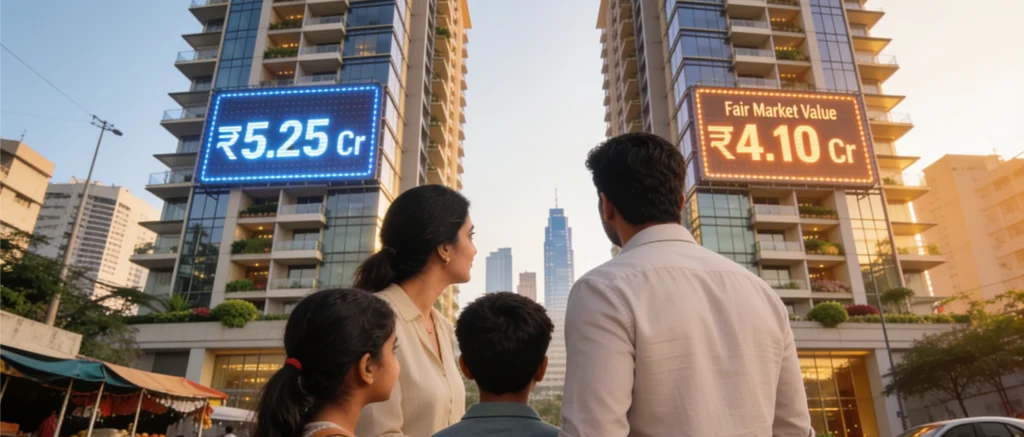
Token payment should come after price checking.
Many buyers reverse the order. They like the flat, feel pressure from the seller or sales team, pay a small amount, and then start asking whether the price was fair.
That small mistake can become expensive.
A https://Business Standard report said housing sales in India’s top 7 cities fell 7% quarter-on-quarter in Q1 2026, based on Anarock data. A BusinessWorld housing report said sales still rose annually, which shows why buyers need micro-market checks instead of reacting to one headline.
Use this simple test before paying token money.
|
Check |
What to do |
|
Nearby price check |
Compare 3 to 5 similar homes in the same area |
|
Circle rate check |
Check the government benchmark for registration |
|
Bank valuation check |
Ask whether the bank is likely to fund the agreed price |
|
Project check |
Compare possession status, amenities, and delivery record |
|
Cost check |
Add stamp duty, registration, maintenance, brokerage, GST if applicable, and loan charges |
|
Resale check |
Ask what similar homes are actually closing at |
If the seller’s quote is much higher than nearby deals, ask why.
A better floor, open view, fresh interiors, corner unit, larger carpet area, or stronger tower placement can justify some premium. Vague answers should make the buyer slow down.
For Prateek Group buyers, this means comparing a project like Prateek Grand City or Prateek Canary with similar homes in the same micro-market, not random city-wide rates.
Fair market value of property is best checked before emotion takes over.
A fair property price needs more than one check!
A fair property price rarely comes from one number.
The seller has an asking price. The government has a circle rate. The bank has its valuation. The buyer has a budget. The market has its own mood.
A good homebuyer studies all 5 before paying token money.
The market value of property should be checked through nearby transactions, current price movement, legal status, bank valuation, resale demand, layout quality, and location comfort. The https://RBI House Price Index uses transaction-level data from registration authorities, while https://NHB RESIDEX tracks housing price movement through official price indices.
The circle rate also needs attention. It affects stamp duty, registration, and tax treatment. The Income Tax Section 50C rule can matter when sale consideration is below the stamp valuation authority’s value, so buyers should avoid casual agreement values.
For buyers in Noida, Ghaziabad, Gurgaon, Pune, Bengaluru, Mumbai, or any other Indian city, the checking path is simple:
- Check the local circle rate.
- Compare nearby market deals.
- Read the builder or seller documents.
- Ask the bank for valuation clarity.
- Study resale and rental demand.
- Add stamp duty, registration, GST if applicable, maintenance, and loan costs.
- Check RERA status, OC, CC, title, and possession condition.
- Compare the final payable amount with daily-life value.
Prateek Group projects can be one reference point for NCR buyers, especially in Noida and Ghaziabad, but the same rule applies everywhere. A home should be judged by location, legal clarity, project upkeep, price, commute, resale comfort, and family use.
The right property value is the price that survives all these checks.
FAQs on market value of properties in India
1. What is the market value of property?
Market value of property is the price a buyer may reasonably pay for a property in the open market. It depends on location, demand, property condition, legal clarity, size, amenities, resale demand, and current market trends.
2. How is property valuation done in India?
Property valuation in India usually checks location, land value, construction quality, age, amenities, legal title, circle rate, nearby sale prices, rental demand, and bank assessment. The RBI house price data also helps buyers understand broad price movement.
3. What is the difference between market value and circle rate?
Market value is the price a buyer may pay in the open market. Circle rate is the government-set minimum value used for registration and stamp duty.
4. What is the circle rate called in different states?
Circle rate may also be called ready reckoner rate, guideline value, DLC rate, collector rate, or jantri, depending on the state.
5. Why is circle rate important for buyers?
Circle rate affects stamp duty, registration cost, and tax checks. A Times of India circle rate guide explains how this benchmark shapes the official cost of buying a home.
6. Can market value be higher than circle rate?
Yes. In strong locations, market value is often higher than circle rate because demand, connectivity, builder quality, and resale comfort can push prices above government benchmarks.
7. Can the circle rate be higher than market value?
Yes. This can happen in slow markets or weak locations. Buyers should still check stamp duty because registration may depend on the higher benchmark.
8. What is the agreement value?
Agreement value is the price written in the sale agreement. It is used for registration, loan processing, tax checks, and legal records.
9. What is the fair market value of property?
Fair market value of property is the reasonable price a property can get between a willing buyer and a willing seller. It should be backed by local market data, property condition, and document checks.
10. How can I calculate property value before buying?
Start with nearby sale prices. Then check carpet area, project age, floor, view, maintenance, legal status, circle rate, bank valuation, and resale demand.
11. Are online property valuation calculators reliable?
A property valuation calculator can give a rough estimate. It cannot fully judge road access, sunlight, maintenance, title quality, tower position, or buyer demand in that micro-market.
12. What is the bank valuation of property?
Bank valuation is the value a lender assigns before approving a home loan. If the bank values the property lower than the agreed price, the buyer may need to arrange more money from savings.
13. Does RERA status affect property value?
Yes. RERA status can affect buyer confidence, resale comfort, and project credibility. Buyers should check registration details on the relevant state RERA portal before paying token money.
14. Does OC or CC affect market value?
Yes. Occupancy certificate and completion certificate help prove that the building has reached an approved completion stage. Missing documents can affect resale, loan approval, and buyer confidence.
15. How does location affect property value?
Location affects commute, rental demand, resale value, school access, hospital reach, road quality, safety, and daily convenience. A smaller home in a better location can sometimes hold stronger value than a larger home in a weak pocket.
16. Should Prateek Group buyers check market value separately?
Yes. Buyers looking at Prateek Group projects should compare the quoted price with nearby projects, circle rate, RERA status, possession stage, location quality, maintenance, and resale demand.
17. What should buyers check before paying token money?
Before paying token money, check the property’s market value, circle rate, agreement value, bank valuation, legal title, RERA status, OC or CC, resale demand, maintenance cost, stamp duty, registration cost, and total payable amount.