A homebuyer usually does the same thing first. They visit the site. They check the sample flat. They ask about the tower, floor, view, parking, club, and payment plan. By the time the cost sheet comes out, the family has already started placing the sofa in the living room in their head.
Then one line changes the mood: GST.
This is where GST in real estate starts feeling confusing. Many buyers also search for GST on real estate at this stage because the rule changes with the property stage. One buyer hears that GST is 5%. Another hears that ready-to-move homes have no GST. Someone else says affordable housing has 1% GST. All 3 can be right, depending on the property stage, flat category, and payment timing.
For 2026 buyers, the first rule is simple. GST mainly matters when you buy an under-construction home and pay before completion. The https://GST Council FAQ explains the 1% and 5% GST structure for residential apartments, while the CBIC completed building rule helps buyers understand why completed homes usually sit outside GST on the sale value.
A buyer looking at Noida or Ghaziabad homes, including Prateek Group projects, should read GST before the booking amount. It affects cash flow, loan planning, and the final amount paid to the builder.
The 2026 context also matters because construction input taxes changed in 2025. The PIB GST reforms note said cement moved from 28% to 18%, which can reduce construction cost pressure. Buyers should still ask how any cost benefit shows in the price, because lower input tax does not automatically reduce every flat price.
GST on property purchase becomes easier when the buyer asks one question early: What am I paying GST on, and why?
GST on property purchase: the basic rule buyers should know
Once the buyer understands the stage of the property, the GST discussion becomes calmer.
The rule starts with 2 broad buckets: under-construction homes and completed homes. Under-construction homes can attract GST. Completed homes, when sold after completion certificate or first occupation, usually do not attract GST on the sale value.
|
Property type |
GST position for homebuyers |
What buyers should check |
|
Under-construction residential flat |
GST is usually charged if payment is made before completion or first occupation |
GST rate, builder GSTIN, invoice breakup, payment plan |
|
Affordable housing flat |
1% GST without ITC, subject to official conditions |
Carpet area, flat value, city category |
|
Other residential flat |
5% GST without ITC |
Taxable value, agreement value, cost sheet |
|
Ready-to-move flat |
Usually no GST on sale value after completion or first occupation |
OC, CC, first occupation proof |
|
Plot or land sale |
GST does not apply on sale of land |
Title, stamp duty, registration cost |
The real estate GST FAQ gives the residential rates from 1 April 2019: 1% without ITC for affordable residential apartments and 5% without ITC for other residential apartments. The CGST Act Schedule III keeps sale of land and completed building sales outside GST when the completion condition is met.
This is why 2 flats in the same area can have different tax treatment.
A buyer comparing an under-construction apartment with a ready-to-move apartment should compare the final payable amount. GST, stamp duty, registration, parking, maintenance deposit, club charges, and loan cost all sit inside the real budget.
For buyers checking Prateek residential projects in Noida or Ghaziabad, the tax check should sit beside the location check. A good floor plan matters. A clean cost sheet matters too.
How does the GST work on under-construction flats?
Most confusion starts when the buyer books before the project is complete.
In an under-construction flat, payments usually move with construction stages. Booking amount first. Then excavation, basement, slab, brickwork, plaster, finishing, possession. GST can get added to these taxable installments.
That is why GST on flat purchase should be checked with the payment plan at the same time. In simple terms, under construction flat GST is paid because the buyer is paying while the construction service is still active.
The GST Council real estate FAQ gives the current residential rate structure, and the 34th GST Council decision note recorded the move to the 1% and 5% rates without ITC from 1 April 2019.
Before booking an under-construction home, ask for these details:
- Is the unit treated as affordable housing or regular residential housing?
- Is GST charged at 1% or 5%?
- Is GST shown as a separate line in the cost sheet?
- Is the builder GSTIN printed on the invoice?
- Are parking, club, PLC, floor rise, power backup, and maintenance deposits taxed separately?
- Is the payment plan construction-linked?
- What happens to GST if possession or completion status changes before final payment?
A family comparing GST on under construction property should avoid reading only the basic sale price. A ₹90 lakh base price can feel very different after GST, stamp duty, registration, and possession-linked charges are added.
This is where a site visit should turn into a paper check. The sample flat shows the dream. The invoice shows the truth.
GST on ready-to-move flats: what changes after completion
Ready-to-move homes are easier to understand once the buyer checks the completion status.
If the flat is sold after completion certificate or first occupation, GST usually does not apply on the sale value. The CBIC Schedule III text keeps completed building sales outside GST supply, subject to the construction-service rule.
This is where GST on ready to move flats becomes different from an under-construction booking. The phrase ready to move property GST usually points to this same question: has the flat crossed completion or first occupation before payment?
A buyer may find one under-construction home with a lower quoted price and one ready home with a higher quoted price. The ready home may still work better for some families because the tax position is cleaner, possession is faster, and rent plus EMI overlap may reduce.
|
Buyer question |
Why it matters |
|
Has the project received OC or CC? |
GST treatment depends on completion status and timing of payment |
|
Was any money paid before completion? |
Earlier payments may attract GST if they relate to construction service |
|
Is the flat ready for the first occupation? |
The CBIC supply guide links completed building treatment with completion or first occupation |
|
Is the builder charging GST on any line? |
Ask which charge is taxable and why |
|
Are maintenance or facility charges separate? |
Post-possession services can have a different tax treatment |
For example, the official Prateek Grand City page describes ready-to-move homes in Siddharth Vihar, Ghaziabad, with OC received and GST-free homes. A buyer should still ask for the project-specific document before relying on any sales line.
Ready-to-move property GST questions should always come back to proof. Ask for OC, CC, or first occupation details. Keep the answer in writing.
Affordable housing GST vs regular housing GST
The 1% GST rate sounds attractive. Buyers should check whether their flat actually qualifies.
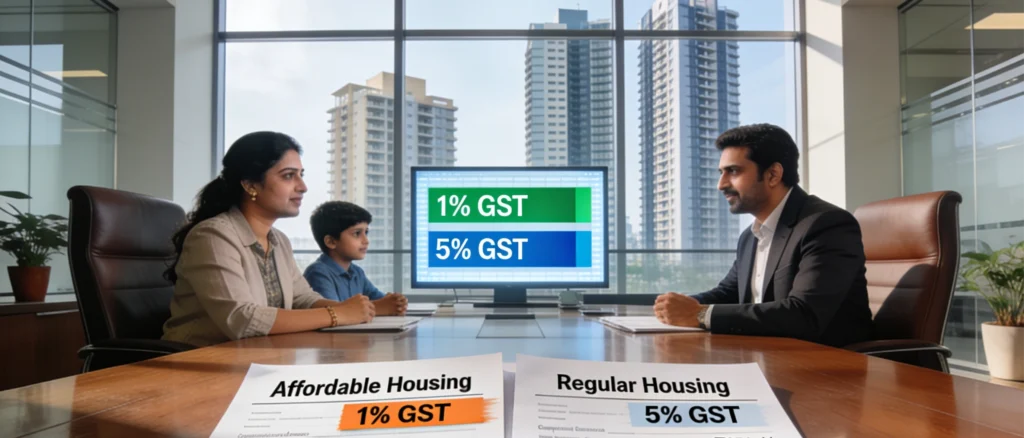
Affordable housing has a defined meaning under GST. Carpet area, property value, and city category matter. The GST Council FAQ explains that affordable residential apartments can attract 1% GST without ITC, while other residential apartments attract 5% GST without ITC.
For Delhi NCR, this needs extra care. Noida, Greater Noida, Ghaziabad, Gurgaon, Faridabad, and Delhi are treated as part of the metro area for this GST rule. So the carpet area limit becomes a real buyer check.
|
GST category |
Basic condition |
GST rate |
Buyer check |
|
Affordable residential apartment |
Must meet carpet area and value rules |
1% without ITC |
Carpet area, agreement value, city category |
|
Other residential apartment |
Does not fit affordable housing definition |
5% without ITC |
Taxable value, invoice, payment plan |
|
Completed residential apartment |
Sold after completion or first occupation |
Usually no GST on sale value |
OC, CC, first occupation proof |
A buyer checking Prateek Canary Noida in Sector 150 may be looking at larger 3 and 4 BHK homes. Another buyer checking Prateek Grand Begonia in Siddharth Vihar may be comparing 2 and 3 BHK homes inside a township setting.
The GST category should come from the flat’s size, value, and legal status. A casual sales discussion cannot decide it.
Ask 3 things before signing:
- Is this unit covered under the affordable housing GST rate?
- What carpet area and agreement value are used for that decision?
- Where is the 1% or 5% GST shown in the cost sheet?
A buyer who asks these questions early usually reads the rest of the cost sheet better.
How should property buyers read the cost sheet?
A cost sheet is where GST becomes real.
The brochure tells the buyer about location, club facilities, green areas, floor plans, and possession status. The cost sheet tells the buyer what leaves the bank account.
For buyers exploring Prateek Group projects in Noida and Ghaziabad, the first step is to separate the flat price from taxes and other charges. A project page can show the location and unit type. A cost sheet should show whether GST on property purchase applies to the booking.
Read it line by line.
|
Cost sheet line |
What to check |
|
Basic sale price |
Whether GST is calculated on the right taxable amount |
|
GST |
Whether 1% or 5% applies and why |
|
PLC or floor rise |
Whether GST is added separately |
|
Parking |
Whether it is included or billed separately |
|
Club or facility charge |
Whether this is a taxable service line |
|
Maintenance deposit |
Whether GST applies now or later |
|
Stamp duty and registration |
Separate state-level costs, not GST |
A buyer checking Prateek Grand City should treat ready-to-move status as a document question. A buyer checking an ongoing tower should treat GST as a payment-stage question.
RERA also matters here. UP RERA has continued to push progress reporting for ongoing projects, and a Times of India report said developers were asked to upload quarterly progress reports, with penalties for default. Buyers should cross-check project status on the UP RERA portal before treating any possession date as final.
A clean cost sheet should answer tax, timing, and total cost in one place.
GST, stamp duty, and registration are separate costs
Many buyers feel they are paying tax again and again.
The cost sheet feels crowded because different charges come from different laws. GST applies to taxable construction services. Stamp duty and registration apply when the property is registered under state rules. Maintenance and facility charges may follow their own GST treatment.
A homebuying cost report in Times of India explained how buyers often miss costs beyond the advertised property price, including GST, stamp duty, registration, parking, maintenance, loan charges, and moving costs.
Use this split while comparing homes.
|
Cost layer |
What it means |
Buyer action |
|
Basic sale price |
Main property price |
Compare with carpet area and unit size |
|
GST |
Tax on applicable under-construction supply |
Check 1% or 5% |
|
Stamp duty |
State charge on registration |
Check current state rate |
|
Registration fee |
Sale deed registration cost |
Keep cash aside |
|
Builder add-ons |
Parking, club, PLC, maintenance deposit |
Ask where GST is added |
|
Loan cost |
Processing fee, legal checks, insurance if taken |
Compare bank offers |
A buyer comparing Prateek Group homes should ask for the full payable amount first. A ready vs under-construction comparison in Times of India also shows why buyers weigh tax, possession, pricing, and waiting period together.
The simple test works well.
Can you explain every line in the cost sheet without calling the sales person again?
GST on maintenance, parking, and other builder charges
The GST question continues after the flat price.
A buyer may plan the EMI, stamp duty, and registration cost. Then smaller lines start appearing: parking, club charges, power backup, meter connection, maintenance deposit, floor rise, preferred location charge.
Some lines may carry GST. Some may already include it. Some may come later through the residents’ association or maintenance agency.
For apartment maintenance, an Economic Times tax report said maintenance charges up to ₹7,500 per month per member are GST-exempt, while the association’s registration threshold also matters. A recent TaxGuru RWA explainer also discussed the dispute around whether GST applies on the full maintenance amount or only the excess once the ₹7,500 limit is crossed.
Before possession, ask these questions:
- Is parking included in the flat price or charged separately?
- Is GST added on parking charges?
- Are club charges one-time or recurring?
- Is the builder collecting maintenance before handover?
- Will the residents’ association collect maintenance later?
- Can monthly maintenance cross ₹7,500 per member?
- Is GST shown separately on every taxable line?
- Does the invoice mention GSTIN and taxable value?
This is where GST on builder charges needs written answers. Many buyers search for GST on apartment maintenance charges only after the first bill arrives, but the better time to ask is before possession. A buyer should accept “all-inclusive” only when the document says what it includes.
For a Prateek Group buyer, the right approach is simple. Ask which charges belong to the flat sale, which charges are separate services, and which charges may continue after possession.
What lower construction-material GST may mean for 2026 buyers?
In 2026, homebuyers may hear builders talk about lower construction costs after GST rate changes.
That conversation needs numbers.
The government’s PIB note said cement moved from 28% to 18% under the 2025 GST reforms. A Business Standard report said lower GST on cement and some materials could ease cost pressure for developers and homebuyers.
For buyers, the benefit depends on project timing.
Project stage | What the buyer should understand |
Early construction | Lower material tax may affect future procurement |
Mid-stage construction | Some material may already be bought |
Near completion | Most major costs may already be locked |
Ready-to-move | GST on sale value usually depends on completion status first |
New launch | Pricing may reflect fresh cost planning |
A Moneycontrol analysis said the cement GST cut may offer limited direct relief to homebuyers because cement is only one part of total project cost. Land, labour, finance cost, approvals, design, marketing, finishing, and location premium also shape the final price.
So buyers should ask the builder:
- Has the project price changed after the GST rate cuts?
- Are lower material costs reflected in the payment plan?
- Is the quoted price all-inclusive?
- Does the benefit apply to this tower, or only to future phases?
For a Prateek Group project discussion, this keeps the conversation grounded. If construction-cost savings are mentioned, the buyer should ask how they appear in the final payable amount.
What homebuyers should check before paying GST?

By this stage, the buyer knows the main GST rules.
Now comes the booking decision.
For Prateek Group property buyers, the GST check should sit beside the project check. A buyer looking at Prateek Canary details can review the location and flat type. A buyer checking Prateek Grand Begonia can review the Siddharth Vihar location, 2 and 3 BHK options, township setting, and RERA-registered positioning.
Then the buyer should ask for paperwork.
Before paying GST, check this:
- Builder GSTIN
- GST rate in writing
- Full cost sheet
- GST invoice format
- Affordable or regular residential category
- Construction stage
- OC or CC status, where relevant
- UP RERA registration
- Parking and club charge breakup
- Maintenance estimate
- Stamp duty and registration estimate
- Payment plan and due dates
The UP RERA project search can help buyers cross-check registration details for Uttar Pradesh projects. A UP RERA compliance report also shows why project progress reporting matters for buyers.
A home is bought with emotion. It should be checked with documents.
GST should be checked before the booking amount!
GST feels less confusing when the buyer checks it before choosing the payment plan.
Start with the property stage. Under-construction homes can attract GST. Completed homes with the right completion or first occupation status usually sit outside GST on sale value. Affordable housing can attract 1% GST if it fits the rules. Other residential apartments usually attract 5% GST.
The GST Council FAQ gives the rate structure, and the CBIC completed building rule explains the completed-property treatment. A buyer should keep both ideas in mind while comparing GST on property purchase.
For buyers looking at Prateek Group homes in Noida or Ghaziabad, the best comparison is the final payable amount. Put the base price, GST, stamp duty, registration, parking, club charges, maintenance deposit, loan cost, and possession timeline in one sheet.
In 2026, construction-cost discussions may also mention lower GST on cement and other materials. A Financial Express report said GST cuts on construction materials could make buying easier, while India Today discussed whether affordable housing could get a push after cement cost changes. Buyers should ask how any benefit appears in the actual quote.
Before paying, ask for 5 things in writing:
- GST rate
- GSTIN
- Full cost sheet
- OC or CC status, where relevant
- RERA registration and project status
A buyer who understands GST asks better questions. Better questions usually lead to a safer purchase.
FAQs on GST in real estate in India
1. Is GST applicable on property purchase in India?
GST applies when a buyer purchases an under-construction property and pays before completion certificate or first occupation. Ready-to-move flats with proper completion status are usually outside GST on sale value.
2. What is the GST rate on under-construction flats in 2026?
The usual GST rate on under-construction residential flats is 5% without ITC. Affordable residential apartments can attract 1% GST if they meet the official conditions. The GST Council real estate FAQ gives the rate structure.
3. Is GST charged on ready-to-move flats?
Usually, GST is not charged on the sale value if the flat is sold after completion certificate or first occupation. Buyers should ask for OC, CC, or first occupation proof.
4. What is GST on affordable housing?
GST on affordable housing is 1% without ITC if the flat meets the carpet area and value conditions. Delhi NCR buyers should check the metro-area treatment carefully.
5. What is the GST rate on property purchase for regular flats?
For regular under-construction residential flats, the GST rate on property purchase is usually 5% without ITC.
6. Does GST apply on resale flats?
GST usually does not apply on resale flats when the property is already completed and sold as immovable property. Stamp duty and registration still apply.
7. Does GST apply on stamp duty and registration?
GST does not apply on stamp duty and registration. These are separate state-level costs paid during property registration.
8. Why does an under-construction flat have GST?
An under-construction flat is treated as a construction service when the buyer pays before completion. Once the building crosses completion certificate or first occupation stage, the CBIC Schedule III treatment becomes relevant for completed building sale.
9. How does GST on completion certificate property work?
GST on completion certificate property questions come down to timing. If the full sale consideration is received after OC, CC, or first occupation, GST usually should not apply on the sale value. If GST is charged, ask which specific service or charge attracts GST.
10. Can a builder charge GST after OC or CC?
If the full sale consideration is received after OC, CC, or first occupation, GST usually should not apply on the sale value. If GST is charged, ask which specific service or charge attracts GST.
11. Is GST charged on parking charges?
GST may apply if parking is charged separately as part of the taxable supply. This is the same reason buyers search for GST on parking charges flat cost sheets show separately. Buyers should ask whether parking is included in the flat price or billed separately.
12. Is GST charged on club membership and floor rise?
GST may apply depending on how the builder bills these charges. Buyers should check the cost sheet line by line.
13. Is GST applicable on apartment maintenance charges?
Maintenance charges up to ₹7,500 per month per member are generally exempt, subject to conditions. The Economic Times tax report explains the ₹7,500 threshold and registration condition.
14. What does “without ITC” mean in real estate GST?
Some buyers search for input tax credit real estate rules because older GST discussions often mention ITC.
Without ITC means the builder cannot use input tax credit under the 1% or 5% residential GST structure. Buyers should focus on the final price and GST breakup.
15. Should Prateek Group buyers check GST separately?
Yes. Buyers checking Prateek Group projects should ask for the cost sheet, GST rate, GSTIN, invoice breakup, construction stage, OC or CC status, and RERA details.
16. Can lower GST on cement reduce flat prices in 2026?
It may reduce construction cost pressure, but the final home price depends on land, labour, finance cost, approvals, finishing, project stage, and builder pricing. Buyers should ask how any benefit shows in the quote.
17. What should I check before paying GST on a flat booking?
Check the flat category, GST rate, GSTIN, invoice breakup, construction stage, RERA status, OC or CC status, parking charges, maintenance deposit, stamp duty, registration cost, and final payable amount.