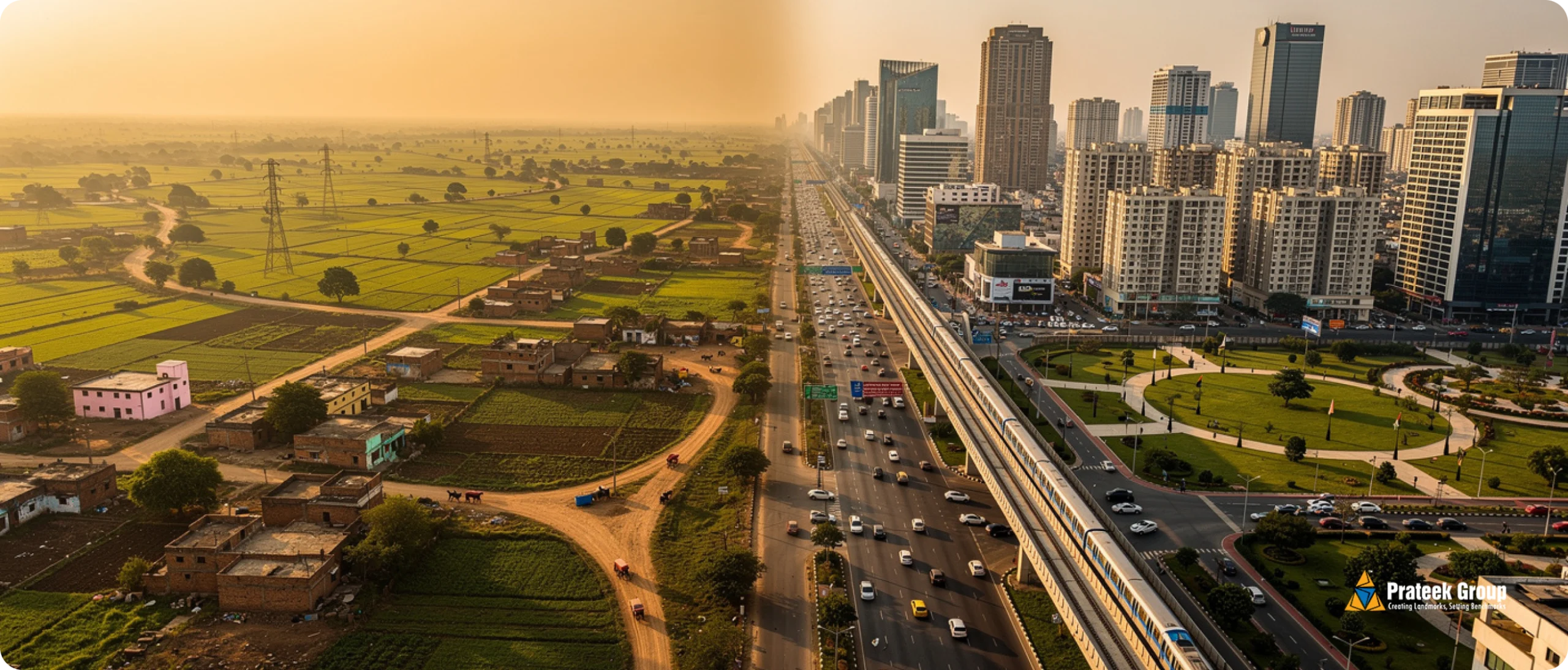
April 17, 1976
Today, Noida turns fifty.
On April 17, 1976, the Government of Uttar Pradesh notified 36 villages lying between the Yamuna and Hindon rivers as the New Okhla Industrial Development Area. The notification was issued under the UP Industrial Area Development Act, 1976. The land was mostly agricultural, occupied by Gujjar farming communities that had worked this floodplain for centuries. There were no paved roads, no sewage lines, no electricity grid.
The year was the middle of the Emergency. The decision to create a new industrial township on Delhi’s eastern periphery was part of a broader urbanisation push led by Sanjay Gandhi. Whatever your view of the Emergency, the bureaucratic machinery moved fast. Within months, the New Okhla Industrial Development Authority was constituted as a statutory body to acquire, plan, and develop the area.
That body still runs the city. Its current chairman is Deepak Kumar, IAS. Its budget for 2026-27 is Rs 10,004 crore. The city it administers covers over 20,000 hectares, has the highest per capita income in Uttar Pradesh, and contributes more than 10% of the state’s GSDP. The story of how 36 villages became all of that is worth telling. Especially today.
The Land Before the City
This land has old roots. Local tradition holds that Guru Dronacharya from the Mahabharata had his ashram here. Eklavya is said to have come from these parts. During British rule, the area saw the 1803 battle between General Gerard Lake’s forces and the Marathas; a memorial pillar still stands near the Noida-Greater Noida Expressway. During the freedom struggle, Ram Prasad Bismil stayed underground in the village of Rampur Jagir, and Bhagat Singh reportedly tested explosives in Nalgarh on what is now the Noida-Greater Noida highway.
By the 1970s, however, this was simply farmland under the district of Bulandshahr. In 1972, the UP government noticed speculative land dealings accelerating near the Delhi border and declared 50 villages as a regulated area. Four years of committee deliberations followed. Then the Emergency provided the administrative push, and on April 17, 1976, 36 of those villages became Noida.
The name was straightforward: “New Okhla” because the area lay opposite Okhla in Delhi, across the Yamuna. “Industrial Development” because the primary purpose was manufacturing. NOIDA was set up not as a municipal corporation run by elected representatives, but as a development authority run by IAS officers. That technocratic structure has shaped the city ever since.
1976 to 1990: Building the Foundation
The first fifteen years were about building an industrial township from bare land. The Authority acquired agricultural plots, laid out the sector grid that still defines Noida, built roads, and allotted industrial plots. Small and medium manufacturing units set up operations. Residential sectors were planned alongside the factories, with green belts, parks, and institutional areas integrated from the start. This co-location of industry, housing, and amenities was borrowed from the British New Town movement and adapted to Indian conditions.
By the late 1980s, Noida had a functioning industrial base and a growing residential population. But it was still an industrial suburb. Two things were missing: fast connectivity to Delhi, and a reason for white-collar professionals to move here.
1991 to 2001: Liberalisation Changes Everything
India’s 1991 economic liberalisation changed Noida’s trajectory. With industrial licensing relaxed and foreign investment opening up, the demand for IT parks, office space, and service-sector infrastructure swept through the NCR. Delhi was running out of room. Gurugram had Haryana’s backing and the DLF Cybercity model. Noida had something Gurugram did not: a pre-existing grid of wide, planned roads that could be repurposed for the new economy.
Through the 1990s, software companies, BPOs, media houses, and back-office operations joined the manufacturers. Film City in Sector 16A became the production base for several major news channels. The Noida SEZ was established. In 1991, Greater Noida was launched as a separate planned city to the south. In 1997, Gautam Buddha Nagar was carved out as its own district, giving Noida an administrative identity separate from Bulandshahr.
Then came the infrastructure that changed the game.
Two Moments That Made Noida a Real City
January 2001: The DND Flyway Opens
The Delhi-Noida Direct Flyway was an 8-lane, 7.5 km expressway built across the Yamuna by Japan’s Mitsui-Marubeni Corporation at a cost of Rs 408 crore. It was India’s first road with electronic toll collection. Before the DND, reaching South Delhi from Noida meant crawling through Kalindi Kunj or Ashram Chowk. The DND cut that to under 15 minutes.
The effect on property was immediate. Sectors near the DND approach (14, 15, 25, 44) saw demand jump. For the first time, South Delhi professionals could live in Noida without accepting a terrible commute. The toll started at Rs 8, rose to Rs 28, and was declared toll-free by the Allahabad High Court in 2016. Today, over 100,000 vehicles cross it daily.
November 2009: The Metro Arrives
The Delhi Metro Blue Line extension to Noida gave the city mass-transit connectivity. An Assocham study found 35% of Noida employees switched to Metro. Property within 500 metres of stations appreciated 25% to 30%. Sectors 50, 51, and 52 on the Blue Line corridor experienced a residential boom.
The Metro changed who lived in Noida. Before the Blue Line, residents mostly worked in Noida. After it, Noida became a base for people working anywhere on the Metro network. The city shifted from self-contained township to integrated NCR residential hub. The Aqua Line, connecting Noida to Greater Noida, opened in January 2019 and extended coverage into the expressway belt.
2010 to 2020: Boom, Correction, and the Developers Who Survived
The 2010s were defined by the Noida-Greater Noida Expressway. Development shifted south along this 24.5 km corridor. Sectors 93, 94, 107, 128, 137, 150 became the new residential frontier. The Yamuna Expressway (165 km to Agra) opened in 2012 and unlocked the Greater Noida-Jewar belt.
But the boom brought problems. Between 2012 and 2016, dozens of projects launched with timelines that were never met. Several builders defaulted. Thousands of buyers were left waiting for flats they had paid for. Names like Amrapali, Jaypee, and Unitech became synonymous with stalled projects. RERA was introduced in 2016 partly in response.
The correction was painful. By 2018-19, prices were flat, inventory was high, and buyer sentiment was cautious. The developers who survived were those with clean balance sheets and actual construction on the ground. Prateek Group’s story during this period is instructive. While others stalled, Prateek delivered. Prateek Stylome in Sector 45, Prateek Wisteria in Sector 77, Prateek Laurel in Sector 120, and Prateek Fedora in Sector 61 were all completed and occupied when completion itself was the exception. That track record is why the Prateek name carries weight in Noida’s broker community today.
2020 to 2026: The Airport Era
The last six years have been the most consequential since the DND opened.
The Noida International Airport at Jewar was inaugurated on March 28, 2026. It is designed as Asia’s largest airport by area, with an ultimate capacity of 225 million passengers annually. Its impact on property values was immediate. According to Square Yards, apartment prices along the Yamuna Expressway nearly tripled between 2020 and 2025. ANAROCK data shows Noida-wide averages rising from Rs 4,795 to Rs 9,200 per sq ft. Unsold inventory fell 72%.
But the airport was just the headline. The Namo Bharat RRTS became fully operational on the Delhi-Meerut corridor in February 2026, with a Ghaziabad-Jewar extension planned. The Chilla Elevated Road (5.9 km, Rs 892 crore) is under construction. The Yamuna Pushta Road upgrade to 8-10 lanes is in survey phase. The FNG Expressway (Faridabad-Noida-Ghaziabad) is 70% complete. The Sports City ban was lifted in April 2026, unlocking 32,000 flats. And the Noida Authority’s stalled projects revival policy has already registered over 4,100 flats.
In Sector 150, where Prateek Canary is located, prices have doubled since 2019 to around Rs 14,274 per sq ft. The sector allocates 80% of its land to green spaces and has become one of the most distinctive residential micro-markets in the NCR. A detailed look at Sector 150’s investment case explains the longer-term growth drivers.
Noida at Fifty: A Snapshot
| Parameter | Detail |
|---|---|
| Area | Over 20,000 hectares |
| Per Capita Income | Highest in Uttar Pradesh |
| GSDP Contribution | Over 10% of UP GSDP (Gautam Buddha Nagar) |
| Green Cover | Over 50%; 170+ parks including botanical and biodiversity parks |
| Delhi Connectivity | DND Flyway, Metro Blue & Aqua Lines, Chilla Elevated Road (under construction) |
| Airport | Noida International Airport, Jewar (inaugurated March 2026) |
| Authority Budget 2026–27 | Rs 10,004 crore |
| Avg. Residential Price (Q1 2025) | Rs 9,200 per sq ft (ANAROCK) |
The Noida Authority is among the richest civic bodies in India, funded by land allotments and lease premiums rather than property tax. The city’s economy has fully transitioned from manufacturing to services. HCL, Samsung, the Times Group, NDTV, and scores of multinationals operate from Noida. Film City remains one of India’s largest media production centres.
The Next Chapter
By 2030 to 2032, Noida will have what very few Indian cities possess: simultaneous metro, rapid rail, expressway, and air connectivity all within its boundaries. The Delhi Metro, the Namo Bharat RRTS (via the planned Ghaziabad-Jewar corridor), the Noida and Yamuna Expressways, the Pushta Road corridor, the FNG Expressway, and the Noida International Airport form a transport network that is genuinely competitive with any city in India.
Square Yards projects apartment values will rise another 22% and plot values 28% over the next two years. New launch prices may reach Rs 18,000 to Rs 22,000 per sq ft by 2027. The regulatory cleanup, from RERA enforcement to the Sports City resolution to the OTS scheme for 36 stalled projects, has restored buyer confidence that was missing for years.
For developers like Prateek Group, who maintained delivery through the difficult years, this is the market they built their reputation for. Buyers are rewarding track records, not promises. RERA registration, OC status, and delivery history are the first questions a serious buyer asks. Understanding how infrastructure reshapes property prices is where any informed buying decision should start. Prateek Group’s projects across Noida sit in the sectors and corridors that this infrastructure story is building around.
What Noida Day Means in 2026
Fifty years is not a long time for a city. Delhi is over a thousand years old. Even by Indian standards, Noida is young.
But look at what those fifty years contain. From 36 farming villages to a city with an international airport, a special economic zone, a media production campus that serves an entire country, one of the densest concentrations of educational institutions in India, and a real estate market that nearly doubled in five years.
The city’s founders in 1976 planned an industrial township. What they actually built was a platform. The sector grid, the green-belt reservations, the institutional zones, the Authority’s land-based revenue model: all of these turned out to be flexible enough to accommodate uses the original planners never imagined. IT parks where factories were supposed to be. Ultra-luxury towers where worker housing was designed. A global airport where farmland sat.
That adaptability is the real story. Any government with enough money can build infrastructure. Planning a city that can reinvent itself decade after decade, without losing its basic structure, is rarer.
On its 50th Noida Day, the city is preparing for its next reinvention. The airport, the rapid rail, the expressway upgrades, the regulatory cleanup: these are the foundations of a Noida that will look as different from the 2020s as the 2020s look from the 1990s.
The families, workers, entrepreneurs, developers, and public servants who built this city over five decades deserve the day. Here is to the next fifty.