

Taking possession of a home is not just about getting the keys. Buyers should first make sure that the required property documents are clear, complete, and aligned with the approved project details. These papers help confirm whether the flat, building, and common facilities are ready from a legal and compliance point of view.
Verbal updates, brochure promises, and expected possession dates can help buyers understand the project timeline, but they should not be treated as final proof. Real confidence comes from checking documents such as the occupancy certificate, completion certificate, possession letter, registry papers, payment receipts, and other handover-related records.
Proper documentation also protects buyers from future confusion around ownership, possession rights, maintenance handover, parking allocation, and project approvals. Before accepting possession, every buyer should review the paperwork carefully so the move into a new home begins with clarity, not uncertainty.
What Is an Occupancy Certificate and Why Should Buyers Check It?
Point | Explanation |
OC Confirms Legal Occupancy | An Occupancy Certificate confirms that the building is approved for living by the local authority. Buyers should check it before moving in because possession alone does not always prove legal occupancy. |
Safety Standards Are Reviewed | OC approval usually means the building has passed important checks related to structure, fire safety, lifts, drainage, electricity, water supply, and other basic safety requirements for residents. |
It Protects Buyers After Possession | Without an OC, buyers may face issues with utilities, resale, home loans, insurance, or future approvals. Checking it early helps avoid legal and practical problems after shifting. |
OC Is Different from Possession Letter | A possession letter comes from the builder, while an OC comes from the authority. Buyers should understand this difference because both documents do not carry the same legal value. |
Tower or Phase Details Matter | In large projects, OC may be issued tower-wise or phase-wise. Buyers should confirm whether the certificate applies to their specific tower, block, floor, or phase before taking possession. |
It Shows Compliance with Approved Plans | The OC helps confirm that the completed building matches approved layouts, height permissions, land use, and construction rules. This reduces the risk of unauthorized changes. |
Important for Resale and Loans | Future buyers, banks, and financial institutions may ask for OC details during resale or loan processing. Having this document makes ownership transfer and financing smoother. |
Buyers Should Verify Before Moving In | Before accepting keys, buyers should request OC details, cross-check the certificate date, authority name, tower coverage, and keep a copy with other property documents. |
Understanding the Completion Certificate: What Every Homebuyer Should Know
Completion Certificate Confirms Project Completion
A Completion Certificate confirms that the building or project section has been completed as per the approved construction plan submitted to the local authority. It shows that the developer has finished the core construction work and that the completed structure has been reviewed against sanctioned drawings and building rules.
It Verifies Approved Plans and Layouts
The CC helps buyers understand whether the completed building matches the approved layout, tower plan, height, setback area, floor structure, and other construction permissions. This matters because any major deviation from approved plans can create legal or documentation issues during possession, resale, or loan processing.
Construction Compliance Becomes Clearer
A Completion Certificate also reflects that the project has followed important construction norms related to land use, structural development, approved FAR, safety-related planning, and authority guidelines. For buyers, this document gives better clarity that the property is not just built, but built within the required compliance framework.
CC Is Different from an Occupancy Certificate
Many buyers confuse a Completion Certificate with an Occupancy Certificate, but both serve different purposes. A CC confirms that construction is complete as per approved plans, while an OC confirms that the building is fit for legal occupancy after safety, utilities, and civic checks are completed by the authority.
Tower or Phase Coverage Should Be Checked
In large housing societies, a Completion Certificate may be issued for a specific tower, block, phase, or project section instead of the full development at once. Buyers should always check whether their own flat, tower, or phase is covered under the certificate before accepting possession or completing final paperwork.
It Supports Future Property Verification
A valid Completion Certificate can help reduce confusion during registry, home loan approval, resale, ownership transfer, and future legal checks. Buyers should collect a copy and keep it safely with the possession letter, payment receipts, registry papers, allotment documents, and other important property records.
Registry Documents Every Buyer Should Review Carefully

Registry is the legal step that records the buyer as the property owner in government records. Before completing it, buyers should review the sale deed, payment details, title transfer terms, stamp duty, registration charges, and unit details carefully. A small mismatch in names, flat number, carpet area, parking details, or payment records can create avoidable problems later.
Buyers should also remember that possession and registry are not the same. Possession gives access to the flat, while registry creates legal ownership proof. That is why every buyer should verify the documents, charges, and registration process before signing the final papers.
Registry Document Checklist
- Check buyer and seller names exactly as per ID proof.
- Verify flat number, tower, floor, area, and parking details.
- Review the final sale deed before signing.
- Confirm stamp duty and registration charges.
- Check payment receipts and pending dues.
- Verify title transfer details clearly.
- Keep copies of allotment letter and builder-buyer agreement.
- Collect the registered sale deed after completion.
Possession Letter vs Actual Legal Possession
Many buyers assume that receiving a possession letter means every legal formality is fully complete, but that is not always the case. A possession letter mainly confirms that the builder is offering handover of the flat, while actual legal possession depends on supporting documents such as the Occupancy Certificate, registry papers, payment clearance, and other approved property records.
Aspect | Possession Letter | Actual Legal Possession |
Meaning | Confirms that the builder is offering possession of the unit to the buyer. | Confirms that the buyer has legally completed ownership and occupancy-related formalities. |
Issued By | Provided directly by the builder or developer. | Supported through authority approvals and legal ownership documents. |
What It Confirms | Indicates handover readiness and possession timeline. | Confirms legal occupancy, ownership transfer, and documentation completion. |
What It Does Not Confirm | It does not automatically confirm legal occupancy approval or completed registry. | Legal possession depends on verified approvals and completed registration processes. |
Documents Buyers Should Check | Buyers should still verify OC, CC, registry papers, dues, and payment receipts. | Buyers should maintain all verified legal and possession-related documents safely. |
Why It Matters | Depending only on the possession letter may create confusion later. | Proper legal possession helps avoid future ownership, resale, or compliance disputes. |
How Reliable Builders Make the Documentation Process Easier
Property documentation becomes much easier when buyers choose developers who maintain approval records, explain possession steps clearly, and guide customers through OC, CC, registry, payment receipts, maintenance handover, and final possession paperwork. In active NCR markets like Noida and Ghaziabad, buyers often compare reputed names such as Prateek Group, ATS, Gaurs, Mahagun, Godrej Properties, Eldeco, and County Group before finalising a home.
A reliable builder does not leave buyers dependent only on verbal updates. They provide clearer timelines, document support, customer relationship teams, and project-specific guidance so buyers understand what has been approved, what is pending, and which papers must be collected before taking possession. This becomes especially important in large societies where approvals may be issued tower-wise, phase-wise, or project-wise.
Prateek Group holds a stronger practical fit in this discussion because its key residential presence is already aligned with buyer demand in Noida and Ghaziabad, including Prateek Canary in Sector 150 Noida and Prateek Grand City/Grand Begonia in Siddharth Vihar, Ghaziabad. These are the same markets where buyers often pay closer attention to possession documents, registry timelines, connectivity, and long-term family living comfort.
Questions Buyers Should Ask Builders Before Final Payment
Before making the final payment, buyers should ask the builder for complete clarity on possession, approvals, registry, maintenance, and pending charges. This step helps buyers avoid last-minute surprises and ensures that the handover is supported by proper documentation, not just verbal assurance.
Key Questions to Ask the Builder
Question Buyers Should Ask | Why It Matters |
Has the Occupancy Certificate been received for my tower or phase? | OC confirms whether the building or specific phase has been approved for legal occupancy by the concerned authority. |
Is the Completion Certificate available for the project section? | CC helps confirm that construction has been completed according to approved plans and required building norms. |
What is the exact registry timeline after final payment? | Buyers should know when the sale deed will be executed and when legal ownership will be recorded. |
Are there any pending dues before possession? | This helps avoid confusion around maintenance charges, club charges, parking payments, GST, IFMS, or other final demands. |
When will maintenance handover begin? | Buyers should understand who will manage security, housekeeping, lifts, common areas, repairs, and society services after possession. |
Is the possession date confirmed in writing? | Written confirmation gives buyers better clarity than verbal updates and helps them plan shifting, interiors, loans, and paperwork. |
Has parking allotment been clearly mentioned? | Parking details should be checked before final payment so there is no later dispute over slot number, basement level, or allocation terms. |
When will the residents’ welfare association or society formation happen? | Society formation matters because it affects future maintenance control, common area decisions, service quality, and resident rights. |
Final Checklist Before Accepting Possession
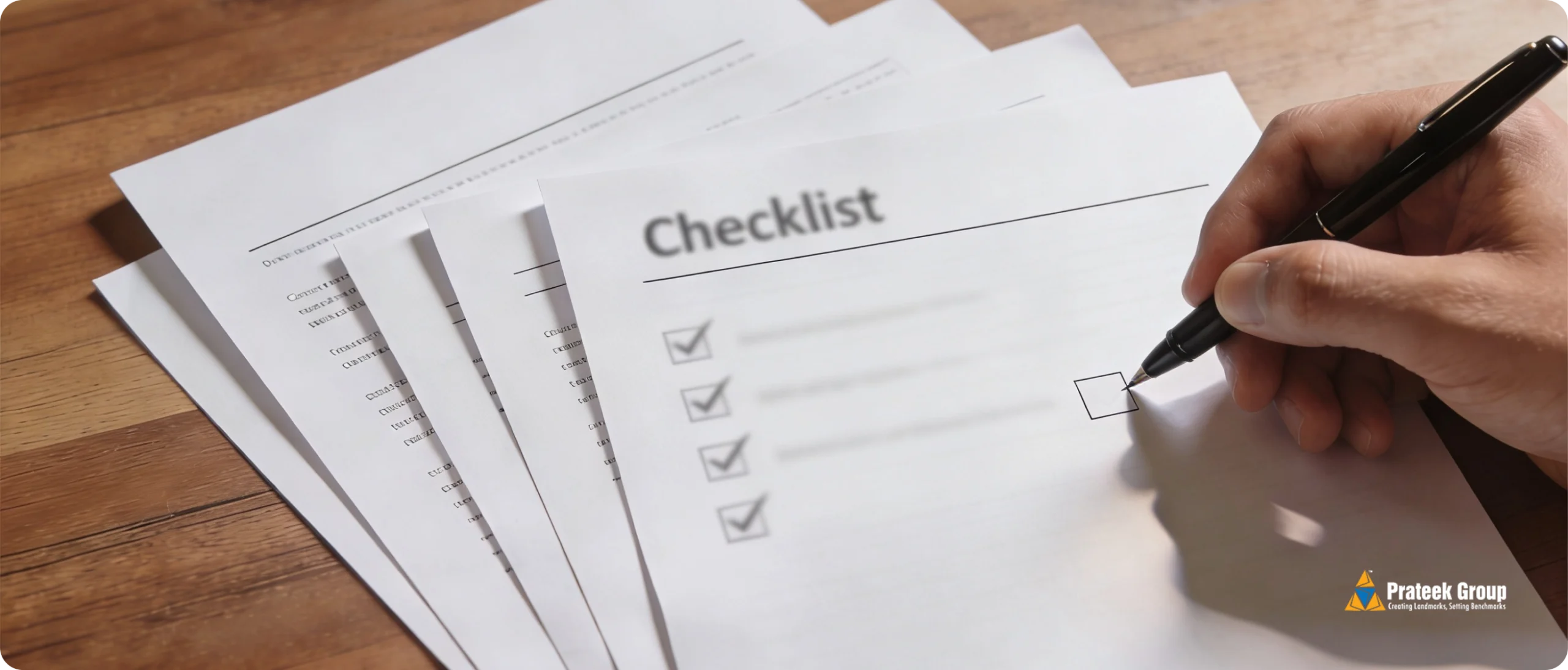
Before taking the keys, buyers should complete one final review of legal documents, payments, approvals, and physical handover condition. This simple checklist can help reduce confusion after shifting.
Legal Approval Check
Confirm the Occupancy Certificate and Completion Certificate for your tower, block, or phase.
Ownership Document Check
Review registry papers, sale deed details, buyer name, flat number, area, and title transfer terms.
Possession Paper Check
Check the possession letter for handover date, unit details, builder terms, and possession conditions.
Payment Clearance Check
Match all payment receipts, final dues, taxes, maintenance deposits, and additional charges.
Maintenance Handover Check
Understand maintenance charges, service start date, IFMS, security, housekeeping, and common area responsibilities.
Parking Allotment Check
Verify parking slot number, parking type, basement level, and written allotment confirmation.
Flat Condition Check
Inspect flooring, walls, doors, windows, plumbing, electrical points, seepage, fittings, and balcony condition.
Common Facility Check
Review lift function, lobby condition, lighting, fire systems, security setup, clubhouse access, and basic society facilities.