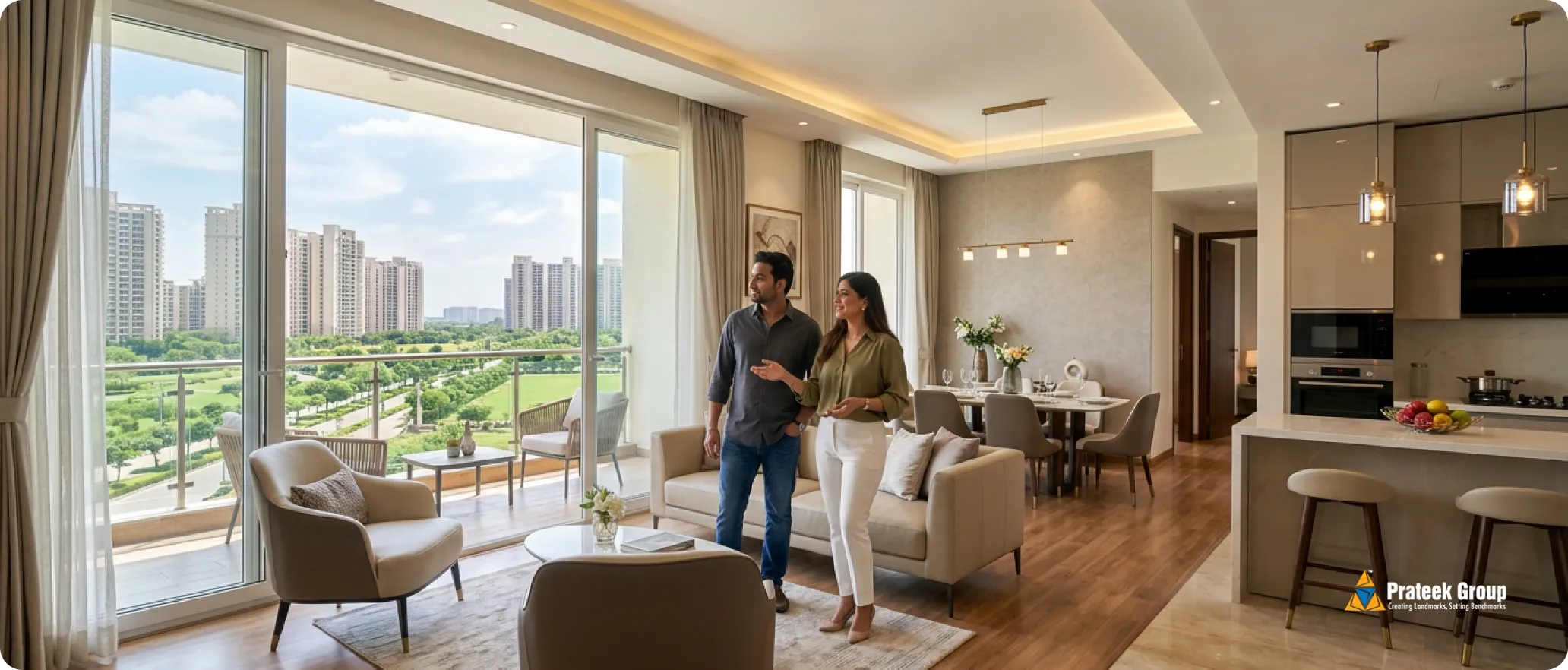
A ₹3 crore budget in Sector 150 does not buy one fixed product. It buys a different home depending on the project, the floor, the facing, the carpet area, the possession stage, and the final cost sheet. This guide breaks that down.
The ₹3 Crore Question Every Sector 150 Buyer Is Asking
₹3 crore is the point where a home stops being a purchase and starts being a decision. For most families it is the largest single commitment they will make. For investors it is capital that could sit somewhere else for a decade.
So the question people actually ask is rarely whether Sector 150 is a good sector. They have usually decided that already. The question is narrower and more uncomfortable. At this budget, what am I really getting, and how do I know I am not overpaying for the same thing dressed up differently?
Sector 150 draws premium buyers for reasons that are easy to list and harder to price. It was planned as a residential and sports-led sector rather than assembled around an older commercial core. A large share of the land is held as open and green area. The projects that came up here arrived at roughly the same time and at roughly the same positioning, which is unusual.
That combination produces a real premium. It also produces hesitation, because a buyer looking at two brochures at similar prices often cannot tell what separates them.
Here is the honest position. At ₹3 crore in this sector, you are not choosing between good and bad. You are choosing between different bundles of space, floor, view, density, possession timing and cost structure. Two homes at the same headline price can differ by several hundred square feet of usable area, by ten floors, by a park view against a road view, and by lakhs in charges that never appear in the advertised figure.
This guide walks through each of those variables in the order a buyer actually meets them. We develop in this corridor, so we have written down what we would check ourselves. A little context on who we are if that helps you weigh the advice.
Nothing here quotes a fixed price for a fixed unit, because inventory, floor and project change that number constantly. What it gives you instead is a method.
First, What Does ₹3 Crore Mean In Sector 150 Today?
Start with the part most buyers get wrong. There is no single rate for Sector 150.
Published rate trackers disagree with each other, sometimes by a wide margin, because each one averages a different mix of projects, unit sizes and transaction types. Before you anchor on any figure, look at more than one source and check the date. Two that publish sector-level trends are 99acres and HexaHome. Treat both as indicative context rather than as a quotation.
Quoted rates vary within the sector for reasons that are entirely legitimate. A launch-stage unit and a ready unit are different products. A tower facing open green area is priced differently from one facing an internal road. A resale flat with a completed registry carries a different risk profile from an under-construction allotment.
The more useful distinction is between base price and all-inclusive cost. The base price is what gets advertised. The all-inclusive cost is what leaves your account. Between them sit parking, club charges, maintenance deposits, preferential location charges, floor-rise charges, power backup, applicable taxes, stamp duty and registration. Section 10 works through these in full.
The table below translates the questions buyers ask into what they actually mean in this sector.
Buyer question | What it means in Sector 150 |
|---|---|
Is ₹3 crore enough? | Often yes for a premium 3 BHK, depending on project, floor and current availability. It may fall short of a large 4 BHK or a duplex penthouse in the same project. |
Why do two projects quote different rates? | Land cost, density, specification, amenity scale, possession stage and brand positioning all differ. A lower rate sometimes signals a denser layout rather than a better deal. |
Should I compare rate per square foot? | Only alongside carpet area. Two homes at the same rate can differ meaningfully in usable space once the loading is accounted for. |
Is a ready flat better value than under construction? | Neither is automatically better. Ready removes timeline risk and usually costs more. Under construction may cost less and carries schedule and approval risk. |
Does resale cost less? | Sometimes, though brokerage, transfer charges, pending dues and refurbishment can close the gap. Compare on landed cost, not asking price. |
What changes the price most within one project? | Floor, facing, tower position and view. These can separate two identical layouts by a noticeable margin. |
Read that table as a warning against single-number thinking. Buyers who compare only ticket size tend to discover the difference after booking, when the cost sheet arrives.
What Type Of Home Can You Expect Around This Budget?
At this budget, four broad outcomes come up repeatedly. Which one you land in depends less on negotiation than on what you decide to prioritise. All of them remain subject to current availability and pricing.
Scenario one: a premium 3 BHK in a stronger project
This suits buyers who want brand, specification and amenity depth over raw area. It often buys a well-planned three-bedroom home in a low-density layout with a credible developer behind it. Check the carpet area against the agreement, the units-per-acre figure, and what the maintenance rate has been in the developer’s completed projects. The trade-off is size. You may get less floor area than a cheaper project offers at the same price.
Scenario two: a larger resale 3 BHK
This suits buyers who value space and a settled building over newness. It can buy noticeably more area, often in a project that is already occupied, so you can see the common areas and speak to residents. Check the registry status, any pending dues, the age of services such as lifts and pumps, and the cost of refurbishment. The trade-off is that you may inherit an older specification and a near-term interior spend.
Scenario three: a better-facing or higher-floor unit
This suits buyers for whom the view and light matter more than the extra bedroom. Within the same project, the budget can move you to a higher floor, a green-facing side, or a corner unit with two open sides. Check exactly what the preferential location charge and floor-rise charge add, and confirm the view is protected rather than dependent on an adjacent plot staying empty. The trade-off is paying for position rather than area.
Scenario four: a stretched upgrade toward a larger configuration
This suits buyers who can extend slightly and want a 4 BHK or a larger format. It can bring a genuinely different home into reach. Check whether the stretch is coming from your interior budget, because a larger home costs more to furnish, cool and maintain. The trade-off is liquidity. Buyers who spend their reserve on the purchase often live in an unfinished home for a year.
One pattern worth naming. Buyers who begin with a fixed area target and treat everything else as negotiable usually end up disappointed with the building. Buyers who begin with a fixed standard of daily life, and let area flex, usually stay happier for longer.
Space, Layout And Livability: Where The Money Actually Goes
Two homes can carry the same super built-up figure and feel completely different to live in. The difference sits in the layout, and layout is where a large part of your money quietly goes.
Start with carpet area against super built-up area. Super built-up includes a share of common space, and the loading varies between projects. Carpet area is the space inside your walls, and it is the only number worth comparing across projects. Ask for it in writing and check it against the agreement rather than the marketing sheet.
Then look at how the space is arranged. A living and dining area that has to accommodate a walkway between the entrance and the bedrooms loses much of its usable value. Bedrooms should take a bed, a wardrobe and a circulation path without the door fouling the furniture. Measure the smallest bedroom, since that is where poor planning shows first.
Balconies deserve particular attention. A balcony deep enough to seat two people is an extra room. A balcony deep enough only to dry clothes is a decorative ledge that you paid for. Kitchens should allow a working triangle and a utility area with room for a washing machine, a sink and drying, ideally out of sight of the living room.
Storage is the most common omission in premium homes. Look for space for luggage, seasonal items and appliances. Light and ventilation matter more than fittings, so check whether rooms get cross ventilation and where the sun falls at midday. Privacy is worth checking from the balcony, because a low set-back between towers means looking into someone else’s living room.
Finally, look at the building rather than the flat. Lift-to-unit ratio determines your morning wait for the next twenty years. Parking allocation, visitor movement and where service vehicles enter shape the daily experience far more than the clubhouse does.
Before you judge the price, check the following.
✓ Is the carpet area clear. Confirm it in writing and compare it against every other project on your shortlist, not just the one in front of you.
✓ Is the living room usable. Look for a seating arrangement that works without blocking the path from the entrance to the bedrooms.
✓ Are balconies functional. Measure the depth. Anything too shallow to place a chair on is not usable space.
✓ Is the kitchen practical. Check the working triangle, the utility area, and whether the washing machine has a proper place.
✓ Are bedrooms truly usable. Measure the smallest one with a bed, a wardrobe and a walking path in mind.
✓ Is there enough storage. Count where luggage, seasonal clothing and spare appliances will actually live.
✓ Does the layout work for daily life. Walk through a normal morning in your head, from waking to leaving the building.
View, Floor And Facing: The Premium Buyers Often Forget
Within a single project, floor and facing can separate two identical layouts by a meaningful amount. Buyers pay this premium often without examining it. The panel below sets the common assumptions against what buyers report after moving in.
What buyers often assume | What buyers usually find |
|---|---|
Green and park-facing views | |
A protected green view is one of the few premiums that holds its value, because it cannot be added later | Confirm the green area is inside the project or on permanently reserved land. A view across a vacant plot is temporary |
Higher floors | |
Higher floors usually mean better light, better air movement and less street noise | Higher floors also mean longer lift waits, greater wind exposure on balconies, and a harder evacuation route. Floor-rise charges accumulate quickly |
Corner units | |
Two open sides give better cross ventilation and more natural light | Corner units carry more external wall area, which can mean more heat gain in summer and higher cooling costs |
Sunlight and heat | |
South and west light feels bright and premium in a morning site visit | Those faces take the heaviest afternoon sun. Visit at midday in summer before deciding, and ask about glazing specification |
Noise exposure | |
Distance from the road solves noise | Internal noise from the clubhouse, the play area, generators and the service road can matter more than the main road. Ask where these sit |
Balcony direction | |
Any balcony adds value | A balcony facing the afternoon sun or an adjacent tower goes unused. Direction and privacy decide whether it becomes a room |
PLC and floor-rise charges | |
These are small add-ons | Together they can add a significant amount to the cost sheet. Ask for them as absolute figures rather than percentages |
None of this argues against paying for a view. It argues for knowing precisely what you are paying, and for checking whether the thing you are buying is permanent.
Amenities At ₹3 Crore: Useful Luxury Or Brochure Luxury?
Amenity lists are written to impress at the point of sale. The better question is which of them you will still be using in year three, and what each one costs you every month through maintenance.
Amenity type | Buyer value | What to check |
|---|---|---|
Clubhouse | High when sized correctly for the number of homes it serves | Total area against unit count. A large clubhouse in a dense project can still feel crowded |
Swimming pool | Moderate to high, and heavily dependent on upkeep | Filtration, changing facilities, and whether the pool is heated or usable through winter |
Gym | High for daily users, and among the cheapest amenities to run | Equipment quality, floor area per resident, and ventilation |
Kids play area | High for families, and often the most used space in the project | Whether it is shaded, visible from homes, and separated from vehicle movement |
Walking and cycling tracks | High, since these get used daily and cost little to maintain | Track length, surface, and whether it is continuous or broken by parking |
Sports spaces | Moderate, and valuable when the sector supports the activity | Number of courts against resident count, and the booking system |
Party deck or banquet | Moderate, used a few times a year | Booking rules, charges, and noise transfer to nearby towers |
Wellness areas | Low to moderate, frequently underused | Whether operation is outsourced, and whether use carries an extra fee |
Security | High, and non-negotiable | Perimeter design, visitor protocol, camera coverage, and staffing at night |
Maintenance quality | The highest value of all, and the least discussed | Current rate per square foot, what it covers, and how it has moved in the developer’s delivered projects |
Judge an amenity list by daily usefulness rather than by length. A project with fewer, well-run facilities usually delivers a better experience than one with a long list that is expensive to maintain and thinly used.
Location Value: Why Sector 150 Commands A Premium
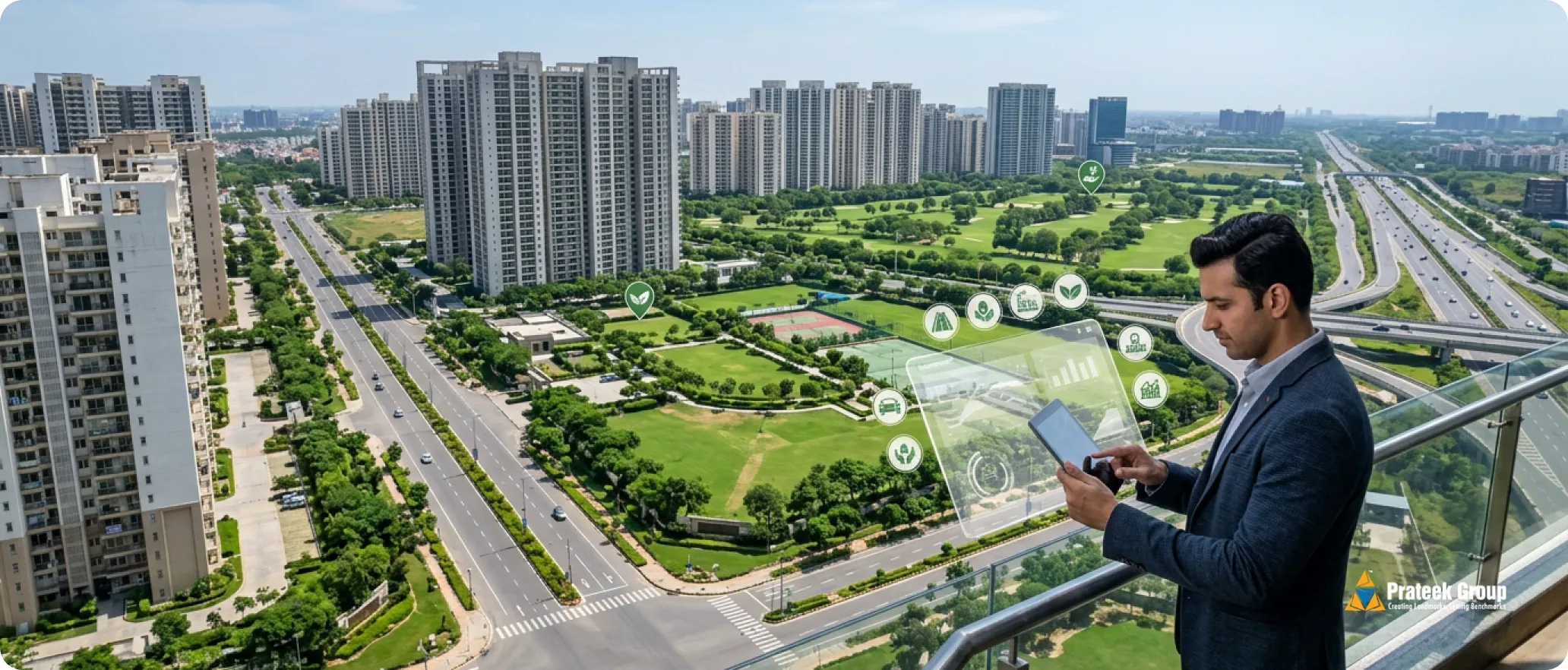
Picture the sector towards the far end of the Noida-Greater Noida Expressway, closer to the Greater Noida side than to old Noida.
From there the expressway runs north-west toward the older Noida sectors, Film City and the Delhi crossings. In the other direction it feeds into Greater Noida and meets the Yamuna Expressway, which continues south past Jewar. That position on the corridor, rather than behind it, is a large part of what buyers are paying for.
Metro access works through the Aqua Line rather than a station inside the sector. Sector 148 is the reference point residents use, which means a short road leg before boarding. If you intend to commute by metro daily, treat that first leg as part of the journey and time it yourself.
The airport corridor matters here as a long-term factor. Noida International Airport is operational, and details on phasing are published on the airport’s official website. It improves the practical case for living on this corridor, particularly for frequent travellers. It should not be read as a promise of price movement in any direction, and any seller framing it that way is overreaching.
The sector’s own character does much of the work. Planned residential land use, wider roads and a high share of open area produce a calmer environment than sectors that grew outward in stages. That is difficult for a competing sector to replicate later, which is why this part of the premium tends to hold.
The honest trade-off is distance. Central Noida and Delhi are further away than they are from older sectors. Buyers who travel into Delhi several times a week feel that difference, and no amount of corridor access removes it.
Run the daily convenience test before you commit Drive your actual commute on a weekday morning and again in the evening. Then check the things you will use weekly: the nearest grocery, a pharmacy, a school run if relevant, and the closest hospital. A sector that works on a Sunday visit can feel different on a Tuesday. |
If you are weighing several sectors along the same corridor, our note on connectivity across the Noida Expressway compares them on daily travel rather than on rate alone.
Where Prateek Canary Fits In This Budget Conversation
For buyers evaluating what a premium Sector 150 home should offer, Prateek Canary gives a useful reference point, because it brings together larger-format residences, low-density planning, green views and a Sector 150 address in one project.
We are using our own project here for a specific reason. We can state its numbers precisely and you can verify every one of them. Use them as a yardstick against any project you are considering, including ours.
Location | Sector 150, Noida |
Land area | 12.55 acres |
Total units | 664 residences |
Configurations | Spacious 3 and 4 BHK residences, plus duplex penthouses |
Positioning | Low-density residential development |
Outlook | Panoramic green views |
Connectivity | Access to the Noida-Greater Noida Expressway, with relevance to the Yamuna Expressway and the wider airport corridor |
RERA number | UPRERAPRJ591510 |
Whether a ₹3 crore budget reaches a particular configuration here depends on the unit, the floor and current availability, so treat any figure you are quoted as subject to change and ask for it in writing.
The more useful exercise is comparison. Take the list below to every project on your shortlist and fill it in.
What to compare | Why it matters |
|---|---|
Units divided by acres | Gives you a density figure. This single number predicts daily crowding better than any amenity list. |
Carpet area for the same configuration | Reveals how much usable space differs behind similar headline sizes. |
Open and green area within the boundary | Distinguishes a permanent outlook from a temporary one across a vacant plot. |
Configuration range in the project | A mix that includes larger formats and penthouses signals a different resident profile from an all-compact project. |
RERA registration and declared timeline | Lets you verify approvals and promised dates against the regulator rather than a brochure. |
Developer’s completed projects | Shows how buildings by the same team look and function several years after handover. |
Configuration and layout detail sits on the Prateek Canary project page, and the registration can be checked directly with UP RERA. Buyers comparing premium formats elsewhere in Noida may also find Prateek Fedora a useful second reference.
₹3 Crore For End-Use Vs Investment: The Answer Changes
The same budget answers to different priorities depending on who is spending it. Find your own profile below before you weigh anyone else’s advice.
End-user Daily comfort should outrank everything. Layout, light, ventilation, density, lift ratio and maintenance quality decide whether you enjoy the home. Resale value follows good living conditions more often than it leads them. Investor Entry price, holding period, resale demand and rental demand carry the weight. Calculate yield on your own all-in cost rather than on the headline price, and be honest about how long you can hold. No return here is guaranteed. NRI buyer Documentation, registry status, power of attorney, maintenance arrangements and long-term family use matter most. Also plan who inspects the home and manages it while you are away, because that gap causes more problems than the purchase itself. | Upgrade buyer You are usually funding this partly from an existing home. Sequence the sale and purchase carefully, and keep an interior reserve. Compare the new layout against your current one room by room rather than on total area. Retired or semi-retired buyer Prioritise a lower floor or reliable lift redundancy, proximity to healthcare, walkability, and predictable maintenance charges. Avoid stretching into a home whose running costs rise faster than a fixed income. Family with children Weigh school access, safe internal circulation, play areas visible from the home, and separation between vehicle routes and pedestrian paths. Check noise from the clubhouse if bedrooms face it. |
Buyers weighing a longer horizon, including those purchasing from abroad, may find our detailed Sector 150 investment guide useful on cost structure and holding assumptions.
Hidden Costs Buyers Should Add Before Saying Yes

A ₹3 crore quoted price and a ₹3 crore final ownership cost are not always the same. Build the real number before you decide, using the four groups below.
Government and legal costs
- Stamp duty, calculated on the applicable rate for the transaction value or circle rate, whichever governs.
- Registration charges payable at the time of registry.
- Legal verification of title, approvals and encumbrance, which is worth paying for independently.
- Documentation and incidental charges, including notarisation and power of attorney where relevant.
Current stamp duty and registration rates can be checked through the Uttar Pradesh registration department rather than taken from a listing page.
Builder and project charges
- Car parking, charged per slot and sometimes mandatory in premium projects.
- Club membership or one-time club charges.
- Interest free maintenance security, commonly known as IFMS.
- Advance maintenance deposit, often collected for a fixed initial period.
- Power backup installation charge, usually priced per kilovolt-ampere of allocated load.
- Preferential location charges for a favourable facing, corner or view.
- Floor-rise charges, which accumulate as you go higher.
- Goods and services tax where applicable to the transaction type.
Resale-specific costs
- Brokerage, typically payable by the buyer on resale transactions.
- Transfer charges levied by the developer or the society.
- Pending dues on maintenance, electricity or club charges, which should be cleared before transfer.
- Repair and replacement of ageing services inside the flat.
- Interior upgrades to bring an older specification up to current standards.
Move-in and setting-up costs
- Modular kitchen, which in a premium home is rarely a small line item.
- Wardrobes and built-in storage across bedrooms.
- Lighting, including fixtures and any false ceiling work.
- Curtains, blinds and soft furnishing across a larger apartment.
- Appliances and air conditioning for every room that needs it.
- Furniture appropriate to the room sizes you have just bought.
- Packing, moving and initial society charges on possession.
Build one number, then compare Put every line above into a single sheet for each shortlisted home, including resale options. Compare projects on that landed figure rather than on the advertised price. Buyers who do this often reorder their shortlist entirely. |
Buyer Verification Checklist Before Booking In Sector 150
Work through these five groups in order. Each takes little time and each has changed a buyer’s decision at some point.
1 | Project checks Verify the RERA number on the regulator’s portal rather than a listing. Confirm the promoter name matches the agreement, review the declared completion timeline, check the approved layout against what you were shown, ask about occupancy certificate status where relevant, and establish the registry position. |
2 | Unit checks Confirm carpet area in writing. Fix the floor, facing, view and tower position on paper, not verbally. Ask for preferential location and floor-rise charges as absolute figures. Confirm parking allocation and location, and check which lift core serves your unit and how many homes share it. |
3 | Financial checks Ask for an all-inclusive cost sheet with every charge listed. Confirm loan eligibility and the sanctioned amount before committing. Check the payment schedule against construction milestones, and set aside a realistic interior budget rather than a hopeful one. |
4 | Livability checks Visit the location at different times, including a weekday evening. Drive the commute you will actually make. Check school, healthcare and grocery access. Ask current residents about maintenance quality, and look at what is under construction nearby and for how long it will continue. |
5 | Builder and society checks Review the developer’s delivery record on completed projects. Read maintenance reviews from residents. Assess the facility management arrangement, security staffing and protocol, and walk the common areas of an older project by the same team to see how they have aged. |
Sector layout and land use information is published by the Noida Authority, and the earlier development history of the sector is covered in our Sector 150 background piece.
Final Verdict: What ₹3 Crore Really Buys You In Sector 150 Noida
At this budget in this sector, you are buying considerably more than area.
You are buying a location on a planned corridor, a sector laid out with open space and lower density built into it, a view that in the right tower is permanent, an amenity set that should be judged on daily use, and a building whose management will shape your experience for decades. Those are real things, and they are difficult for a cheaper sector to reproduce later.
You are also buying a set of obligations that the advertised price does not show. The final cost, the layout efficiency, the floor and facing premium, the possession and registry position, and the maintenance charge all sit behind that number. A buyer who checks those five items is rarely the one who regrets the purchase.
Sector 150 suits people who value comfort, planning, greenery and long-term livability, and who intend to stay long enough for those things to pay them back. It suits patient investors who buy at a sensible entry point and treat rental income as secondary. It suits price-led buyers and short-horizon buyers considerably less well, and that is a question of fit rather than quality.
If your priorities match the first two groups, the honest answer is that ₹3 crore can buy a genuinely good home here. What it buys specifically depends on the choices covered above, and every one of them is worth checking before you sign.
Frequently Asked Questions
1. Is ₹3 crore enough to buy a home in Sector 150 Noida?
It can be, depending on the project, configuration, floor and current availability. The budget often reaches a premium 3 BHK in the sector, though a large 4 BHK or a duplex penthouse in the same project may sit above it. Buyers should ask for an all-inclusive cost sheet before treating any figure as final.
2. Can ₹3 crore buy a 3 BHK in Sector 150?
In many projects it can, subject to current availability and pricing. What varies is the carpet area, the floor, the facing and the possession stage. Two 3 BHK homes at the same price can differ noticeably in usable space, so compare carpet area rather than headline size.
3. What should buyers check before buying in Sector 150?
Verify the RERA registration with the regulator, confirm carpet area in writing, calculate the all-inclusive cost including every charge, fix floor and facing on paper, test the commute at real hours, and ask about the maintenance rate and how it has moved in the developer’s delivered projects.
4. Is Sector 150 better for end-use or investment?
It suits end-users most clearly, particularly those who value low density, open surroundings and long-term livability. Investors can still make a considered case, though it depends on entry price, a long holding period and realistic rental expectations rather than on the sector alone.
5. Why is Sector 150 considered premium?
The premium comes from planning rather than any single feature. The sector was laid out with residential and sports-led land use, a high share of open and green area, and expressway access, and the projects built here cluster at a similar positioning. Those conditions are difficult to replicate elsewhere later.
6. Does Noida International Airport improve Sector 150’s value?
The airport is operational and adds a long-term corridor advantage, particularly for frequent travellers. It should be treated as a convenience and positioning factor rather than a guarantee of price growth, and buyers should be cautious of anyone presenting it as assured appreciation.
7. Where does Prateek Canary fit in Sector 150?
Prateek Canary is a low-density project in Sector 150 offering spacious 3 and 4 BHK residences and duplex penthouses across 664 units on 12.55 acres, with panoramic green views, registered under RERA number UPRERAPRJ591510. Buyers can use it as one reference point while comparing premium homes in the sector.
8. Should buyers compare base price or all-inclusive cost?
Always the all-inclusive cost. Parking, club charges, maintenance deposits, preferential location and floor-rise charges, power backup, applicable taxes, stamp duty and registration all sit outside the advertised figure. Comparing base prices across projects can be misleading.
9. Is a higher floor always better in Sector 150?
Not automatically. Higher floors often bring better light, air movement and less street noise, though they also carry floor-rise charges, longer lift waits and greater wind exposure on balconies. The right floor depends on your household, not on a general rule.
10. What hidden costs should buyers calculate?
Stamp duty and registration, legal verification, parking, club charges, IFMS and maintenance deposits, power backup, preferential location and floor-rise charges, applicable taxes, and on resale also brokerage, transfer charges and pending dues. Add interiors, appliances and moving costs before deciding.