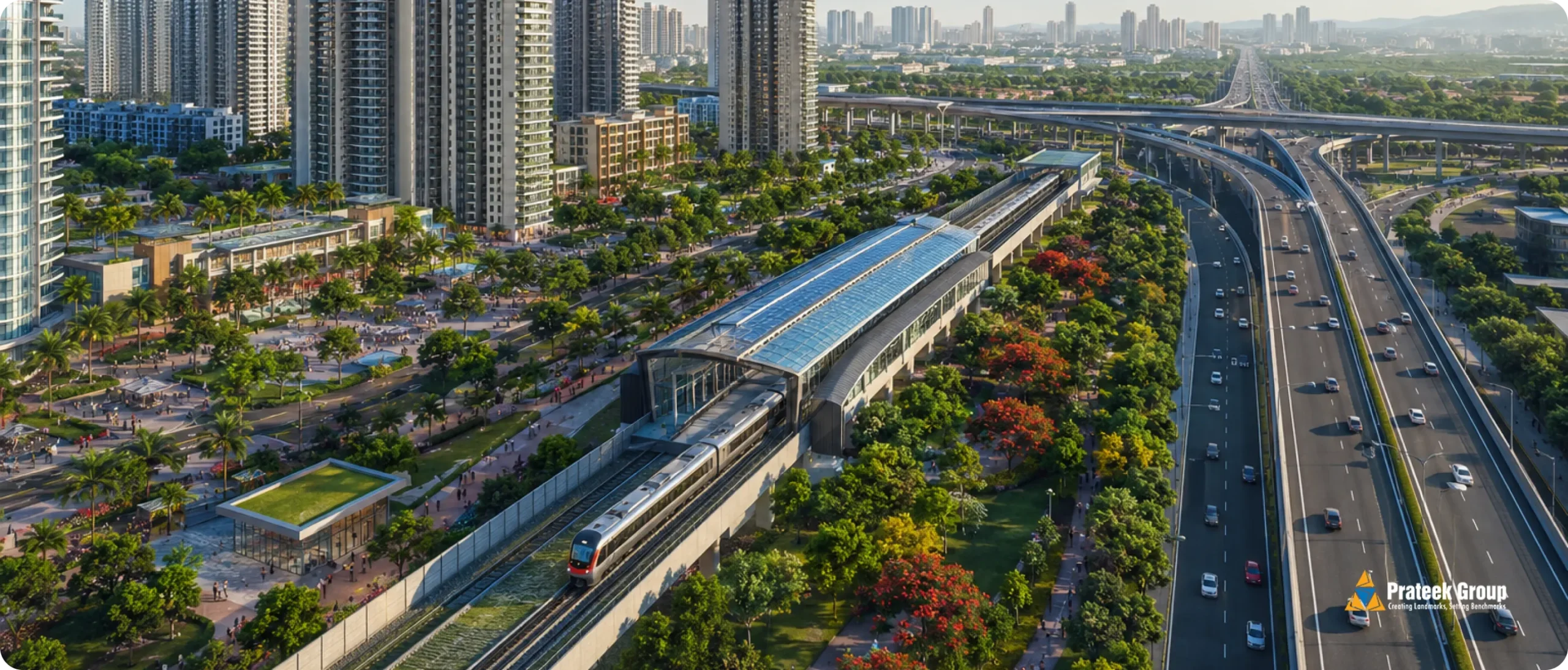
Five years ago, Siddharth Vihar was a quiet Awas Vikas pocket on the edge of Ghaziabad that most NCR buyers couldn’t place on a map. In 2026 it’s one of the fastest-appreciating residential addresses in the region, and the reason isn’t a single launch or a single developer. It’s two pieces of public infrastructure that have come online within months of each other: the fully operational Namo Bharat Regional Rapid Transit System and the newly inaugurated Delhi-Dehradun Expressway. Together they’ve changed who’s buying here, what they’re willing to pay, and how the next price cycle is likely to play out.
This is a detailed look at what’s actually happening to property value in Siddharth Vihar right now, backed by current data rather than broker optimism, so you can decide whether the window is still open or already pricing you out.
Where prices stand today
Let’s start with the numbers, because the appreciation story here is unusually clean.
Flat rates in Siddharth Vihar currently sit in the range of roughly ₹7,950 to ₹10,700 per square foot, with the average for apartments hovering around ₹9,300 per square foot as of mid-2026. Land rates are higher, in the ₹13,000 to ₹17,100 per square foot band, reflecting how little open land is left in the township.
The appreciation curve tells you why investors are paying attention:
Time period | Flat price change in Siddharth Vihar |
Last 1 year | About 10 to 12% |
Last 3 years | About 66% |
Last 5 years | About 96% |
Last 10 years | About 155% |
A near doubling of flat prices in 5 years, in a market that’s also added schools, hospitals, and ready inventory, is the kind of curve that usually signals a locality moving from speculative to end-user demand. Individual projects have outpaced even that: some towers in the township have recorded year-on-year appreciation in the 15 to 23% range over the past year.
Rental yields sit at roughly 3 to 4%, which is healthy for an NCR residential market and is propped up by the short commute to the Noida Sector 62 and 63 IT belt. For a buyer weighing a home loan against rental income, that yield matters, and we’ll come back to it.
To put Siddharth Vihar’s run in context: Anarock data shows Delhi-NCR recorded the highest annual residential price appreciation among India’s top 7 cities in 2025, at roughly 24% year-on-year, with cumulative 5-year growth across NCR crossing 80%. Siddharth Vihar hasn’t just ridden that wave, it’s been ahead of it.
The Namo Bharat factor: a 15-minute corridor to Delhi and Meerut

Here’s the piece that reset the locality’s connectivity overnight.
The Delhi-Meerut RRTS, branded Namo Bharat, became fully operational on 22 February 2026, when the corridor extended to its complete 82.15 km length from Sarai Kale Khan in Delhi to Modipuram in Meerut. This isn’t a future promise. The whole line is running, with trains at roughly 15-minute frequency, and projected ridership for the full corridor is in the region of 800,000 passengers a day.
Why does this matter for Siddharth Vihar specifically? Because the Sahibabad RRTS station sits roughly 5 km from the township. Sahibabad was the very first station to open on the priority corridor back in 2023, and it’s now a node on a line that puts both central Delhi and Meerut within a fast, predictable, traffic-free ride. For a working professional, that’s the difference between a locality you commute out of with dread and one you actually choose.
The research on transit-oriented development is consistent on one point: localities near RRTS stations have outperformed. Areas like Siddharth Vihar and Raj Nagar Extension have seen price rises in the 30 to 67% range since 2023, with proximity to RRTS stations a clear driver. For a station-by-station view of the corridor, see our RRTS corridor property guide from Sahibabad to Siddharth Vihar. The Ghaziabad Master Plan 2031 leans into exactly this, structuring future growth around transit-oriented zones along the Metro and RRTS corridors across 33,543 hectares planned for a population of about 48 lakh.
The Delhi-Dehradun Expressway: the 2026 catalyst
If the RRTS reset the rail connectivity, the Delhi-Dehradun Expressway reset the road story, and it did so this year.
Prime Minister Modi inaugurated the full 210 km expressway on 14 April 2026. Built at a cost in the region of ₹12,000 to 13,000 crore, it cuts the Delhi-to-Dehradun drive from 5 to 6 hours down to about 2.5 hours. The Delhi entry point is Akshardham, and the early stretch runs through the Ghaziabad side of NCR before heading toward Baghpat and Saharanpur.
The effect on Ghaziabad property was almost immediate. In the 10 days following the expressway’s inauguration, Ghaziabad saw a price surge of roughly 30%, with the buyer profile shifting from budget-conscious end-users toward high-net-worth individuals and luxury investors. The areas named as primary beneficiaries were Siddharth Vihar, Raj Nagar Extension, and the NH-24 belt, where demand for 3 and 4 BHK homes spiked.
Read that again, because it’s the heart of the 2026 story: a locality that was sold as an “affordable alternative” to Noida is now being bought by the luxury segment. That’s a structural repricing, not a seasonal bump.
Why the road and rail combination is the real story
Plenty of NCR localities can claim one good piece of infrastructure. What makes Siddharth Vihar’s 2026 position distinct is the stacking.
Sitting on the Delhi-Meerut Expressway (NH-9, also tagged NE-3), the township gives you:
- A direct road link to central and east Delhi, with the Akshardham and ITO side reachable without the usual Ghaziabad bottlenecks.
- Noida Sector 62 and 63, the nearest large job hub, in roughly 5 to 10 minutes.
- The Sahibabad Namo Bharat station within about 5 km for fast rail to Delhi and Meerut.
- Shaheed Sthal on the Red Line metro about 4 km away, and Noida Electronic City on the Blue Line about 6 km away.
- Ghaziabad Railway Station within about 4 km.
- Proximity to two airports: the existing Hindon airport, and the new Noida International Airport at Jewar, which began commercial operations on 15 June 2026.
That last point deserves emphasis. With Jewar now live and driving a fresh wave of demand across NCR, every Ghaziabad locality with a clean road link to the airport corridor gains a second tailwind. Siddharth Vihar has it. We break down which corridors gain most in our guide to the Noida International Airport and the NCR corridors that actually benefit.
No single one of these would move the needle on its own. Stacked together, they explain why the buyer mix has shifted upmarket and why developers are pricing new launches accordingly.
The supply side: who's building, and what it signals
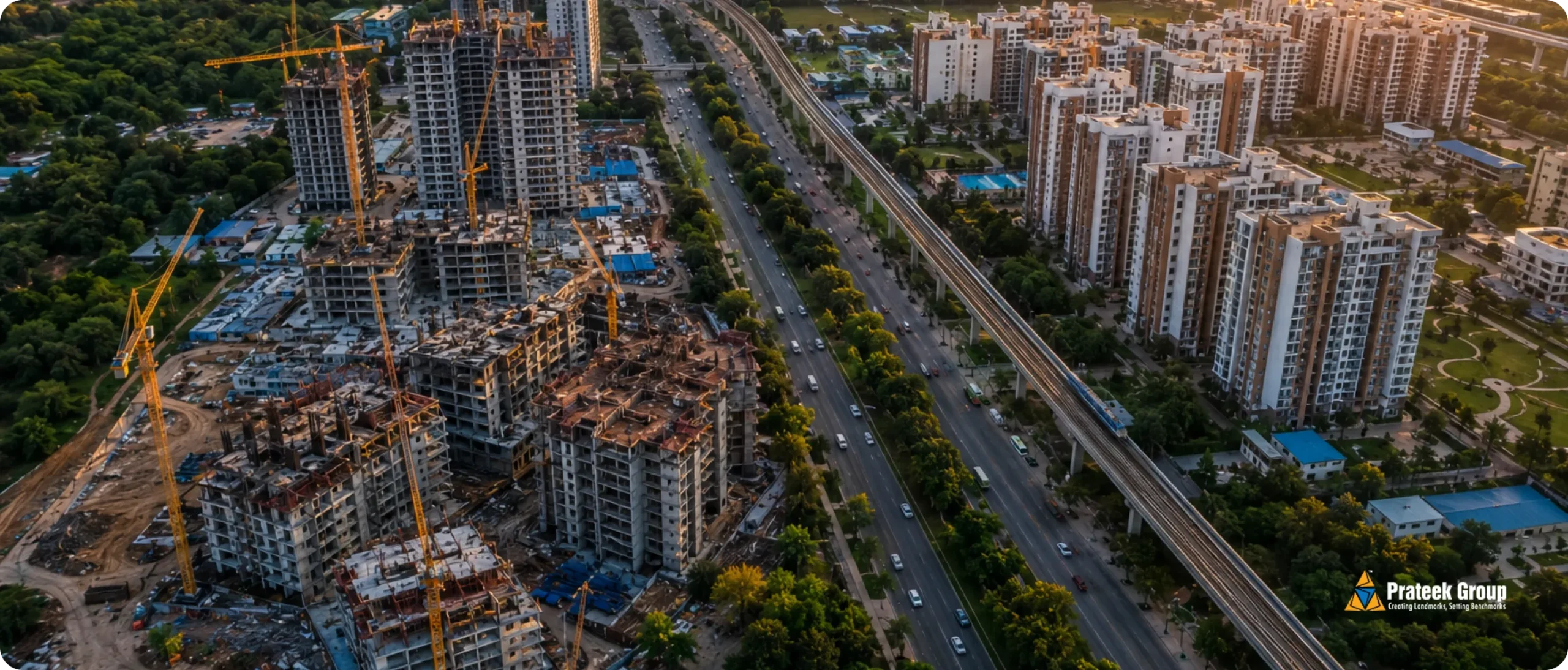
A locality’s price trajectory is shaped as much by who’s willing to build there as by who’s willing to buy. On that measure, Siddharth Vihar is attracting serious capital.
Recent and upcoming activity includes:
• AU Real Estate acquired a 5.6-acre parcel in Siddharth Vihar for ₹336 crore to develop Cosmos Corner, a project of around 831 units with a planned investment of ₹1,200 crore and projected revenue near ₹1,600 crore.
• SKA Group is bringing a low-density 3-tower project with 3 BHK configurations of 1,450, 1,750, and 2,200 square feet, at pre-launch pricing around ₹7,500 to ₹8,000 per square foot.
• Established names already delivered or active in the township include Gaurs, Apex, SG Estates, T and T Group, and Prateek Group, with newer entrants like Prestige Group signalling launches in the wider belt.
When developers of this calibre commit fresh land at these prices, they’re underwriting their own demand forecast. That’s a more reliable signal than any single price chart.
Where Prateek Grand City fits
Among the township’s established addresses, Prateek Grand City is one of the reference points buyers use to benchmark the area. It’s a roughly 40-acre integrated township with 2, 3, and 4 BHK apartments, around 70% of the area kept as open and green space, and Mivan construction across its towers. Its two phases, Grand Carnesia and Grand Paeonia, are RERA-registered (UPRERAPRJ723 and UPRERAPRJ1133) and ready to move, sitting right on the NH-24 frontage next to Indirapuram.
For a buyer, the relevance is straightforward: a ready-to-move, fully-titled township from a developer with a long NCR delivery record gives you the connectivity upside of Siddharth Vihar without the construction-timeline risk that comes with buying into a fresh launch. In a locality where several projects are being built in phases, that distinction is worth real money.
What this means for three kinds of buyers
The infrastructure story is the same for everyone. The right move isn’t.
If you’re an end-user buying to live here. The case is strongest for you. You get a sub-Delhi-price address with Delhi-grade rail and road access, and you’re buying into a township that already has the schools, hospitals, and daily retail that early Siddharth Vihar lacked. The commute math to Noida’s job hubs is genuinely short. Ready-to-move stock removes the rent-plus-EMI overlap that hurts under-construction buyers.
If you’re an investor. The 3 to 4% rental yield plus the appreciation history is a reasonable combination, but the easy money in raw appreciation has partly been made. The smarter 2026 play is selectivity: 3 BHK units below the ₹1.5 crore mark are the supply-constrained sweet spot where demand still outpaces inventory. If you’re still comparing micro-markets, our Greater Noida West vs Siddharth Vihar comparison weighs the two on price, yield, and connectivity. Verify RERA status tower by tower, since phased construction means not every unit in a project carries the same delivery certainty.
If you’re an NRI or long-distance buyer. Siddharth Vihar’s appeal is the combination of a recognised developer base, RERA transparency, and ready inventory you can register without a multi-year wait. Stick to RERA-registered, ready-to-move or near-complete towers from developers with a verifiable delivery record, and the remote-purchase risk drops sharply. Our checklist on how to verify a real estate project before booking walks through exactly what to confirm.
The honest risks
Depth means covering what the brochures skip.
- Air quality and construction dust. Sitting beside a wide expressway and multiple active construction sites means dust is a real, daily issue for now. It eases as the township matures, but it’s a genuine current drawback.
- Phased delivery risk. Several towers are being built in stages. Buying into an early-phase, under-construction tower carries possession-timeline risk that ready-to-move stock doesn’t.
- Pricing has caught up. The “undervalued secret” framing no longer applies. You’re buying a market that’s already repriced, and a proposed circle rate revision across Noida and Greater Noida could lift registration costs further, so your return depends more on selective project choice than on the rising tide.
- Infrastructure dependence. Much of the appreciation case rests on infrastructure that’s now live, which is good, but future upside leans on the next layer (internal commercial hubs and continued job creation) rather than another connectivity surprise.
The bottom line
Siddharth Vihar in 2026 is a locality that has finished its transition from peripheral to performing. The Namo Bharat RRTS gave it fast, reliable rail access to Delhi and Meerut. The Delhi-Dehradun Expressway gave it a road catalyst that visibly moved prices and pulled in luxury buyers. The Jewar airport adds a third regional tailwind. The supply side, from AU Real Estate to SKA to established players like Prateek Group, is voting with its capital.
The window for “cheap” Siddharth Vihar has closed. The window for a well-connected, RERA-clean, ready-to-move NCR home at a price still below comparable Noida addresses is very much open, provided you choose the project carefully.
If you’re weighing a ready-to-move option in the township, a 40-acre integrated address like Prateek Grand City is a sensible benchmark to start from, both for what you’d pay and for the delivery certainty you’d get.