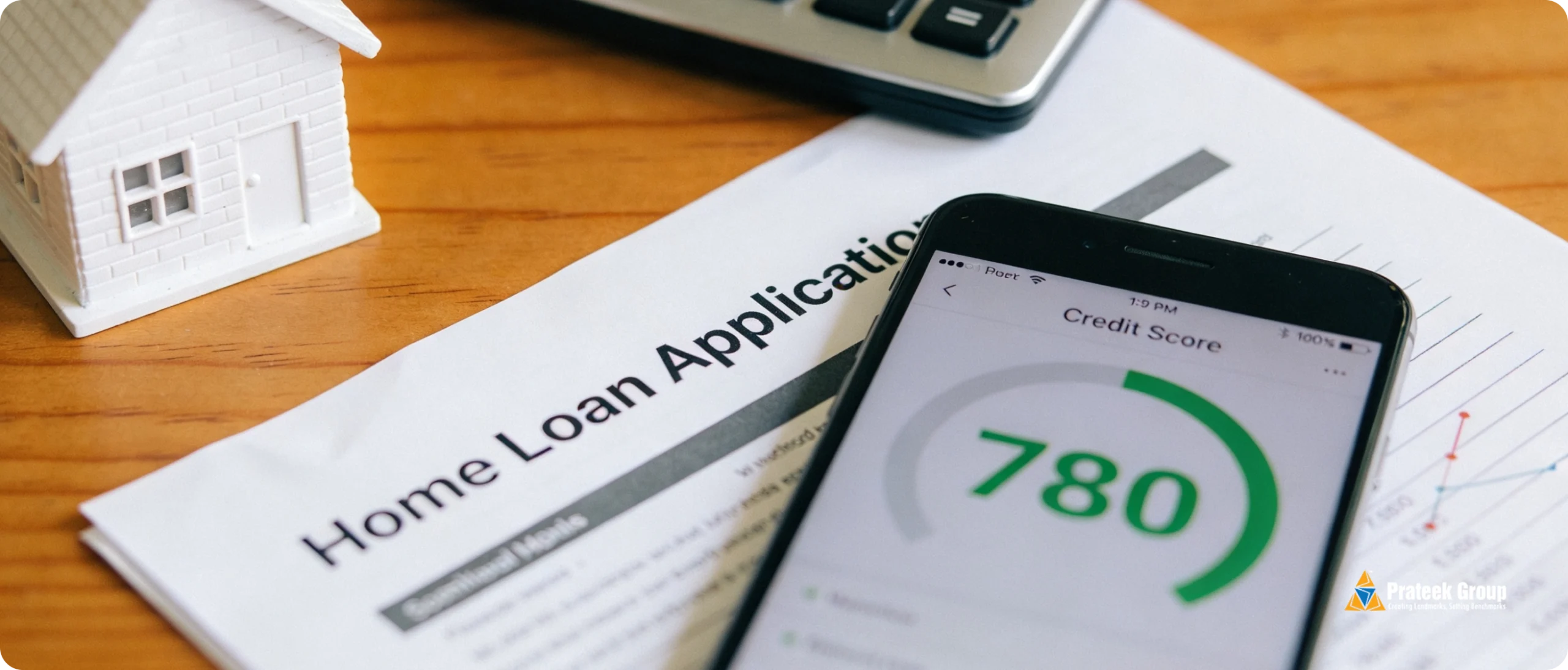
What Your Credit Score Really Tells A Home Loan Lender
Most homebuyers start with the visible parts of the decision: the property, the budget, the location, the down payment, and the monthly EMI.
A lender starts somewhere quieter. They look at repayment risk.
Before a lender studies the flat, the location, or the sale agreement, they want to know one thing: have you repaid borrowed money properly in the past?
That is where your CIBIL score for home loan approval becomes important. TransUnion CIBIL says the score ranges from 300 to 900, and 79% of loans are sanctioned to consumers with a score above 750. So, when a lender sees a higher score, the file usually starts with more confidence. (cibil.com)
A lower score doesn’t always mean rejection. But it can change the terms of the discussion.
The lender may ask for more income proof, review existing EMIs with more care, reduce the eligible loan amount, ask for a stronger co-applicant, or offer a higher rate. For a long-term loan, even a small doubt matters because repayment runs for years.
Your salary shows what you earn now. Your CIBIL report shows how you handled credit when bills, EMIs, and due dates had to be managed month after month.
A good credit score for home loan approval gives the lender an early reading of your repayment discipline before the rest of the file is studied.
What Is A CIBIL Score For Home Loan Applicants?
A CIBIL score is a 3-digit credit score prepared from your credit history. It includes details such as loan repayments, credit card usage, old accounts, new applications, and overdue payments.
For a home loan applicant, it works like a quick background check.
If your score is high, the lender sees a cleaner repayment pattern. If it is low, the lender may still review the application, but the file can move with tighter conditions.
The minimum CIBIL score for home loan approval is not the same across all lenders. ICICI Bank says a score of 750 or above is favourable for a home loan, while a score between 650 and 700 may still work with added conditions such as extra income proof or a co-applicant. (icici.bank.in)
Axis Bank gives a similar view. It says the minimum score differs by lender, but 650 to 750 is usually considered workable, and a score above 750 can help borrowers qualify for better home loan deals. (axis.bank.in)
Here is a simple way to read the score before applying:
CIBIL Score Range | What It Usually Means for a Home Loan |
750 to 900 | Stronger approval chances and better rate discussion |
700 to 749 | Usually acceptable, with closer checks on income and EMIs |
650 to 699 | Possible, but extra conditions may apply |
550 to 649 | Difficult with many lenders unless the rest of the profile is strong |
NA or NH | No credit history, so income, banking behaviour, and documents matter more |
So, what is a good CIBIL score for home loan approval?
A score above 750 is the safer zone. It does not guarantee approval, but it gives your application a cleaner start and gives the lender fewer reasons to pause.
Minimum CIBIL Score Required For A Home Loan In India
Here’s the question most buyers ask before they speak to a lender:
“Is my score good enough, or should I wait before applying?”
That answer depends partly on your CIBIL score for home loan approval. A score of 750 or above is usually the safer zone because TransUnion CIBIL says the score ranges from 300 to 900, and 79% of loans are sanctioned to borrowers with scores above 750.
But a lender will not judge your file only by one number.
A buyer with a 720 score, stable income, low existing EMIs, and a strong down payment may still look more reliable than someone with a 760 score but heavy credit card dues and multiple recent loan enquiries.
So before you ask, “What is the minimum CIBIL score for home loan approval?”, ask yourself a better question:
Will my full repayment profile make the lender comfortable?
Most lenders prefer borrowers who have clean repayment behaviour, manageable debt, and steady income. ICICI Bank explains that a score of 750 or above is favourable for home loans, while scores between 650 and 700 may still work with extra conditions such as stronger income proof or a co-applicant.
Axis Bank also notes that the minimum score differs by lender, but 650 to 750 is usually considered workable, and 750+ can help borrowers qualify for better home loan deals.
For buyers, this means 3 practical things:
- 750+ gives your file a cleaner start.
- 700 to 749 may still work if income, existing EMIs, and documents are strong.
- Below 650 can make the process harder, especially with lenders that follow stricter risk checks.
Credit behaviour is becoming more important in lending decisions. Economic Times reported that lenders have been showing stronger preference for borrowers with higher CIBIL scores, especially around 730 and above, as risk checks become tighter.
If you are planning a home loan soon, read your score with the rest of your financial life. Check your EMI comfort, job stability, down payment, credit card use, and co-applicant profile too.
A good score can open the door faster. A strong full file gives the lender fewer reasons to negotiate against you.
How CIBIL Score Is Calculated Before A Home Loan Decision

Your score does not change without reason. It follows your credit behaviour.
If you have paid EMIs on time, kept card usage low, avoided too many loan applications, and handled credit responsibly for a few years, your score usually reflects that discipline.
If you have missed payments, settled loans, used most of your card limit, or applied for credit too often, those signals can affect your home loan approval.
Quick Check: What Shapes Your Score?
- Repayment History
Have you paid every EMI on time? Were there any late credit card payments? Any defaults, settlements, or write-offs?
This is the first area lenders check because a home loan is a long repayment commitment. Axis Bank says repayment history carries around 30% weight in CIBIL score calculation.
For a home loan buyer, even a small delay can matter if it appears close to the application date.
- Credit Utilisation
Credit utilisation shows how much of your available credit limit you are using.
If your card limit is ₹1,00,000 and your outstanding amount stays near ₹80,000, the lender may see pressure in your monthly cash flow.
Axis Bank recommends keeping credit utilisation below 30%. So, on a ₹1,00,000 credit limit, staying around ₹30,000 or lower is usually safer.
This is where many borrowers get surprised. They may pay on time, but high usage still makes their profile look stretched.
- Credit Age And Credit Mix
A longer credit record gives lenders more repayment history to study.
A borrower who has handled a credit card, car loan, or personal loan responsibly for years gives lenders more evidence than a first-time borrower with no repayment record.
Axis Bank explains that credit type and credit duration together carry around 25% weight. A healthy mix of secured and unsecured credit can support your score when repayments are clean.
This matters when you want a good CIBIL score for home loan approval because lenders prefer steady behaviour over sudden credit activity.
- Hard Enquiries And New Credit
Fresh credit activity can affect how lenders read your file.
If you apply for multiple credit cards, personal loans, or consumer loans just before your home loan application, the lender may see a borrower taking on too much too quickly.
Every lender application can trigger a hard enquiry. Axis Bank notes that hard enquiries and new credit behaviour are part of the score factors, and too many applications in a short period can affect the score.
Before applying for a home loan, avoid fresh credit unless it is genuinely needed.
- Existing Debt Behaviour
Your salary does not directly decide your CIBIL score. Your borrowing behaviour does.
Still, lenders read both together. If you already have personal loan EMIs, credit card dues, and consumer durable loans, they may ask a simple question:
After all these payments, can you comfortably manage a home loan EMI?
That is why how CIBIL score is calculated matters. The score comes from credit habits, but the lender reads it along with income, active EMIs, repayment capacity, and property value.
What Affects CIBIL Score Before You Apply For A Home Loan?
A home loan lender doesn’t look at your score like a school mark. They read it like a pattern.
This section is about timing. The same credit habits that shape your score can become more serious when they happen close to your home loan application.
Did you delay a card payment last month? Did you take a personal loan recently? Did you apply for 3 credit cards while also checking home loan offers?
These details can affect your CIBIL score for home loan approval before the bank even studies your income documents.
Quick View: Habits That Can Pull Your Score Down
Credit Behaviour | Why It Matters Before A Home Loan |
Missed EMIs | Lenders may see it as a repayment risk, especially if the delay is recent. |
High credit card usage | Heavy usage can make your monthly cash flow look stretched. |
Frequent loan applications | Too many hard enquiries can make you look credit-hungry. |
Loan settlement | A settled account can show that the full dues were not repaid as agreed. |
Old dues left unpaid | Even small overdue amounts can affect the credit report. |
Ignoring report errors | Wrong overdue entries or active loans can damage the file unfairly. |
1. Missed EMIs Leave The Strongest Signal
If you missed a personal loan EMI 2 years ago, the lender may still ask what happened. If you missed one 2 months ago, the concern becomes sharper.
Payment history is one of the biggest parts of CIBIL score calculation. Axis Bank explains that a good repayment record can help borrowers get better home loan terms, while missed payments can weaken the application.
Before applying, check whether every closed loan, card payment, and EMI is correctly reflected in your report.
2. High Credit Card Use Can Make Income Look Weaker
You may earn well. But if most of your card limit is used every month, the lender may wonder how much room you have for a new EMI.
For example, if your credit card limit is ₹1,00,000 and your outstanding amount stays near ₹80,000, the issue is not just repayment. It is pressure.
A lower balance shows breathing space.
This is why what affects CIBIL score is not limited to missed payments. Credit usage matters too.
3. Too Many Fresh Applications Can Hurt Timing
Are you applying for a home loan after taking a personal loan, upgrading your credit card, and checking offers from multiple lenders?
That timing can work against you.
Every formal credit application can create a hard enquiry. TransUnion CIBIL says recent credit behaviour and enquiries are among the factors that influence your score.
A safer approach is to stop fresh credit activity before your home loan application, unless it is truly needed.
4. Settled Accounts Need Extra Care
A “settled” loan is not the same as a “closed” loan.
Closed usually means the dues were fully paid. Settled usually means the lender accepted a lower amount than what was originally due. That difference can matter when you apply for a long-term housing loan.
If you have an old settled account, speak to the lender and understand whether it can be updated after full repayment.
5. Credit Report Errors Can Create Unnecessary Trouble
Sometimes the problem is not your behaviour. It is the report.
A closed loan may still show active. An old overdue amount may appear unpaid. A loan you never took may show against your name.
TransUnion CIBIL allows users to raise disputes for errors in account information, personal details, ownership issues, and duplicate entries.
So, before you ask for the minimum CIBIL score for home loan, first check whether your report is clean.
How CIBIL Score Affects Home Loan Interest Rate, EMI, And Loan Amount
Here is where the score starts touching real money.
A stronger score may help you get smoother processing, better rate discussion, and a higher eligible loan amount. A weaker score can lead to stricter checks, a lower sanction, higher margin money, or a higher rate.
For a home loan, even a small interest rate difference can affect your EMI for years.
Where Your Score Can Change The Loan Conversation
Home Loan Area | How A Strong Score Helps | What A Weak Score Can Trigger |
Approval | Cleaner first impression | More scrutiny or rejection risk |
Interest rate | Better negotiation room | Higher rate possibility |
EMI | Lower rate can reduce EMI | Higher rate increases monthly burden |
Loan amount | Better chance of higher sanction | Lower eligibility or tighter loan-to-value |
Processing | Fewer doubts in the file | More documents and questions |
Co-applicant need | May not be required in many cases | Lender may ask for one |
Interest Rate
A good CIBIL score for home loan approval can support better pricing because the lender sees lower repayment risk.
Union Bank of India notes that a strong score can improve approval chances, interest rate eligibility, loan amount, and negotiation power.
This is why borrowers with a cleaner credit profile often compare lenders before finalising the loan.
EMI
Your EMI depends on loan amount, interest rate, and tenure. The score does not directly decide EMI, but it can influence the rate offered.
For example, on a large home loan, even a small rate difference can change the monthly EMI noticeably. Over 20 years, that gap can become substantial.
So when you think about CIBIL score and home loan interest rate, think beyond approval. Think about long-term repayment costs.
Loan Amount
A strong score does not mean the lender will approve any amount you ask for.
But it helps the file.
The lender still checks income, existing EMIs, property value, age, tenure, and down payment. If the score is weak, the lender may reduce the loan amount to lower its risk.
Processing Speed
A clean credit report can make the application easier to assess.
A report with late payments, multiple enquiries, old dues, or settlements can slow down the process because the lender may ask for explanations.
Balance Transfer
Your score can also matter later.
If you want to shift your loan to another lender for a better rate, the new lender will check your repayment behaviour again. A clean record after taking the loan can help you negotiate better during a balance transfer.
Your credit profile can also affect future choices such as a top-up loan, rate renegotiation, or refinancing decision. The score keeps working in the background long after the first sanction letter arrives.
Can You Get A Home Loan With A Low CIBIL Score?
A low score does not always close the loan discussion. It changes the way the lender looks at your file.
If your score is below the safer range, the lender may ask for stronger income proof, a higher down payment, fewer existing liabilities, or a co-applicant with a better credit profile. ICICI Bank says scores between 650 and 700 may still work for a home loan, but extra conditions can apply.
So, if you are asking, “Can I get a home loan with low CIBIL score?”, the practical answer is yes, in some cases. But the file must give the lender another reason to trust your repayment ability.
A salaried borrower with steady income, low EMIs, and clean bank statements may get a better hearing than someone with irregular income and unpaid credit card dues. Bajaj Finserv notes that scores below 650 to 700 can lead to stricter conditions or higher interest rates.
A co-applicant can also help when the main applicant’s score is weak. This works better when the co-applicant has a stable income, clean repayment record, and low existing debt.
Before applying, look at the visible weak points in your file. Clear overdue amounts, avoid fresh loan applications, prepare an explanation for old delays, and check whether the co-applicant’s credit profile is actually stronger than yours.
Still, don’t apply randomly to many lenders just because one bank says no. Multiple applications can add hard enquiries and weaken the file further. A better step is to fix visible issues first, then apply with a cleaner profile.
If the score is low because of an old mistake, prepare the explanation before the lender asks. A paid overdue, closed loan, or corrected credit report gives you a stronger starting point than silence.
Why Income, Job Stability, And Existing EMIs Still Matter
A strong CIBIL score helps, but lenders still want to know whether the EMI fits your monthly life.
Can you pay the EMI after rent, school fees, insurance, groceries, travel, and existing loans? That question matters as much as the score because a home loan can run for 20 years or more.
Axis Bank states that home loan eligibility depends on factors such as age, income, other debt liabilities, employment type, credit score, location, and property details. So, your credit score for home loan approval works with the rest of your profile, not separately.
Income does not directly build your CIBIL score. Your repayment behaviour does. But income helps the lender judge whether you can handle a new EMI without stretching your finances too far.
Existing EMIs are equally important. If personal loan payments, car loan EMIs, and credit card dues already take a large share of your income, even a good score may not be enough.
HDFC Bank also says home loan eligibility depends on monthly income, current age, credit score, fixed monthly financial obligations, credit history, and retirement age. That is why lenders look beyond the number.
Job stability adds another layer. A borrower with steady employment or a consistent business track record gives the lender more comfort than someone with frequent job changes or irregular income.
Before you apply, check the full picture: score, salary, current EMIs, savings, down payment, and the comfort of the future EMI. A good score can get the lender’s attention, but repayment comfort decides whether the loan will feel manageable after approval.
Credit Report Errors That Can Hurt Your Home Loan Application
Sometimes the problem is not your credit behaviour. It is a wrong entry sitting quietly in your report.
Before applying for a home loan, check your CIBIL report line by line. A lender may read a wrong overdue amount, an active loan that you already closed, or an enquiry you never made as a risk signal. That can slow the file even when your repayment behaviour is clean.
Quick Checks Before You Apply
What To Check | Why It Matters |
Closed loans | A closed loan showing active can affect your home loan approval. |
Overdue amounts | Even a small unpaid amount can raise questions. |
Credit card limits | Wrong limits can affect your credit utilisation reading. |
Unknown enquiries | These may suggest credit activity you did not initiate. |
Settlement status | A settled account can hurt more than a properly closed account. |
If you find an error, raise it before sending your home loan file. TransUnion CIBIL allows borrowers to raise disputes for inaccuracies, account ownership issues, duplicate information, enquiry errors, and personal detail errors. (cibil.com)
Also use your free report wisely. RBI has directed credit information companies to provide individuals one free full credit report every calendar year after authentication. (rbi.org.in)
A clean report gives the lender fewer reasons to pause. It also helps you understand whether the issue is your score, your credit history, or a reporting mistake that needs correction.
How To Improve CIBIL Score Before Applying For A Home Loan
If your score needs work, start before the lender checks it.
A last-minute fix rarely changes the full picture. Credit behaviour needs time to reflect, especially when payments, dues, and account updates move through lenders and credit bureaus. TransUnion CIBIL explains that banks and financial institutions send loan and credit card data to CIBIL, and report updates may take time to show. (cibil.com)
90 Days Before Applying
Download your CIBIL report and check every loan, card, enquiry, and overdue entry. If you see an error, raise a dispute immediately.
Also stop applying for fresh credit unless it is required. Multiple new applications can create hard enquiries, which may affect the score and make lenders question your borrowing behaviour.
60 Days Before Applying
Clear overdue amounts and reduce credit card usage.
TransUnion CIBIL says payment history, credit utilisation, age of credit, and enquiries are key factors in score calculation. (cibil.com) So, if your card balance is high, bring it down before the lender reviews your file.
30 Days Before Applying
Keep your EMI payments clean and avoid fresh loans, new credit cards, or unnecessary “pre-approved” offers.
This is the stage where discipline matters. RBI’s move towards faster credit reporting means borrower data is becoming more current, with Economic Times reporting weekly reporting to credit information companies from April 1, 2026. (m.economictimes.com)
Final Buyer Check
Before you apply, ask yourself:
- Are all overdue amounts cleared?
- Is credit card usage under control?
- Are closed loans correctly marked?
- Is the co-applicant’s score also clean?
- Can the future EMI fit your monthly budget?
This is where improve CIBIL score for home loan becomes a practical plan, not a vague goal. A stronger score helps, but a cleaner credit report and steady repayment behaviour make the full file easier to trust.
Home Loan CIBIL Score Checklist Before You Apply

By this point, one thing should be clear: your score matters, but lenders don’t read it alone.
They read your CIBIL score for home loan approval along with income, EMIs, credit behaviour, co-applicant strength, property value, and repayment comfort. So, before you submit the file, do one final check.
Quick Buyer Checklist
- Check your latest CIBIL report before applying.
- Clear overdue credit card bills, EMIs, or small unpaid dues.
- Keep credit card usage low, ideally below the safer utilisation range.
- Avoid fresh personal loans or credit cards before applying.
- Check if old closed loans are marked correctly.
- Review whether any settled or written-off account is still affecting your report.
- Keep income proof, bank statements, and property documents ready.
- Check your co-applicant’s credit profile if you plan to apply jointly.
- Compare lenders instead of applying randomly everywhere.
- Apply when your file looks stable, not when it looks rushed.
A good CIBIL score for home loan approval gives you a stronger start, but a clean file gives the lender more confidence. That is the part many buyers miss.
If your score is already above 750, use that strength wisely. Compare rates, check processing fees, and negotiate better terms.
If your score is lower, don’t panic. Fix the report, clear dues, reduce debt, and give your profile time to improve. A home loan is a long-term decision, so taking a few weeks to clean your credit profile can save you stress later.
The right question is bigger than, “Will the bank approve my loan?”
Ask this too: Will this loan stay comfortable for me 5, 10, and 15 years from now?
A strong credit profile can help you get approved. Careful borrowing helps you live with the EMI after the approval message arrives.
FAQs On CIBIL Score For Home Loan
1. What Is A Good CIBIL Score For Home Loan Approval?
A score of 750 or above is usually considered a strong score for home loan applicants. It can improve approval chances and may help during rate discussions. Still, lenders also check income, existing EMIs, age, employment stability, property value, and repayment capacity.
2. What Is The Minimum CIBIL Score For Home Loan Approval?
There is no single fixed cut-off for every lender. Many lenders prefer 700 or above, while 750+ is generally safer. Some lenders may consider scores between 650 and 700 if the borrower has steady income, low debt, proper documents, or a strong co-applicant.
3. Can I Get A Home Loan With A 650 CIBIL Score?
A 650 score may still get considered, but approval can become harder. A lender may ask for a higher down payment, stronger income proof, lower loan amount, or a co-applicant. The interest rate may also be higher compared to borrowers with stronger credit profiles.
4. Can I Get A Home Loan If I Have No CIBIL Score?
Some lenders may consider borrowers with no credit history, especially if income, bank statements, job stability, and property documents are strong. But the lender has less repayment history to judge, so the file may go through more checks.
5. Does Checking My Own CIBIL Score Reduce It?
No. Checking your own score is treated as a soft enquiry and does not reduce your score. Hard enquiries usually happen when you formally apply for a loan or credit card and the lender checks your credit report.
6. Can A Co-Applicant Help If My CIBIL Score Is Low?
A co-applicant can help if they have a stable income and a strong credit profile. Lenders may feel more comfortable when another earning applicant shares repayment responsibility. But a weak co-applicant profile can also create problems, so both reports should be checked.
7. How Long Does It Take To Improve CIBIL Score For Home Loan?
The timeline depends on the issue. Paying overdue amounts, reducing credit card usage, and correcting report errors can help over time. Serious issues like settlements, write-offs, or repeated missed EMIs may take longer to recover from. Start at least 60 to 90 days before applying.
8. Does Income Affect CIBIL Score?
Income does not directly decide your CIBIL score. Your repayment behaviour, credit usage, loan history, and enquiries affect the score. But income matters for home loan eligibility because lenders check whether you can comfortably pay the EMI.
9. Can Credit Card Usage Affect My Home Loan Approval?
Yes. High credit card usage can affect your score and make your monthly cash flow look tight. Even if you pay on time, using most of your credit limit regularly may worry lenders before a large home loan approval.
10. Can Errors In My CIBIL Report Cause Home Loan Rejection?
Yes, report errors can create trouble. A wrong overdue amount, closed loan showing active, duplicate account, or incorrect settlement status can hurt your application. Check your report before applying and raise a dispute if something is wrong.