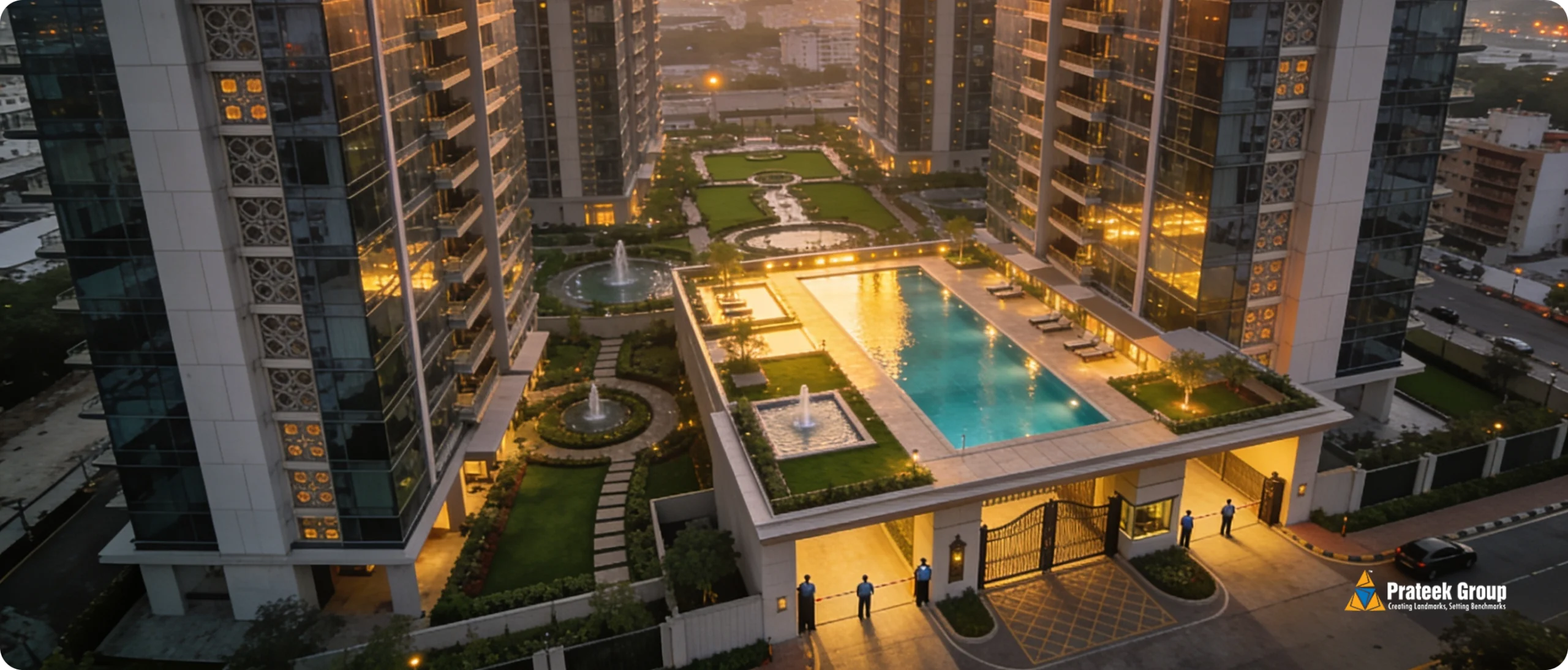
Something has changed in how Non-Resident Indians look at property investment in India. Earlier, the decision often started with price, affordability, and expected appreciation. In 2026, the question is broader. NRIs are now looking at how livable the home is, whether the developer has a visible delivery record, how the neighborhood may grow, and whether the property can support family use, rental income, or a future return to India.
This shift is backed by stronger market signals. India’s real estate sector is widely projected to move toward the USD 1 trillion mark by 2030, while 2026 outlooks continue to point to strong demand for premium and high-end homes, supported by rising incomes and greater NRI participation. For NRIs, premium homes now offer more than a better address. They bring better planning, stronger amenities, improved security, and clearer long-term usability. This blog explains the main trends shaping NRI real estate investment in 2026, why premium residential projects are gaining more attention, and what buyers should check before making a commitment.
How NRI Investment Preferences Are Changing in 2026
NRI buyers are no longer looking at Indian real estate only through emotion. In 2026, the decision is more measured, with buyers comparing lifestyle value, rental potential, developer credibility, and long-term usability before committing.
From Sentiment to Strategy
For many NRIs, owning a home in India still carries emotional value. It keeps them connected to family, familiar cities, and future return plans. However, the investment logic has become much sharper. Buyers now study appreciation trends, rental demand, connectivity upgrades, and developer delivery records before shortlisting a property. Recent industry commentary shows NRI participation in Indian property purchases has moved from about 7–10% during 2015–2018 to nearly 18–20% in 2025, with premium housing seeing stronger interest from overseas buyers. As a result, NRI real estate investment is now less about buying “something back home” and more about choosing an asset that can support wealth planning, family use, and future flexibility.
Younger NRIs Are Entering the Market
A younger group of NRIs in their 30s and 40s is now entering the Indian property market with a more digital-first mindset. Many are based in the UAE, US, UK, Canada, and Australia, and they are comfortable using virtual site visits, online document sharing, RERA portals, and digital payment systems to complete early-stage checks. Because of this, premium homes are getting more attention. Younger buyers often look beyond basic square footage and compare security, amenities, construction quality, community planning, and day-to-day convenience. For them, a home in NCR is both an emotional anchor and a practical investment.
Diversification Away from Western Property Markets
Many NRIs are also comparing Indian real estate with expensive and slower-moving property markets in cities such as Toronto, London, and parts of Europe. India offers a different value equation, especially in premium residential corridors where infrastructure, rental demand, and lifestyle quality are improving. At the same time, premium housing has become a stronger part of India’s residential market. JLL data reported by Times of India noted that homes priced at ₹1 crore and above accounted for 62% of sales in H1 2025, up from 51% a year earlier. This makes Indian premium real estate a more deliberate global portfolio choice for NRIs, rather than a backup purchase.
The Currency Advantage Is Real — And It Is Significant
For NRIs earning in dollars, pounds, or dirhams, currency conversion can change the affordability equation. In 2026, this advantage is still visible, especially when buyers compare premium Indian homes with property costs in mature overseas markets.
More Home for Every Dollar, Pound, or Dirham
The rupee has remained under pressure against the US dollar in 2026, with recent USD-INR levels around the mid-94 range in late April. For NRIs earning in stronger currencies, this creates higher rupee purchasing power when funds are converted for an Indian property purchase.
This matters most in premium housing. A spacious 3 BHK or 4 BHK home in a planned NCR community may feel expensive for a domestic salary buyer, but for an NRI earning abroad, the same property can look more accessible after currency conversion. As a result, many overseas Indians are able to consider better layouts, stronger amenities, and more established locations instead of compromising only on price.
Better Returns Than Most International Alternatives
Indian residential prices continued to rise through 2025, with RBI-based housing price data showing national growth into Q3 FY2025-26, while premium segments in major cities remained stronger than the broader average. For NRIs, this creates a different return profile from many mature overseas markets, where entry costs are high and growth can be slower.
However, the return is not automatic. Buyers still need to study the micro-market, developer record, possession status, rental demand, and exit options. When these checks are done properly, premium NCR real estate can work as both a lifestyle asset and a long-term portfolio choice.
Rental Yields That Actually Work
Rental demand is another reason premium homes are gaining attention. Well-connected NCR corridors such as Noida, Greater Noida, and Siddharth Vihar attract working professionals, business owners, and families who want better access to offices, expressways, schools, and daily conveniences.
Townships and completed communities usually perform better because tenants can see security, amenities, parking, maintenance, and common areas before renting. In Siddharth Vihar, recent market commentary points to stable rental yields around 3–4%, supported by proximity to Noida Sector 62 and improving infrastructure. For NRIs who do not plan to return immediately, this combination of rent and long-term appreciation can make premium housing a practical asset.
Why Premium Homes Are Attracting Stronger NRI Attention

Premium homes are getting stronger attention from NRIs because buyers now want more certainty from their investment. They are comparing space, security, project delivery, amenities, rental demand, and long-term family use before choosing a property.
The Shift from Price-Only Thinking to Lifestyle-Led Investment
Earlier, many NRI buyers looked mainly at affordability and appreciation. In 2026, that approach has changed. Buyers now want homes that can serve more than one purpose: a family base in India, a rental asset, and a long-term wealth holding.
This shift is visible in the wider housing market. Cushman & Wakefield expects luxury and high-end housing launches in India to exceed 300,000 units in 2026, supported by rising incomes and higher NRI participation. JLL also reported that homes priced at ₹1 crore and above made up about 62% of total sales in H1 2025, up from 51% a year earlier.
The New Checklist — Space, Green, Security, and Amenities
NRI buyers are becoming very specific about what they expect from a premium home. Spacious 3 and 4 BHK layouts, usable balconies, planned green areas, secure gated access, proper parking, working club facilities, and sports amenities now matter as much as the address.
This is also why planned communities and townships are gaining preference. Buyers can judge daily comfort more clearly when the project has visible open areas, maintained amenities, and an active residential environment. In this context, Prateek Grand City in Siddharth Vihar fits the township-led preference because it spans over 40 acres, with 70% dedicated to green landscapes and a large delivered portion already in use.
Ready-to-Move Inventory Feels Safer — and It Is
For many NRIs, ready-to-move and near-possession homes feel safer because the risk is easier to measure. The unit can be inspected, amenities can be checked, and the surrounding community is already visible.
This matters in NCR, where buyers are more cautious after past delays across several micro-markets. A completed or occupied project removes much of the uncertainty linked with construction timelines. For NRIs who want rental income immediately or plan to keep the home ready for family use, paying slightly more for delivery certainty often makes practical sense.
Lifestyle, Rental, and Resale Value of Premium Residential Projects
Premium residential projects give NRIs more than ownership value. They support better daily living, stronger tenant appeal, and clearer resale confidence, especially when the home is part of a well-managed township with active amenities and proven community use.
Township Living Offers What Standalone Buildings Cannot
There is a clear difference between a standalone apartment building and a planned township. In a township, internal roads, open areas, security, clubhouse spaces, retail access, and daily conveniences are planned together. For NRIs, this matters because the home must work smoothly even when they are managing it from another country.
A good township also attracts better tenants because families and professionals prefer secure, maintained communities with usable amenities. Prateek Grand City in Siddharth Vihar reflects this model with its 40-acre township planning, 70% green landscape focus, and 25 acres already delivered.
- Township living gives families a more complete daily environment
- Tenants prefer secure communities with working amenities
- Delivered township phases reduce uncertainty for NRI buyers
Rental Demand From NCR’s Growing Professional Economy
NCR continues to draw working professionals because of its office hubs, expressway access, and expanding residential corridors. Locations near employment centres, highways, public transport, schools, hospitals, and daily services usually perform better for rental demand, especially when the property is inside a well-managed gated community.
For NRIs, this matters because rental income depends on more than the apartment size. Tenants also judge maintenance, parking, security, clubhouse access, and travel convenience. A professionally managed township can therefore reduce vacancy concerns and make remote ownership easier.
- Office access and connectivity support steady rental demand
- Gated communities often attract longer-stay family tenants
- Good maintenance helps NRIs manage rentals from abroad
Resale Value in Premium Projects Holds Up Better
Premium homes in established communities often hold resale value better because buyers can see the actual condition of the project, amenities, and surrounding infrastructure. A completed, maintained community gives resale buyers more confidence than a project that still depends heavily on future promises.
Recent listing-market data shows Prateek Grand City recorded about 20.05% appreciation in average price per sq. ft. over the last year, while Siddharth Vihar recorded about 19.26% in the same period. That makes the earlier 6.8% quarterly figure worth updating to a broader current-year reference.
- Completed communities create stronger resale confidence
- Visible amenities make premium homes easier to evaluate
- Current data shows strong yearly appreciation in Siddharth Vihar
Why Trusted Developers and Completed Communities Matter More Now
For NRIs, developer trust is no longer judged by brochures or sales conversations alone. In 2026, delivery record, RERA clarity, completed communities, and post-possession maintenance matter much more.
The Post-RERA Shift in Developer Accountability
RERA has made Indian real estate more transparent by requiring registered projects to disclose timelines, approvals, layout details, and construction updates. For NRI buyers, this reduces dependency on verbal assurances and gives them a formal way to verify project status before making a decision.
- No unregistered selling: Buyers should avoid projects without valid RERA details.
- Delay accountability: Missed timelines can lead to compensation or refund claims.
- Documented progress: RERA portals help buyers check updates remotely.
What Makes a Developer Worth Trusting
A trustworthy developer is one whose work can be checked through delivered projects, occupied societies, clear approvals, and resident experience. NRIs should look beyond promised amenities and study whether the developer has completed communities where people are already living comfortably. Prateek Group fits this context because it has been active in NCR since 2005, with delivered residential projects across Noida and Ghaziabad. Developments such as Prateek Grand City give buyers a visible example of township planning, completed phases, and community living.
- Multiple deliveries: Completed projects show real execution strength.
- Clear compliance: RERA and approval records reduce buyer uncertainty.
- Post-possession support: Maintenance quality matters after handover.
The Comfort of an Already-Living Community
An already-living community gives NRIs something plans cannot provide: visible proof. Buyers can see the entrance, landscaping, security, clubhouse, lifts, parking, and daily resident movement before committing. This matters when the home is meant for parents, tenants, or future self-use. A completed township with families already living inside reduces the risk of moving into an isolated or unfinished environment.
- Mature surroundings: Families prefer settled, active communities.
- Tested security: Daily use reveals how systems actually perform.
- Better confidence: What buyers see is closer to what they receive.
Key Checks Every NRI Must Make Before Investing in a Premium Home

Before signing any agreement, NRIs should verify whether the investment is legally clear, financially compliant, and practical for long-term ownership. These checks reduce avoidable risk and make the buying decision more secure.
RERA Registration — Start Here, Always
Every NRI should begin with the state RERA portal. For projects in Uttar Pradesh, buyers can check the UP-RERA website for the project name, promoter details, registration number, approvals, timelines, and uploaded disclosures. UP-RERA also provides a registered project search facility, which helps buyers verify claims directly instead of relying only on brochures or broker conversations.
Title Clarity, Land Status, and Approvals
After RERA, the next step is legal due diligence. A property lawyer should verify the title deed, ownership chain, encumbrance status, land use approval, building plan sanction, and required no-objection certificates. RERA registration improves transparency, but it should not replace title verification. Buyers should also check whether the land has pending authority dues, bank charges, litigation, or development restrictions.
Developer Track Record and Possession Status
NRIs should study the developer’s completed projects before trusting a premium launch. Resident feedback, possession history, maintenance quality, and post-handover support often reveal more than marketing material. Ready-to-move or near-possession homes may also reduce risk because buyers can inspect the actual unit, amenities, access, parking, and occupancy status before payment.
Banking, FEMA Compliance, and Tax Planning
NRI property payments must move through approved banking channels. RBI guidance allows payments through inward remittance or debit to NRE, FCNR(B), or NRO accounts, while traveler’s checks, foreign currency notes, and unsupported payment routes are not permitted. Tax planning should also begin early. Rental income, resale gains, TDS, repatriation, and loan documentation can affect the overall return. SBI’s official home loan rate page currently shows home loans starting from 7.25% per annum, effective April 1, 2026, subject to profile and terms.
Closing Thoughts
The NRI investor of 2026 is more informed, more selective, and more focused on long-term value than before. Premium homes are gaining attention because they offer stronger liveability, better security, improved amenities, and clearer rental or resale potential. NCR continues to remain important because of major infrastructure movement, including Noida International Airport, Namo Bharat connectivity, metro expansion, FNG Expressway, and the wider NH-24/NH-9 network. As a result, locations such as Noida, Greater Noida, and Siddharth Vihar are being viewed with more confidence by overseas buyers.
For NRIs, the decision should still be made carefully. Choose a micro-market with visible growth, a developer with delivered projects, and a community where amenities, maintenance, and occupancy can be checked. Before signing, verify RERA details, review legal documents, confirm payment compliance, and plan taxes properly. Premium homes in well-planned NCR townships can offer more than ownership. With the right checks, they can support family use, rental income, and long-term wealth planning.