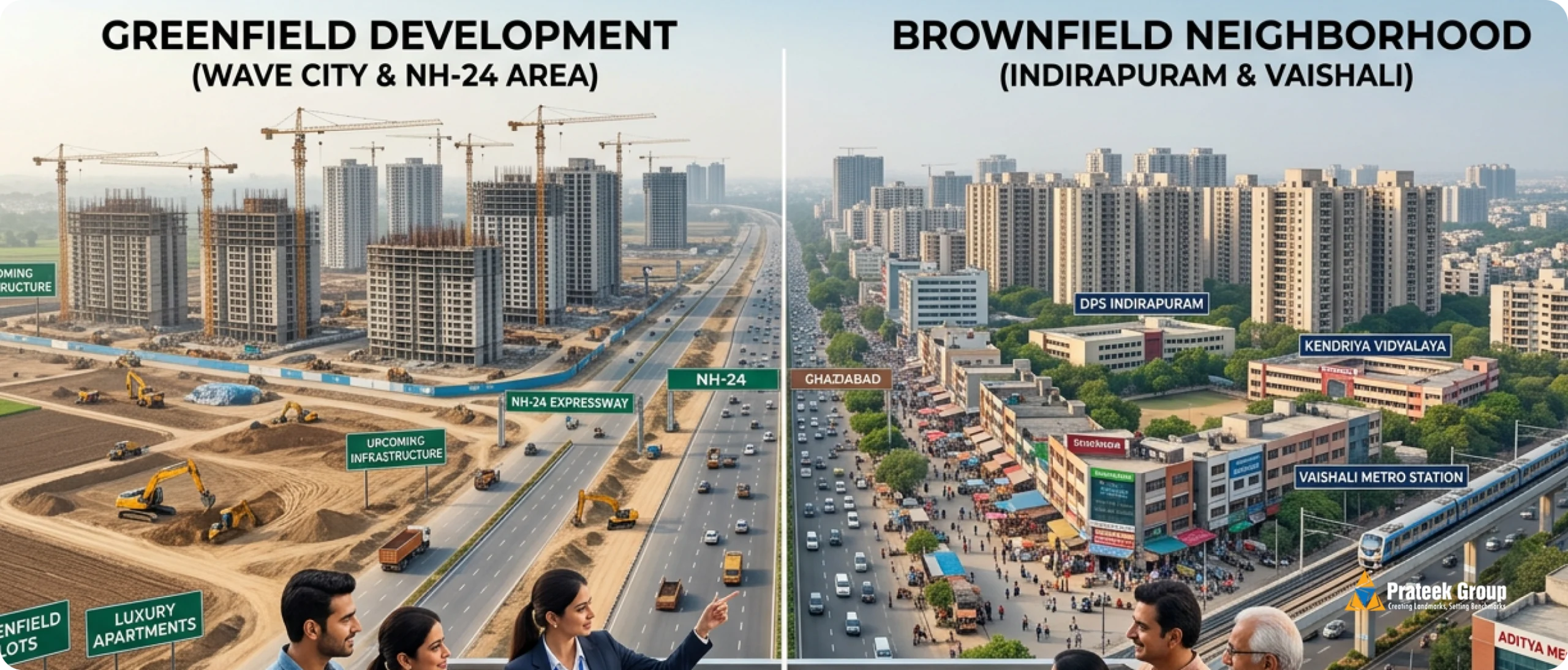
Ghaziabad is no longer just the “affordable option near Delhi.” That old label is getting weaker every year.
Today, one buyer is looking at a newer township belt near NH-24 or Wave City, hoping the next 5 years bring stronger appreciation. Another buyer is looking at Indirapuram or Vaishali because the schools, markets, hospitals, metro access, and rental demand are already there.
Both buyers are right in their own way.
That is why Greenfield vs Brownfield Development in Ghaziabad is not just a technical real estate topic. It is the difference between buying into future growth and buying into an already-working location.
The timing also matters. ANAROCK’s NCR Residential Market Viewpoints Q2 2025 reported that Ghaziabad saw a 62% quarter-on-quarter rise in housing sales, while the city held a 20% share of NCR sales during the quarter. That tells us one thing clearly: buyers are not ignoring Ghaziabad anymore. (ANAROCK NCR Residential Market Viewpoints Q2 2025)
But here is the real question.
Should you choose a newer growth corridor that may mature over time, or a settled pocket where daily life already works?
A family comparing Wave City and Indirapuram is not only comparing 2 locations. They are comparing 2 timelines. One timeline says, “wait for growth.” The other says, “pay for convenience now.”
This blog will help homebuyers and investors in Ghaziabad understand that difference without getting trapped by brochure language.
Why does Greenfield vs Brownfield development in Ghaziabad matter right now?
Ask any serious NCR homebuyer what they want, and you will usually hear 2 answers: better connectivity and better long-term value. Ghaziabad is sitting right at that intersection.
On one side, newer growth belts are getting attention because of NH-24, NH-9, the Delhi Meerut Expressway, the Namo Bharat corridor, and future planning under Ghaziabad Master Plan 2031. Housing.com’s explainer on the master plan says it includes 2 Special Development Areas and 7 RRTS influence zones, which is exactly the kind of planning that can push new housing and township-style growth. (Housing.com guide to Ghaziabad Master Plan 2031)
On the other side, older locations still hold their ground. Indirapuram, Vaishali, Kaushambi, Sahibabad, and parts of old Ghaziabad already have the everyday things families need. You can find schools, chemists, clinics, grocery stores, gyms, salons, metro access, and office routes without waiting for the “next phase” of development.
That choice depends on your patience.
A Greenfield location may look more open today. It may have wider planning and newer buildings. But social infrastructure can take time. A Brownfield location may feel crowded, but life starts from day 1 because the market, road network, and rental demand are already active.
This is why the Ghaziabad real estate market cannot be judged by price alone. A lower price in a developing belt may work for a long-term investor. A higher price in a mature locality may still make sense for a family that wants convenience now.
Even established developers and projects should be looked at through this lens. For instance, Prateek Group’s official project page lists Prateek Grand City in Siddharth Vihar, a location that sits between newer housing growth and established NCR connectivity. That kind of area shows why Ghaziabad is not always purely Greenfield or purely Brownfield. Some pockets are mixed, and buyers need to read them carefully.
That is where the decision becomes interesting.
You are not only buying a flat. You are buying the stage of development around that flat.
What is Greenfield Development in Ghaziabad real estate?
Before you compare prices, look at the area around the project. Is it already working, or is it still being built around you?
That is the easiest way to understand Greenfield development in Ghaziabad.
Greenfield development means real estate built on largely undeveloped or underdeveloped land. In simple terms, the area starts with more open land, fewer older structures, and more room for planned roads, new housing clusters, utility networks, parks, commercial pockets, and township-style living.
Visit a Greenfield belt on a weekday afternoon and you may see wide roads, new towers, empty plots, half-ready shops, and construction dust. That mix is the reality. The promise is future growth. The trade-off is waiting.
What does a Green field usually look like?
In Ghaziabad, Greenfield-style growth often shows up in areas where the city is expanding outward or being planned in larger land parcels.
You will usually notice:
- wider internal roads
- newer apartment clusters
- larger township layouts
- more open spaces in the early years
- fresh commercial development
- future-facing connectivity promises
- construction activity around the project
A newer belt may look organised inside the project gate, but the area outside may still be maturing. Roads may be improving. Shops may be limited. Schools and hospitals may take time to become fully convenient.
That is why buyers need to separate “project planning” from “area maturity.”
Where does it show up in Ghaziabad?
You can see this pattern around growth belts linked to Wave City Ghaziabad, NH-24, NH-9, Raj Nagar Extension, and some RRTS-influenced areas. Wave City’s official website positions the township with 3 BHK homes, greenery, modern amenities, and connectivity to Indirapuram and Delhi through NH-24 and Eastern Peripheral Road, which makes it a useful example of newer township-led planning in Ghaziabad. (Wave City official township page)
This is where the appeal begins for investors.
If the infrastructure arrives on time and people start moving in steadily, a Greenfield location can grow in value as the area fills out. But if the surrounding development is slow, the buyer may live with dust, diversions, weak retail access, and lower rental demand for a few years.
The real test is patience. A family that needs school access, clinics, grocery stores, and public transport from the first week may not enjoy waiting for an area to mature.
If you can wait, Greenfield projects in Ghaziabad may deserve a closer look. If daily convenience matters immediately, you need to be more selective. Greenfield tells you what a location may become. Brownfield tells you what a location already handles every day.
What is Brownfield Development in Ghaziabad real estate?
Brownfield development is the other side of the Ghaziabad story.
Here, the area is already alive. The roads exist. Markets exist. Schools exist. Clinics, chemists, food joints, metro links, autos, cabs, banks, and daily services are already part of the neighbourhood. New projects or redevelopment may happen, but they happen inside an older, working urban fabric.
That is Brownfield development in Ghaziabad in practical terms.
Visit Indirapuram or Vaishali in the evening and you will see the opposite of a new growth belt: traffic, shops, school vans, food outlets, tenants, brokers, and full parking lanes. It may feel crowded, but it is already working.
What Brownfield usually gives buyers?
A Brownfield area may not always look as fresh as a new township. You may see traffic, older buildings, tighter roads, parking pressure, and fewer large open spaces.
But daily life is easier. For many families, that matters more than a glossy brochure.
Brownfield locations often give:
Buyer need | Why Brownfield helps |
Daily convenience | Markets, schools, clinics, banks, and services already exist |
Rental demand | Tenants prefer locations where transport and daily needs are ready |
Commute predictability | Road and metro usage patterns are already known |
Resale visibility | Buyers understand the area better |
Faster settling-in | Families don’t need to wait for the neighbourhood to develop |
Where does it show up in Ghaziabad?
Think of Indirapuram, Vaishali, Kaushambi, Sahibabad, and older city pockets. These are not blank-slate locations. They have been lived in, tested, crowded, repaired, and expanded over time.
And that is exactly why they still attract buyers.
A Times of India real estate report listed Indirapuram and Vaishali among Ghaziabad’s major hotspots for 2026, noting Indirapuram’s access to malls, schools, hospitals, and NH-24, while Vaishali benefits from metro and road connectivity along with social infrastructure. (Times of India Ghaziabad hotspot report)
Now compare that with Siddharth Vihar.
It is an interesting middle case. It has newer housing clusters, but it sits close to Indirapuram and NH-24. That is why this pocket does not fit neatly into one box. It has a newer township feel, but its value is also tied to nearby mature infrastructure.
A buyer comparing Wave City with Indirapuram is not comparing only price. They are comparing a developing corridor with a lived-in neighbourhood. Someone looking at Raj Nagar Extension may accept a longer maturity curve. Someone choosing Vaishali may be paying extra for metro access and daily convenience.
That answer will shape your entire Ghaziabad property investment decision.
Greenfield vs Brownfield Development in Ghaziabad: the real difference for buyers
Here is where many buyers get trapped.
They compare only price per sq. ft., flat size, tower height, and amenities. But they miss the bigger question: what kind of location are they buying into?
Greenfield vs Brownfield Development in Ghaziabad is really a question of timing. Are you entering early into a growth belt, or are you paying more for a locality that already works?
Greenfield vs Brownfield: Quick Buyer Comparison
Buyer factor | Greenfield development in Ghaziabad | Brownfield development in Ghaziabad |
Area stage | Still developing or expanding | Already settled and active |
Roads and utilities | May improve in phases | Usually already functional, though sometimes crowded |
Social infrastructure | Schools, hospitals, and markets may take time | Daily services are already available |
Lifestyle | Newer layouts, gated planning, larger parcels | More convenience, but less open space |
Rental demand | Builds gradually as occupancy rises | Usually stronger from the beginning |
Appreciation | Can be higher if infrastructure delivers | More stable, driven by location scarcity |
Risk | Delays, underdeveloped surroundings, future supply | Congestion, older buildings, parking pressure |
Best suited for | Patient buyers and long-term investors | End-users and rental-focused investors |
The real test is patience.
If your family can wait for an area to mature, Greenfield projects in Ghaziabad may make sense. If your child’s school, your office commute, your parents’ hospital access, and your daily market run matter from the first week, Brownfield locations may feel safer.
This is why a buyer comparing Wave City Ghaziabad, Raj Nagar Extension, Siddharth Vihar, Indirapuram, Vaishali, and Kaushambi should not put every area in the same bucket.
Wave City’s official website describes it as a large township on NH-24, with about 4,200 acres of planned development and 1,470 acres of green area, which makes it a clear example of township-led Greenfield-style planning. (Wave City official township page)
Indirapuram and Vaishali, on the other hand, are mature pockets. A Times of India real estate report listed both among Ghaziabad’s key 2026 hotspots, noting Indirapuram’s malls, schools, hospitals, NH-24 access, and Vaishali’s metro and road connectivity. (Times of India Ghaziabad hotspot report)
Siddharth Vihar sits somewhere in between. It has newer housing growth, but it also benefits from nearby Indirapuram and NH-24 access. This is where projects such as Prateek Grand City, Apex Quebec, T&T Eutopia, and other Siddharth Vihar developments need to be judged by both project quality and surrounding infrastructure, not by builder name alone.
That is the real difference. Greenfield is about what the area can become. Brownfield is about what the area already is.
Where Greenfield projects in Ghaziabad are shaping future growth?
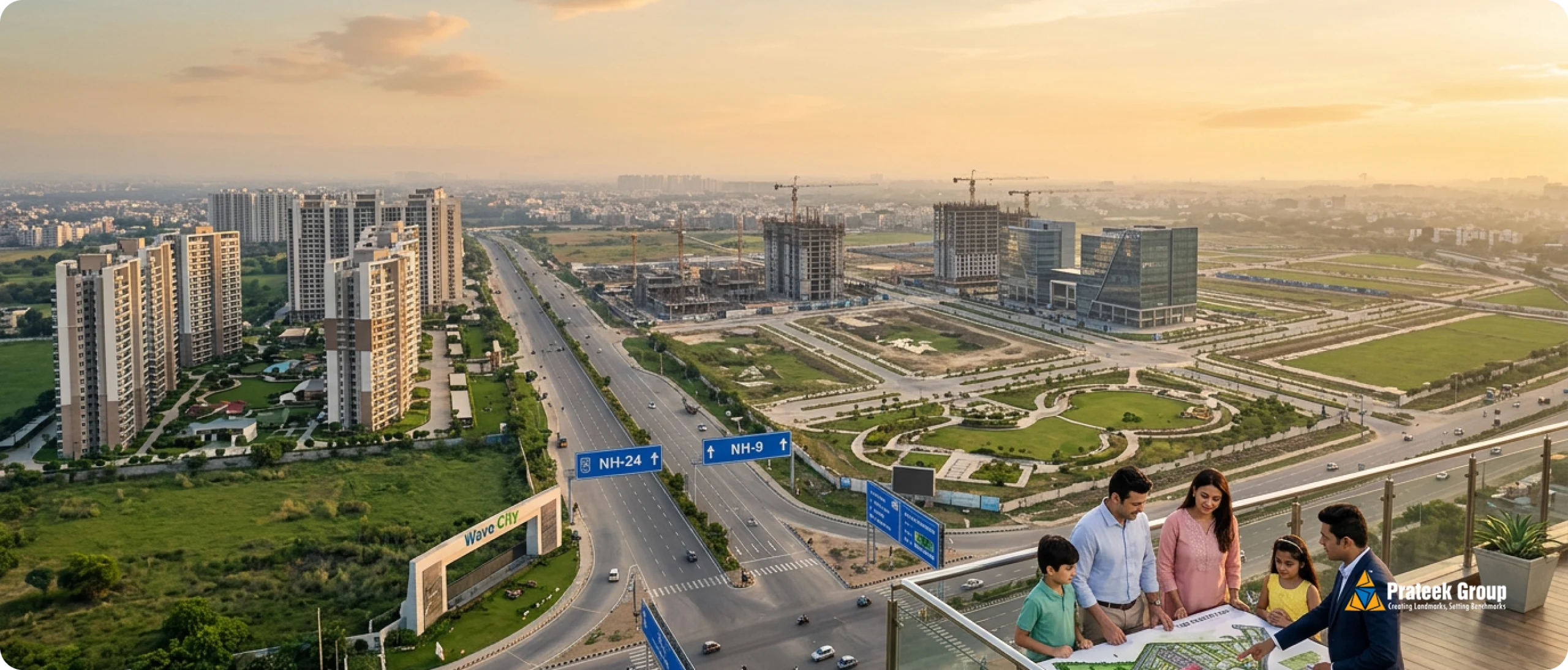
Greenfield growth in Ghaziabad is not happening randomly. It is following roads, transit corridors, land availability, and master planning.
If you are an investor, this is where your attention should go first. Because future value usually follows usable infrastructure, not just future promises.
1. Wave City and the NH-24/NH-9 belt
Wave City is one of the clearest examples of Greenfield development in Ghaziabad. Its official website talks about large-scale township planning on NH-24, with residential, commercial, road, and green-area planning inside a much larger land parcel. (Wave City official township page)
But buyers should look outside the project gate too.
A township can be well-planned inside, but long-term value depends on external roads, public transport, schools, hospitals, retail, and office movement. That is why the NH-24 and NH-9 belts matter. These routes connect Ghaziabad with Delhi, Noida, and Meerut-side movement, which is one reason buyers keep tracking this corridor.
2. Raj Nagar Extension
Raj Nagar Extension has become a strong value-driven market for buyers who want newer housing without paying mature-location prices.
Times of India listed Raj Nagar Extension among Ghaziabad’s 2026 real estate hotspots, describing it as a budget-friendly locality with modern amenities, wide roads, ongoing infrastructure work, and rental-yield appeal. (Times of India Ghaziabad hotspot report)
For a long-term buyer, that matters. But the buyer should still check occupancy levels, maintenance quality, public transport access, and how much of the surrounding retail is already working.
3. RRTS influence zones and Master Plan 2031 areas
The Ghaziabad Master Plan 2031 adds another layer to the Greenfield story. Housing.com’s guide says the plan includes 2 Special Development Areas and 7 RRTS influence zones, with structured residential, commercial, and industrial growth planned around transit influence areas. (Housing.com guide to Ghaziabad Master Plan 2031)
That is important for Ghaziabad property investment, especially for buyers tracking future growth corridors.
But planned development should always be checked against on-ground progress. A map can show potential. A site visit shows reality.
Where Brownfield projects in Ghaziabad offer ready urban comfort?
Some buyers don’t want to “wait for the area to develop.”
They want the school bus to come next week. They want a pharmacy within 5 minutes. They want metro access, nearby markets, working roads, and enough tenant demand to make resale easier later.
That is where Brownfield development in Ghaziabad has its strongest case.
Brownfield locations are already tested by daily life. They may not always look new or perfectly planned, but families know how these areas function in the morning rush, during school hours, on weekends, and during festival traffic.
Mature Ghaziabad pockets buyers keep comparing
Location | Why buyers still consider it | What to watch carefully |
Indirapuram | Strong social infrastructure, malls, schools, hospitals, NH-24 access | Traffic, parking pressure, older societies |
Vaishali | Metro connectivity, Delhi-Noida access, established services | Higher density, limited new land parcels |
Kaushambi | Commercial activity, metro access, Delhi border advantage | Congestion and older building stock |
Sahibabad | Industrial-commercial base, older connectivity, redevelopment potential | Mixed land use and infrastructure pressure |
Old Ghaziabad pockets | Existing markets, railway access, long-settled communities | Narrow roads and redevelopment quality |
A Times of India real estate report listed Indirapuram and Vaishali among Ghaziabad’s 2026 property hotspots, pointing to Indirapuram’s malls, schools, hospitals, and NH-24 access, while Vaishali benefits from metro connectivity and proximity to Delhi and Noida. (Times of India Ghaziabad hotspot report)
Now think like an end-user.
Would you prefer a newer tower where the clubhouse is ready but the surrounding market is still thin? Or an older locality where the building may need better maintenance, but life outside the gate is already sorted?
There is no one answer.
A family with school-going children may prefer Vaishali or Indirapuram because daily services matter. A young investor may still look at a newer belt if the entry price is better and the holding period is longer.
Why does Brownfield still win for many families?
Brownfield locations usually work better when the buyer wants:
- ready social infrastructure
- predictable commute routes
- stronger rental demand in Ghaziabad
- easier resale visibility
- active markets and public transport
- lower uncertainty around basic services
But mature locations come with their own trade-off.
The road may be busier. The society may be older. Parking may be tight. Open space may be limited. New supply may be expensive because land is scarce.
This is why Brownfield projects in Ghaziabad should not be judged only by location name. Buyers should check the building age, maintenance quality, parking, lift condition, water supply, society dues, and title clarity.
A good Brownfield purchase feels boring at first. Then you realise boring can be useful when rent comes on time and daily life does not depend on future promises.
Greenfield Development in Ghaziabad: benefits for homebuyers and investors
Greenfield development has one thing mature areas often cannot give: room to plan from scratch.
That is why Greenfield development in Ghaziabad attracts buyers who are not only thinking about today’s convenience. They are thinking about what the area may look like after 5 or 7 years.
What buyers usually like about Greenfield locations?
Benefit | Why it matters for homebuyers | Why it matters for investors |
Larger land parcels | Better scope for internal roads, towers, parks, and amenities | Future phases may lift area value |
Newer construction | Modern layouts, lifts, parking, clubhouses, and security systems | Easier to market to future buyers or tenants |
Planned township development | Schools, retail, parks, and housing may be planned together | Township scale can support long-term property investment |
Lower entry point in some belts | Buyers may get more space for the same budget | Price growth may come as infrastructure matures |
Future connectivity | Better road or transit links can improve livability later | Infrastructure-led growth can support appreciation |
This is why areas around Wave City Ghaziabad, NH-24, NH-9, Raj Nagar Extension, and RRTS influence belts remain part of the investment conversation.
ANAROCK’s NCR Residential Market Viewpoints Q2 2025 reported that Ghaziabad saw a 353% quarter-on-quarter rise in new supply and a 62% quarter-on-quarter rise in sales. That is a strong signal that new housing activity and buyer interest are both moving in the city. (ANAROCK NCR Residential Market Viewpoints Q2 2025)
Activity is rising, but buyers still need to check whether new supply in their chosen micro-market is being absorbed properly. A city-level jump does not automatically mean every project or pocket will perform equally.
But the smart buyer should ask one extra question: Is the growth real on the ground, or only present in the brochure?
Greenfield makes sense when these 4 things are visible
- Roads are already usable, not only proposed.
- Occupancy is rising across nearby projects.
- Daily retail has started forming around the area.
- Schools, hospitals, or transport links are reachable without stress.
If these signs are missing, the project may still be good, but the holding period becomes longer.
For Homebuyers
Greenfield can work well if you want newer layouts, better amenities, more open surroundings, and a quieter early-stage neighbourhood.
But check your daily routine honestly. If your child’s school, your office route, or your parents’ hospital access depends on future infrastructure, the purchase may test your patience.
For Investors
Greenfield can offer stronger upside when the entry price is reasonable and infrastructure is genuinely moving.
But timing matters. Buying too early can lock your money for years. Buying too late can reduce the upside. The safest approach is to track actual road work, occupancy, rental enquiries, commercial activity, and RERA status before committing.
That is the real promise of Greenfield projects in Ghaziabad. The value grows when the area grows with you.
Brownfield Development in Ghaziabad: benefits for homebuyers and investors
Brownfield locations have a simple advantage: people already live there in large numbers. That means the market has been tested by daily routines, traffic, school timings, office movement, rentals, repairs, and resale demand. For many homebuyers in Ghaziabad, this matters more than a new project brochure.
A mature location may not look as open as a new growth belt, but it usually gives a clearer idea of what life will feel like after possession.
The biggest strength of Brownfield development in Ghaziabad is ready social infrastructure. Schools, hospitals, grocery stores, salons, clinics, banks, metro access, autos, and food options are already part of the area. A Times of India real estate report listed Indirapuram and Vaishali among Ghaziabad’s major 2026 hotspots, pointing to their connectivity, schools, hospitals, malls, and daily convenience. (Times of India Ghaziabad hotspot report)
For an end-user, that means less waiting. You don’t have to depend on a future mall, a future hospital, or a future road widening plan. The area already has a rhythm. You can visit in the morning, evening, and weekend to understand traffic, noise, parking, and market access before buying.
That is a big plus.
For investors, mature pockets often support better rental demand in Ghaziabad. Tenants usually prefer locations where daily services are close and commute options are known. A flat in a lived-in area can be easier to rent than a newer unit in a half-occupied belt, even if the newer unit has better amenities.
Brownfield locations also give better resale visibility. Buyers already know the area’s reputation. Brokers understand the price range. Nearby transactions can help you judge whether the asking price is fair. That is harder in newer belts where price discovery is still forming.
But don’t romanticise mature areas.
Older pockets may bring traffic, parking pressure, ageing buildings, higher maintenance issues, and limited open space. The right question is not whether Brownfield is better. The right question is whether the location’s convenience is strong enough to balance these trade-offs.
So far, Greenfield and Brownfield both look attractive. Now comes the part buyers often skip: the downside.
Risks buyers often miss in Greenfield and Brownfield projects
Every buyer likes to talk about appreciation. Fewer buyers ask what can go wrong. That is where many property decisions become weak.
In Greenfield projects in Ghaziabad, the first risk is delayed area maturity. A project may be ready, but the surrounding roads, markets, schools, public transport, and healthcare access may still be catching up. If you are moving with family, that gap can affect daily life more than you expect.
Greenfield buyers should also watch supply. ANAROCK’s NCR Residential Market Viewpoints Q2 2025 reported a 353% quarter-on-quarter rise in Ghaziabad’s new supply. That shows strong launch activity, but buyers should still compare supply with actual occupancy and absorption before assuming price growth will be quick. (ANAROCK NCR Residential Market Viewpoints Q2 2025)
Another risk is buying only on future connectivity. A planned road, RRTS station, or commercial hub can lift long-term value, but only when it becomes usable. Until then, the buyer lives with the present condition. Visit the area during peak hours before trusting the map.
For Brownfield projects in Ghaziabad, the risks are different. The location may be ready, but the building may be tired. Lifts, parking, seepage, water pressure, fire safety systems, society finances, and maintenance quality need close checking.
A mature locality can also hide congestion. A road that looks fine at 12 noon may become painful at 8:30 am. A society that looks peaceful on a weekday may struggle with parking every evening. So visit more than once.
Brownfield buyers should check:
- building age and maintenance records
- parking availability
- water supply and power backup
- lift condition
- society dues and repair funds
- title and registry clarity
- resale demand in the same pocket
The smarter way to compare Greenfield vs Brownfield development in Ghaziabad is not by asking which one is risk-free. Neither is.
Ask which risk you can live with: waiting for an area to mature, or paying more for an area that already works but carries older-city pressure.
Quick decision guide: which buyer are you?
Some buyers already know what they want. Others realise it only after visiting 5 projects and getting confused by 5 different sales pitches.
Use this quick guide before shortlisting.
If you are this buyer | Better fit |
You want ready schools, markets, and commute routes | Brownfield |
You can wait 5 to 7 years for the area to mature | Greenfield |
You want rental income soon | Brownfield |
You want future appreciation potential | Greenfield |
You dislike construction around your home | Brownfield |
You want newer layouts and township planning | Greenfield |
You are moving with elderly parents | Brownfield |
You are buying early for a long-term hold | Greenfield |
This is not a fixed rule. It is a filter.
A family comparing Wave City and Indirapuram should first decide whether it values future growth more, or working convenience today. That one answer can remove half the confusion from the search.
Ghaziabad property investment: which development type suits your goal?
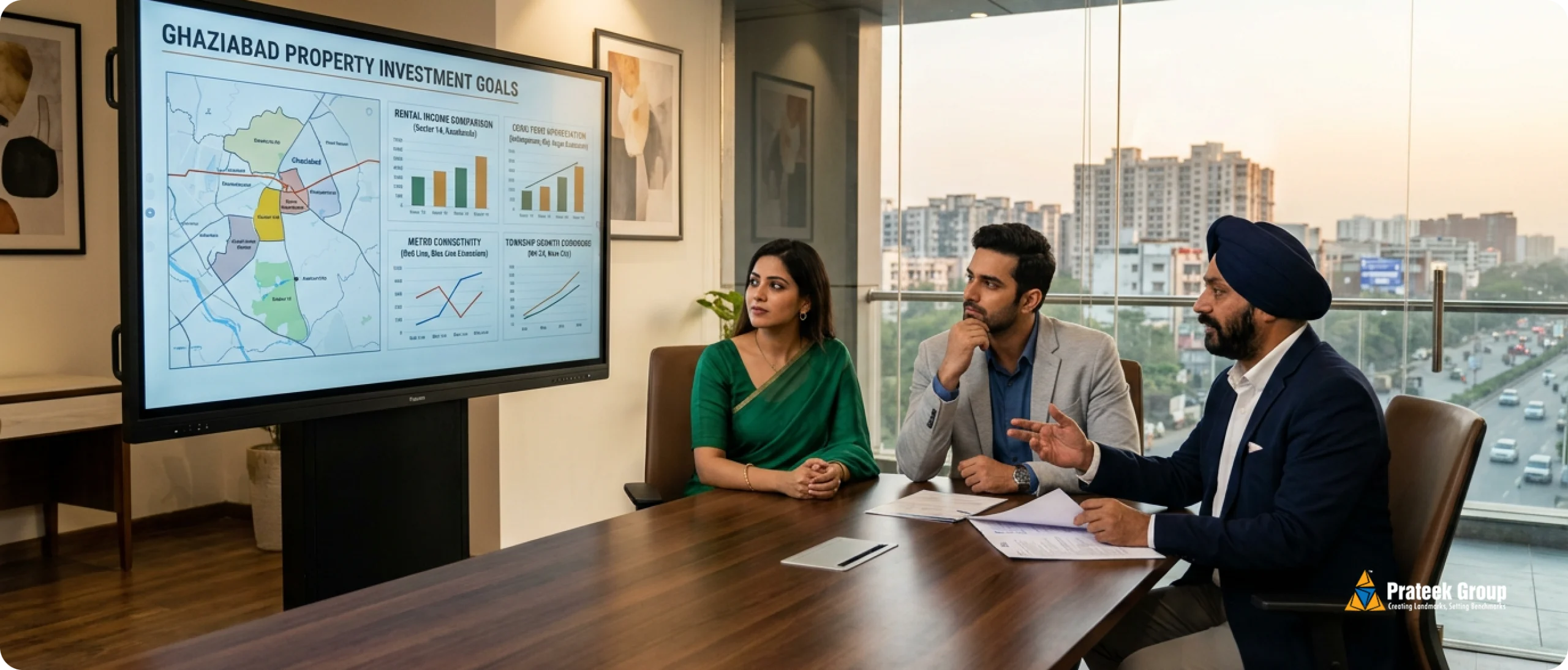
A good property decision starts with honesty. Are you buying for your family, or are you buying for returns? Are you planning to move in within 6 months, or can you wait 5 years? Do you want rental income soon, or are you comfortable holding the property while the area grows?
That is where Ghaziabad property investment becomes personal.
For end-users, Brownfield locations can feel safer because daily life is already active. Schools, hospitals, markets, metro access, local transport, and service support are easier to judge. You don’t have to imagine the area after 5 years. You can visit it this weekend and see how it works.
For investors, Greenfield development in Ghaziabad can still make sense when the entry price is reasonable and the infrastructure story is visible on the ground. Growth corridors near RRTS influence zones, NH-24, NH-9, and newer township belts may offer better long-term upside if demand keeps moving in that direction.
But don’t buy only because someone says “this area will boom.”
Ask sharper questions:
- Are people actually moving into nearby projects?
- Are shops, schools, and clinics opening?
- Is public transport usable today?
- Are resale transactions happening?
- Is rental demand forming, or only being promised?
- Is the project RERA registered?
- Are roads and drainage already working?
ANAROCK’s NCR Residential Market Viewpoints Q2 2025 reported that Ghaziabad held a 20% share of NCR housing sales in that quarter, after Gurugram and Greater Noida. That shows stronger buyer activity, but it also means buyers need to compare micro-markets carefully instead of treating the whole city as one investment zone. (ANAROCK NCR Residential Market Viewpoints Q2 2025)
If you want rental stability, mature Brownfield locations may fit better. If you want a longer holding period and can tolerate area-level growth pains, Greenfield belts may work better.
The better investment is the one that matches your timeline.
How RRTS, NH-24, NH-9, and Ghaziabad Master Plan 2031 change the decision?
Infrastructure changes the real estate map slowly, then suddenly. A road improves. A station opens. Travel time drops. Families who earlier ignored a location start visiting projects there. Brokers begin quoting new rates. Shops open. Schools follow. Then the “far” location starts feeling normal.
This is why RRTS corridor Ghaziabad, NH-24, NH-9, the Delhi Meerut Expressway, and Ghaziabad Master Plan 2031 matter so much in this discussion.
Housing.com’s guide on Ghaziabad Master Plan 2031 says the plan is GIS-based and includes 2 Special Development Areas and 7 RRTS influence zones. That gives buyers a better idea of where planned residential, commercial, and transit-linked growth may move in the coming years. (Housing.com guide to Ghaziabad Master Plan 2031)
The Namo Bharat corridor is another big reason buyers are looking at Ghaziabad differently. Outlook Money reported that housing demand is being reshaped around the corridor, with projects being planned closer to stations and stronger buyer interest around NH-24 and Wave City-side locations. (Outlook Money report on Namo Bharat corridor)
But infrastructure should be checked in real life, not only on maps.
Before buying, visit the route during office hours. Check how long it takes to reach Delhi, Noida, Meerut Road, or the nearest metro/RRTS access point. A project may look well connected online, but one bad stretch, one narrow entry road, or one unfinished flyover can change your daily experience.
For Greenfield belts, infrastructure can create value over time.
For Brownfield locations, infrastructure can protect value because mature areas become even stronger when commute options improve.
That is why Greenfield vs Brownfield Development in Ghaziabad is not a fixed answer. RRTS, NH-24, NH-9, and the master plan can tilt the decision depending on where the project sits, how soon you need possession, and what kind of buyer demand the area is already seeing.
Buyer checklist before choosing Greenfield or Brownfield property in Ghaziabad
Before you choose any property in Ghaziabad, check these points properly:
What to check | Why it matters |
RERA registration | Confirms basic project registration details |
Builder delivery record | Helps you judge possession risk |
Current road access | Shows how livable the location is today |
Distance from schools and hospitals | Matters for family use and rental demand |
Metro or RRTS access | Can affect commute and resale value |
Occupancy status | Shows whether people are actually living there |
Maintenance cost | Affects monthly affordability |
Water and power backup | Daily comfort depends on this |
Parking | Mature areas often struggle here |
Resale demand | Shows whether the market accepts the location |
Registry and title clarity | Protects you from legal problems |
For homebuyers in Ghaziabad, the checklist should start with daily life. For investors in Ghaziabad, it should start with demand, holding period, and exit options.
A good deal should not need blind faith. It should make sense after 2 site visits, document checks, and a hard look at your own needs.
Final Verdict: should you choose Greenfield or Brownfield property in Ghaziabad?
Greenfield vs Brownfield Development in Ghaziabad comes down to one simple choice: do you want future growth or ready convenience?
Greenfield locations may suit buyers who can wait, track infrastructure, and hold the property for a longer period. Brownfield locations may suit families who want daily services, rental demand, and a tested neighbourhood from the start.
For Ghaziabad property investment, don’t follow the loudest pitch. Follow the facts on the ground. Visit the area. Check the commute. Read the RERA details. Compare rental demand. See whether people are actually living there.
A good Ghaziabad property should pass 2 tests: can you live there comfortably today, and will the location still make sense 5 years from now?
FAQs on Greenfield vs Brownfield development in Ghaziabad
What is Greenfield development in Ghaziabad?
Greenfield development in Ghaziabad means new real estate growth on largely undeveloped or underdeveloped land. It is usually seen in newer township belts, growth corridors, and planned expansion areas where roads, housing, retail, and public services are still taking shape.
What is Brownfield development in Ghaziabad?
Brownfield development in Ghaziabad means new construction, redevelopment, or upgrades inside already-developed areas. These locations usually have existing roads, schools, markets, hospitals, metro access, and tenant demand, but they may also face congestion and older infrastructure pressure.
Which is better for homebuyers in Ghaziabad, Greenfield or Brownfield?
Brownfield usually suits buyers who want life to work from day 1: school, commute, market, hospital, and rental demand. Greenfield may suit buyers who want newer layouts, more open planning, and can wait for the area to mature.
Which is better for investors in Ghaziabad?
For investors, Greenfield projects in Ghaziabad may offer stronger long-term appreciation if infrastructure arrives as planned. Brownfield locations may give better rental demand and resale comfort. A short-term investor may prefer mature areas, while a patient investor may look at growth corridors.
Is Wave City Ghaziabad a Greenfield development area?
Wave City Ghaziabad is commonly viewed as a Greenfield-style township because it is built around large-scale planned development on the NH-24 belt. Buyers should still check current occupancy, road access, nearby services, and resale activity before investing.
Is Indirapuram a Brownfield market?
Yes, Indirapuram is a mature Brownfield-style market. It already has malls, schools, hospitals, road access, rental demand, and working social infrastructure. Buyers should still check parking, building age, traffic, and society maintenance before finalising a property.
How does the RRTS corridor affect Ghaziabad property investment?
The RRTS corridor can improve travel comfort and make some locations more attractive for homebuyers and investors. Outlook Money reported that housing demand is being reshaped around the Namo Bharat corridor, especially around station-linked and NH-24-side growth areas. (Outlook Money report on Namo Bharat corridor)
How does the RRTS corridor affect Ghaziabad property investment?
The RRTS corridor can improve travel comfort and make some locations more attractive for homebuyers and investors. Outlook Money reported that housing demand is being reshaped around the Namo Bharat corridor, especially around station-linked and NH-24-side growth areas. (Outlook Money report on Namo Bharat corridor)
Are Greenfield projects riskier than Brownfield projects?
Greenfield projects can carry area-level risk because roads, retail, schools, hospitals, and occupancy may still be developing. Brownfield projects carry different risks, such as older buildings, traffic, parking pressure, and higher maintenance issues. The risk is different, so the checks should be different too.
Do Brownfield areas give better rental income?
Brownfield areas often have stronger rental demand in Ghaziabad because tenants prefer working locations with transport, markets, schools, offices, and services nearby. Rental income still depends on the exact society, unit condition, rent level, and tenant profile.
What should buyers check before investing in Ghaziabad real estate?
Buyers should check RERA registration, builder delivery record, road access, metro/RRTS connectivity, schools, hospitals, occupancy, maintenance cost, water supply, parking, title clarity, resale demand, and rental potential. A low price should never replace proper due diligence.