
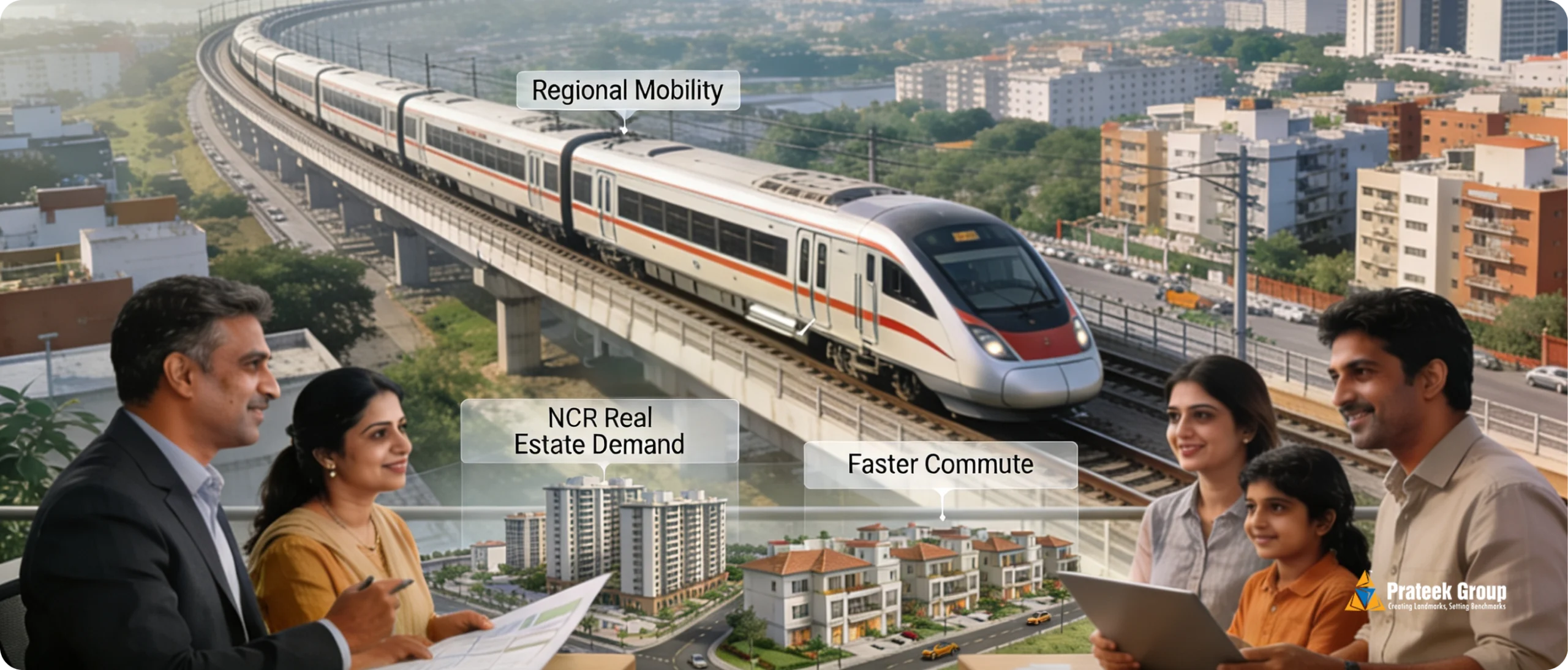
Delhi Meerut RRTS real estate impact: NCR buyers have started reading the map differently
Did you travel from Delhi to Meerut today, or from Meerut to Delhi?
It’s the tired return home. The missed dinner. The weekend that starts with recovery instead of rest. For years, NCR property decisions were shaped by one painful question: “How long will the daily travel take?”
A home could be bigger, newer, and better priced, but if the commute felt punishing, buyers usually stepped back.
The Delhi-Meerut RRTS is changing that conversation. According to NCRTC’s official corridor details, the 82-km Delhi-Ghaziabad-Meerut corridor connects Delhi, Ghaziabad, and Meerut through 16 Namo Bharat stations, with 9 more stations linked to Meerut MRTS integration.
That scale matters because this is no small local upgrade. It is a regional mobility spine running through some of NCR’s most active housing belts.
This is where the Delhi Meerut RRTS real estate impact becomes visible. Buyers who once looked only at Delhi, Noida, or central Ghaziabad are now comparing homes around Sahibabad, Duhai, Muradnagar, Modinagar, Meerut South, and other station-linked areas.
The change is practical. A family may still want a larger home, a better society, cleaner planning, and a price that doesn’t feel stretched. Faster regional travel now gives them more room to consider locations that earlier felt too far.
Established housing belts in Ghaziabad, especially around Siddharth Vihar, Indirapuram, Sahibabad, Raj Nagar Extension, and NH-9-linked areas, may get viewed differently as buyers compare ready social infrastructure with faster regional travel.
In NCR, convenience often becomes the first price trigger. Once travel feels more predictable, buyers start accepting locations they earlier rejected.
Namo Bharat has cut travel time, but the real story is what buyers do next
Ask any NCR buyer what hurts more: the price of the flat or the travel after buying it?
Most will pause.
Because a cheaper home stops looking cheap when daily travel eats 3 hours of your life.
That is exactly where the Namo Bharat real estate impact starts to feel real. The Delhi-Ghaziabad-Meerut corridor is built for faster regional movement, with Namo Bharat trains designed for 160 kmph operations and a starting frequency of 15 minutes, according to NCRTC’s official project information.
Think about what this means for a buyer in Meerut.
Earlier, Delhi access sounded good on paper. In real life, the travel was tiring. Now, when Delhi to Meerut movement is being discussed in the range of about an hour after the full corridor launch, the mental distance between the two cities shrinks.
The Times of India report on the full launch also connected the travel-time cut with a fresh push for property demand along the corridor.
Now bring this down to a buyer’s level.
A Meerut family can think about a larger home without feeling fully cut off from Delhi. A Ghaziabad buyer can compare station access with existing metro and road links. A tenant can judge rent and commute cost together, which is often how real housing choices are made.
These are practical shifts. They shape the Delhi Meerut RRTS property demand story better than any sales pitch.
The smarter buyer won’t just ask, “Is the RRTS nearby?”
They’ll ask, “Can I reach the station easily every day?”
That one question may decide which projects gain real demand and which ones only use the RRTS name in advertising.
RRTS impact on NCR real estate: some locations will gain, some will only make noise
Every big infrastructure project creates excitement. NCR has seen this before.
A new expressway comes in, land rates jump, brokers get louder, and suddenly every project claims to be “well connected.” Buyers have become sharper now. They know the difference between actual access and a clever sales pitch.
The RRTS impact on NCR real estate will work in the same way. Areas with strong station access, good roads, social infrastructure, and liveable neighbourhood planning will gain more steadily.
Areas that are far from stations or weak on basics may still see price talk, but demand may take longer to hold.
Here’s where the market starts splitting.
Hindustan Times reported that the fully operational Delhi-Meerut RRTS corridor is expected to support regional mobility, real estate demand, and transit-oriented growth along the route. The same report cited PropEquity data showing 131% price growth in Ghaziabad and 54% growth in Meerut over 4 years.
Ghaziabad already had housing, schools, malls, hospitals, and office access. The RRTS adds another layer of confidence. Sahibabad, Ghaziabad, Guldhar, and Duhai are becoming part of a faster regional movement belt.
Meerut has a different story. The city has land, local demand, and improving rail access. Its real test will be how quickly station-side areas get better roads, cleaner planning, and stronger daily services.
Then come Muradnagar and Modinagar. These places may attract buyers who want lower entry prices and better future upside. The catch is simple: lower price alone can’t carry a property decision. Families still need schools, markets, healthcare, safety, and reliable last-mile connectivity.
The Delhi Meerut corridor real estate market will rise unevenly.
Some pockets will become proper residential markets. Some will see rental demand first. Some may stay investor-heavy for a while. A few may ride the RRTS buzz without giving buyers enough comfort on the ground.
For readers tracking NCR property, this is the main filter: don’t follow the corridor blindly. Follow the daily-use value around each station.
Ghaziabad property demand RRTS: the market is hot, but buyers need to compare smarter
Ghaziabad was never waiting for RRTS to become a housing market. It already had buyers.
The RRTS simply gives those buyers another reason to stay interested.
It already had the base: housing societies, schools, hospitals, malls, NH-9 access, metro links, and a large working population that moves between Delhi, Noida, and Ghaziabad every day. The RRTS adds faster regional travel to that existing setup.
But here’s the question buyers should ask:
Will every Ghaziabad project gain equally from the RRTS?
Probably not.
The Namo Bharat station information includes Sahibabad, Ghaziabad, Guldhar, Duhai, and Duhai Depot on the Ghaziabad side. These stations matter because they bring faster rail access into areas where housing demand was already active.
How Ghaziabad pockets compare after RRTS
Location | Why buyers are watching it | What to compare |
Sahibabad / Indirapuram side | Strong Delhi access, metro links, malls, dense housing belt | Ready societies, resale rates, parking pressure, and actual travel to the RRTS station |
Siddharth Vihar | NH-24/NH-9 access, large housing supply, proximity to Indirapuram | Prateek Grand City, Gaurs Siddhartham, local resale stock, road condition, and civic upkeep |
Raj Nagar Extension | More affordable than Indirapuram and many Noida pockets | Station access, road congestion, tenant demand, and daily travel towards Delhi |
Duhai / Guldhar belt | Closer to RRTS movement, more future-led demand | Social infrastructure, safety, local market depth, and end-user activity |
For a fair comparison, buyers should look at more than one Ghaziabad pocket instead of judging the market from a single project. In Siddharth Vihar, buyers can compare projects such as Gaurs Siddhartham, which is located on NH-24 and, as mentioned on its official website, offers 2 BHK and 3 BHK homes with RERA number UPRERAPRJ3935. Prateek Grand City is also located in Siddharth Vihar, close to Indirapuram and NH-24, with Grand Carnesia and Grand Paeonia listed on the official Prateek Group page. Another option is Saya Gold Avenue in Vaibhav Khand, Indirapuram, next to NH-9, where the official website mentions 2, 3, and 4 BHK ready-to-move homes.
Buyers should also verify the RERA details directly on the UP RERA official website before making any booking decision.
Ask sharper questions.
- How many minutes to the station in peak traffic?
- Is there a direct road?
- Does the locality already have schools and daily shops?
- Will tenants prefer this address?
- Is the builder’s handover record clean?
That is where the Delhi Meerut RRTS property demand story becomes more useful. The best-performing pockets may be the ones that combine RRTS access with liveable neighbourhood planning.
The weakest pockets may only gain on paper.
And paper gains don’t help much when the service road is broken.
What is the Delhi-Meerut RRTS route, and why are property buyers suddenly interested?
The Delhi-Meerut RRTS route is India’s first major regional rapid rail corridor built to cut travel time between Delhi and Meerut. NCRTC’s project details place the corridor length at 82 km, with 16 Namo Bharat stations and 9 additional Meerut MRTS stations.
That simple number, 82 km, explains why the Delhi Meerut RRTS route real estate story is bigger than one city. The corridor runs through Delhi, Ghaziabad, and Meerut, touching areas that already had housing demand but needed stronger travel confidence.
For buyers, the route is useful because it connects work, family life, education, healthcare, and business movement in a cleaner way.
A person living in Meerut can think about faster access towards Delhi. A buyer in Ghaziabad can look at station-side pockets with better long-term confidence. A tenant working across NCR can compare rent and travel cost together, instead of looking only at distance.
The Namo Bharat system is built for faster regional movement, with trains designed for 160 kmph operations and a starting frequency of 15 minutes, as mentioned by NCRTC on its official project page.
This is why the Namo Bharat corridor is getting serious attention from homebuyers and investors. Property demand usually follows convenience.
Once a corridor makes daily movement easier, nearby housing markets start getting revalued, street by street, station by station.
Buyers comparing ready housing in Ghaziabad can also review established residential options in Siddharth Vihar, including Prateek Grand City, while comparing it with other projects and resale options in the same belt.
Meerut real estate growth: the city is getting a bigger buyer pool
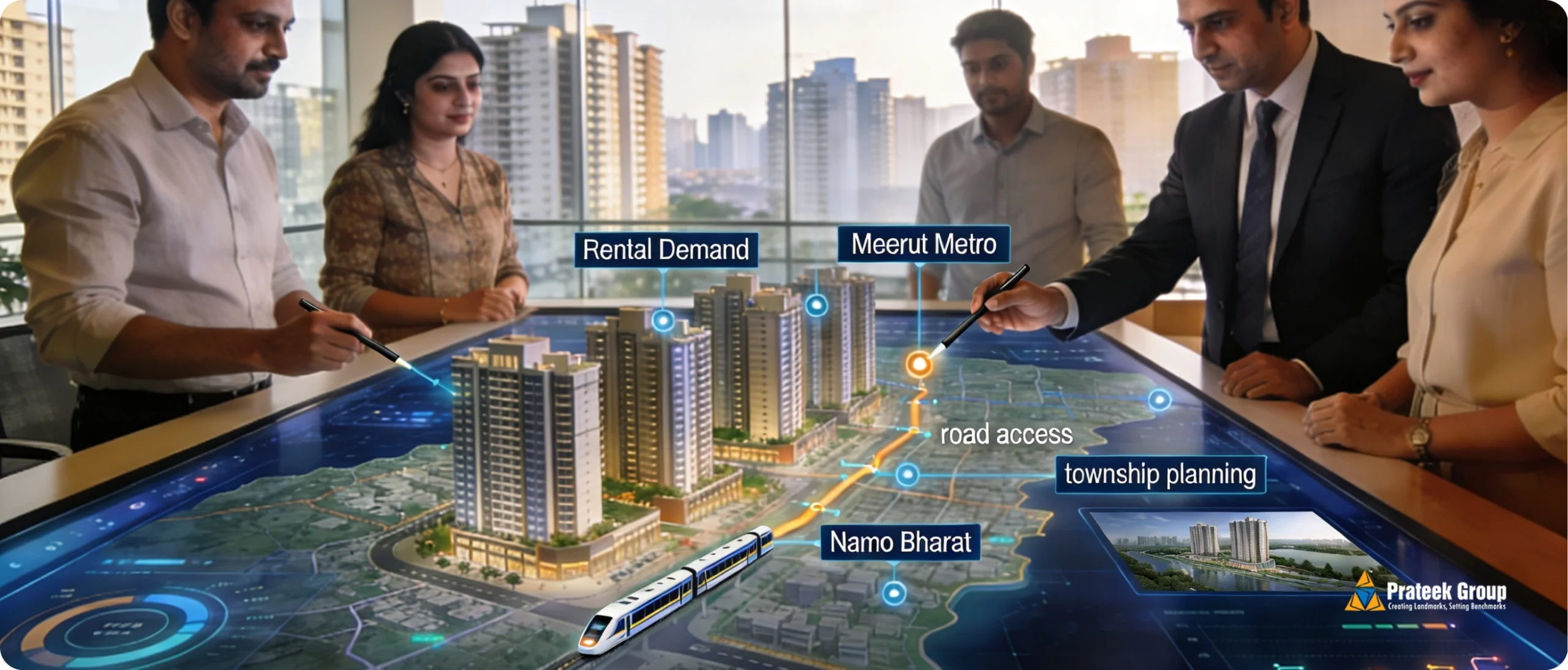
Meerut’s property market has always had local strength. The interesting part now is that it may no longer remain only a local market.
Local families bought homes there. Business owners bought land there. People with roots in western UP stayed connected to the city.
Now the buyer pool is widening.
The Meerut real estate growth story after Namo Bharat and Meerut Metro is about one big shift: Meerut is becoming easier to consider for people who still need strong Delhi-Ghaziabad access.
NCRTC’s interactive map says Meerut Metro service starts from Meerut South and goes up to Modipuram. Meerut South works as a shared point for Namo Bharat and Meerut Metro services, which gives it a stronger role in the city’s property conversation.
Meerut pockets buyers may track
- Meerut South: Useful for people entering or exiting the city through the Delhi side. Station access can shape housing and rental demand here.
- Shatabdi Nagar: A planned residential belt that appears in the Namo Bharat station sequence and may gain from better intra-city movement.
- Partapur and Rithani: Likely to attract buyers who want stronger access between Meerut and the wider corridor.
- Begumpul and Brahmpuri: Older city-side areas where metro access may improve daily movement, though congestion will still matter.
- Modipuram and Pallavpuram: Already known residential belts with highway access, schools, and healthcare around them.
The Times of India report on Meerut metro-linked zones listed Pallavpuram as one of the Meerut areas benefiting from metro connectivity, noting its location near national highways and its residential appeal.
Here, buyers should compare established and emerging pockets more carefully.
Meerut-side pocket | What it brings | What buyers should check |
Meerut South belt | Stronger Delhi-side entry and exit point | Station distance, resale demand, road access |
Shatabdi Nagar | Planned residential character and station-side interest | Approval status, civic services, local demand |
Partapur / Rithani | Corridor movement and possible lower entry cost | Last-mile travel, neighbourhood maturity |
Modipuram / Pallavpuram | Existing residential base, highway access, daily services | Traffic, rental depth, maintenance standards |
The Meerut Metro real estate impact may first show up through rental interest and end-user confidence. Investors often move early, but families move when daily life looks workable.
And that is Meerut’s real test.
Can the areas around stations give buyers more than a faster train? Can they give clean roads, reliable power, decent markets, school access, and safe evening movement?
If yes, Delhi Meerut corridor real estate demand may pull Meerut into a much larger NCR housing conversation. If the city only gets speed without better ground-level planning, the growth may stay uneven.
Muradnagar and Modinagar real estate demand: cheaper today, but will it feel liveable tomorrow?
Muradnagar and Modinagar sit in the middle of the Delhi-Ghaziabad-Meerut movement belt. That position gives them a clear advantage.
Buyers priced out of central Ghaziabad may look here for bigger homes, plotted options, and lower entry prices.
The Namo Bharat station list includes Murad Nagar, Modi Nagar South, and Modi Nagar North on the route, which puts these towns directly inside the rapid rail corridor.
But price alone can’t sell a location forever. Families still ask simple questions.
Is the road safe at night? Are schools nearby? Can parents reach a hospital quickly? Will daily groceries, coaching centres, and local markets be easy to access?
Modinagar real estate demand may rise, but only the better-connected pockets will hold long-term buyer trust.
Muradnagar has a slightly different pull. It sits between Ghaziabad and Modinagar, so it may attract people who want corridor access without entering Meerut’s deeper city stretch.
The Muradnagar property market may also see interest from smaller investors because early-stage locations often look more affordable before large-scale price movement settles in.
This is where the sales pitch and the real commute separate.
If a project is 8-10 km from the station and the road is weak, the RRTS benefit becomes thinner. The phrase “RRTS-connected” sounds nice, but the real test is the last 15 minutes of your daily travel.
NCRTC’s official website has also discussed last-mile connectivity and feeder access around the Delhi-Ghaziabad-Meerut corridor, which shows how important station access is beyond the train itself.
For buyers, RRTS corridor investment in these mid-corridor towns should be judged with 4 checks: actual station travel time, road width, social infrastructure, and resale demand.
A lower price can be attractive, but a liveable address usually wins over time.
Property near Namo Bharat stations: “near” is the most misused word in real estate
Every buyer has seen this line: “Just minutes from the station.”
But how many minutes? In peak traffic or Sunday afternoon traffic? By car, auto, e-rickshaw, or on foot?
That is why property near Namo Bharat stations needs a more practical definition. A home may look close on Google Maps, but daily travel can feel very different when service roads are narrow, autos are irregular, parking is messy, or the route crosses a busy highway.
Brokers may sell distance in kilometres. Buyers live distance in minutes.
What “good station access” should actually mean
Buyer check | Why it matters |
10-15 minute real travel time | This is more useful than a loose kilometre claim |
Clean feeder access | Autos, e-rickshaws, buses, and drop-off points decide daily comfort |
Safe walking or pickup route | Evening travel matters for families, students, and working women |
Road quality | A short distance can still feel tiring if the road is broken or congested |
Nearby daily services | Markets, clinics, schools, and pharmacies make a location easier to live in |
NCRTC’s project details mention that waiting time and interchanges can discourage public transport use, and the Delhi-Ghaziabad-Meerut corridor is planned with wider regional movement in mind. This is a useful reminder for buyers.
A fast train is powerful, but the full journey matters.
So, when you hear station-linked housing demand, don’t just think of flats beside the track. Think of the full daily chain: home to station, station to destination, and destination to office or market.
The strongest Delhi Meerut RRTS property demand will likely come from places where this chain feels smooth.
There’s another point many buyers miss. Station-side locations can become noisy, crowded, and more commercial over time.
That may help rentals, but it may not suit every family.
Delhi Meerut rapid rail property prices: the jump is real, but don’t buy only because rates moved up
Property prices along the corridor have already started reacting. Times of India reported that locations within 2 km of Namo Bharat stations saw price growth of 30% to 67% over 2 years, based on industry estimates.
That is a strong rise, especially for buyers who entered early.
But here’s the uncomfortable part.
A rising market doesn’t make every purchase smart. Delhi Meerut rapid rail property prices can move fast near station belts, but the final value still depends on road access, builder delivery, local demand, rental depth, and how liveable the area feels after 8 pm.
Hindustan Times also reported PropEquity data showing 131% price growth in Ghaziabad and 54% growth in Meerut over 4 years. That tells you the corridor is already being priced differently by the market.
Ghaziabad has a larger ready housing base. Meerut has more room for fresh growth. These two markets are moving for different reasons, even though the corridor connects them.
What buyers should read behind the price rise
Price signal | What it may mean | What you should check |
Sharp rise near stations | Early demand is entering station-linked pockets | Is the price backed by real end-users or only investor talk? |
Higher rates in Ghaziabad | Existing infrastructure is supporting faster absorption | Is the location close to daily-use roads, metro, schools, and hospitals? |
Land price movement in Meerut | Future expectations are getting priced in | Are approvals, roads, and civic services clear? |
Rental demand claims | Commuters may prefer easier station access | Are tenants actually asking for that micro-market today? |
Meerut has also seen noticeable land-rate movement. Hindustan Times reported local market estimates where land prices moved from around ₹8,000-12,000 per sq yd to ₹12,000-20,000 per sq yd in recent years.
That’s a big shift for a market that earlier depended more on local buyers.
So, what should you do as a buyer?
Use the Delhi Meerut RRTS real estate impact as one filter, not the full decision. A good location near the RRTS may age well. A weak location with only a “rapid rail nearby” claim may become expensive before it becomes useful.
The smarter move is simple: compare the current price with actual daily comfort.
If the station is close but the last-mile route is poor, you may be paying today for a benefit you won’t enjoy properly tomorrow.
Transit Oriented Development NCR: the next big shift may happen around stations, not highways
For years, NCR real estate grew around highways. Expressways, wide roads, and flyovers carried the story.
Now stations may start carrying more weight.
That’s where Transit Oriented Development NCR becomes important. In simple words, TOD means planning homes, shops, offices, public spaces, and daily services around transit points so people don’t have to depend on long road trips for everything.
Meerut is already moving in that direction. Economic Times Infra reported that Meerut Development Authority earmarked about 3,273 hectares for TOD, with 2,442 hectares marked into 7 TOD zones and 2 special development area zones around the Namo Bharat and Meerut Metro corridors.
This matters because the Delhi Meerut RRTS route real estate story can’t depend only on faster trains. A station becomes powerful when the area around it is planned well.
What TOD can change for buyers
TOD element | Why it matters for real estate |
Housing near stations | Makes daily commuting easier for working families |
Retail and markets | Helps residents avoid long travel for basic needs |
Offices and small business spaces | Creates local employment and rental demand |
Walkable public areas | Makes station-side pockets feel safer and more usable |
Better zoning | Reduces random growth around major transit points |
But TOD is a planning promise first. Buyers still need to check what has actually been approved, what is under construction, and what is only being discussed.
The Namo Bharat corridor gives NCR a chance to build cleaner station-side growth. The best results will come where transport planning, local roads, civic services, and housing supply work together.
For investors, TOD zones may sound exciting. For families, the question is more direct: will this place make everyday life easier?
That is the real test for the next phase of the NCR property market.
Residential, rental, and commercial demand: the corridor is pulling different types of money
The Delhi Meerut corridor real estate market is moving because different kinds of buyers, tenants, and businesses are entering the conversation.
Families want bigger homes. Tenants want easier travel. Small businesses are watching station footfall.
That mix is what makes the corridor interesting.
How demand may change across the corridor
Demand type | Who is driving it | Where it may show first | What can slow it down |
Residential demand | Families priced out of Delhi, Noida, and prime Ghaziabad | Ghaziabad, Duhai, Meerut South, Modipuram | Weak last-mile travel, poor roads, thin social infrastructure |
Rental demand near RRTS | Office workers, students, service staff, daily commuters | Sahibabad, Ghaziabad, Meerut South, Begumpul | Low tenant activity outside station belts |
Commercial real estate demand | Retailers, clinics, coaching centres, food outlets, offices | Around busier stations and TOD zones | Slow civic planning, random parking, low walking traffic |
For homebuyers, the RRTS gives one strong comfort: distance feels less scary when travel is faster. NCRTC’s interactive route information shows how the Delhi-Ghaziabad-Meerut corridor connects major Namo Bharat and Meerut Metro stations across the route.
But ask yourself this before buying: will your family actually use the station every week?
If yes, property near Namo Bharat stations can make sense. If the answer is no, don’t pay a heavy “RRTS premium” only because a brochure says the corridor is nearby.
Rental demand may be the quicker story in some locations. Tenants often move faster than end-users because they test a location before committing to it.
A working professional may rent near Sahibabad or Ghaziabad if it saves daily travel time. A student or young worker may prefer Meerut South or Begumpul if the station cuts down long road travel.
Commercial demand will take longer. Shops, food outlets, clinics, small offices, and service businesses follow repeat footfall.
Times of India recently reported that the Delhi-Ghaziabad-Meerut Namo Bharat corridor crossed 3 crore passenger journeys within months of full commissioning, which shows strong commuter use across NCR.
That ridership number matters. More riders mean more station activity. More activity can bring better retail and rental interest.
Still, this growth won’t be equal everywhere. A station with clean access, parking, feeder transport, and nearby housing will perform better than a station surrounded by broken service roads and scattered development.
RRTS corridor investment: what buyers should check before booking property
The RRTS corridor investment story sounds exciting, but real estate punishes lazy decisions.
A fast train can lift a location. It can’t fix every weak project, poor road, unclear title, or badly planned neighbourhood.
So before you book anything along the Delhi-Meerut RRTS belt, slow down and check the ground reality.
Buyer checklist before investing near the RRTS
What to check | Why it matters |
Actual station travel time | A 3 km distance can feel long if traffic, turns, and road cuts are bad |
Last-mile connectivity | Autos, feeder buses, e-rickshaws, and safe pickup points decide daily comfort |
RERA registration | Project approvals, timelines, and carpet area details need to be verified |
Builder delivery record | Past possession history says more than sales-office promises |
Local resale demand | A good investment should have buyers beyond one market cycle |
Rental demand | Talk to brokers and tenants, not only sales teams |
Road width and drainage | These decide daily pain during peak hours and monsoon |
Schools and hospitals | Families don’t buy only for trains |
Maintenance cost | Low entry price can hurt later if upkeep is poor |
Price gap from nearby pockets | Don’t overpay for future growth that is already priced in |
NCR has seen this movie before. A new road or metro line gets announced, prices jump, and buyers rush in. Some make good gains. Some get stuck in locations where the promised growth takes years.
The Delhi Meerut RRTS property demand is stronger in places where transport, housing, and daily services meet. Ghaziabad has an advantage because many parts already have schools, hospitals, malls, and ready homes.
Meerut has room to grow, but station-side planning and civic work will decide how fast that growth turns into real buyer confidence.
Last-mile travel deserves special attention. A Times of India report on the Ghaziabad RRTS station noted that the planned foot overbridge to Shaheed Sthal New Bus Adda metro station was still pending, forcing commuters to depend on e-rickshaws or three-wheelers for a short connection.
That shows how even a small missing link can affect daily use.
So, don’t ask only, “Is it near RRTS?”
Ask better questions.
- Can I reach the station safely?
- Will tenants want this address?
- Is the price still fair compared with similar areas?
- Can my family live here comfortably without waiting 5 years for basics?
That is how homebuyers in NCR should read the RRTS corridor.
Conclusion: the Delhi-Meerut RRTS can change NCR real estate, but the best gains will be selective
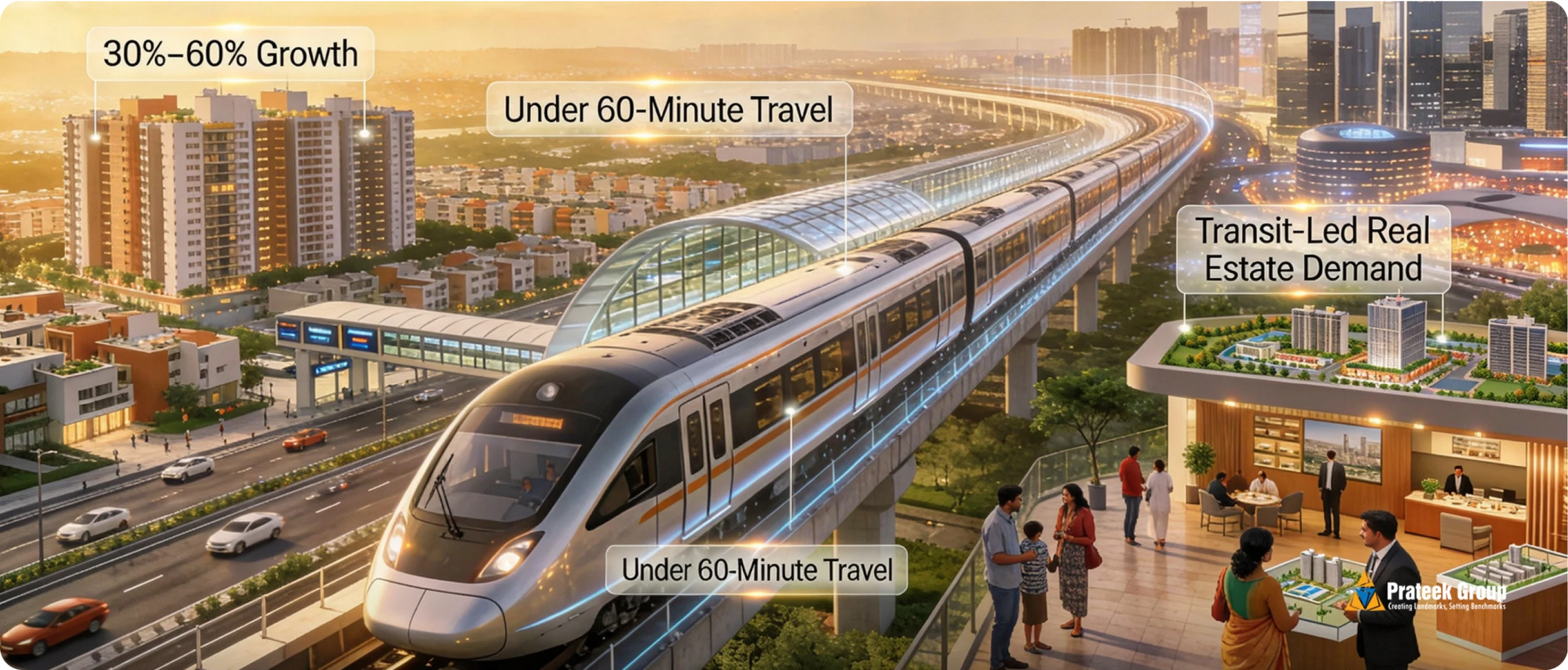
The Delhi Meerut RRTS real estate impact is already visible in buyer interest, station-side price movement, and stronger attention towards Ghaziabad, Muradnagar, Modinagar, and Meerut.
The corridor has made one thing clear: NCR buyers are ready to look beyond old comfort zones when travel becomes easier.
But the best property decisions will still come from ground checks. Station distance, road access, social infrastructure, legal clarity, rental demand, and project quality will decide which locations age well.
Hindustan Times reported that property prices near stations like Modipuram and Shatabdi Nagar have already seen 30% to 60% growth, while the corridor has brought Delhi travel time for Meerut closer to under 60 minutes.
That kind of data explains why the market is excited.
But excitement alone shouldn’t guide a purchase.
The RRTS impact on NCR real estate will be strongest in pockets where daily life improves, not just where prices rise. A good home still needs clean access, safety, markets, schools, healthcare, and resale confidence.
The RRTS won’t make every corridor property a smart buy. It will reward the places where the train actually improves daily life.
That is the line buyers need to hold.
Frequently Asked Questions
How will Delhi-Meerut RRTS affect property prices in NCR?
The Delhi-Meerut RRTS can support price growth in station-linked areas because faster travel makes nearby locations more useful for buyers and tenants. Times of India reported 30% to 67% price growth within 2 km of stations over 2 years, based on industry estimates.
Which areas will benefit most from the Delhi-Meerut RRTS?
Sahibabad, Ghaziabad, Guldhar, Duhai, Muradnagar, Modinagar, Meerut South, Shatabdi Nagar, Begumpul, and Modipuram may see stronger interest. The best growth is likely in places with station access, good roads, and daily-use infrastructure.
Is it good to buy property near Namo Bharat stations?
It can be a good choice if the station is easy to reach, the project has clear approvals, and the area already supports daily living. Buyers should check real travel time to the station instead of trusting distance claims in ads.
Will Ghaziabad property demand rise because of RRTS?
Ghaziabad may gain strongly because it already has housing supply, Delhi access, schools, hospitals, metro links, and active residential markets. The RRTS adds another travel option, which can support Ghaziabad property demand RRTS in well-connected pockets.
Will Meerut real estate grow after Namo Bharat and Meerut Metro?
Meerut real estate growth may improve as the city becomes easier to reach from Delhi and Ghaziabad. Areas around Meerut South, Shatabdi Nagar, Begumpul, and Modipuram may see better buyer and rental interest if local infrastructure keeps pace.
Is Modinagar a good investment after RRTS?
Modinagar may attract buyers looking for lower entry prices along the corridor. But Modinagar real estate demand will depend on station access, road quality, schools, hospitals, local jobs, and resale demand.
Is Muradnagar property market worth tracking?
Yes, the Muradnagar property market is worth tracking because it sits between Ghaziabad and Modinagar on the rapid rail corridor. Buyers should still check local infrastructure, safety, and last-mile travel before paying a premium.
What is Transit Oriented Development in NCR?
Transit Oriented Development means planning homes, shops, offices, and public spaces around public transport stations. Economic Times reported that Meerut Development Authority has earmarked about 3,273 hectares for TOD around the Namo Bharat and Meerut Metro corridors.
Can RRTS improve rental demand near stations?
Yes, rental demand near RRTS can grow where commuters, students, workers, and families find station access useful. The strongest rental pockets will likely be near busy stations with safe roads, feeder transport, markets, and good housing supply.
What should buyers check before investing near the RRTS corridor?
Buyers should check actual station distance, last-mile connectivity, RERA registration, builder track record, road quality, local resale demand, rental activity, schools, hospitals, and price comparison with nearby areas.