
For NRIs comparing Indian real estate in 2026, the choice often narrows to NCR, Bangalore, and Pune. Each market has a clear reason to stay on the list. Bangalore continues to draw tenants through its technology-led job base, while Pune remains attractive for its education, auto, manufacturing, and IT mix. NCR, however, is being judged differently now because several corridors are gaining from infrastructure-led demand, wider housing choices, and relatively better space for the same investment budget.
The difference in 2026 is the way these factors are coming together. A stronger foreign-currency position still gives many NRIs better buying capacity in India, while NCR’s major infrastructure story has moved beyond announcements. Noida International Airport, RRTS-led regional movement, expressway upgrades, and metro-linked growth are changing how buyers evaluate Noida, Greater Noida, Ghaziabad, and nearby corridors. At the same time, several mature pockets of Bangalore and Pune have already absorbed a large part of their price growth, making future appreciation more selective.
This blog does not treat one city as the automatic winner. Instead, it compares cost, usable space, rental logic, and the 12–18% appreciation potential in select NCR corridors so NRIs can match the market with their actual investment goal.
Why NCR Is Back on the NRI Investment Radar in 2026
NCR is drawing renewed attention from NRIs because the investment story now feels more visible on the ground. Better roads, airport-led growth, rapid transit, and township-style development are giving overseas buyers stronger reasons to compare NCR seriously with Bangalore and Pune.
NCR’s Shift From Scattered Growth to Corridor-Led Development
For many years, NCR had a mixed image among NRI investors. Delayed projects and uneven delivery made buyers cautious, especially those managing property decisions from abroad. However, the market has become more disciplined after RERA, and buyer interest is now moving toward specific corridors rather than scattered locations.
3 Game-Changers:
- Jewar Airport: Noida International Airport has received final security clearance, with commercial flights expected in the first week of June 2026. This is adding stronger confidence around the Yamuna Expressway and nearby Noida-Greater Noida belts.
- RRTS: The Delhi-Ghaziabad-Meerut Namo Bharat corridor is improving regional movement and giving Ghaziabad stronger access-led relevance.
- Aqua Line Extension: Greater Noida West continues to benefit from metro-led planning and better daily connectivity expectations.
Prateek Group’s township planning at Siddharth Vihar suits this interest because many NRI buyers now prefer secure, planned, and self-contained communities instead of isolated standalone projects.
Why Noida, Greater Noida, Ghaziabad, and Gurugram Are Attracting Overseas Buyers
Noida and Greater Noida remain strong because they offer newer housing, wider layouts, and better long-term infrastructure visibility. Sector 150, in particular, continues to stand out for low-density planning and premium residential appeal. Gurugram still attracts NRIs seeking premium rental income, especially from corporate and expat tenants. Meanwhile, Ghaziabad and Siddharth Vihar offer an earlier-entry advantage with expressway access and township-scale growth.
How Infrastructure Is Changing Buyer Confidence
NRIs are no longer looking only at promises. They are looking at functional roads, active transit corridors, and visible airport progress. As a result, the discussion has shifted from “Will this area develop?” to “How much upside is still left?”
Confidence Boosters:
- RRTS improving Delhi-Ghaziabad-Meerut movement
- Jewar Airport nearing commercial operations
- Dwarka Expressway fully operational since June 2025
Why NRIs Are Looking Beyond Only Bangalore and Pune
Bangalore and Pune remain solid markets, but many preferred pockets already carry higher entry costs. Bangalore’s Whitefield and Outer Ring Road belts are still rental-friendly, while Pune’s Hinjewadi and nearby IT locations remain steady.
NCR Edge: The infrastructure story is still unfolding, which leaves room for early-mover advantage in select corridors..
NCR vs Bangalore vs Pune: Cost Advantage for NRIs
For NRIs comparing these three cities, the decision often comes down to how far a fixed budget can stretch. While all markets remain active in 2026, the difference in space, pricing, and lifestyle offering is becoming clearer across NCR, Bangalore, and Pune.
Why NCR Offers Wider Property Choices Across Price Bands
One of the first things NRI buyers notice is how much variation NCR offers within a single region. A similar budget can place buyers in very different segments depending on the micro-market. In practical terms, around ₹1.5 crore in NCR can still translate into a larger 3BHK within a township setup, often with parking, open areas, and shared amenities. This flexibility is harder to match in more tightly priced city markets.
What also stands out is the ability to move across price bands without leaving the region. Buyers can shift from Ghaziabad to Noida or toward Gurugram depending on budget, rental expectations, or long-term plans. As a result, NCR gives NRIs room to adjust decisions without restarting their search entirely.
How Bangalore’s Mature Tech Corridors Affect Entry Cost
Bangalore continues to hold strong demand, especially in established IT corridors. However, entry cost has steadily moved up in these areas. Locations like Whitefield and Outer Ring Road now operate at higher base prices, which means the same investment typically results in smaller unit sizes.
A standard ₹1.5 crore budget in Bangalore often fits within a compact 3BHK or a well-located 2BHK, depending on the project. In addition, buyers need to factor in roughly 8–10% extra for registration, interiors, and finishing. Over time, appreciation remains stable, but the starting point itself is already elevated.
Why Pune Remains Balanced but Selective by Location
Pune presents a more balanced picture, but location plays a key role. Areas like Hinjewadi, Wakad, and Kharadi continue to see steady demand due to IT and employment hubs, while premium zones like Baner and Koregaon Park operate at a higher price bracket.
For NRIs focused on rental income, Pune remains a steady performer with moderate appreciation and consistent tenant demand. However, the trade-off often comes in the form of location-driven limitations, where lifestyle, commute, and project scale vary significantly from one micro-market to another.
Why Larger Homes and Township Living Make NCR Attractive
Many NRI buyers prefer larger homes within planned communities rather than standalone apartment blocks. NCR continues to deliver this format at scale. Integrated townships with schools, clubhouses, green areas, and daily-use infrastructure are more widely available here, especially in Noida, Greater Noida, and emerging Ghaziabad corridors.
Projects like Grand Begonia in Siddharth Vihar reflect this preference, where buyers get access to a more complete living setup within a single development. Compared to Bangalore and Pune, where similar formats often come at a higher cost within premium zones, NCR still offers relatively better value for space and community living.
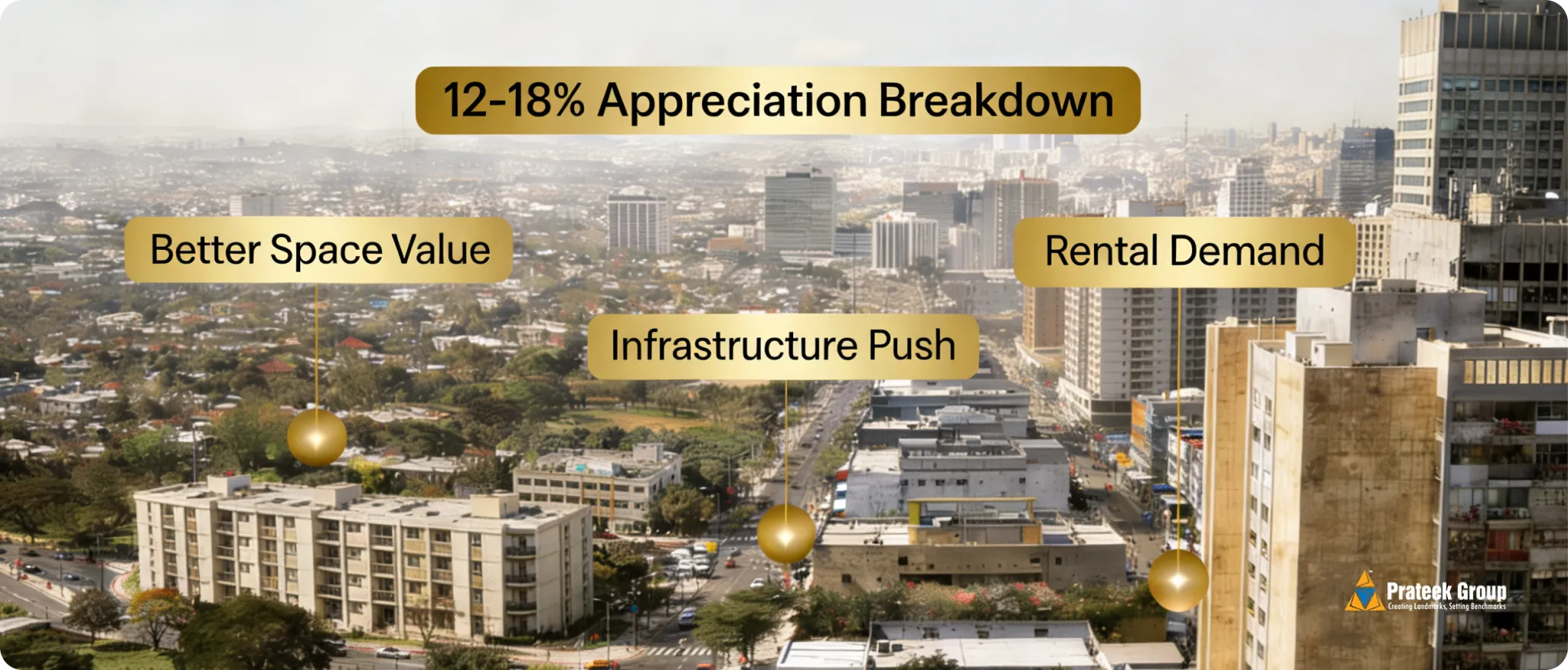
Understanding the 12–18% Appreciation Potential in NCR

NCR’s appreciation story needs careful reading. Some corridors have moved sharply because of infrastructure, better supply, and stronger end-user demand. Even then, NRIs should treat 12–18% as a realistic potential in select pockets, not as a fixed return across every project.
What This Appreciation Range May Mean for NRI Investors
A 12–18% appreciation range usually applies to infrastructure-backed corridors where buyer demand is already visible and future connectivity is still improving. In Noida, for example, property rates in popular sectors, including Sector 150, Noida Expressway, and Noida Extension, have grown by about 10–24% in 2026, according to NoBroker.
This does not mean every property in NCR will perform the same way. A ready project near active infrastructure may appreciate differently from an under-construction project in a weaker pocket. Therefore, NRIs should look at the corridor, delivery status, RERA details, developer record, and resale demand before using 12–18% as an expectation.
Which NCR Corridors May Support Stronger Value Growth
Top 5 Bets:
- Sector 150, Noida: Green surroundings, low-density planning, and FNG/Expressway connectivity make this a strong premium residential pocket. Magicbricks reported that Sector 150 recorded 139% price appreciation, placing it among India’s strongest-performing micro-markets.
- Greater Noida West: Volume demand, metro-linked planning, and improving social infrastructure support steady value growth.
- Yamuna Expressway: Jewar Airport remains the main long-horizon trigger, especially for buyers willing to hold for five to seven years.
- Dwarka Expressway: Prices along this corridor nearly doubled between 2020 and 2024, rising from ₹9,434 per sq. ft. to ₹18,668 per sq. ft., as reported by The Times of India.
- Siddharth Vihar: This Ghaziabad micro-market offers expressway access and township-scale living. Prateek Grand City, including Grand Carnesia and Grand Paeonia, is positioned as a 40-acre ready-to-move township in Siddharth Vihar, while Grand Begonia sits within the same broader township ecosystem as a newer residential option.
Why Appreciation Should Never Be Treated as Guaranteed
Market factors still matter. Interest rates, job growth, project delivery, resale liquidity, and oversupply can affect returns. UP RERA’s 2025 data showed strong NCR registration activity, with Noida and Ghaziabad seeing major project investment, but that also means buyers must study supply carefully.
NRI Discipline:
- Verify UP-RERA timelines
- Check at least three completed projects by the developer
- Keep a five-to-seven-year holding view
- Avoid treating projected appreciation as assured return
Rental Yield and Tenant Demand: How the Three Markets Compare
For NRIs, rental income remains an important part of the decision, especially when the property is not immediately used for personal living. In 2026, Bangalore, Pune, and NCR each offer a different rental pattern, shaped by employment mix, tenant type, and location dynamics.
Bangalore’s Strength in IT-Driven Rental Demand
Bangalore continues to deliver one of the most reliable rental markets in India, largely supported by its technology ecosystem. Areas such as Whitefield and Outer Ring Road maintain steady tenant demand from IT professionals, which keeps vacancy levels relatively controlled. Rental yields typically range between 3.5% and 5%, with stronger performance in well-connected micro-markets. However, this strength also comes with a limitation. Since the rental base is closely tied to the IT sector, demand can slow during hiring pauses or layoffs. For NRIs, this means stable income in most cycles, but some sensitivity during sector-specific downturns.
Pune’s Stable Rental Demand from IT, Education, and Manufacturing
Pune’s rental demand is less concentrated in a single sector. IT parks in Hinjewadi and Kharadi drive a large share of tenants, but education hubs, automotive industries, and manufacturing zones add to overall demand. This mix creates a more balanced rental environment. Yields in Pune usually fall between 3% and 4.5%, with select pockets touching slightly higher levels. The growth may not be as sharp as Bangalore during strong IT cycles, but the stability across sectors makes Pune a steady option for NRIs who prefer predictable income over aggressive yield.
NCR’s Growing Tenant Base Across Corporate, Business, and Family Segments
NCR’s rental story is broader because it is not dependent on one type of tenant. Gurugram attracts corporate tenants and expats, especially in premium segments. Noida and Greater Noida draw working professionals linked to IT parks, data centres, and business hubs. At the same time, township developments are seeing rising demand from families looking for larger homes and better community infrastructure.
In some corridors, rental growth has been stronger than expected. The Noida–Greater Noida Expressway region has recorded noticeable year-on-year rental increases, while Gurugram’s luxury segment has seen strong leasing activity in 2026.
3 Tenant Types:
- Corporates in Gurugram
- IT professionals in Noida
- Families in township communities
Township projects, including developments in Siddharth Vihar, are seeing steady family rentals as more end-users move into completed communities.
Why NRIs Should Balance Rental Income with Capital Appreciation
Focusing only on rental yield can limit long-term returns. A better approach is to combine rental income with future value growth.
Goal | Best Market | Why |
Max Yield | Gurugram | 4–5% luxury rentals |
Steady Income | Pune | Multi-sector demand |
Growth + Yield | NCR Expressway | Rental + appreciation |
Family + Income | NCR Townships | Space + lifestyle |
For most NRIs, the decision works better when rental income and long-term appreciation are evaluated together rather than separately.
Lifestyle, Connectivity, and Long-Term Family Value
For many NRIs, buying property in India is not only about return on investment. The home may later serve as a retirement base, a residence for parents, or a future family address. Because of this, lifestyle, access, and daily convenience matter as much as price growth.
Why NRIs Consider Future Self-Use While Investing
Future self-use changes the way NRIs evaluate a property. The focus moves beyond resale value and rental income. Buyers start asking practical questions: Is there a good school nearby? How far is the hospital? Can parents manage daily needs without depending on long drives? Is airport connectivity improving?
These details often make NCR more interesting, especially for families comparing long-term usability. Noida International Airport has received final security clearance, with commercial flights expected from the first week of June 2026, which strengthens confidence around Noida, Greater Noida, and the Yamuna Expressway belt.
NCR’s Advantage in Larger Apartments and Integrated Communities
NCR has more room to support large residential communities, especially across Noida, Greater Noida, Ghaziabad, and selected Gurugram corridors. This allows buyers to find larger apartments, clubhouses, gardens, walking spaces, and family-focused facilities within the same development.
For NRIs, this matters because many want a home that works for different generations. Prateek Group’s township-led planning in Siddharth Vihar reflects this preference, with Prateek Grand City positioned as a 40-acre ready-to-move township with sports facilities, high-street shopping, healthcare, recreation, and secure community living, as stated in its brochure.
Bangalore and Pune’s Lifestyle Strengths and Congestion Challenges
Bangalore and Pune still have strong lifestyle appeal. Bangalore offers strong job access, international schools, and a well-established urban culture. Pune has education, IT, manufacturing, and a comparatively calmer pace in several pockets. However, traffic remains a real concern in both cities. Bangalore’s Whitefield and Outer Ring Road belts, along with Pune’s Hinjewadi side, can affect daily comfort during peak hours. Metro expansion is improving mobility, but buyers still need to check actual commute times before finalizing a property.
Why Schools, Healthcare, Retail, Airports, and Expressways Matter
For NRIs, these are liquidity drivers. Homes near schools, hospitals, retail, airports, metro lines, and expressways usually attract stronger end-user and tenant interest. The Delhi-Ghaziabad-Meerut RRTS/Namo Bharat corridor also improves regional movement, with Sarai Kale Khan planned as a major interchange point for Phase 1 corridors. Because of this, NCR’s strongest projects are those where lifestyle and connectivity work together, not separately.
How NRIs Can Choose the Right City and Project in 2026

Choosing between NCR, Bangalore, and Pune should begin with the purpose of the purchase. In 2026, NRIs need to look beyond city popularity and compare rental demand, total cost, future usability, legal safety, and developer reliability.
Match the Investment Goal: Rental, Resale, Self-Use, or Family Asset
The right city depends on what the property is expected to do. If rental income is the main goal, Pune and Bangalore’s established employment corridors can offer steady tenant demand. If appreciation is the priority, NCR’s expressway-linked and airport-influenced corridors, including Noida Expressway and Sector 150, may offer stronger long-term upside.
For family use, NCR has a clear advantage in larger apartments and township-style communities. Buyers looking for a balanced asset often prefer projects where rental income, future resale, and lifestyle value can work together.
- Rental: Pune/Gurugram
- Appreciation: NCR Expressway/Sector 150
- Family: Ghaziabad township communities
- Balanced: Grand Begonia-style township living
Compare Total Cost, Not Just Property Price
NRIs should avoid comparing only the base price. The actual cost includes stamp duty, registration, GST, parking, maintenance deposits, interiors, and loan-related charges.
All-In Reality:
NCR 3BHK: ₹1.80 Cr base + approx. 12% charges = ₹2 Cr
Bangalore: ₹2.20 Cr base + approx. 10% charges = ₹2.40 Cr, often with less space
This is where NCR can become more attractive. The same budget may deliver a larger apartment, better community infrastructure, and stronger long-term usability.
Verify RERA, Title, Approvals, and Developer Track Record
For NRIs, legal verification is non-negotiable. Every project should be checked through the relevant RERA portal, along with land title, approvals, construction status, possession timeline, and developer history.
NRI Remote Checklist:
- UP-RERA/HRERA/K-RERA/MahaRERA verification
- At least three delivered projects by the developer
- Independent title search
- Clear payment trail through NRE/NRO accounts
Why Trusted Developers Like Prateek Group Help NRIs Buy with More Confidence
For overseas buyers, the developer relationship continues long after booking. Prateek Group’s brochure positions the brand around trust, transparency, and delivering what it promises, with 20+ million sq. ft. delivered, 5000+ customers, and 20+ years of expertise. Its NCR portfolio also includes delivered communities across Noida and Ghaziabad, along with township-led projects such as Prateek Grand City in Siddharth Vihar. For NRIs, that means the decision is about buying into a planned community, not just selecting a flat.
Conclusion
In 2026, NRI real estate decisions need a more careful comparison. Bangalore still offers strong IT-led rentals, while Pune remains steady because of its balanced employment base and manageable pricing. However, NCR now deserves closer attention because infrastructure-led growth across Noida, Greater Noida, Ghaziabad, and Gurugram is creating stronger long-term value in selected corridors.
For NRIs looking at larger homes, township living, and 12–18% appreciation potential in suitable micro-markets, NCR offers a practical case. Prateek Group projects such as Canary in Sector 150, Noida, and Grand City township developments in Siddharth Vihar reflect this shift well, with planned communities, better lifestyle infrastructure, and proven delivery focus. The better approach is simple: choose the corridor carefully, verify the developer, and invest where the project supports both family use and future value.